
Same as Gang, n., 2.
Word of the Day: Catachrestical
A plant, or the root of a species of Amomum, a native of the East and West Indies. The roots are jointed, and the stalks rise two or three feet, with narrow leaves. The flower stems arise by the side of these, immediately from the root, naked and ending in an oblong scaly spike. The dried roots are used for various purposes, in the kitchen and in medicine.
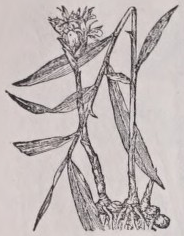
1. A plant of the genus Zingiber, of the East and West Indies. The species most known is Z. officinale.
Ginger
Encyclopedia Britannica
GINGER (French, Gingembre-, German, Ingwer), the rhizome or underground stem of Zingiber officinale, Roscoe, a perennial reed-like plant growing from 3 to 4 feet high. The flowers and leaves are borne on separate stems, those of the former being shorter than those of the latter, and averaging from 6 to 12 inches. The flowers themselves are borne at the apex of the stems in dense ovate oblong conelike spikes from 2 to 3 inches long, composed of obtuse strongly-imbricated bracts with membranous margins, each bract enclosing a single small sessile flower. The leaves are alternate, bright green, smooth, tapering at both ends, with very short petioles. The plant, though unknown in a wild state, is considered with very good reason to be a native of the warmer parts of Asia, over which it has been cultivated from an early period, and the rhizome imported into England. From Asia the plant has spread into the West Indies, South America, western tropical Africa, and Australia....
The use of ginger as a spice has been known from very early times; it was supposed by the Greeks and Romans to be a product of southern Arabia, and was received by them by way of the Red Sea; in India it has also been known from a very remote period, the Greek and Latin names being derived from the Sanskrit. Flückiger and Hanbury, in their Pharmacographia, give the following notes on the history of ginger. Ou the authority of Vincent’s Commerce and Navigation of the Ancients, it is stated that in the list of imports from the Red Sea into Alexandria, which in the second century of our era were there liable to the Roman fiscal duty, ginger occurs among other Indian spices. So frequent is the mention of ginger in similar lists during the Middle Ages, that it evidently constituted an important item in the commerce between Europe and the East. It thus appears in the tariff of duties levied at Acre in Palestine about 1173, in that of Barcelona in 1221, Marseilles in 1228, and Paris in 1296. Ginger seems to have been well known in England even before the Norman Conquest, being often referred to in the Anglo-Saxon leech-books of the 11th century. It was very common in the 13th and 14th centuries, ranking next in value to pepper, which was then the commonest of all spices, and costing on an average about Is. 7d. per ft>. Three kinds of ginger were known among the merchants of Italy about the middle of the 14th century:—(1) Belledi or Baladi, an Arabic name, which, as applied to ginger, would signify country or wild, and denotes common ginger; (2) Colombino, which refers to Columbum, Kolarn, or Quilon, a port in Travancore, frequently mentioned in the Middle Ages; and (3) ΛIicchino, a name which denoted that the spice had been brought from or by way of Mecca. Marco Polo seems to have seen the ginger plant both in India and China between 1280 and 1290. John of Montecorvino, a missionary friar who visited India about 1292, gives a description of the plant, and refers to the fact of the root being dug up and transported. Nicolo di Conto, a Venetian merchant in the early part of the 15th century, also describes the plant and the collection of the root, as seen by him in India. Though the Venetians received ginger by way of Egypt, some of the superior kinds were taken from India overland by the Black Sea. The spice is said to have been introduced into America by Francisco de Mendoça, who took it from the East Indies to New Spain. It seems to have been shipped for commercial purposes from San Domingo as early as 1585, and from Barbados in 1654; so early as 1547 considerable quantities were sent from the West Indies to Spain.
Ginger is known in commerce in two distinct forms, termed respectively coated and uncoated ginger, as having or wanting the epidermis. For the first, the pieces, which are called “races” or “hands,” from their irregular palmate form, are washed and simply dried in the sun. In this form ginger presents a brown, more or less irregularly wrinkled or striated surface, and when broken shows a dark brownish fracture, hard, and sometimes horny and resinous. To produce uncoated ginger the rhizomes are washed, scraped, and sun-dried, and are often subjected to a system of bleaching, either from the fumes of burning sulphur or by immersion for a short time in a solution of chlorinated lime. The whitewashed appearance that much of the ginger has, as seen in the shops, is due to the fact of its being washed in whiting and water, or even coated with sulphate of lime. This artificial coating is supposed by some to give the ginger a better appearance; it often, however, covers an inferior quality, and can readily be detected by the ease with which it rubs off, or by its leaving a white powdery substance at the bottom of the jar in which it is contained. Uncoated ginger, as seen in trade, varies from single joints an inch or less in length to flattish irregularly branched pieces of several joints, the “races” or “hands,” and from 3 to 4 inches long; each branch has a depression at its summit showing the former attachment of a leafy stem. The colour, when not whitewashed, is a pale buff; it is somewhat rough or fibrous, breaking with a short mealy fracture, and presenting on the surfaces of the broken parts numerous short bristly fibres.
The British market derives its supply of ginger from various parts of the world. The principal sorts, however, or those most commonly found in commerce, are Jamaica, Cochin, Bengal, and African, though each of these in its turn has its several varieties and qualities. The best or most valued kind of all is the Jamaica, and next to it the Cochin. For ordinary purposes uncoated ginger is considered the best; the largest and finest pieces, of a pale buff colour both outside and inside, and cutting softly and evenly, are considered the most valuable. The chief sources of supply are the East and West Indies, Sierra Leone, and Egypt.
The principal constituents of ginger are starch, volatile oil (to which the characteristic odour of the spice is due), and resin (to which is attributed its pungency). Its chief use is as a condiment or spice, but as an aromatic and stomachic medicine it is also used internally. “The stimulant, aromatic, and carminative properties render it of much value in atonic dyspepsia, especially if accompanied with much flatulence, and as an adjunct to purgative medicines to correct griping.” Externally applied as a rubefacient, it has been found to relieve headache and toothache. The rhizomes, collected in a young green state, washed, scraped, and preservedin syrup, form a delicious preserve, which is largely exported both from the West Indies and from China. Cut up into pieces like lozenges, and preserved in sugar, ginger also forms a very agreeable sweetmeat.
9th ed. Encyclopædia Britannica, vol. 10, p. 603 — signed J. R. J.
[1,183 words — estimated reading time: 7 minutes]
[1,183 words — estimated reading time: 7 minutes]
Nicely; cautiously. [Not used.]
Niceness; tenderness. [Not used.]
Cautiousness; tenderness.
A kind or striped cotton cloth.
Gingham
Encyclopedia Britannica
GINGHAM is a woven cotton fabric, of a close stoutish texture, the distinguishing characteristics of which are that it is a plain (i.e., untwilled) cloth, woven into yarn-dyed stripes or checks of two or more colours. In some cases as many as seven or eight colours are introduced in the warp and weft of a gingham; but no patterns are made that cannot be woven in a common plain loom. Gingham was originally an Indian product, but its manufacture was early introduced into the Lancashire and Glasgow districts; and during the first half of the present century the trade formed an important feature in the textile industries of the latter locality—the demand for the fabric coming chiefly from the United States and the West Indies. The trade distinction of gingham is now to a large extent superseded by other terms.
9th ed. Encyclopædia Britannica, vol. 10, p. 604
[143 words — estimated reading time: 1 minute]
[143 words — estimated reading time: 1 minute]
The lining of a mine shaft with stones or bricks to prevent caving.
Pertaining to the gums.
Of or pertaining to the gums.
1. GIN'GLE
An order of ganoid fishes, including the modern gar pikes and many allied fossil forms. They have rhombic, ganoid scales, a heterocercal tail, paired fins without an axis, fulcra on the fins, and a bony skeleton, with the vertebrae convex in front and concave behind, forming a ball and socket joint. See Ganoidel.
Alt. of Ginglymoidal
In anatomy, a species of articulation resembling a hinge. That species of articulation in which each bone partly receives and is partly received by the other, so as to admit only of flexion and extension, is called angular ginglymus
A hinge joint; an articulation, admitting of flexion and extension, or motion in two directions only, as the elbow and the ankle.
GinguenÉ
Encyclopedia Britannica
GINGUENÉ, Pierre Louis (1748-1815), the author of the Histoire littéraire d'Italie, was born on 25th April 1748 at Rennes in Brittany. He was educated at a Jesuit college in his native town, but he owed most of his literary tastes and accomplishments to his father, who early imbued him with a love of music and the languages of England and Italy. His first literary effort, a poetical piece entitled Confession de Zulmé, brought him into notice among the literary coteries of Paris, from the circumstance that, when published at first anonymously, it was claimed by six or seven different authors. Though the value of the piece is not very great, it is Ginguené’s poetical chef d'oeuvre. The part he took as a defender of Piccini against the partisans of Gluck made him still more widely known; and the reputation he acquired as a promising political writer secured employment for him in the public service in 1780. He hailed, however, the first symptoms of the Revolution, joined Rabaut, St Étienne, and Cerutti in producing the Feuille Villageoise, and celebrated in an indifferent ode the opening of the states-general. A more creditable effort was his Lettres sur les Confessions de J. J. Rousseau, 1791, in which he defended to the uttermost the life and principles of his author. Refusing to countenance the excesses of the Revolution, he was thrown into prison, whence he only escaped with life by the downfall of Robespierre. Some time after his liberation he assisted, as director-general of the “commission exécutive de l'instruction publique,” in reorganizing the system of public instruction. When the Institute was established in 1796, he was elected a member of the division called the academy of moral and political sciences. In 1798 the directory appointed him minister ...plenipotentiary to the king of Sardinia, whose ruin, begun by force of arms, they had determined to complete by treachery. A less promising tool could not have been found for carrying out their design. After fulfilling his duties for seven months, very little to the satisfaction of his employers, Ginguené retired to his country house of St Prix, in the valley of Montmorency, and there he prosecuted his literary labours till the Revolution of the 18th Brumaire called him once more before the world. He was appointed a member of the tribunate, which made a show of maintaining democratic opposition to the first consul; but Napoleon, finding that he was not sufficiently tractable, had him expelled at the first “purge,” and Ginguené once more joyfully returned to his favourite pursuits. These were now more than ever a necessity of life to him, as his only other source of income was the small endowment attached to his seat in the Institute. Fortunately he was nominated one of the commission charged to continue the literary history of France, which had been brought down by the Benedictines to about the close of the 12th century; and the three volumes of this series which appeared in 1814, 1817, and 1820 are for the most part the result of his labours. But the work by which Ginguené will be longest remembered is his Histoire littéraire T Italie (9 vols. 8vo, 1811-1819), to which he was putting the finishing touches when he was cut off by a painful disease, November 16, 1815. The first six volumes appeared before their author’s death; the seventh is entirely his except a few pages; and of the eighth and ninth he wrote about a half, the other half being composed by Salfi, and revised by Daunou. The success of the history in Italy was astonishing: editions were published in various parts of the peninsula, with notes and comments by the best scholars, and three translations appeared respectively at Milan, Naples, and Venice.
Ginguené was originally led to make Italian literature his special study by finding how ill that subject was understood, and how little it was appreciated, by his countrymen. In the composition of his history he was guided for the most part by the great work of the Jesuit Tiraboschi, but he avoids the prejudices and party views of his model. His own style, though occasionally forcible and eloquent, is noi unfrequently too tame for the subject, and he often trespasses on his reader’s patience by over-minuteness of detail; but these faults are more than atoned for by fine critical discernment, impartiality, and freedom. On the score of accuracy, indeed, Ginguené sometimes offends, but seldom in matters of great moment; and his slips are such as are almost inevitable to a foreigner, who could hardly be said to have even seen the country whose literary history he relates. The Italians felt grateful to him for having placed their literature in its proper light, and readily forgave the excessive eulogies which he passed on many of their writers, whose very names had been forgotten in their own country.
During the latter years of his life Ginguené wrote extensively for the press, and he edited the Décade philοsοphupue, politique, et littéraire, till it was suppressed by Napoleon in 1807. He contributed largely to the Biographic universelle, the Mercure de France, and the Encyclopédie méthodique; and he edited the works of Chamfort and of Lebrun. Among his minor productions are an opera, Pomponin ou le Tuteur mystifié, 1777; La Satire des Satires, 1778; De l’autorité de Rabelais dans la révolution qrrésente, 1791; De Μ. Neckar, 1795; Fables inédites, 1814. See “Éloge de Ginguené,” by Dacier, in the Mémoires de ΐ Institut, tom. vii.; “Discours” by Μ. Daunou, prefixed to the 2d edit, of the Hist. litt. d'Italie·, D. J. Garat, Notice sur la vie et les ouvrages de P. L. Guingené, Paris, 1817
9th ed. Encyclopædia Britannica, vol. 10, p. 604
[967 words — estimated reading time: 6 minutes]
[967 words — estimated reading time: 6 minutes]
No thesaurus entries found for "ging".
No Bible verses found for "ging".