
SAXE, Maurice, Comte de (1696—1750), marshal of France, was the natural son of Augustus II. of Saxony and the countess Aurora of Königsmark. An entry in the parish registers of Goslar shows that he was born in that town, 28th October 1696. In 1698 the countess sent him to Warsaw to his father, who had been elected king of Poland the previous year, but on account of the unsettled condition of the country the greater part of his youth was spent outside its limits, a yearly income being assigned him. This enforced separation from his father made him more independent of his control than he would otherwise have been, and had an important effect on the character of his future career. At the age of twelve he was present, under the direction of the count of Schulenburg, in the army of Eugene, at the sieges of Tournay and Mons and the battle of Malplaquet, but the achievements ascribed to him in this campaign are chiefly fabulous. A proposal to send him at the close of it to a Jesuit college at Brussels was relinquished on account of the strong protests of his mother; and, returning to the camp of the allies in the beginning of 1710, he displayed a courage so impetuous as to call forth from Eugene the friendly admonition not to confound rashness with valour. After receiving in 1711 formal recognition from his father, with the rank of count, he accompanied him to Pomerania, and in 1712 he took part in the siege of Stralsund. As he grew up to manhood he was seen to bear a strong resemblance to his father, both in person and character. His grasp was so powerful that he could bend a horse-shoe with his hand, and to the last his energy and endurance were unsubdued by the severe bodily illnesses resulting from his many excesses. The impetuosity noted by Eugene manifested itself in ...his private life in a dissoluteness only slightly tempered by his generosity and good humour. In his military career during his mature years it was indicated only in his blindness to danger and his unmoved calm amidst the blackest lowerings of misfortune, for it was tempered by the “vigilance, forethought, sagacious precaution” which Carlyle notes as “singular in so dissolute a man.” In 1714 a marriage was arranged between him and one of the richest of his father’s subjects, the Countess von Loeben, but her immense fortune he dissipated so rapidly that he was soon heavily in debt, and, having given her more serious grounds of complaint against him, he consented without defence to an annulment of the marriage in 1721. Meantime, after serving in a campaign against the Turks in 1717, he had in 1719 gone to Paris to study mathematics, and in 1720 obtained the office of “maréchal de camp.” In 1725 negotiations were entered into for his election as duke of Courland, at the instance of the duchess Anna Ivanovna, who offered him her hand. He was chosen duke in 1726, but declining marriage with the duchess found it impossible to resist her opposition to his claims, although, with the assistance of £30,000 lent him by the French actress Adrienne Lecouvreur, his relations with whom form the subject of the drama of that name by Scribe and Legouvé, published in 1849, he raised a force by which he maintained his authority till 1727, when he withdrew and took up his residence in Paris. On the outbreak of the war in 1734 he served under Marshal Berwick, and for a brilliant exploit at the siege at Philippsburg he was in August named lieutenant-general. It was, however, with the opening of the Austrian Succession War in 1741 that he first rose into prominence. In command of a division forming the advance guard of an army sent to invade Austria, he on the 19th November surprised Prague during the night, and took it by assault before the garrison were aware of the presence of an enemy, a coup de main which at once made him famous throughout Europe. After capturing on the 19th April 1742 the strong fortress of Eger, he received leave of absence, and went to Russia to push his claims on the duchy of Courland, but obtaining no success returned to his command. His exploits had been the sole redeeming feature in an unsuccessful campaign, and on 26th March 1743 his merits were recognized by his promotion to be marshal of France. In 1744 he was chosen to command the expedition to England in behalf of the Pretender, which assembled at Dunkirk but did not proceed farther. After its abortive issue he received an independent command in the Netherlands, and by dexterous manoeuvring succeeded in continually harassing the superior forces of the enemy without risking a decisive battle. In the following year he made a rapid march on Tournay, and, when the allies sent an army of 60,000 under the duke of Cumberland to its relief, gave them battle 11th May, without relaxing the siege, from a strongly entrenched position at Fontenoy. The contest raged from early morning till two o’clock, when, by a charge at a critical moment which annihilated a column of the enemy, fortune was decided in his favour. During the battle he was unable on account of dropsy to sit on horseback except for a few minutes, and was carried about in a wicker basket. In recognition of his brilliant achievement the king conferred on him the castle of Chamford for life, and in April 1746 he was naturalized. The campaign of 1746 was signalized by the capture of Antwerp on the 1st June, the capture of Namur in September, and the total rout of Prince Charles at Rauconx 11th October. Having on the 12th January 1747 been made marshal-general, he in the following campaign won the victory of Lawfeldt over the duke of Cumberland, and on 16th September he stormed Bergen-op-zoom. In May 1748 he captured Maestricht after a month’s siege. After the peace, he lived in broken health chiefly at Chamford, and he died thero 30th November 1750.
Maurice de Saxe was the author of a work on military science, Mes Rêveries, described by Carlyle as “a strange military farrago, dictated, as I should think, under opium,” published posthumously in 1757 (last ed., Paris, 1877). His Lettres et Mémoires Choisis appeared in 1794. Many previous errors in former biographies were corrected and additional information supplied in Carl von Weber’s Moritz, Graf von Sachsen, Marschall von Frankrcich, nach archivalischcn Quellen (Leipsic, 1863), and in Taillandier’s Maurice de Saxe, étude historique d'après les documents des Archives de Dresde (1865). See also Carlyle’s Frederick the Great.
[1,133 words — estimated reading time: 7 minutes]
SAXE-ALTENBURG (Germ. Sachsen-Altenburg), a duchy in Thuringia, and an independent member of the German empire, consists of two detached and almost equal parts, separated from each other by a portion of Reuss (junior line), and bounded on the S. and W. by the grandduchy of Saxe-Weimar-Eisenach, on the N. by Prussia, and on the E. by the kingdom of Saxony. There are in addition 12 small exclaves. The total area is 510 square miles (about half the size of Cheshire in England), of which 254 are in the east or Altenburg division and 256 in the west or Saal-Eisenberg division. The former district, traversed by the most westerly offshoots of the Erzgebirge and watered by the Pleisse and its tributaries, forms an undulating and fertile region, containing some of the richest agricultural soil in Germany. The western district, through which the Saale flows, is rendered hilly by the beginnings of the Thuringian Forest, and in some measure makes up by its fine woods for the comparatively poor soil. The mineral wealth of Saxe-Altenburg is scanty; lignite, the chief mineral, is worked mainly in the eastern district....
According to the returns for 1883, 58½ per cent. of the entire duchy was occupied by arable land, and 27½ per cent. by forests, of which four-fifths were coniferous. The chief crops were rye (42,317 acres, yielding 20,412 tons), oats (36,807 acres, 22,996 tons), barley (21,390 acres, 13,912 tons), wheat (17,490 acres, 9724 tons), and potatoes (19,870 acres, 113,209 tons). The cattleraising and horse-breeding of the duchy are of considerable importance. In 1883 the duchy contained 9934 horses, 60,335 cattle, 20,996 sheep, 46,387 pigs, and 12,420 goats. About 35 per cent. of the population are directly supported by agriculture. The manufactures of the duchy are very varied, but none is of any great importance; woollen goods, gloves, hats, porcelain and earthenware, and wooden articles are the chief products. Trade in these, and in horses, cattle, and agricultural produce, is tolerably brisk. The chief seats of trade and manufacture are Altenburg the capital (29,422 inhabitants in 1885), Ronneburg (5485 inhabitants in 1880), Schmölln (6394), Gössnitz (4949), and Meuselwitz (3402) in the Altenburg division; and Eisenburg (6277), Roda (3465), and Kahla (2999) in the Saal-Eisenburg division. Besides these there are the towns of Lucka (1505) and Orlamünde (1461), and 449 villages, of which Russdorf (1781), in an exclave, is the largest.
Next to the two principalities of Reuss, Saxe-Altenburg is the most densely peopled part of Thuringia. In 1880 the population was 155,036, or 304 per square mile. Of these 154,187 were Protestants, 741 Roman Catholics, 33 Jews, and 75 of other sects. The population in 1885, according to a provisional return of the census of that year, was 161,129. In the west division the population (49,788) is wholly Teutonic, but in the east (111,341) there is a strong Wendish or Slavonic element, still to be traced in the peculiar manners and costume of the country-people, though these are gradually being given up. The farmers and peasant-proprietors of the east division (Altenburger Bauern) are an industrious and well-to-do class, but like similar classes in other countries they are said to be avaricious and purse-proud. Their holdings are seldom divided; a custom corresponding to Borough-English (q.v.) though not supported by law, obtains among them; and sometimes the elder brothers are employed by the youngest as servants on the paternal farm. The destitution to which the disinherited children are often reduced by this custom is seriously prejudicial to morality. The Altenburg peasants are pleasure-loving, and in spite of their avarice are said to gamble for very high stakes, especially at the complicated card-game of “skat,” now universal in Germany, which many believe to have been invented here.
Saxe-Altenburg is a limited hereditary monarchy, its constitution resting on a law of 1831, subsequently modified. The diet consists of 30 members, elected for 3 years, of whom 9 are returned by the highest taxpayers, 9 by the towns, and 12 by the country districts. The franchise is enjoyed by all males over 25 years of age who pay taxes. The duke has considerable powers of initiative and veto. The government is carried on by a ministry of three members, of whom two administer justice and finance respectively, and the third all the other departments of home and foreign affairs. The budget for 1884-86 estimated the yearly income at £127,180 and the yearly expenditure at £125,530. The Altenburg troops are united with the contingents of Schwarzburg, Rudolstadt, and the two Reusses to form the 7th Thuringian infantry regiment of the imperial army. Saxe-Altenburg has one vote in the Reichstag and one in the federal council.
After the conquest of the Wends, the present Altenburg district became an imperial possession, lying partly in the Pleissengau and partly in the Voigtland, while the west district was divided among a number of small nobles. The margrave of Saxony obtained permanent possession of Altenburg about 1329, and the west division was also early incorporated with his dominions. Both districts were among the lands assigned to the Ernestine line of the house of Saxony by the convention of Wittenberg in 1547 (see Saxony). From 1603 till 1672 there existed an independent duchy of Altenburg; but in 1826, when the present division into the four Saxon duchies was made, both Altenburg and Eisenburg belonged to Gotha. Duke Frederick, who exchanged Saxe-Hildburghausen for the present duchy of Saxe-Altenburg in 1826, was the founder of the reigning line. A constitution was granted in 1831 in answer to popular commotion; and greater concessions were extorted by more threatening disturbances in 1848. The second duke (Joseph) abdicated in 1848 in favour of his brother George. Under Ernest, who succeeded his father as fourth duke in 1853, a period of violent reaction set in, so that even now the constitution is considerably less liberal than it was in 1849. In 1873 the long-disputed question as to the public domains was settled, two-thirds of these being now regarded as belonging to the duke in fideicommissum and in lieu of a civil list.
[1,059 words — estimated reading time: 7 minutes]
SAXE-COBURG-GOTHA (Germ. Sachsen-Koburg-Gotha), a duchy in Thuringia, and an independent member of the German empire, consists of the two formerly separate duchies of Coburg and Gotha, which lie at a distance of 14 miles from each other, and of eight small scattered exclaves, the most northerly of which is 70 miles from the most southerly. The total area is 760 square miles (about 2 square miles more than the county of Surrey in England), of which 217 are in Coburg and 543 in Gotha. The duchy of Coburg is bounded on the S.E., S., and S.W. by Bavaria, and on the other sides by Saxe-Meiningen, which, with part of Prussia, separates it from Gotha. The considerable exclave of Königsberg in Bavaria, 10 miles south, belongs to Coburg, Lying on the south slope of the Thuringian Forest, and in the Franconian plain, this duchy is an undulating and fertile district, reaching its highest point in the Senichshöhe (1716 feet) near Mirsdorf. Its streams, the chief of which are the Itz, Steinach, and Rodach, all find their way into the Main. The duchy of Gotha, more than twice the size of Coburg, stretches from the south borders of Prussia along the northern slopes of the Thuringian Forest, the highest summits of which (Grosse Beerberg, 3225 feet; Schneekopf, 3179 feet; Inselberg, 2957 feet) rise within its borders. The more open and level district on the north is spoken of as the “open country” (“das Land ”) in contrast to the wooded hills of the “forest” (“der Wald ”). The Gera, Hörsel, Unstrut, and other streams of this duchy flow to the Werra or to the Saale....
In both duchies the chief industry is agriculture, which employs 33 per cent. of the entire population. According to the returns for 1883, 53½ per cent. of the area was occupied by arable land, 10 per cent. by meadow-land and pasture, and 30 per cent. by forest. In the same year the chief crops were oats (43,715 acres, yielding 19,229 tons), barley (37,387 acres, 20,148 tons), rye (29,077 acres, 12,048 tons), wheat (24,255 acres, 9,272 tons), and potatoes (24,546 acres, 116,695 tons). A small quantity of hemp and flax is raised (less than 1000 acres of each), but a considerable quantity of fruit and vegetables is annually produced. Cattle-breeding is an important resource, especially in the valley of the Itz in Coburg. In 1883 the two duchies contained 8187 horses, 58,196 cattle, 73,249 sheep, 51,549 pigs, and 27,015 goats. The mineral wealth of Saxe-Coburg-Gotha is insignificant; small quantities of coal, lignite, ironstone, millstone, &c., are annually raised. There are also saltworks and some deposits of potter’s clay.
The manufactures of the duchies, especially in the mountainous parts less favourable for agriculture, are tolerably brisk, but there is no large industrial centre in the country. Iron goods and machinery, safes, glass, earthenware, chemicals, and wooden articles, including large quantities of toys, are produced; and various branches of textile industry are carried on. Ruhla (two-fifths of which is situated in Saxe-Weimar-Eisenach) is famous for its meerschaum pipes and cigar-holders, which are exported to all parts of the world; and the maps of Perthes’s geographical institute at Gotha may also be reckoned among the national products. Coburg (15,791 inhabitants in 1881) and Gotha (28,100 in 1885) are the chief towns of the duchies, to which they respectively give name; the latter is the capital of the united duchy. There are seven other small towns, and 320 villages and hamlets. The villages of Fried- richroda and Ruhla and the Inselberg and Schneekopf and other-picturesque points annually attract an increasing number of summer visitors and tourists. Neudietendorf or Gnadenthal is a Moravian settlement founded in 1742.
The population in 1880 was 194,716, or 256 per square mile, of whom 56,728 (261 per square mile) were in Coburg and 137,988 (254 per square mile) in Gotha. In the former duchy the people belong to the Franconian and in the latter to the Thuringian branch of the Teutonic family. In 1880 there were 192,025 Lutherans, 2062 Roman Catholics, 490 Jews, and 139 others. In 1885 the population was 198,717,—57,355 in Coburg and 141,362 in Gotha.
Saxe-Coburg-Gotha is a limited hereditary monarchy, its constitution resting on a law of 1852, modified in 1874. For its own immediate affairs each duchy has a separate diet (in Coburg of 11, in Gotha of 19 members); but in more important and general matters a common diet, formed of the members of the separate diets, meeting at Coburg and Gotha alternately, exercises authority. The members are elected for four years; the franchise is extended to all male taxpayers of twenty-five years of ago and upwards. The ministry has special departments for each duchy, but is under a common president. In finance the duchies are also separate, the budget in Coburg being voted for a term of six years, and in Gotha for four years. After long disputes between the duke and the Government a compromise was effected in 1855, by which the greater part of the public lands is regarded as a fideicommissum in the possession of the reigning duke, while the income from the rest is regarded as state-revenue. There are thus two budgets for each duchy. The annual income of the public lands in Coburg is estimated for the period 1886-92 at £20,700, and the expenditure at £11,900; in Gotha (period 1886-90) the same source is estimated to yield £102,621 and to cost £61,996;—together producing a surplus of £49,425, of which the duke receives £29,700 and the state-treasury £19,725. The annual state-revenue in the same periods was estimated for Coburg at £51,520, or £2246 more than the estimated expenditure, and in Gotha at £106,020, or £2244 more than the expenditure. Besides the civil list the duke of Saxe-Coburg-Gotha enjoys a very large private fortune, amassed chiefly by Ernest I., who sold the principality of Lichtenberg to Prussia in 1834 for an annual payment of £12,000. The congress of Vienna had bestowed the principality upon him in recognition of his services in 1813. The house of Saxe-Coburg-Gotha is directly connected with five of the royal houses of Europe, and the actual rulers or the heirs of three kingdoms trace their descent from it. The succession is hereditary in the male line; and by the deed of succession of 1855 the heir to the throne is the duke of Edinburgh, nephew of the present duke.
History.— The elder line of Saxe-Coburg was founded in 1680 by Albert, the second son of Ernest the Pious. On his dying childless in 1699, however, the line became extinct, and his possessions became the subject of vehement contention amongst the other Saxon houses, until they were finally distributed at the end of the 18th century. The present reigning family is the posterity of John Ernest, the seventh son of Ernest the Pious, who originally ruled in Saxe-Saalfeld. His two sons, ruling in common, acquired possession of Coburg, and, changing their residence, styled themselves dukes of Saxe-Coburg-Saalfeld. Under the son and successor of the survivor (who introduced the principle of primogeniture), Ernest Frederick I. (1764-1800), the land was plunged into bankruptcy, so that an imperial commission was appointed on his death to manage the finances. The measures adopted to redeem the country’s credit were successful, but imposed so much hardship on the people that a rising took place, which had to be quelled with the aid of troops from the electorate of Saxony. The duke Francis Frederick Antony died in December 1806, and was succeeded by his son Ernest III. (1806-1844), although the country was occupied by the French from 1807 until the peace of Tilsit in 1816. In the redistribution of the Saxon lands in 1826, Ernest resigned Saalfeld to Meiningen, receiving Gotha in exchange and assuming the title of Ernest I. of Saxe-Coburg-Gotha. The line of Saxe-Gotha had been founded in 1680 by the eldest son of Ernest the Pious, and had become extinct in 1825. When Ernest II. (b. 1818) succeeded in 1844 both the public finances and the private fortune of the ducal family (see above) were flourishing. In his reign various liberal reforms have been achieved, and the union of the duchies has been made closer.
[1,443 words — estimated reading time: 9 minutes]
SAXE-MEININGEN (Germ. Sachsen-Meiningen), a duchy in Thuringia, and an independent member of the German empire, consists chiefly of an irregular crescentshaped territory, which, with an average breadth of 10 miles, stretches for over 80 miles along the south-west slope of the Thuringian Forest. The convex side rests upon the duchy of Coburg, and is in part bounded by Bavaria, while the concave side, turned towards the north, contains portions of four other Thuringian states and Prussia be tween its horns, which are 46 miles apart. The districts of Kranichfeld, 15 miles north-west, and Kamburg, 22 miles due north of the eastern horn, together with a number of smaller scattered exclaves, comprise 74 of the 953 square miles now belonging to the duchy (about the size of county Down in Ireland). The surface on the whole is hilly, and is partly occupied by offshoots of the Thuringian Forest; the highest summits are the Kieserle (2851 feet) and the Bless (2834 feet). The chief streams are the Werra, which traverses the south and east of the duchy, and various tributaries of the Main and the Saale, so that Saxe-Meiningen belongs to the basins of the three great rivers Weser, Rhine, and Elbe....
The soil is not very productive, although agriculture flourishes in the valleys and on the level ground; grain has to be imported to meet the demand. In 1883 only 41 '8 per cent. of the total area (in 1878, 41·6) was devoted to agriculture, while meadow land and pasture occupied 11 per cent. The chief grain crops in 1883 were rye (44,442 acres, yielding 16,112 tons), oats (42,447 acres, 17,343 tons), wheat (25,252 acres, 9033 tons), and barley (19,015 acres, 94,456 tons). The cultivation of potatoes is very general (31,006 acres, 143,327 tons). Tobacco, hops, and flax (in 1883, 997 acres) are also raised. The Werrathal and the other fertile valleys produce large quantities of fruit. Sheep and cattle raising is a tolerably important branch of industry throughout the duchy; horses are bred in Kamburg. In 1883 Saxe-Meiningen contained 5174 horses, 66,733 cattle, 58,940 sheep, 45,136 pigs, and 26,817 goats. The extensive and valuable forests, of which 75 per cent. are coniferous trees, occupy 41·9 per cent. of the entire area. Nearly one half of the forests belong to the state and about one-third to public bodies and institutions, leaving little more than a sixth for private owners. The mineral wealth of the duchy is not inconsiderable. Iron, coal, and slate are the chief minerals worked. There are salt-works at Salzungen and Sulza, the former the most important in Thuringia; and the mineral water of Friedrichshall is well known. The manufacturing industry of Saxe-Meiningen is very active, especially in the districts of Sonneberg, Gräfenthal, and Saalfeld. Iron goods of various kinds, glass and pottery, school-slates, marbles, &c., are produced; the abundant timber fosters the manufacture of all kinds of wooden articles, especially toys; and textile industry is also carried on to a slight extent.
The capital of the duchy is Meiningen (in 1881 11,227 inhabitants). Of the sixteen other towns (Salzungen, Wasungen, Hildburghausen, Eisfeld, Sonneberg, Saalfeld, Pössneck, Kamburg, &c.) none has so many as 10,000 inhabitants. There are 392 villages and hamlets. In 1880 the population was 207,075 (217 per square mile), of whom 30 per cent. lived in communities of more than 2000. As in the other Saxon duchies the population is almost exclusively Lutheran; in 1883 202,970 belonged to that confession, 2274 were Roman Catholics, 204 of other Christian sects, and 1627 Jews.
Saxe-Meiningen is a limited monarchy, its constitution resting on a law of 1829, subsequently modified. The diet, elected for six years, consists of 24 members, of whom 4 are elected by the largest landowners, 4 by those who pay the highest personal taxes, and 16 by the other electors. The franchise is enjoyed by all domiciled males over twenty-five years of age who pay at least a minimum of taxes. The government is carried on by a ministry of five, with departments for the ducal house and foreign affairs, home affairs, justice, education and public worship, and finance. The returns of the state-lands and the ordinary state-revenue are treated in separate budgets. The estimate for the period 1884-86 puts the annual income from the former at £105,340 and the annual expenditure at £77,915, while the annual income and expenditure of the latter are balanced at £145,148. Half of the surplus of £27,425 is credited to each fund. The duke’s civil list of £19,714 (394,286 marks) is paid out of the returns from the state-lands, at one time in the possession of the reigning house. Saxe-Meiningen has one vote in the federal council and sends two deputies to the reichstag.
The original territory of the duchy of Saxe-Meiningen, founded in 1680 by Bernhard, third son of Ernest the Pious, consisted of what is now the western horn of the duchy, from Henneberg northwards. Bernhard was succeeded in 1706 by his three sons; but by 1746 the only survivor was the youngest, Antony Ulrich, who reigned alone until his death in 1763. The duchy had meanwhile been considerably increased in extent; but contentions and petty wars with the other Saxon principalities on questions of inheritance, the extravagance of the court, and the hardships of the Seven Years’ War plunged it into bankruptcy and distress. A happier time was enjoyed under Charlotte Amalie, Antony’s wife, who ruled as regent for her two sons Charles (1775-1782) and George (1782-1803), and also under these princes themselves. George, who had introduced the principle of primogeniture, was succeeded by his infant son Bernhard Erich Freund, born in 1800. The war with France at the beginning of the present century, with its attendant quartering of troops, conscription, and levies of money, joined with cattle-disease and scanty harvests in once more plunging the country into distress, from which it but slowly recovered. Bernhard had already spontaneously granted a liberal constitution to his subjects in 1824, when large additions (530 square miles) consequent upon the redistribution of the Saxon lands in 1826 more than doubled his possessions and rendered reorganization necessary. Among the additions to Saxe-Meiningen were the duchy of Hildburghausen (whence the full title of the present duchy is Saxe-Meiningen-Hildburghausen), which had been founded in 1680 by Ernest, the sixth son of Ernest the Pious; the principality of Saalfeld, which, founded by John Ernest, Ernest’s seventh son, in 1680, had been united to Coburg in 1735; and the districts of Themar, Kranichfeld, Kamburg, and other smaller territories. Saxe-Meiningen, like the other Saxon duchies, entered the Confederation of the Rhine in 1806; but in 1866, unlike its neighbours, it declared for Austria in the war against Prussia. The land was at once occupied by Prussian troops, and Bernhard abdicated (September 1866) in favour of his son George, who made peace with Prussia and entered the North German Confederation. In 1871 the dispute which had lasted since 1826 between the duke and the diet as to the respective rights of each to the state-lands was terminated by a compromise.
[1,229 words — estimated reading time: 8 minutes]
SAXE-WEIMAR-EISENACH (Germ. Sachsen-Weimar-Eisenach), the largest of the Thuringian states, is a grandduchy and a member of the German empire. It consists of the three chief detached districts of Weimar, Eisenach, and Neustadt, and twenty-four scattered exclaves, of which Allstedt, Oldisleben, and Ilmenau belonging to Weimar, and Ostheim belonging to Eisenach, are the chief. The first and last named of these exclaves are 70 miles apart; and the most easterly of the other exclaves is 100 miles from the most westerly. The total area of the grand-duchy is 1387 square miles (or slightly larger than Wiltshire in England), of which 678 are in Weimar, 465 in Eisenach, and 244 in Neustadt....
The district of Weimar, which is at once the largest division and the geographical and historical kernel of the grand-duchy, is a roughly circular territory, situated on the plateau to the north-east of the Thuringian Forest. It is bounded on the N. and E. by Prussia, on the S. and W. by the Schwarzburg Oberherrschaft and detached portions of Saxe-Altenburg, and lies 23 miles east of the nearest part of Eisenach, and 7 miles north-west of the nearest part of Neustadt. The exclaves of Allstedt and Oldisleben lie in Prussian territory 10 miles to the north and north-west respectively; Ilmenau as far to the southwest. The surface is undulating and destitute of any striking natural features, although the valleys of the Saale and Ilm are picturesque. The Kickelhahn (2825 feet) and the Hohe Tanne (2641 feet) rise in Ilmenau; but the Grosser Kalm (1814) near Remda, in the extreme south, is the highest point in the main part of Weimar. The broad-based Ettersburg (1519 feet), a part of which is known as “Herder’s Hill” after the poet, rises on the Ilm plateau, near Ettersburg, where Schiller finished his Maria Stuart. The Saale flows through the east of the district, but, although the chief river hydrographically, it yields in fame to its tributary the Ilm. The Unstrut joins the Saale from Oldisleben and Allstedt. The chief towns are Weimar, the capital, on the Ilm; Jena, with the common university of the Thuringian states, on the Saale; and Apolda, the “Manchester of Weimar,” to the west.
Eisenach, the second district in size, and the first in point of natural beauty, stretches in a narrow strip from north to south on the extreme western boundary of Thuringia, and includes parts of the church lands of Fulda, of Hesse, and of the former countship of Henneberg. It is bounded on the N. and W. by Prussia, on the S. by Bavaria (which also surrounds the exclave of Ostheim), and on the E. by Saxe-Meiningen and Saxe-Gotha. The north is occupied by the rounded hills of the Thuringian Forest, while the Rhön Mountains extend into the southern part. The chief summits of the former group, which is more remarkable for its fine forests and picturesque scenery than for its height, are the Wartburg Hill (1355 feet), the north-western termination of the system, Ottowald (2103 feet), Wachstein (1801 feet), Ringberg (2106 feet), Hohe Vogelheid (2378 feet), and the Glöckner (2211 feet). Among the Rhön Mountains in Eisenach the loftiest summits are the Elnbogen (2677 feet), Bayer-berg (2359 feet), Hohe Rain (2375), and the Glaserberg (2231 feet). The chief river is the Werra, which flows across the centre of the district from east to west, and then bending suddenly northwards, re-enters from Prussia, and traverses the north-eastern parts in an irregular course. Its chief tributaries in Eisenach are the Hörsel and the Ulster. Eisenach is the only town of importance in this division of the grand-duchy.
Neustadt, the third of the larger divisions, is distinguished neither by picturesque scenery nor historical interest. It forms an oblong territory, about 24 miles long by 16 broad, and belongs rather to the hilly district of the Voigtland than to Thuringia. It is bounded on the N. by Reuss (junior line) and Saxe-Altenburg, on the W. by Saxe-Meiningen and a Prussian exclave, on the S. by the two Reuss principalities, and on the E. by the kingdom of Saxony. The Kesselberg (1310 feet) near the town of Neustadt is the chief eminence. This district lies in the basin of the Saale, its chief streams being the White Elster, the Weida, and the Orla. Neustadt, Auma, and
Weida are the principal towns.
Agriculture forms the chief occupation of the inhabitants in all parts of the duchy, though in Eisenach and Ilmenau a large proportion of the area is covered with forests. According to the returns for 1883, 56·3 per cent. of the entire surface was occupied by arable land, 25·8 per cent. by forests, 8·8 by pasture and meadow-land, and 4·1 per cent. by buildings, roads, and water, Only 5 per cent. was unproductive soil or moorland. These figures indicate that Saxe-Weimar-Eisenach has nearly as large a percentage of arable land as Saxe-Alien burg, and, notwithstanding the extensive woods in Eisenach and Ilmenau, a lower proportion of forest than any other Thuringian state. In 1883 the chief grain crops were oats (80,682 acres, yielding 38,271 tons), barley (78,067 acres, 45,249 tons), rye (72,607 acres, 29,006 tons), and wheat (47,732 acres, 19,949 tons). About 50,000 acres were planted with potatoes, yielding 237,627 tons, or nearly 4 per cent. per acre less than the average of the five years immediately preceding. All the grain crops were slightly above the average of the same period. The 79,405 acres devoted to hay produced 98,910 tons. Among the other crops were beetroot for sugar (8602 acres), flax (1300 acres), and oil-yielding plants (4562 acres). Fruit grows in abundance, especially in the neighbourhood of Jena, in the valley of the Gleisse, and on the lower Ilm; 1070 acres, mostly on the banks of the Saale, were occupied with vines. Of the forests 38·5 per cent. are deciduous and 61·5 per cent. coniferous trees; fully a half of the former are beeches. The greater part of the forests belong to the Government. Cattle-raising is carried on to a considerable extent, especially in Eisenach and Neustadt, while the sheepfarming centres in Weimar. The grand-ducal stud-farm in Allstedt maintains the breed of horses. In 1883 the duchy contained 17,271 horses, 110,092 cattle, 145,442 sheep, 101,443 pigs, and 41,291 goats. Although iron, copper, cobalt, and lignite are worked, the mineral wealth is trifling. Salt is also worked at different places.
The manufacturing industries in the grand-duchy are consider - able; they employ 37·3 per cent. of the population. The most important is the textile industry, which centres in Apolda, and employs more than 20,000 hands throughout the country. The production of woollen goods (stockings, cloth, underclothing) forms the leading branch of the industry; but cotton and linen weaving and yarn-spinning are also carried on. Large quantities of earthenware and crockery are made, especially at Ilmenau. The microscopes of Jena, the scientific instruments (thermometers, barometers, &c.) of Ilmenau, and the pipes and cigar-holders of Ruhla (partly in Gotha) are well known. Leather, paper, glass, cork, and tobacco are among the less prominent manufactures. There are numerous breweries in the duchy. The volume of trade is not very great, although some of the productions (chiefly those first mentioned) are exported all over Europe, and in some cases to other continents as well. The chief imports, besides colonial goods, are wool for the manufactures, hides, coal, meerschaum (from Smyrna and Vienna), amber, horn, Ac. Eisenach and Weimar are the chief seats of trade.
The population in 1880 was 309,577, or 223 per square mile, of whom 297,735 were Lutherans, 10,267 Roman Catholics, 327 Christians of other sects, and 1248 Jews. The Thuringian and Franconian branches of the Teutonic family are both represented in the duchy. According to the employment census of 1882, agriculture, forestry, and fishing supported 135,200 or 44 per cent. of the population; industrial pursuits, 114,835 or 87‘3 per cent.; trade, 23,939 or 7·8 per cent.; service, 4086 or 1·3 per cent.; official, military, and professional employments, 16,066 or 5·2 per cent; while 13,597 persons or 4 4 per cent. made no returns.
Saxe-Weimar-Eisenach is a limited hereditary monarchy, and was the first state in Germany to receive a liberal constitution. This was granted in 1816 by Charles Augustus, the patron of Goethe, and was revised in 1850. The diet consists of one chamber with thirty-one members, of whom one is chosen by the nobility, four by owners of land worth at least £150 a year, five by those who derive as much from other sources, and twenty-one by the rest of the inhabitants. The diet meets every three years; the deputies are elected for six years. The franchise is enjoyed by all domiciled citizens over twenty-five years of age. The government is carried on by a ministry of three, holding tho portfolios of finance, of home and foreign affairs, and of religion, education, and justice, with which is combined the ducal household. The budget for the finance-period 1884-86 estimated the yearly income at £308,586 and the yearly expenditure at about £1560 less. The public debt is more than covered by the active capital. The ducal house receives a civil list of £46,500. The Saxe-Weimar family is the oldest branch of the Ernestine line, and hence of the whole Saxon house. By treaties of succession the grand-duke is the next heir to the throne of Saxony, should the present Albertine line become extinct. He is entitled to the predicate of “royal highness.” By a treaty with Prussia in 1867, which afterwards became the model for similar treaties between Prussia and other Thuringian states, the troops of the grand-duchy were incorporated with the Prussian army.
In early times Weimar, with the surrounding district, belonged to the counts of Orlamünde, and from the end of the 10th century until 1067 it was tho seat of a line of counts of its own. It afterwards fell to the landgrave of Thuringia, and in 1440 passed into the possession of Frederick the Mild, elector of Saxony. Involved after the convention of Wittenberg (1547) in the complicated and constantly shifting succession arrangements of the Ernestine dukes of Saxony, who delayed the introduction of primogeniture, Weimar does not emerge into an independent historical position until 1640, when the brothers William, Albert, and Ernest the Pious founded the principalities of Weimar, Eisenach, and Gotha. Eisenach fell to Weimar in 1644, and, although the principality was once more temporarily split into tho lines Saxe-Weimar, Saxe-Eisenach (1672-1741), and Saxe-Jena (1672-1690), it was again reunited under Ernest Augustus (1728-1748), who secured it against future subdivision by adopting the principle of primogeniture. His son of the same name who succeeded died in 1758, two years after his marriage with Anna Amalia of Brunswick. Next year the duchess Amalia, although not yet twenty years old, was appointed by the emperor regent of the principality and guardian of her infant son Charles Augustus (1758-1828). The reign of the latter, who assumed the government in 1775, is the most brilliant epoch in the history of Saxe-Weimar. A gifted and intelligent patron of literature and art, Charles Augustus attracted to his court the leading authors and scholars of Germany. Goethe, Schiller, and Herder were members of the illustrious society of the capital, and tho university of Jena became a focus of light and learning, so that the hitherto obscure little state attracted the eyes of all Europe. The war with France was fraught with danger to tho continued existence of the principality, and after the battle of Jena (October 14, 1806) it was mainly tho skilful management of the duchess Louise that dissuaded Napoleon from removing her husband from among the reigning princes. In 1807 Saxe-Weimar-Eisenach entered the Confederation of the Rhine, and was promoted from a principality (Fürstenthum) to a duchy (Herzogthum). In the following campaigns it suffered greatly; and in 1815 the congress of Vienna recompensed its ruler with an addition to his territory of 660 square miles (including most of Neustadt) with 77,000 inhabitants, and with the title of grand-duke (Grossherzog). O11 the restoration of peace Charles Augustus redeemed his promise of granting a liberal constitution (1816). Freedom of the press was also granted, but after the festival of the Wartburg in 1819 it was seriously curtailed. Charles Frederick (1828-1853) continued his father’s policy, but his reforms were neither thorough enough nor rapid enough to avert political commotion in 1848. A popular ministry received power, and numerous reforms were carried through. Reaction set in under Charles Alexander, who succeeded his father in 1853, and the union of the state-lands and crown-lands was repealed, though both were appointed to remain under the same public management. In 1866 the grand-duchy joined Prussia against Austria, although its troops were then garrisoning towns in the Austrian interest; later it entered the North German Confederation. The press restrictions were removed in 1868 and the tendency of recent legislation has been liberal.
[2,245 words — estimated reading time: 13 minutes]
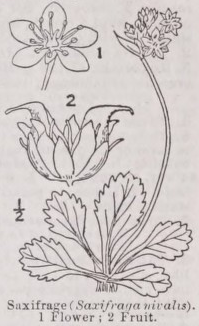
SAXIFRAGE(Saxifraga), a genus of plants which gives its name to the order of which it is a member. There are nearly 200 species distributed in the temperate and arctic parts of the northern hemisphere, frequently at considerable heights on the mountains. They are mostly herbs with perennial rootstocks, leaves in tufts, or, on the flower-stalks, scattered. The arrangement of the flowers is very various, as also are the size and colour of the flowers themselves. They have a calyx with a short tube, five petals, ten (or rarely five) stamens springing, like the petals, from the edge of the tube of the calyx. The pistil is partly adherent ‘to the calyx-tube, and is divided above into two styles. The ovules are numerous, attached to axile placentas. The seed-vessel is capsular. Many species are natives of Britain, some alpine plants of great beauty (S. oppositifolia, S. nivalis, S. aizoides, &c.), and others, like S. granulata, frequenting meadows and low ground, while S. tridactylites may be found on almost any dry wall. Many species are in cultivation, including the Bergenias or Megaseas with their large fleshy leaves and copious panicles of rosy or pink flowers, the numerous alpine species, such as S. pyramidalis, S. Cotyledon, Ac., with tall panicles studded with white flowers, and many others.
[218 words — estimated reading time: 2 minutes]