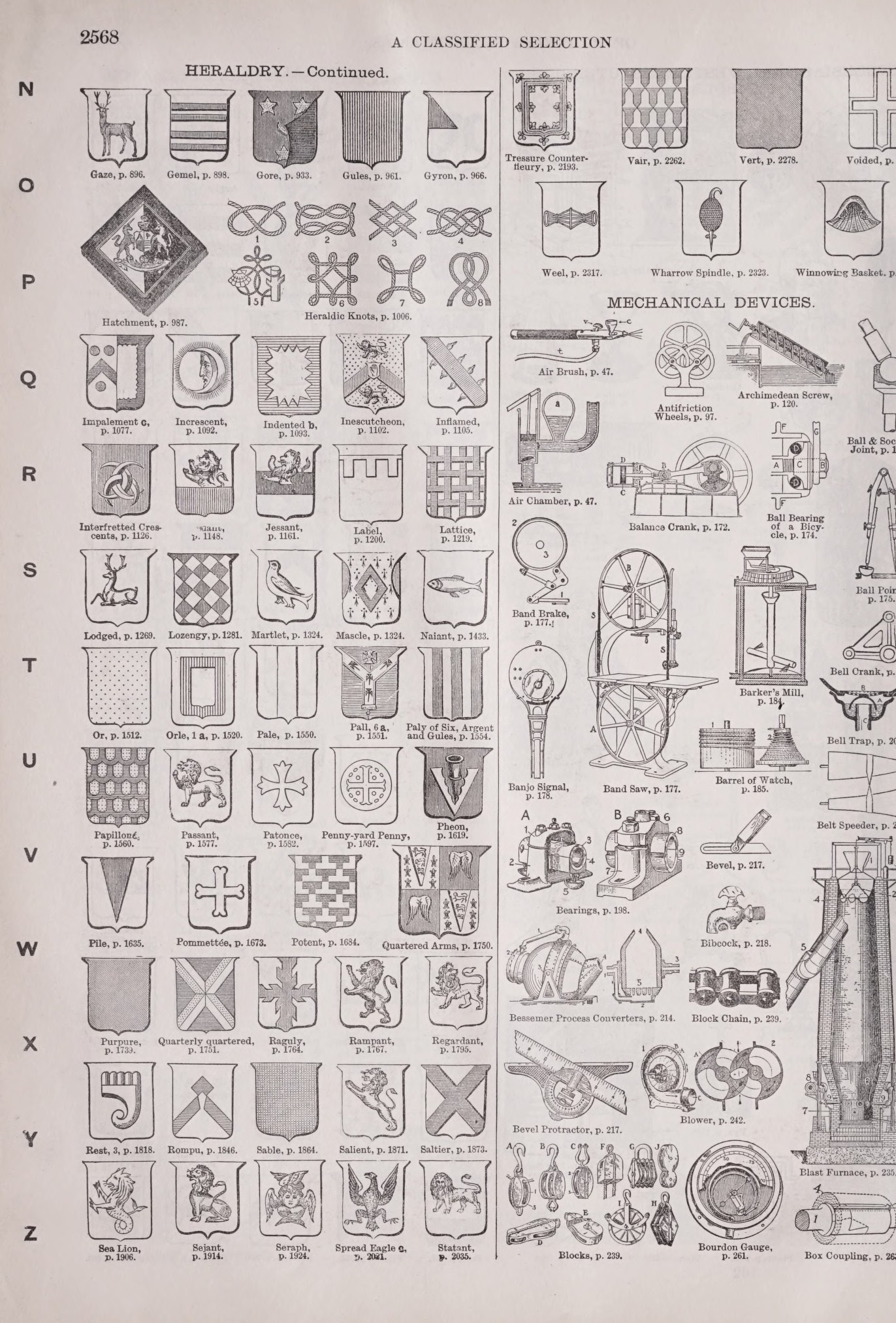
Particular symbols have in all ages been assumed by the various families of mankind, civilized and uncivilized. Such were the lion of the tribe of Judah, the S. P. Q. R. upon the standards of ancient Rome and the eagle surmounting them, the tattoo marks of the savages of America and the Pacific, the Danish raven, and the white horse of Saxony, which still remains carved upon the chalk downs of western England. Heraldry, however, is a purely feudal institution, coeval with close armour, devised possibly in Germany, adopted and improved in France, Spain, and Italy, and imported into England by the Norman invaders and settlers. Its figures have little or nothing to do with the older symbols, though these have occasionally been incorporated into its charges, and an apparent connexion thus established between them. These symbols, as has been well said, were the precursors and not the ancestors of heraldic bearings. The supposed connexion, however, misled the credulous heraldic writers of the 16th and 17th centuries, and caused them to attribute coats of arm3 to the heroes of sacred and profane history, who were certainly as ignorant of hèraldry as ever was Adam of genealogy....
“Arms” or “armories,” so called because originally displayed upon defensive armour, and “coats of arms” because formerly embroidered upon the surcoat or camise worn over the armour, are supposed to have been first used at the great German tournaments, and to have reached England, though to a very moderate extent, in the time of Henry II. and Coeur de Lion. To “blazon,” now meaning to describe a coat of arms, is the German “blasen,” to blow as with the horn, because the style and arms of each knight were so proclaimed on public occasions. The terms employed in heraldry are, however, mostly French or of French origin. Though now matters of form and ceremonial, and subject to the smile which attaches to such in a utilitarian age, armorial bearings were once of real use and importance, and so continued as long as knights were cased in plate, and their features thus concealed. At that time leaders were recognized in the field by their insignia alone, and these—both figures and colours—became identified with their fame, from personal became hereditary, were subject to certain rules of descent, and to the laws of property and the less certain rules of honour.
Froissart mentions a case in which a knight of the Scrope family could with difficulty be restrained from putting to death a prisoner because he wore the same bearings with himself. The last De Clare owed his death on the field of Bannockburn to his having neglected to wear his cotte d’armes; had he been recognized, his great value as a prisoner would have saved him. Also the loss of the battle of Barnet was in part attributed to the similarity between the royal cognizance of a sun and that of John de Vere, a star with streamers,—Warwick charging Oxford by mistake for the king.
The best if not the only absolutely safe evidence for the origin of armorial bearings is that afforded by seals. Seals were in common use both before and after the introduction of armorial bearings, and they are not so likely as rolls of arms or monumental effigies to be the work of a later age. There are said by Courcelles to be extant, appended to charters of 1030 and 1037 a.d., two seals of Adalbert, duke of Lorraine, which bear on a shield an eagle with wings closed. This however wants confirmation; but Anna Comnena, describing the shields of the French knights who visited Constantinople about 1100, gives their surfaces as of metal only, polished but plain; nor have any decided traces of arms been discovered among the early crusaders. Louis le Jeune, who seems first of the French kings to have used the fleur-de-lys, caused it to be represented in gold over the azure mantle and chaussures worn by his son at his coronation. Also, in 1180, he seals with a fleur -de-lys, but it is placed in a circle, not upon a shield. Planché cites two seals of Philip, count of Flanders, one plain, in 1157, and another in 1164 charged with a lion, their subsequent bearing. Seton mentions the seal of John de Mundegumbri in 1170 as bearing a fleur-de-lys, which, like that of Louis, has two intermediate flower-stems, as seen on Florentine coins. He also gives the seal of Falconer (1170) as bearing a falcon; and that of Corbet bore two ravens perched upon a fleur-de-lys, while his brother bore them upon a tree. This indeed was at a period when fleurs-de-lys, stars, and various animals were commonly represented as mere ornaments on seals, but the peculiarity of the instances named is that the falcon and the raven, like the fleur-de-lys of France, were afterwards the heraldic bearings of those families. The seals of the close of the 12th century, though not generally heraldic, certainly betray many of the elements of heraldry. No doubt, when once introduced, armorial bearings were felt to supply a real and serious want, and came rapidly into use, but Wace, the poet of the reign of Henry II., although he tells us that
“N’i a riche home ne Baron, Ki n’ait lez li son gonfanon, U gonfanon u altre enseigne,”
can scarcely be seriously held to mention armorial bearings.
It is uncertain at what period armorial bearings found their way into England. The Conqueror and his successors certainly did not use them; they do not appear upon their seals, nor are they shown upon the banners of the Bayeux tapestry. The monk of Marmoutier, probably a contemporary, describes Henry I., upon the marriage of his daughter to Geoffrey of Anjou in 1122, as hanging about the bridegroom’s neck a shield adorned with small golden lions, “leonculos aureos;” and, making mention of a combat in which Geoffrey was engaged, he describes him as “pictos leones praeferens in clypeo.” It is true that the number, attitude, and position of these lions on the shield are not specified, but considering that not long afterwards two lions became the arms of Plantagenet, and so of England, this may fairly be taken as their introduction. Stephen is said to have used a centaur, Sagittarius, as an emblem, because he landed in England when the sun was in that sign, but on his great seal his shield is quite plain, save a ridge down the .centre, evidently a part of its construction. On the seals of the Conqueror, Rufus, and Henry I., only the hollow or under side of the shield is shown; so there probably was no design upon the front. There is no seal of Duke Robert, but William, earl of Flanders, his son, shows a plain shield on his seal. His monumental effigy (1128) bears a large pavesse shield, and upon it an escarbuncle, apparently a highly ornamented clamp. The seal of Henry II. also shows the hollow of the shield. The first great seal of Richard I. bears a lion rampant, who from his position may be inferred to be fighting with a similar lion upon the sinister and concealed half of the shield, blazoned in a MS. cited by Mr Way as “two lion3 confrontés.”
Up to this time the kings, though represented on horseback and in full armour, have the face uncovered, and therefore their persons would be known. The seal of Richard I. in 1189 shows a close helmet, and upon the shield two lions passant gardant in pale, “leones lopardés,” as they were then or soon after called. On a later seal, after his return from captivity in 1194, Richard added a third lion. John, while earl of Mortaine, sealed with two lions, but his seal as king bears three, and the coat has so remained. That the two lions were more than a mere ornament is evident from their having been adopted by John’s natural son, Richard de Warren, who seals with two lions passant regardant. The seals of the great barons show the growth of the practice. Richard, constable of Chester, contemporary with Stephen, bears a shield covered over with small plates, tegulated, like his armour; but Stephen, earl of Richmond, as early as 1137, seals with seven fleurs-de-lys, a very early heraldic seal. Waleran, earl of Meulan (died 1166), also used an heraldic seal. Duchesne gives a seal of Bouchard de Montmorenci (1182), a contemporary of Louis le Jeune, with a cross between four alerions on his shield, and another in whch the cross is charged with roundels. Mathieu, his son, seals also with the cr0s3 and alerions, which had evidently become, as they remained, hereditary. In England, William, earl of Essex (died 1190), seals with the escarbuncle of his family. In 1187 Gervase Paganel, a great Anglo-Norman baron, seals with two lions passant, which his family continued to bear.
With the 13th century arms came rapidly into use. The second seal of Mathieu de Montmorenci in 1209 has them introduced upon his horse furniture, but this practice does not appear upon the seals of the kings of England until the second seal of Edward I. Baldwin de Bethune, earl of Albemarle (died 1214), sealed with three martlets in chief, and many other early examples of regular heraldic seals occur at this period attached to extant charters. The earliest roll of arms is of the reign of Henry III.; of a second of the same reign a copy is preserved in the Harleian collection; and a third, in the next reign, is the roll of Caerlavrock, 1300 ad. So that for the reign of Henry and his son the evidence for armorial bearings is copious and excellent. Other rolls exist carrying the practice through the 14th and 15th centuries, before the middle of which there is no known work on heraldry, nor any trace of heraldic regulations save what may be deduced from recorded practice.
Coats of arms were not at first strictly hereditary, nor even always permanent in the same person. Thus William de Ferrars, 6th earl of Derby (died 1216), seems to have borne “argent, 6 fers de cheval, or horse shoes, 3, 2, 1, sable.” William, his son, in consequence of a match with Peveril, who bore “vair,” changed his bearing to “vair, or and gules, on a border azure 8 horse shoes argent.” Robert his son, 8th earl (died 1278), dropped the horse shoes, and bore “vair, or and gules.”
“Ferrars his tabard with rich vair yspread.”
After the match with Quincy, the Ferrarses laid aside their own coat and bore that of Quincy, “gules, 7 mascles conjoined 3, 3, 1, or.” Their male heir through a younger branch, —Ferrers of Baddesley-Clinton,—commemorates these various changes by bearing “quarterly,—(1st) vair, or and gules; (2d) sable, 6 horse shoes, 3, 2, 1, argent; (3d) gules, i mascles, 3, 3, 1, or, a canton ermine.” Hugh Lupus, earl of Chester (died 1101), is fabled to have borne a wolf’s head, and not improbably his surname arose from some such emblem. Richard, his son, is said to have borne “azure, semée of crosslets or, a wolf’s head erased argent” Ranulph Meschines, 3d earl (died 1128), was sister’s son to the first earl, and to him is assigned “or, a lion rampant gules.” Hugh Cyfeliøc, 5th earl (died 1180), certainly bore “azure 6 garbs of wheat, 3, 2, 1, or;” and Ranulph Blondevile, his son, bore “azure, 3 garbs or.” With him the line failed, but as the wheat-sheaf is a common Cheshire bearing, it is probable that arms came into general use in the palatinate, in the time of the last two earls.
Sir Nicholas Carru (died 1283) seals with a tricorporate lion, but at Caerlavrock in 1300 is found with a
“Banière et jaune bien passable, O trois passans lyons de sable/’ the arms of the Carews of our day. The fess and label of Saher de Quincy, earl of Winchester, in 1170, were changed by Roger his son for the mascles by which they were best known, and which he repeats upon his housings. The fact is that, at the close of the 13th century, arms, though on the whole hereditary, had not quite acquired that fixed character that belonged to them half a century later. That the changes were the exception rather than the rule is, however, clear from the roll of Henry IΠ., and from the arms of the forty great barons which he caused to be painted on the walls of Westminster Abbey, almost all of which, so far as they are on record, are the same with those borne or quartered by their representatives. There exist also in England a few families of Norman origin, the period of whose arrival in England is known, and whose arms are the same with those of the present stock in the parent country. Such are Harcourt of Ankerwyke and D’Aubigny, who therefore bore their arms before the separation from Normandy under Henry III.
Early bearings were usually very simple, the colours in strong contrast, and their form and outline such as could readily be distinguished even in the dust and confusion of a battle. They are mostly composed of right lined figures known in heraldry as ordinaries. The favourite beast is the lion.
The earliest and most valuable records relating to English armorial bearings are undoubtedly the rolls of arms of the reigns of Henry III and the first three Edwards, which have been well edited by Sir II. Nicolas. That of Henry III. known as Glover’s roll, drawn up between 1243 and 1246, describes or blazons 218 coats of arms, and therefore shows very sufficiently the heraldry of the period. Of these coats nearly one-half are composed solely of the ordinaries and subordinaries, and other simple lines and figures. About two score of them exhibit lions, chiefly rampant, and leo-pardés, a form of the sune animal. The only other beast is the “teste de sanglier” borne by Swinburne. Of birds there are but the eagle and the papagay, several martlets, and single examples of the raven, the cock, the heron, and the horiole. The luce or pike is the only fish. The cinquefoil and sexfoil, the fleurde-lys, the rose, and the wheat-sheaf, used very sparingly, represent the vegetable world. For the rest there are annulets, barnacles, crescents, estoiles, escallops, fers de cheval, mullets, and water budgets. There is one ray of the sun, and one whirlpool.
The coat of Mortimer “barré, a chef palée,a corner geren-née d’or et d’azur, a ung escucheon d’argent,”—or, in modern terms, “harry, a chief paly, its corners gyronny or and azure, an escutcheon argent ’’ (fig. 63),—is the only one at all of a complex character, and this is composed of ordinaries and subordinaries'; and though many of the ordinaries bear the smaller charges, or are placed between them, there are very few examples of an ordinary so charged also placed between charges, a common usage in later coats. An exception is Chandos, who bears three estoiles on a pile, which again is placed between six others; but this stands alone.
The roll of Edward II. blazons 957 coats of the bannerets of England, so that the use of arms had increased considerably. The lions have risen to 225, the eagles to 43; and there are 102 crosses of various kinds. Of new beasts, fabulous or real, there are the griffin, the wyvern, the stag, wolf, goat, and greyhound: of new birds, the falcon ; of fishes, the dolphin. Of other objects the additions are the millrind, buckle, covered cup, chaplet, gauntlet, arrow, trumpet, hammer, battle-axe, palmer’s staff, pots, winnowing fans or vans, pens, cushions, and chessrooks. The character of the arms remains very simple, and the blazon employed agrees in the main with that still in use, and is in general perfectly intelligible. These rolls give various examples of changes of coats, either altogether or by the introduction of a difference to distinguish members of the same∣ family; and it is observable that when the figures are altered the colours are usually adhered to, as though it were considered undesirable to change them. Thus Gilbert de Segrave (died 1254) bore “sable, 3 garbs argent.” Of his grandsons John and Nicholas, John bore the paternal coat, but Nicholas, at Caerlavrock, had exchanged the garbs for a lion. This afterwards became the family bearing as “sable, a lion rampant argent, crowned or,” the colours being retained.
No sooner had the great barons assumed arms for themselves than they began to grant them to their followers. Arms so granted commonly bore some resemblance to those of the grantor, and hence certain charges prevailed in certain districts. Thus the chevron of De Clare was common in South Wales, in the Honours of Gloucester and Clare, and about Tonbridge. The garb or wheat-sheaf was found in Cheshire; the cinquefoils of the Bellomonts in Leicestershire; the annulets of Vipont in Westmoreland; the lion all over England, and the tressure in Scotland, both from the royal arms. Some of these grants remain; others can with certainty be inferred. Stephen Curzon, who held under the earls of Derby, bore “vair, with a border of 8 popinjays argent,” and Richard, his brother, bore “vair, on a fess 3 horse-shoes.” Hubert, earl of Kent, bore “7 lozenges vair;” and Anselm de Guise, on taking under him lands in Berks and Gloucester, assumed the same coat, with the addition of a canton or, charged with a mullet sable. In 1349 Robert Morle granted to Robert de Corby and his heirs the arms “d’argent, ove un saltier engrailé de sable,” which he himself had inherited from Baldwin de Manoirs. In 1356-7 William, baron of Greystock, who bore “harry of 6 argent and azure, 3 chaplets gules,” granted to Adam de Blencowe and his heirs for ever “an escutcheon sable with a bend closetted [or barred] argent and azure, with 3 chaplets gules.” In 1391-2 Thomas Grendale granted to William Morgue his heirs and assigns, “argent, on a cross azure 5 garbs or,” which, as cousin and heir, he himself hid inherited from John Beaumeys. Finally, in 1442, Humphrey, earl of Stafford, who bore “or, a chevron gules,’ granted to Robert Whitgreaves “un escue d’azure, a quatre points d’or, quatre chevrons de gules,” to him and hi3 heirs, of lineage,—in modern terms “azure, a cross quarter-pierced or, on each limb a chevron gules.” A coat o. arm3 was not only heritable, subject to certain heraldic customs, but could, be willed or granted away, wholly or in part, like chattel property.
The crusades, by bringing together soldiers of different nations, tended to produce a certain assimilation in their heraldries, but their influence upon the arms themselves has been exaggerated. The stories as to bearings adopted to commemorate feats of arms in Palestine are mostly inventions. The cross no doubt was a crusading bearing, but it was so because it was the emblem of Christianity, and primarily popular as such. The stars, torteaux, water budgets, and other charges attributed to the crusaders, were of earlier date and of independent origin. There is no evidence that the crosses pâtée of the Berkeleys, or the crosslets of Beauchamp, Clinton, Windsor, and Howard, were added to their simpler bearings in token of services in the Holy Land. The star of De Vere, always attributed to an adventure there, was evidently a mark of cadency, adopted by Robert de Vere, brother of Alberic, 2d earl of Oxford. The fact appears to be that most of the additions to or alterations in the earlier coats of arms were made for some genealogical reason, to commemorate a match with some great family or to distinguish between the several branches from the parent tree. After, usually long after, the period of the crusades, arms were invented for “fabled knights in battles feigned,” and but few of the Saracens’ heads which figure so formidably in many coats of arms are contemporary with any Saracenic war.
The diversion of the tournament did even more than actual war to promote the glories of heraldry. On these occasions the presence of spectators, and especially of ladies, encouraged all sorts of heraldic display. At a tournament at Calais in 1381 Richard Beauchamp, earl of Warwick, one of the most accomplished knights of the reigns of Richard II., Henry IV., and Henry V., suspended on three shields three several coats of arms, as representing three several knights who professed to be ready successively to meet all comers. Three Frénch...