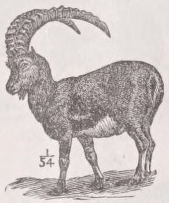
1. The wild goat of the genus Capra, which is said to be the stock of the tame goat. It has large knotty horns reclining on its back, is of a yellowish color, and its beard is black. It inhabits the Alps.
2. The Aegagras, or wild goat of the mountains of Persia, appears to be the stock of the tame goat. The ibex is a distinct species.
IBEX, the common name of several closely allied species of ruminant mammals, belonging to the genus Capra or goats, inhabiting the loftiest regions of Europe, Asia, and Africa. The European ibex or steinboc (Capra ibex) abounded during the Middle Ages among the higher mountain ranges of Germany, Switzerland, and the Ural, but has since disappeared from the greater part of this area, being now almost wholly confined to the Alps which separate Valais from Piedmont, and to the lofty peaks of Savoy, where its continued existence is mainly due to the action of protective game laws. The ibex is a handsome animal, measuring about 4⅛ feet in length and 2∣ feet high; its skin is covered in summer with a short fur of an ashy grey colour, and in winter with much longer yellowish-brown hair concealing a dense fur beneath. A short beard is present in the male in winter, but, as it disappears altogether in spring, Darwin regards this appendage as rudimentary. The horns, especially in the male, form a striking feature: rising from the crest of the skull, they bend gradually backwards, attaining a length in old specimens of about 2 feet; they are thick and flat, and have the anterior face ridged with knotty transverse bands. In the female the horns never exceed half a foot in length, and are much less rugose than in the male. The front legs are somewhat shorter than those behind, which enables the ibex to ascend the mountain slopes with more facility than it can descend, while its hoofs, according to Tschudi, are “as hard as steel, rough underneath, and when walking over a flat surface capable of being spread out.” These, together with its powerful sinews, enable it to take prodigious leaps, to balance itself on the smallest foothold, and to scale almost perpendicular rocks. ...The ibex lives habitually at a greater height than the chamois or any other of the Alpine mammals, its vertical limit being the line of perpetual snow. There it rests in sunny nooks during the day, descending at night to the highest woods to graze, and retiring at sunrise to its snowy fastnesses. This return journey forms the ibex hunter’s opportunity. To get within gunshot the huntsman has usually to approach from above; accordingly he ascends to the limit of perpetual snow, and there passes the night among the daily haunts of the ibex, lying in wait from early dawn for its return. The ibexes are gregarious, feeding in herds of ten to fifteen individuals; the old males, however, generally live apart from, and usually at greater elevations than, the females and young. They are said to give out a sharp whistling sound not unlike that of the chamois, but when greatly irritated or frightened they make a peculiar snorting noise. The period of gestation in the female is ninety days, after which she produces—usually at the end of June—a single young one, which is able at once to follow its mother. These when caught young and fed on goat’s milk can, it is said, be readily tamed; and in the 16th century young tamedibexes were, according to Tschudi, frequently driven to the mountains along with the goats, in whose company they would afterwards voluntarily return. Even wild specimens have thus been known to stray among the herds of goats, although, strange to say, they at all times shun the society of the chamois. The ibex was formerly hunted largely for its flesh and skin; but, although the latter, owing to its scarcity, now commands a high price, the difficulty arising from the operation of the game laws, and above all the difficulty and danger inseparable from the sport, have reduced the number of hunters to a few hardy mountaineers, who find in the pursuit of the ibex the keenest enjoyment of life. For weeks the sportsman will follow a track across fields of ice, along narrow ledges, over precipices, and across chasms, nearly frozen to death at night, and often with little more than a crust of bread for sustenance, yet considering himself more than repaid by the sight at last of his prey grazing within range of his rifle. Its flesh is said to resemble mutton, but has a flavour of game.
9th ed. Encyclopædia Britannica, vol. 12, p. 605 [715 words — estimated reading time: 5 minutes]
the deer, the gazelle, the roe deer, the wild goat, the ibex, the antelope, and the mountain sheep.
This site uses cookies to remember your display preferences (search sources and editions, Bible version, auto-link, images, light/dark theme). No personal data whatsoever is collected. Privacy Policy