
An animal of the goat kind, whose skin is made into soft leather, called shammy. It is now arranged with the Antelopes.
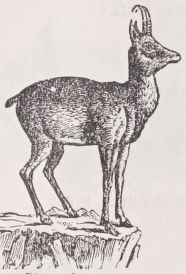
CHAMOIS(Rupicapra trag ns) ,the Gemse of the Germans, is the only Antelope found in Western Europe; and forms the type of the Rupicaprine or goat-like group of that family. It resembles the roebuck in size, being about 3 feet long and 2 feet high at the shoulders, and is specially characterized by the form of its horns. These are from 6 to 8 inches long, of a black colour, slender, round, and slightly striated, rising perpendicularly from the forehead, and suddenly hooked backwards at their extremities. They are common to both sexes, although in the female they are less uncinated. The body is covered with long hair of a chestnut brown colour in winter, when it is also longest, that of the head being paler, with a dark brown streak on each side. At other seasons the colour is somewhat lighter, in spring approaching to grey. Underneath the external covering the body is further protected from the cold by a coat of short thick wool of a greyish colour. The tail is short and black, the ears pointed and erect; the hoofs are solid, with the outer edges higher than the soles, and are thus admirably adapted for laying hold of the slightest projection or roughness on the face of the rocky precipices it frequents. The chamois is gregarious, living in herds of 15 or 20, and feeding generally in the morning or evening. The old males, however, live alone except in the rutting season, which occurs in October, when they join the herds, driving off the young males, and engaging in fierce contests with each other, that often end fatally for one at least of the combatants. The period of gestation is twenty weeks, when the female, beneath the shelter generally of a projecting rock, produces one and sometimes two young. They are said to attain the age of thirty years. The chamois inhabits ...the Alpine regions of Central Europe from the Pyrenees to the Caucasus, and extends eastwards as far as Persia, frequenting the wildest and most inaccessible peaks and ravines of these mountain ranges. Tn summer it ascends to the limits of perpetual snow, being only outstripped in the loftiness of its haunts by the ibex; and during that season it shows its intolerance of heat by choosing such browsing grounds as have a northern exposure. In winter it descends to the wooded districts that immediately succeed the region of glaciers, and it is there only that it can be successfully hunted. Chamois are exceedingly shy; and their senses, especially those of sight and smell, are exceedingly acute. The herd never feeds without having a sentinel posted on some suitable prominence to give timely notice of the approach of danger; this is done by stamping on the ground with the fore feet, and uttering a shrill whistling note, which puts the entire herd on the alert. No sooner is the object of alarm scented or seen than each one seeks safety in the most inaccessible situations, which are often reached by a series of astounding leaps over crevasses, up the faces of seemingly perpendicular rocks, or down the sides of equally precipitous chasms. The chamois will not hesitate, it is said, thus to leap down 20 or even 30 feet, and this it effects with apparent ease by throwing itself forward diagonally and striking its feet several times in its descent against the face of the rock. Chamois-shooting is most successfully pursued when a number of hunters form a circle round a favourite feeding ground, which they gradually narrow; the animals, scenting the hunters to windward, fly in the opposite direction, only to encounter those coming from leeward. Chamoishunting, in spite of, or perhaps owing to, the great danger attending it, has always been a favourite pursuit among the hardy mountaineers of Switzerland and Tyrol, as well as of the amateur sportsmen of all countries, with the result that the animal is now much rarer than formerly. In certain parts of Switzerland it now enjoys a close season; thus in the Canton of Grisons it can only be hunted during September, and there in 1874 no fewer than 918 were killed during that period, the largest number shot by one sportsman being 16. The chamois feeds in summer on mountain herbs and flowers, and in winter chiefly on the young shoots and buds of the fir and pine trees. It is particularly fond of salt, and in the Alps sandstone rocks containing a saline impregnation are often met with hollowed by the constant licking of these creatures. The skin of the chamois is very soft; inade into leather it was the original shammy, which is now made, however, from the skins of many other animals. The flesh is prized as venison. The chamois can be at least partially tamed, and in that state, according to Major Smith, it evinces all the mixture of impudence, timidity, and curiosity observed in goats.