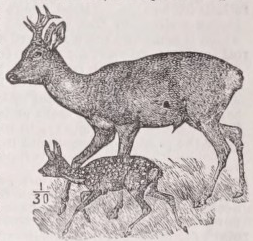
1. ROE ,
2. RO'E-STONE, noun Called also oolite, which see.
ROE. See Deer, vol. vii. p. 24.
ROE or Row, Sir Thomas (1568 7-1644), an eminent political agent of the reigns of James I. and Charles I., was born in 1568 (?) at Low Leyton near Wanstead in Essex (being a grandson of Sir Thomas Roe, a well-known lord mayor of London). He was entered as a commoner at Magdalen College, Oxford, in 1593, but shortly afterwards he left the university and, having read for the bar, became esquire of the body to Queen Elizabeth. From James I. he received the honour of knighthood in 1604, and in 1609 he was sent by Prince Henry on a mission to the West Indies, during which he visited Guiana and the river Amazons. As member of parliament in 1614 he supported the principles of Sandys and Whitelocke. His permanent reputation was mainly secured by the success which attended his embassy in 1615-18 to the court at Agra of the Great Mogul (Jahangir, son of Akbar), whose importance had been made known by Sir John Hawkins, —the principal object of the mission being to obtain the protection of an English factory at Surat. Sir Thomas Roe’s Journal, reprinted in a more or less complete shape in the collections of Purchas, Pinkerton, and Kerr, forms one of the leading authorities for the reign of Jahangir. Appointed ambassador to the Porte in 1621, he filled this difficult position under Osman, Mustapha, and Amurat; and after his return from the East he continued to be employed on various political missions to Poland, Denmark, and other European courts, till in 1641 he was sent by Charles I. to the diet of Ratisbon. Roe died in 1644....
The Society for the Encouragement of Learning proposed to publish a whole series of Roe’s papers, but owing to lack of funds only one of the five volumes, edited by Samuel Richardson, ever saw the light— The Negotiations of Sir Thomas Roe in his Embassy to the Ottoman Forte, 1621-1628 (London, 1740). In regard to his minor publications and manuscript remains see Wood’s Athenae Oxonienses; Allibone’s Dictionary of British . . . Authors·, and Notes and Queries, vii., viii., ix., and xi. (2d ser.).
ROEBLING John Augustus (1806-1869), civil engineer, was born at Mühlhausen, Prussia, 6th June 1806. Soon after his graduation from the polytechnic school at Berlin he removed to the United States, and in 1831 entered on the practice of his profession in western Pennsylvania. He established at Pittsburgh a manufactory of wire rope, and in May 1845 completed his first important structure, the suspended aqueduct of the Pennsylvania Canal across the Monongahela river. This was followed by the Monongahela suspension bridge at Pittsburgh and several suspended aqueducts on the Delaware and Hudson Canal. Removing his wire manufactory to Trenton, New Jersey, he began, in 1851, the erection at Niagara Falls of a long span wire suspension bridge with double roadway, for railway and carriage use (see Bridge, vol. iv. pp. 338-339), which was completed in 1855. Owing to the novelty of its design, the most eminent engineers, including Stevenson, regarded this bridge as foredoomed to failure; but, with its complete success, demonstrated by long use, the number of suspension bridges rapidly multiplied, the use of wire-ropes instead of chain-cables becoming all but universal. The completion, in 1867, of the still more remarkable suspension bridge over the Ohio river at Cincinnati, with a clear span of 1057 feet (see Cincinnati, vol. v. p. 782), added to Roebling’s reputation, and his design for the great bridge spanning the East River between New York and Brooklyn was accepted. While personally engaged in laying out the towers for the bridge, Roebling received an accidental injury, which resulted in his death, at Brooklyn, from tetanus, 22d July 1869....
At the time of his death Roebling’s work on Long and Short Span Bridges (New York, 1869) was in the press. It is devoted to an exposition of his belief that “the principle of suspension will of necessity become the main feature in our future long span railway bridges,” and was intended as the initial volume of a series relating to his general theory of bridge construction, with detailed plans and descriptions of the larger works erected by him.
ROEMER Ole (Latinized Olaus) (1644-1710), Danish astronomer, was born at Aarhuus in Jutland, 25th September 1644. He studied mathematics at the university of Copenhagen until 1671, when he assisted Picard in determining the geographical position of Tycho Brahe’s observatory (Uranienburg on the island of Huen). In 1672 he accompanied Picard to Paris, where he remained nine years, occupied with observations at the new royal observatory and hydraulic works at Versailles and Marly. In 1675 he read a paper before the Academy on the successive propagation of light as revealed by a certain inequality in the motion of the first of Jupiter’s satellites (see Parallax, vol. xviii. p. 251). In 1681 he returned to Copenhagen, where he spent the remainder of his days as professor of astronomy, but his great ability and practical talents were made use of in several other public employments. He died on 23d September 1710....
Roemer’s name is now best known by his discovery of the finite velocity of light. Most of his contemporaries doubted the reality of this discovery, chiefly because the eclipses of the three outer satellites of Jupiter did not show similar irregularities to those exhibited by the first satellite. This is not surprising, as the mutual attraction of the satellites makes their motions far more complicated than astronomers imagined before the development of the theory of gravitation, and it should perhaps be chiefly ascribed to chance that Roemer brought forward his theory, which Bradley’s discovery of the aberration of light about fifty years later proved to be a true one. Roemer’s ingenuity has, however, appeared very prominently in the important improvements which he carried out in the construction of astronomical instruments. The large “armil-lary spheres,” first constructed by the astronomers of Alexandria and also used by Tycho Brahe, had been superseded by the meridian or mural quadrant for measuring meridian zenith distances, and by the sextant for measuring distances between stars in order to find their difference of right ascension by solving the spherical triangle between the pole and the two stars. Both these instruments were introduced by Tycho Brahe. Roemer, however, saw that Tycho’s idea of making the rotating earth itself an astronomical instrument by observing the transits of stars across the meridian could be carried out better by fixing a telescope at right angles to a horizontal axis placed exactly east and west, so that the telescope could only move in the meridian. The first transit instrument was constructed in 1689 and erected in Roemer’s house in 1690. In the same year he erected in the university observatory an instrument with altitude and azimuth circles (for observing equal altitudes on both sides of the meridian) and an equatorial instrument. In 1704 he constructed a private observatory at Vridlösemagle, a few miles west of Copenhagen, and mounted a meridian circle (the transit instrument and vertical circle combined) and a transit instrument moving in the prime vertical. Roemer may thus be considered the inventor of nearly all our modern instruments of precision, and it is much to be regretted that his ideas were not adopted by astronomers until about a century later. All the results of his observations were destroyed in a great conflagration in 1728, except three days’ work, which has been discussed by Galle (O. Roemeri triduum οbservatiοnum astroenoemiearum a. 1706 institutarurn, Berlin, 1845). His disciple Horrebow has left us a very detailed description of Roemer’s instruments and ideas in his Opera mathematico-physiea (3 vols., Copenhagen, 1740-41). Grant’s History of Physical Astronomy (London, 1852) gives a very correct account of Roemer and his inventions. About his life see also an article by Philipsen in Nordisk Universitets Tidsskrift, vol. v., 1860.
ROERMOND or Roermonde (i,e., “Roer-Mouth ”), a town of the Netherlands in the province of Limburg (formerly Guelderland), on the right bank of the Maas (Meuse) at the mouth of the Roer, which separates it from the suburb of St Jacob. It is 29 ⅜ miles from Maestricht by the railway to Venlo (opened 1865). The old fortifications were dismantled in 1819 and have been partly turned into promenades. At this point the Maas is crossed by a bridge erected in 1866-67, and the Roer by one dating from 1771 and replacing the older structure destroyed in 1764. The finest building in the town is the Romanesque minster church, begun in 1218, and dedicated by Archbishop Engelbert of Cologne. In the middle of the nave is the tomb of Count Gerhard III. of Guelderland and his wife Margaret. The cathedral of St Christopher is also of note; on the top of the tower (246 feet) is a copper statue of the saint and the interior is adorned with paintings by Rubens, Jacob de Wit, &c. The Reformed church was once the chapel of the monastery of the Minorites. The old bishop’s palace is now the court-house, and the old Jesuits’ monastery with its fine gardens is now occupied as a higher burgher school. Woollen, cotton, silk, and mixed stuffs, paper, flour, and beer are manufactured at Roermond. The population of the town was 5712 in 1840 and 8797 in 1870; and that of the commune has increased from 6005 in 1840 to 10,470 in 1879....
Till the 13th century Roermond was only a village with a hunting lodge known as Pot. The erection of the monastic church in 1218 was followed by the building of town walls in 1231 by Count Otho II. In 1543 Roermond was occupied by the troops of Charles V., and in the course of the Eighty Years’ War few places more frequently changed hands. The peace of Münster (1648) left it in the Spanish Netherlands; but between 1702 and 1716 it was held by the forces of the United Provinces.