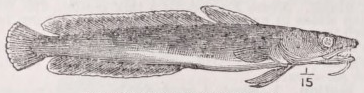
LING(fHolva vulgaris'), a fish of the cod-fish family (Gadidae), readily recognized by its long body, two dorsal fins (of which the anterior is much shorter than the posterior), single long anal fin, separate caudal fin, a barbel on the chin, and large teeth in the lower jaw and on the palate. Its usual length is from 3 to 4 feet, but larger individuals of 5 or 6 feet in length, and some seventy pounds in weight, have been taken. The ling is found in the North Atlantic, from Spitzbergen and Iceland southwards to the coast of Portugal. Its proper home is the German Ocean; especially on the coasts of Norway, Denmark, Great Britain, and Ireland it occurs in great abundance, generally at some distance from the land, in depths varying between 50 and 100 fathoms. During the winter months it approaches the shores, when great numbers are caught by means of long lines. On the American side of the ocean it is less common, although generally distributed along the south coast of Greenland, and on the banks of Newfoundland. This fish is one of the most valuable species of the cod-fish family; a certain number are consumed fresh, but by far the greater portion are prepared for exportation to various countries on the Continent (Germany, Spain, Italy). They are either salted and sold as “salt-fish,” or split from head to tail and dried, forming, with similarly prepared cod and coal-fish, the article of which during Lent immense quantities are consumed in Germany and elsewhere under the name of “stock-fish.” Also the oil is frequently extracted from the liver and used by the poorer classes of the coast population for the lamp or as medicine.
LING. See Heath.
[290 words — estimated reading time: 2 minutes]

LINGARD, John (1771-1851), the Roman Catholic historian of England, was born of humble parentage at Winchester on February 5, 1771. His intellectual abilities began to manifest themselves at a very early age, and in 1782 he was sent to the English college at Douay, where he continued until shortly after the declaration of war by England (1793). For some time after his return to England he lived as tutor in the family of Lord Stourton, but in October 1794 he settled along with seven other former members of the old Douay college at Crook Hall near Durham, where on the completion of his theological course he became vice-president of the reorganized seminary. In 1795 he was ordained priest, and soon afterwards undertook the charge of the chairs of natural and moral philosophy. In 1808 he accompanied the community of Crook Hall to the new and more commodious buildings at Ushaw, Durham, but in 1811, after declining the presidency of the college at Maynooth, he withdrew to the secluded mission at Hornby in Lancashire, where for the rest of his life he found the leisure which his literary pursuits demanded. In 1817 he visited Rome, where he made some researches in the Vatican Library, and also negotiated some business connected with the English college. In 1821 Pope Pius VII. created him doctor of divinity and of canon and civil law; and in 1825 Leo XII. is said to have made him cardinal in petto. He died at Hornby on July 17, 1851....
Lingard was the author of a considerable number of occasional and ephemeral writings of an avowedly controversial character. He also wrote The Antiquities of the Anglo-Saxon Church (1806), of which a third and greatly enlarged addition appeared in 1845 under the title The History and Antiquities of the Anglo-Saxon Church; containing an account of its origin, government, doctrines, worship, revenues, and clerical and monastic institutions ; but the work with which his name is chiefly associated is A History of England·, from the first invasion by the Romans to the commencement of the reign of William III., which appeared originally in 8 vols, at intervals between 1819 and 1830. Three successive subsequent editions had the benefit of extensive revision by the author; a fifth edition in 10 vols. 8vo appeared in 1849, and a sixth, with life of the author by Tierney prefixed to vol. x., in 1854-55. Soon after its appearance it was translated into French, German, and Italian. It is a work of ability and research; and, though Cardinal Wiseman certainly claimed too much for its author when he called him “the only impartial historian of our country,” yet the candid and dispassionate student will always find it profitable to learn from the pages of Lingard the aspects which the events of English histoιy presented to the mind of an able and intense Roman Catholic in the earlier decades of the 19th century.
[491 words — estimated reading time: 3 minutes]