Pertaining to, or designating, an acid of the acrylic acid series, metameric with crotonic acid, and obtained as a colorless liquid; -- so called from having four carbon atoms in the molecule. Called also isocrotonic acid.
2. The fourth part; as the quarter of an hour or of a mile; one quarter of the expense. Living is a quarter dearer in the city than in the country.
3. In weight, the fourth part of a hundred pounds avoirdupois, or of 112lb., that is, 28lb.; as a quarter of sugar.
4. In dry measure, the fourth of a ton in weight, or eight bushels; as a quarter of wheat.
5. In astronomy, the fourth part of the moon's period or monthly revolution; as the first quarter after the change or full.
6. A region in the hemisphere or great circle; primarily, one of the four cardinal points; as the four quarters of the globe; but used indifferently for any region or point of compass. From what quarter does the wind blow? Hence,
7. A particular region of a town, city or country; as all quarters of the city; in every quarter of the country or of the continent. Hence.
8. Usually in the plural, quarters, the place of lodging or temporary residence; appropriately, the place where officers and soldiers lodge, but applied to the lodgings of any temporary resident. He called on the general at his quarters; the place furnished good winter quarters for the troops. I saw the stranger at his quarters.
11. Bacon uses the word in the singular. 'Make love keep quarter '
12. On board of ships, quarters signifies the stations or places where the officers and men are posted in action. Pipe all hands to quarters.
13. In military affairs, the remission or sparing of the life of a captive or an enemy when in one's power; mercy granted by a conqueror to his enemy, when no longer able to defend himself. In desperate encounters, men will sometimes neither ask nor give quarter The barbarous practice of giving no quarter to soldiers in a fortress taken by assault, is nearly obsolete.
14. He magnified his own clemency, now they were at his mercy, to offer them quarter for their lives, if they would give up the castle.
15. Lambs at the mercy of wolves much expect no quarter
19. In the slaughter house, one limb of a quadruped with the adjoining parts; or one fourth part of the carcase of a quadruped, including a limb; as a fore quarter or hind quarter
20. In the menage, the quarters of a horse's foot are the sides of the coffin, between the toe and the heel. False quarters are a cleft in the horn of the hoof, extending from the coronet to the shoe, or from top to bottom. When for any disorder, one of the quarters is cut, the horse is said to be quarter-cast.
21. In a siege, quarters are the encampment on one of the principal passages round the place besieged, to prevent relief and intercept convoys.
22. In seminaries of learning, a fourth part of the year, or three months. Tuition and board at twenty five dollars the quarter This is a moderate quarter bill.
23. The quarter of a ship, is the part of a ship's side which lies towards the stern, or the part between the aftmost end of the main-chains and the sides of the stern, where it is terminated by the quarter-pieces.
24. In heraldry, one of the parts or members of the first division of a coat that is divided into four parts.
25. On the quarter in seamen's language, is a point in the horizon considerably abaft the beam, but not in the direction of the stern.
26. QUARTER -bill, among seamen, is a list containing the different stations where the officers and crew are to take post in time of action, and the names of the men assigned to each.
27. QUARTER -cloths, long pieces of painted canvas, extended on the outside of the quarter-netting from the upper part of the gallery to the gangway.
28. QUARTER -deck, that part of the deck of a ship which extends from the stern to the mainmast. But in some kinds of vessels, the quarter-deck does not extend to the mainmast, but is raised above the main deck.
29. QUARTER -gallery, a sort of balcony on the quarters of a ship.
30. QUARTER -railing, narrow molded planks, reaching from the top of the stern to the gangway, serving as a fence to the quarter-deck.
31. QUARTER -master, in an army, an officer whose business is to attend to the quarters for the soldiers, their provisions, fuel, forage, etc.; in the navy, an officer who assists the mates in their duties, in stowing the hold, coiling the cables, attending the steerage, and keeping time by the watch glasses.
32. QUARTER -master-general, in military affairs, is an officer whose duty is to mark the marches and encampments of an army, the head-quarters, the place for the artillery, and procure supplies of provisions and forage, etc.
33. Quarter-staff, a long staff borne by foresters and park-keepers, as a badge of office and a weapon.
35. QUARTER -sessions, in England, a general court held quarterly by the justices of peace of each county, with jurisdiction to try and determine felonies and trespasses; but capital offenses are seldom or never tried in this court.
36. QUARTER -round, in architecture, the echinus or ovolo.
37. Head-quarters, the tent or mansion of the commander in chief of an army.
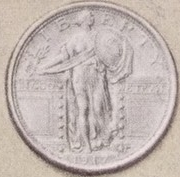
1. One of four equal parts into which anything is divided, or is regarded as divided; a fourth part or portion; as, a quarter of a dollar, of a pound, of a yard, of an hour, etc.
2. The fourth of a hundred-weight, being 25 or 28 pounds, according as the hundredweight is reckoned at 100 or 112 pounds.
3. The fourth of a ton in weight, or eight bushels of grain; as, a quarter of wheat; also, the fourth part of a chaldron of coal.
4. The fourth part of the moon's period, or monthly revolution; as, the first quarter after the change or full.
5. One limb of a quadruped with the adjacent parts; one fourth part of the carcass of a slaughtered animal, including a leg; as, the fore quarters; the hind quarters.
6. That part of a boot or shoe which forms the side, from the heel to the vamp.
7. That part on either side of a horse's hoof between the toe and heel, being the side of the coffin.
8. A term of study in a seminary, college, etc, etc.; properly, a fourth part of the year, but often longer or shorter.
9. The encampment on one of the principal passages round a place besieged, to prevent relief and intercept convoys.
10. The after-part of a vessel's side, generally corresponding in extent with the quarter-deck; also, the part of the yardarm outside of the slings.
11. One of the divisions of an escutcheon when it is divided into four portions by a horizontal and a perpendicular line meeting in the fess point.
1. A division of a town, city, or county; a particular district; a locality; as, the Latin quarter in Paris.
2. A small upright timber post, used in partitions; -- in the United States more commonly called stud.
3. The fourth part of the distance from one point of the compass to another, being the fourth part of 11¡ 15', that is, about 2¡ 49'; -- called also quarter point.
4. Proper station; specific place; assigned position; special location.
5. A station at which officers and men are posted in battle; -- usually in the plural.
6. Place of lodging or temporary residence; shelter; entertainment; -- usually in the plural.
7. A station or encampment occupied by troops; a place of lodging for soldiers or officers; as, winter quarters.
8. Treatment shown by an enemy; mercy; especially, the act of sparing the life a conquered enemy; a refraining from pushing one's advantage to extremes.
QUARTER SESSIONS (in full, General Quarter Sessions of the Peace) is the name given to a local court with civil and criminal jurisdiction. In England the court consists in counties of two or more justices of the peace, one of whom must be of the quorum (see Justice of the Peace), in cities and boroughs of the recorder alone. The quarter sessions are a court of record. The records in a county are nominally in the custody of the custos rotulorum, the highest civil officer in the county, practically in that of the clerk of the peace, who is nominated by the custos and removable by the quarter sessions. In a city or borough he is appointed by the council and removable by the recorder. The original jurisdiction of quarter sessions seems to have been confined to cognizance of breaches of the peace. By a series of statutes passed in the reign of Edward III. the time of the holding of the sessions was fixed, and their jurisdiction extended to the trial of felonies and trespasses. The jurisdiction now depends upon a mass of legislation reaching from 1344 to the present time. The dates at which the county sessions must meet are fixed, by 2 Geo. IV. and 1 Will. IV. c. 70, to be the first weeks after the 11th of October, the 28th of December, the 31st of March, and the 24th of June. Quarter sessions in a city or borough depend upon the Municipal Corporations Act, 1882, 45 & 46 Vict., c. 50. A grant of quarter sessions to a city or borough is made by the crown in council on petition of the town council. The main points in which borough differ from county quarter sessions are these:—(1) the recorder, a barrister of five years’ standing, is sole judge in place of a body of laymen; (2) the recorder has a discretion to fix his own dates for the holding of a court, as long as he ...holds it once every quarter of a year; it may be held more frequently if the recorder think fit or a secretary of state so direct; (3) the recorder has no power to levy a borough rate or to grant a licence for the sale of exciseable liquors by retail. In some few boroughs the recorder is judge of the borough civil court. Quarter sessions in the counties of Middlesex, Kent, and Lancaster, as also in London and the Cinque Ports, are governed by special legislation.
The jurisdiction of quarter sessions is either original or appellate.
Original Jurisdiction.—Civil.— This includes the levying of a county rate and its application, the appointment of a county licensing committee, and of public officers, such as the county treasurer, the public analyst, and the inspectors of weights and measures, the confirmation of bye-laws made by local authorities, the increase or alteration of polling places and petty sessional divisions, the regulation of police, and powers under various Acts of Parliament, such as the Highway Acts, and the Contagious Diseases (Animals) Act. The quarter sessions of the metropolitan counties have by 25 Geo. II. c. 36 the power of licensing music-halls, &c., within 20 miles of London.
Criminal.— Apart from statute, the commissions of justices of the peace provide that they shall reserve the graver felonies for trial at assizes. They are now forbidden by several Acts of Parliament to try a prisoner for treason or murder, or for any felonypunishable without a previous conviction by penalservitude for life (such as burglary and rape), or for any of the offences enumerated in 5 & 6 Vict. c. 38, the most practically important of which are perjury, forgery, bigamy, abduction, concealment of birth, libel, bribery, and conspiracy. The procedure is by indictment, as at assizes, and the trial of offences by jury. In the case of incorrigible rogues and of sureties of the peace the quarter sessions exercise a quasi-criminal jurisdiction without a jury. They may also estreat recognizances entered into for appearance in a court of summary jurisdiction, but this part of their jurisdiction may be considered practically obsolete, as the Summary Jurisdiction Act, 1879, gives the court of summary jurisdiction power to estreat the recognizances itself.
Appellate Jurisdiction.—Civil.— The principal cases in which this jurisdiction is exercised are in appeals from orders of a court of summary jurisdiction as to the assessment of the poor-rate and the removal and settlement of paupers, and orders made under the Highway, Licensing, and Bastardy Acts.
Criminal.— An appeal lies to quarter sessions from a court of summary jurisdiction only where such an appeal is expressly given by statute. The appellate jurisdiction has been considerably increased by the Summary Jurisdiction Act, 1879 (42 & 43 Viet, c. 49), which allows an appeal (with certain exceptions) from every conviction or order of a court of summary jurisdiction inflicting imprisonment without the option of a fine. The appeal may be brought in accordance with either the Act giving the appeal or the Summary Jurisdiction Act.
There is no appeal from quarter sessions on the facts, but their decision may be reviewed by the High Court of Justice by means of certiorari, mandamus, prohibition, or a case stated under 12 & 13 Vict. c. 45, § 11. A case may be stated for the opinion of the court of criminal appeal under 1Ï & 12 Vict. c. 78, § 1.
Ireland.— In Ireland the chairman of quarter sessions is a salaried professional lawyer, and has important civil jurisdiction corresponding very much to that of a county court judge in England. His jurisdiction depends chiefly upon 14 & 15 Vict. c. 57. The recorders of Dublin and Cork are judges of the civil bill courts in those cities.
Scotland.— In Scotland quarter sessions were established by the Act 1661, c. 338, under which justices were to meet on the first Tuesday of March, May, and August, and the last Tuesday of October to “administrate justice to the people in things that are within their jurisdiction and punish the guilty for faults and crimes done and committed in the preceding quarter.” The jurisdiction of quarter sessions in Scotland is more limited than in England, much of what would be quarter-sessions work in England being done by the sheriff or the commissioners of supply. Quarter sessions have appellate jurisdiction in poaching, revenue, and licensing cases, and under the Pawnbrokers and other Acts. All appeals from proceedings under the Summary Jurisdiction Acts are taken to the High Court of Justiciary at Edinburgh or on circuit (44 & 45 Vict. c. 33). The original jurisdiction of quarter sessions is very limited, and almost entirely civil. Thus they have power to divide a county and to make rules for carrying into effect the provisions of the Small Debts Act, 6 Geo. IV. c. 48. The decision of quarter sessions may be reviewed by advocation, suspension, or appeal.
United States.— In the United States courts of quarter sessions exist in many of the States; their jurisdiction is determined by State legislation, and extends as a rule only to the less grave crimes. They are in some States constituted of professional judges.
9th ed. Encyclopædia Britannica, vol. 20, p. 159 [1,194 words — estimated reading time: 7 minutes]
1. Containing or consisting of a fourth part; as quarterly seasons.
2. Recurring at the end of each quarter of the year; as quarterly payments of rent; a quarterly visitation or examination. The secretary requires quarterly returns from his officers.
1. By quarters; once in a quarter of a year; as, the returns are made quarterly.
2. In quarters, or quarterings; as, to bear arms quarterly; in four or more parts; -- said of a shield thus divided by lines drawn through it at right angles.
1. An officer whose duty is to provide quarters, provisions, storage, clothing, fuel, stationery, and transportation for a regiment or other body of troops, and superintend the supplies.
2. A petty officer who attends to the helm, binnacle, signals, and the like, under the direction of the master.
But before they lay down, the men of the city, even the men of Sodom, compassed the house round, both old and young, all the people from every quarter:
Before they had gone to bed, all the men of the city of Sodom, both young and old, surrounded the house.
Unleavened bread shall be eaten seven days; and there shall no leavened bread be seen with thee, neither shall there be leaven seen with thee in all thy quarters.
Unleavened bread shall be eaten during those seven days. Nothing leavened may be found among you, nor shall leaven be found anywhere within your borders.
And with the one lamb a tenth deal of flour mingled with the fourth part of an hin of beaten oil; and the fourth part of an hin of wine for a drink offering.
With the first lamb offer a tenth of an ephah of fine flour, mixed with a quarter hin of oil from pressed olives, and a drink offering of a quarter hin of wine.
And the meat offering thereof shall be two tenth deals of fine flour mingled with oil, an offering made by fire unto the LORD for a sweet savour: and the drink offering thereof shall be of wine, the fourth part of an hin.
along with its grain offering of two-tenths of an ephah of fine flour mixed with oil—an offering made by fire to the LORD, a pleasing aroma—and its drink offering of a quarter hin of wine.
Then shall he that offereth his offering unto the LORD bring a meat offering of a tenth deal of flour mingled with the fourth part of an hin of oil.
then the one presenting his offering to the LORD shall also present a grain offering of a tenth of an ephah of fine flour mixed with a quarter hin of olive oil.
And the drink offering thereof shall be the fourth part of an hin for the one lamb: in the holy place shalt thou cause the strong wine to be poured unto the LORD for a drink offering.
The drink offering accompanying each lamb shall be a quarter hin. Pour out the offering of fermented drink to the LORD in the sanctuary area.
And their drink offerings shall be half an hin of wine unto a bullock, and the third part of an hin unto a ram, and a fourth part of an hin unto a lamb: this is the burnt offering of every month throughout the months of the year.
Their drink offerings shall be half a hin of wine with each bull, a third of a hin with the ram, and a quarter hin with each lamb. This is the monthly burnt offering to be made at each new moon throughout the year.
Then your south quarter shall be from the wilderness of Zin along by the coast of Edom, and your south border shall be the outmost coast of the salt sea eastward:
Your southern border will extend from the Wilderness of Zin along the border of Edom. On the east, your southern border will run from the end of the Salt Sea,
And the east border was the salt sea, even unto the end of Jordan. And their border in the north quarter was from the bay of the sea at the uttermost part of Jordan:
The eastern border was the Salt Sea as far as the mouth of the Jordan.
And the border was drawn thence, and compassed the corner of the sea southward, from the hill that lieth before Beth-horon southward; and the goings out thereof were at Kirjath-baal, which is Kirjath-jearim, a city of the children of Judah: this was the west quarter.
On the west side the border curved southward from the hill facing Beth-horon on the south and came out at Kiriath-baal (that is, Kiriath-jearim), a city of the sons of Judah. This was the western side.
And the servant answered Saul again, and said, Behold, I have here at hand the fourth part of a shekel of silver: that will I give to the man of God, to tell us our way.
The servant answered him again. “Look,” he said, “I have here in my hand a quarter shekel of silver. I will give it to the man of God, and he will tell us our way.”
And king David sent to Zadok and to Abiathar the priests, saying, Speak unto the elders of Judah, saying, Why are ye the last to bring the king back to his house? seeing the speech of all Israel is come to the king, even to his house.
Then King David sent this message to Zadok and Abiathar, the priests: “Say to the elders of Judah, ‘Why should you be the last to restore the king to his palace, since the talk of all Israel has reached the king at his quarters?
And there was a great famine in Samaria: and, behold, they besieged it, until an ass’s head was sold for fourscore pieces of silver, and the fourth part of a cab of dove’s dung for five pieces of silver.
So there was a great famine in Samaria. Indeed, they besieged the city so long that a donkey’s head sold for eighty shekels of silver, and a quarter cab of dove’s dung sold for five shekels of silver.
In four quarters were the porters, toward the east, west, north, and south.
The gatekeepers were stationed on the four sides: east, west, north, and south.
This site uses cookies to remember your display preferences (search sources and editions, Bible version, auto-link, images, light/dark theme). No personal data whatsoever is collected. Privacy Policy