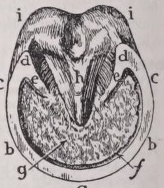
A horse is said to be hoof-bound when he has a pain in the fore-feet, occasioned by the dryness and contraction of the horn of the quarters, which straightens the quarters of the heels, and often makes him lame.
HOOFT, Pieter Cornelissen (1581-1647), Dutch poet and historian, was born at Amsterdam on the 16th of March 1581, His father was one of the leading citizens of Holland, both in politics and in the patronage of letters, and for some time burgomaster of Amsterdam. As early as 1598 the young man was made a member of the chamber of rhetoric of the Eglantine, and produced before that body his tragedy of Achilles and Polyxena, not printed until 1614. In June 1598 he left Holland and proceeded to Paris, where on the 10th of April 1599 he saw the body of Gabrielle d’Estrees lying in state. He went a few months later to Venice, Florence, and Rome. In 1600 he proceeded to Naples, and during all this Italian sojourn he made a deep and fruitful study of the best literature of Italy. In July 1600 he sent home to the Eglantine a very fine letter in verse, which is considered to mark an epoch in the development of Dutch poetry. He returned through Germany, and after an absence of three years and a half found himself in Amsterdam again on the 8th of May 1601. He soon after brought out his second tragedy, the Ariadne, in 1602. In 1605 he completed his beautiful pastoral drama Granula, not published until 1615. He studied law at Leyden from 1606 to 1609, and in June of the latter year received from the prince of Orange the appointment of steward of Minden, bailiff of Gooiland, and lord of Weesp, a joint office of great emolument. He occupied himself with repairing and adorning the decayed castle of Minden, which was his residence during the remainder of his life. In August 1610 he married the famous botanist, Christina van Erp. In 1612 Hooft produced, and in 1613 printed, his national tragedy of Geeraerdt van Velsen, a story of the reign of Count Floris V. In 1614 was performed at ...Coster’s academy Hooft’s comedy of Ware-ηar, an adaptation of the Aulularia of Plautus, first printed in 1617. In 1616 he wrote another tragedy, Baeto, or the Origin of the Dutch, not printed until 1626. It was in 1618 that he abandoned poetry for history, and in 1626 he published the first of his great prose works, the History of Henry the Great (Henry IV. of France). His next production was his Miseries of the Princes of the House of Medici, printed in 1638. In 1642 he published the masterpiece of his life, his Dutch History, a magnificent performance, to the perfecting of which he had given fifteen years of labour. Hooft died on a visit to Prince Frederick Henry at the Hague on the 21st of May 1647, and was buried in the New Church at Amsterdam.
Hooft is one of the most brilliant figures that adorn Dutch literature at its best period. He was the first writer to introduce a modern and European tone into belles lettres, and the first to refresh the sources of native thought from the springs of antique and Renaissance poetry. His lyrics and his pastoral of Granida are strongly marked by the influence of Tasso and Sannazaro; his later tragedies belong more exactly to the familiar tone of his native country. But high as Hooft stands among the Dutch poets, he stands higher, he holds perhaps the highest place, among writers of Dutch prose. His historical style has won the warmest eulogy from so temperate a critic as Motley, and his letters are the most charming ever published in the Dutch language. After Vondel, he may on the whole be considered the most considerable author that Holland has produced.
Hooft ’ s poetical and dramatic works were collected in two volumes, 1871, 1875, by P. Leendertz. Many editions exist of his prose works.
9th ed. Encyclopædia Britannica, vol. 12, p. 146 [635 words — estimated reading time: 4 minutes]
Our cattle also shall go with us; there shall not an hoof be left behind; for thereof must we take to serve the LORD our God; and we know not with what we must serve the LORD, until we come thither.
Even our livestock must go with us; not a hoof will be left behind, for we will need some of them to worship the LORD our God, and we will not know how we are to worship the LORD until we arrive.”
Nevertheless these shall ye not eat of them that chew the cud, or of them that divide the hoof: as the camel, because he cheweth the cud, but divideth not the hoof; he is unclean unto you.
But of those that only chew the cud or only have a divided hoof, you are not to eat the following: The camel, though it chews the cud, does not have a divided hoof; it is unclean for you.
The carcases of every beast which divideth the hoof, and is not clovenfooted, nor cheweth the cud, are unclean unto you: every one that toucheth them shall be unclean.
Every animal with hooves not completely divided or that does not chew the cud is unclean for you. Whoever touches any of them will be unclean.
Nevertheless these ye shall not eat of them that chew the cud, or of them that divide the cloven hoof; as the camel, and the hare, and the coney: for they chew the cud, but divide not the hoof; therefore they are unclean unto you.
But of those that chew the cud or have a completely divided hoof, you are not to eat the following: the camel, the rabbit, or the rock badger.
And the swine, because it divideth the hoof, yet cheweth not the cud, it is unclean unto you: ye shall not eat of their flesh, nor touch their dead carcase.
Although they chew the cud, they do not have a divided hoof. They are unclean for you, as well as the pig; though it has a divided hoof, it does not chew the cud. It is unclean for you. You must not eat its meat or touch its carcass.
At the noise of the stamping of the hoofs of his strong horses, at the rushing of his chariots, and at the rumbling of his wheels, the fathers shall not look back to their children for feebleness of hands;
With the hoofs of his horses shall he tread down all thy streets: he shall slay thy people by the sword, and thy strong garrisons shall go down to the ground.
The hooves of his horses will trample all your streets. He will slaughter your people with the sword, and your mighty pillars will fall to the ground.
I will destroy also all the beasts thereof from beside the great waters; neither shall the foot of man trouble them any more, nor the hoofs of beasts trouble them.
I will slaughter all her cattle beside the abundant waters. No human foot will muddy them again, and no cattle hooves will disturb them.
Arise and thresh, O daughter of Zion: for I will make thine horn iron, and I will make thy hoofs brass: and thou shalt beat in pieces many people: and I will consecrate their gain unto the LORD, and their substance unto the Lord of the whole earth.
Rise and thresh, O Daughter of Zion, for I will give you horns of iron and hooves of bronze to break to pieces many peoples. Then you will devote their gain to the LORD, their wealth to the Lord of all the earth.
This site uses cookies to remember your display preferences (search sources and editions, Bible version, auto-link, images, light/dark theme). No personal data whatsoever is collected. Privacy Policy