
QUINAULT, Philippe (1635-1688), a dramatist of merit, and the only European writer who has made the opera libretto a work of literature (so much so that the popularity of opera may be said to be not a little due to him), was born at Paris on June 3, 1635. He was educated by the liberality of Tristan, the author of Marianne. His first play was produced at the Hôtel de Bourgogne in 1653 when Quinault was only eighteen. It is said that it was the occasion of an important innovation in dramatic history. Tristan had offered it and it had been accepted as his own at the price of a hundred crowns, which, though little enough, was twice the regular price of a few years before. When Tristan told the actors that it was the work of a novice they wished to throw up their bargain and only held to it on the terms of a ninth part of the receipts. The piece succeeded and Quinault followed it up, but he also read for the bar; and in 1660, when he married a widow with money, he bought himself a place in the Cour des Comptes. Then he tried tragedies {Agrippa, <fcc.) with more success than desert. He received one of the literary pensions then recently established, and was elected to the Academy in 1670....
Up to this time he had written some sixteen or seventeen comedies, tragedies, and tragi-comedies, of which the tragedies were mostly of very small value and the tragicomedies not of much more. But his comedies—especially his first piece Les Rivales, L’Amant Indiscret (1654) (which has some likeness to Molière’s Étourdi, and was with it used to make up Newcastle’s and Dryden’s Sir Martin Mar-all), Le Fantôme Amoureux (1659), and La Mère Coquette (1665), perhaps the best—are much better. None of these styles, however, made Quinault worthy of a place here. In 1671 he contributed to the singular miscellany of Psyche, in which Corneille and Molière also had a hand, and which was set to the music of Lulli. Here he showed a remarkable faculty for lyrical drama, and from this time till just before his death he confined himself to composing libretti for Lulli’s work. This was not only very profitable (for he is said to have received four thousand livres for each, which was much more than was usually paid even for tragedy), but it established Quinault’s reputation as the master of a new style,—so much so that even Boileau, who had previously attacked and satirized his dramatic work, was converted, less to the opera, which he did not like, than to Quinault’s remarkably ingenious and artist-like work in it. His libretti are among the very few which are readable without the music, and which are yet carefully adapted to it. They certainly do not contain very exalted poetry or very perfect drama.
But they are quite free from the ludicrous doggerel which (not merely in English) has made the name libretto a byword, and at the same time they have quite enough dramatic merit to carry the reader, much more the spectator, along with them. It is not an exaggeration to say that Quinault, coming at the exact time when opera became fashionable out of Italy, had very much to do with establishing it as a permanent European genre. His first piece after Psyche was a kind of classical masque, The Feast of Love and Bacchus (1672). Then came Cadmus (1674), then in the same year and the three following Alceste, Thésée, Atys (one of his best-liked pieces), and Isis. All these, it may be observed, were classical in subject, and so was Proserpine (1680), which was superior to any of them. The Triumph of Love (1681) is a mere ballet, but in Persée and Phaeton Quinault returned to the classical opera. Then he finally deserted it for romantic subjects, in which he was even more successful. Amadis (1684), Roland (1685), and Armide (1686) are his masterpieces, the last being the most famous and the best of all. It should perhaps be observed that the very artificiality of the French lyric of the later 17th century and its resemblance to alexandrines cut into lengths were aids to Quinault in arranging lyrical dialogue. Lulli died in 1687, and Quinault, his occupation gone (for the two had now worked together for more than fifteen years, and it would probably have been difficult to find another composer equally well suited to his librettist) became devout, began a poem called the “Destruction of Heresy,” and died on November 26, 1688. The best edition of his works is that of 1739 (Paris, 5 vols.).
[799 words — estimated reading time: 5 minutes]
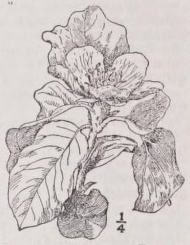
QUINCE. Among botanists there is a difference of opinion whether or not the quince is entitled to take rank as a distinct genus or as a section of the genus Pyrus. It is not a matter of much importance whether we call the quince Pyrus Cydonia or Cydonia vulgaris. For practical purposes it is perhaps better to consider it as distinct from Pyrus, differing from that genus in the twisted manner in which the petals are arranged in the bud, and in the many-celled ovary, in which the numerous ovules are disposed horizontally, not vertically as in the pears. The quinces are much-branched shrubs or small trees with entire leaves, small stipules, large solitary white or pink flowers like those of a pear or apple, but with leafy calyxlobes, and a many-celled ovary, in each cell of which are numerous horizontal ovules. The common quince is a native of Persia and Anatolia, and perhaps also of Greece and the Crimea, but in these latter localities it is doubtful whether or not the plant is not a relic of former cultivation. By Franchet and Savatier P. Cydonia is given as a native of Japan with the native name of “maroumerou.” It is certain that the Greeks knew a common variety upon which they engrafted scions of a better variety which they called κυδώνιοιζ, from Cydon in Crete, whence it was obtained, and from which the names Cydonia, Codogno (Italian), Coudougner and Coing (French), Quitte (German), and Quince have been derived. Pliny (7/. N., xv. 11.) mentions that the fruit of the quince, Malum cotoneum, warded off the influence of the evil eye; and other legends connect it with ancient Greek mythology, as exemplified by statues in which the fruit is represented, as well as by representations on the walls of Pompeii. The fragrance and astringency of the fruit of the ...quince are well known, and the seeds are used medicinally for the sake of the mucilage they yield when soaked in water, a peculiarity which is not met with in pears. This mucilage is analogous to, and has the same properties as, that which is formed from the seeds of linseed. In English gardens three varieties are cultivated—the apple-shaped quince, the pear-shaped quince, and the Portugal quince; the last-named has larger fruits than the other two (4 inches in length, 3-3{ in width), of a rich yellow colour when ripe and with less astringency, hence it is better suited for culinary and confectionary purposes than the other two, but is said to be somewhat more tender. The common quince and its varieties are very largely used as “dwarfing” stocks on which choice pears are engrafted. The effect is to restrain the growth of the pear, increase and hasten its fruitfulness, and enable it to withstand the effects of cold (see Horticulture, vol. xii. p. 213). The common Japan quince, Pyrus or Cydonia japonica, is grown in gardens for the sake of its flowers, which vary in colour from creamy white to rich red, and are produced during the winter and early spring months. C. Maulei, a recently introduced shrub from Japan, bears a profusion of equally beautiful orange-red flowers, which are followed by fruit of a yellow colour and agreeable fragrance, so that, when cooked with sugar, it forms an agreeable conserve, as in the case of the ordinary quince. The fruit of the ordinary Japan quince is quite uneatable.
[577 words — estimated reading time: 4 minutes]
QUINCY, a city of the United States, the county seat of Adams county, Illinois, occupies a limestone bluff 125 feet above low-water mark on the east bank of the Mississippi at the extreme western point of the State. The river is crossed here by the great bridge of the Hannibal and St Joseph Railroad. Quincy Bay, an arm of the river, is the finest natural harbour for steamboats on the upper Mississippi. By water Quincy is 160 miles above St Louis, and by rail 263 miles south-west of Chicago via Galesburg. Commanding an extensive view, being well built, having excellent waterworks, and forming an important centre in the railway system of the region, Quincy is both an attractive and a prosperous place, with very miscellaneous industries. Among the public buildings are the court-houses, St John’s cathedral (1877), a medical college (1873), a city library, and several hospitals and asylums. The population in 1860 was 13,718; in 1870, 24,052 (1073 coloured); and in 1880, 27,268 (1508 coloured). Laid out in 1825 or about three years after the arrival of the first white settler, Quincy was made a town in 1834, and a city in .1839....
QUINCY, a township and seaport of the United States, in Norfolk county, Massachusetts, on a small bay of its own name in the south of Massachusetts Bay and 7 miles south-south-east of Boston by rail. It is best known for its great granite quarries, in connexion with which was constructed in 1827 the first (horse) railway in the United States, and as the birthplace of Governor John Hancock and Presidents John Adams and John Quincy Adams. Among the principal buildings—chiefly situated in the village, which lies on an elevated plain near the centre of the township—are the granite town-house, the so-called Adams Temple (a church erected in 1828), beneath the portico of which are the tombs of the two Presidents Adams, the Adams Academy, a home for infirm sailors, a public library, and the mansions of the Quincy and Adams families, whose estates occupied the greater portion of the township. Quincy, which till 1792 formed part of Braintree, had 5017 inhabitants in 1850, 6779 in 1860, 7442 in 1870 and 10,570 in 1880.
QUINCY, Josiah, Jr. (1744-1775), born in Boston, Mass., 1744, is the most eminent of a well-known family whose founder emigrated to New England in 1633. At the time of his death, at the age of thirty-one, he had won distinction as a lawyer, and his place was secured in history as among the most eloquent, the most clear-sighted, and the most devoted of the men who led the American colonists in the measures preliminary to the revolution In 1767 he entered upon the public discussion of political questions, maintaining with great ability and courage the
duty of his countrymen to resist any encroachments upon their right to self-government. In 1770 he wrote An Address of the Merchants, Traders, and Freeholders of Boston in favour of a non importation Act, asserting, about the same time, in a newspaper article that Americans would “know, resume, assert, and defend their rights” by the “arts of war” if “the arts of policy” should fail. In December 1773 he took an active and leading part in the town-meeting which virtually ordered the destruction of the cargoes of the tea-ships in Boston harbour. The appeal to the other towns for help to sustain Boston against the enforcement of the consequent Acts of Parliament was written by him; and soon after there appeared under his own name Observations on the Boston Port Bill, with Thmwjhts on Civil Society and Standing Armies, his longest and most important political paper, which made him a marked man both in England and America. He sailed a few months afterwards for England with the approval of the leading revolutionists, to present, though unofficially, to the ministry and other public men the grievances and the determination of the colonists. After six months failing health—he had long been threatened with consumption—compelled him to return home, and he died on shipboard as the vessel was entering the harbour of Gloucester, Massachusetts, April 26, 1775.
A memoir written by his only son, Josiah Quincy (1772-1864), containing his life, correspondence, and the Observations on the Boston Port Bill, was published in 1825 (2d ed. 1874). This only son of Josiah Quincy, jun., born in Boston in February 1772, lived to be three times the age of his father, and filled public stations for more years than his father lived; he was a member of Congress during the eventful period from 1805 to 1813; as the second mayor of Boston his sagacity and energy insured the future prosperity of that city; in Congress he maintained at the head of the Federal party the struggle with the disastrous foreign policy of the administrations of Jefferson and Madison, and the dangerous growth of the slave-power, which he never ceased to oppose; as president of Harvard College for sixteen years (1829-45) he increased the usefulness and added to the influence of that seat of learning. He wrote a history of the college for two hundred years, which was also largely a history of Massachusetts. He died in June 1864 in the ninety-third year of his age. A life of him, by his youngest son Edmund Quincy, an accomplished scholar and well-known author, was published in 1867.
[201 words — estimated reading time: 2 minutes]