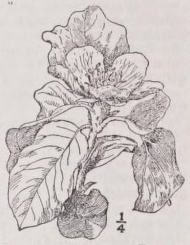
2. The fruit of the Pyrus cydonia, so named from Cydonia, a town of Crete, famous for abounding with this fruit. One species of this fruit is of an oblong shape, from which probably it has its French name.
1. The fruit of a shrub (Cydonia vulgaris) belonging to the same tribe as the apple. It somewhat resembles an apple, but differs in having many seeds in each carpel. It has hard flesh of high flavor, but very acid, and is largely used for marmalade, jelly, and preserves.
QUINCE. Among botanists there is a difference of opinion whether or not the quince is entitled to take rank as a distinct genus or as a section of the genus Pyrus. It is not a matter of much importance whether we call the quince Pyrus Cydonia or Cydonia vulgaris. For practical purposes it is perhaps better to consider it as distinct from Pyrus, differing from that genus in the twisted manner in which the petals are arranged in the bud, and in the many-celled ovary, in which the numerous ovules are disposed horizontally, not vertically as in the pears. The quinces are much-branched shrubs or small trees with entire leaves, small stipules, large solitary white or pink flowers like those of a pear or apple, but with leafy calyxlobes, and a many-celled ovary, in each cell of which are numerous horizontal ovules. The common quince is a native of Persia and Anatolia, and perhaps also of Greece and the Crimea, but in these latter localities it is doubtful whether or not the plant is not a relic of former cultivation. By Franchet and Savatier P. Cydonia is given as a native of Japan with the native name of “maroumerou.” It is certain that the Greeks knew a common variety upon which they engrafted scions of a better variety which they called κυδώνιοιζ, from Cydon in Crete, whence it was obtained, and from which the names Cydonia, Codogno (Italian), Coudougner and Coing (French), Quitte (German), and Quince have been derived. Pliny (7/. N., xv. 11.) mentions that the fruit of the quince, Malum cotoneum, warded off the influence of the evil eye; and other legends connect it with ancient Greek mythology, as exemplified by statues in which the fruit is represented, as well as by representations on the walls of Pompeii. The fragrance and astringency of the fruit of the ...quince are well known, and the seeds are used medicinally for the sake of the mucilage they yield when soaked in water, a peculiarity which is not met with in pears. This mucilage is analogous to, and has the same properties as, that which is formed from the seeds of linseed. In English gardens three varieties are cultivated—the apple-shaped quince, the pear-shaped quince, and the Portugal quince; the last-named has larger fruits than the other two (4 inches in length, 3-3{ in width), of a rich yellow colour when ripe and with less astringency, hence it is better suited for culinary and confectionary purposes than the other two, but is said to be somewhat more tender. The common quince and its varieties are very largely used as “dwarfing” stocks on which choice pears are engrafted. The effect is to restrain the growth of the pear, increase and hasten its fruitfulness, and enable it to withstand the effects of cold (see Horticulture, vol. xii. p. 213). The common Japan quince, Pyrus or Cydonia japonica, is grown in gardens for the sake of its flowers, which vary in colour from creamy white to rich red, and are produced during the winter and early spring months. C. Maulei, a recently introduced shrub from Japan, bears a profusion of equally beautiful orange-red flowers, which are followed by fruit of a yellow colour and agreeable fragrance, so that, when cooked with sugar, it forms an agreeable conserve, as in the case of the ordinary quince. The fruit of the ordinary Japan quince is quite uneatable.
9th ed. Encyclopædia Britannica, vol. 20, p. 182 [577 words — estimated reading time: 4 minutes]
This site uses cookies to remember your display preferences (search sources and editions, Bible version, auto-link, images, light/dark theme). No personal data whatsoever is collected. Privacy Policy