1. The bottom of the foot; and by a figure, the foot itselft.
2. The bottom of the shoe; or the piece of lether which constitutes the bottom. The cliga was a military show with a very thick sole tied above the instep.
3. The part of any thing that forms the bottom, and on which it stands upon the ground. Elms is proper for mills, soles for wheels, and pipes.
4. A marine fish of the genus Pleurinectes, so called probably because it keeps on or near the bottom of the sea. These fish abound on the British coast, and hence the name of sole bank, to the southward of Ireland. This fish sometimes grows to the weight of six or seven pounds.
5. In ship-building, a sort of lining, used to prevent the wearing of any thing.
1. Any one of several species of flatfishes of the genus Solea and allied genera of the family Soleidae, especially the common European species (Solea vulgaris), which is a valuable food fish.
2. Any one of several American flounders somewhat resembling the true sole in form or quality, as the California sole (Lepidopsetta bilineata), the long-finned sole (Glyptocephalus zachirus), and other species.
3. The bottom of the foot; hence, also, rarely, the foot itself.
4. The bottom of a shoe or boot, or the piece of leather which constitutes the bottom.
5. The bottom or lower part of anything, or that on which anything rests in standing.
6. The bottom of the body of a plow; -- called also slade; also, the bottom of a furrow.
7. The horny substance under a horse's foot, which protects the more tender parts.
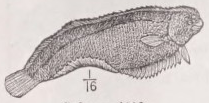
SOLE. Soles are a group of Flat-Fishes (Pleuronectidae), which is represented by numerous species in all suitable localities within the temperate and tropical zones; they become, however, scarce in the southern parts of the southern temperate zone, and are absent altogether in some districts—for instance, on the coasts of southern Australia. Many of the species enter fresh water freely, and some have become thoroughly acclimatized in it. Soles are a highly specialized type of flat-fish; their mouth is very narrow, twisted round to the blind side, and small teeth are developed on that side only. As they always lie or swim on one side, the pectoral fins have ceased to have a function, and consequently these organs are reduced in size, and in many of the species are mere rudiments or are lost entirely. The eyes are small, invariably on the right side of the fish, the upper occupying a position more or less in advance of the lower. Soles are littoral fishes, inhabiting sandy bottoms, shifting with the season from shallow into somewhat deeper water. Like all flat-fishes they are carnivorous, but feed on small animals only; none attain to a large size, scarcely exceeding that of 2 feet. Of the forty species known of the genus Solea, four are found on the British coast; the one most generally known and commercially most important is the Common Sole (Solea solea) ; it seems to occur in greater or less abundance on all flat coasts of Europe, but its numbers have been considerably thinned within the last quarter of a century, at least on the British coasts, doubtless in consequence of the introduction of the trawl. At any rate, that over-fishing is the cause of the decrease of this valuable table fish is amply proved by the fact that simultaneously with the quantity the average ...weight of the fish has been diminished, soles of 12 inches in length and of 8 ounces in weight being now in many localities the largest that can be obtained. At present young specimens form the majority of the soles in the market, and are sold under the names of “slips” or “tongues.” During the breeding-season, which falls in the months from February to April, soles lose much of their flavour. It is a singular fact that male soles seem to be almost unknown, and some ichthyologists account for it by supposing that the males remain much smaller than the females, and are overlooked in consequence. The Lemon Sole (Solea aurantiaca) is much less esteemed than the common sole, and more rarely seen in the market, probably because it is locally distributed in deeper water. It is of a yellow colour, marbled with brown and irregularly spotted with black; the pectoral fin is ornamented with an ovate black spot on its hinder half. Even when this bright coloration has disappeared in the fish after death, it may always be distinguished from the common sole by its large dilated nasal opening on the blind side, which is surrounded by a broad fringe. The Variegated Sole (Solea variegata) is at times taken in considerable numbers on the south coast by means of the trawl, and esteemed as a table fish. It differs from the two preceding species by the rudimentary condition of the pectoral fins, that of the blind side being minute. The colour is brown; darker bands cross the body, and are darkest on the dorsal and anal fins, where they appear as a row of about six large spots. It does not appear to grow to the same size as the common sole. The fourth British species, Solea minuta, is still smaller, not much exceeding 5 inches in length; it is therefore not of commercial importance, although it may be caught at times in the trawl in large numbers. As in the preceding species, the pectoral on the blind side is minute, but that of the right side is large enough to show a distinct black spot. The colour of the body is brownish or greyish, with small black spots, and every sixth or seventh ray of the dorsal and anal fins is black.
Flat-fishes resembling soles abound on the shores of the Indian Ocean beside the true soles, but they have the eyes on the left side of the head and lack pectoral fins altogether. They have been referred, therefore, to distinct genera, such as Plagusia and Cynoglossus.
9th ed. Encyclopædia Britannica, vol. 22, p. 249 [740 words — estimated reading time: 5 minutes]
1. Impropriety in language, or a gross deviation from the rules of syntax; incongruity of words; want of correspondence or consistency. A barbarism may be in one word; a solecism must be of more.
2. Any unfitness, absurdity or impropriety. Cesar, by dismissing his guards and retaining his power, committed a dangerous solecism in politics.
1. An impropriety or incongruity of language in the combination of words or parts of a sentence; esp., deviation from the idiom of a language or from the rules of syntax.
1. sol'em. [Latin solennis, form soleo, to be accustomed, to use, that is, to hold on or continue, as we have wont.]
2. Anniversary; observed once a year with religious ceremonies. The worship of this image was advanced and a solemn supplication observed every year. [I doubt the correctness of this definition of Johnson; or whether solemn in out language, ever includes the sense of anniversary. In the passage cited, the sense of anniversary is expressed by every year, and if it is included in solemn also the sentence is tautological. I should say the, that solemn in this passage of Stillingfleet, has the sense given in the second definition below.]
3. Religiously grave; marked with pomp and sanctity; attended with religious rites. His holy rites and solemn feasts profan'd.
4. Religiosly serious; piously grave; devout; marked by reverence to God; as solemn prayer; the solemn duties of the sanctuary.
5. Affectiong with seriousness; impressing or adapted to impress seriousness, gravity or reverence; sober; serious. There reign'd a solemn silence over all. To 'swage with solemn touches troubled thoughts.
6. Grave; serious; or affectedly grave; as a solemn face.
7. Sacred; enjoined by religion; or attended with a serious appeal to God; as a solemn oath.
1. A rite or ceremony annualy performed with religious reverence. Great was the cause; our old solemnities from no blind zeal or fond tradition rise, but sav'd from death, our Arguves yearly pay these grateful honors to the god of day.
2. [Solemnities seems here to include the sense of anniversary. See the fourth line. But in modern usage, that sense is rarely or never attached to the word.]
3. A religious ceremony; a ritual performance attended with religious reverence; as the solemnity of a funral or of a sacrament.
4. A ceremony adapted to impress awe; as the solemnities of the last day.
5. Manner of acting awfully serious. With horrible solemnity he caused every thing to be prepared for his triumph of victory.
6. Gravity; steady seriouness; as the solemnity of the Spanish language.
7. Affected gravity. Solemnity's a cover for a sot.
5. Solemn state or feeling; awe or reverence; also, that which produces such a feeling; as, the solemnity of an audience; the solemnity of Westminster Abbey.
6. A solemn or formal observance; proceeding according to due form; the formality which is necessary to render a thing done valid.
1. To dignify or honor by ceremonies; to celebrate; as, to solemnize the birth of Christ. Their choice nobility and flow'r met from all parts to solemnize this feast.
2. To perform with ritual ceremonies and respect, or according to legal forms; as, to solemnize a marriage.
3. To peform religiouly once a year.
4. To make grave, serious and reverential; as, to solemnize the mind for the duties of the sanctuary. [This use of the word is well authorized in the United States.]
Adv. singly, alone, by itself, per se, only, apart, in the singular number, in the abstract, one by one, one at a time, simply, one and a half, sesqui-
Phr. natura il fece, e poi roppe la stampa, du fort au faible, "two souls with but a single thought, two hearts that beat as one"
V. be supported &c, lie on, sit on, recline on, lean on, loll on, rest on, stand on, step on, repose on, abut on, bear on, be based on &c, have at one's back, bestride, bestraddle, support, bear, carry, hold, sustain, shoulder, hold up, back up, bolster up, shore up, uphold, upbear, prop, under prop, under pin, under set, riprap, bandage, give support, furnish support, afford support, supply support, lend support, give foundations, furnish foundations, afford foundations, supply foundations, lend foundations, bottom, found, base, ground, imbed, embed, maintain, keep on foot, aid
But the dovefound no rest for the sole of her foot, and she returned unto him into the ark, for the waters were on the face of the whole earth: then he put forth his hand, and took her, and pulled her in unto him into the ark.
But the dovefound no place to rest her foot, and she returned to him in the ark, because the waters were still covering the surface of all the earth. So he reached out his hand and brought her back inside the ark.
I am the God of Bethel, where thou anointedst the pillar, and where thou vowedst a vow unto me: now arise, get thee out from this land, and return unto the land of thy kindred.
I am the God of Bethel, where you anointed the pillar and made a solemn vow to Me. Now get up and leave this land at once, and return to your native land.’”
And when the inhabitants of the land, the Canaanites, saw the mourning in the floor of Atad, they said, This is a grievousmourning to the Egyptians: wherefore the name of it was called Abel-mizraim, which is beyond Jordan.
When the Canaanites of the land saw the mourning at the threshingfloor of Atad, they said, “This is a solemn ceremony of mourning by the Egyptians.” Thus the place across the Jordan is called Abel-mizraim.
And Moses took the bones of Joseph with him: for he had straitly sworn the children of Israel, saying, God will surely visit you; and ye shall carry up my bones away hence with you.
Moses took the bones of Joseph with him because Joseph had made the sons of Israel swear a solemn oath when he said, “God will surely attend to you, and then you must carry my bones with you from this place.”
And Moses said unto the LORD, The people cannot come up to mount Sinai: for thou chargedst us, saying, Set bounds about the mount, and sanctify it.
But Moses said to the LORD, “The people cannot come up Mount Sinai, for You solemnly warned us, ‘Put a boundary around the mountain and set it apart as holy.’”
Seven days ye shall offer an offering made by fire unto the LORD: on the eighth day shall be an holy convocation unto you; and ye shall offer an offering made by fire unto the LORD: it is a solemn assembly; and ye shall do no servile work therein.
For seven days you are to present an offering made by fire to the LORD. On the eighth day you are to hold a sacred assembly and present an offering made by fire to the LORD. It is a solemn assembly; you must not do any regular work.
Also in the day of your gladness, and in your solemn days, and in the beginnings of your months, ye shall blow with the trumpets over your burnt offerings, and over the sacrifices of your peace offerings; that they may be to you for a memorial before your God: I am the LORD your God.
And on your joyous occasions, your appointed feasts, and the beginning of each month, you are to blow the trumpets over your burnt offerings and fellowship offerings to serve as a reminder for you before your God. I am the LORD your God.”
And will make an offering by fire unto the LORD, a burnt offering, or a sacrifice in performing a vow, or in a freewill offering, or in your solemn feasts, to make a sweet savour unto the LORD, of the herd, or of the flock:
and you present an offering made by fire to the LORD from the herd or flock to produce a pleasing aroma to the LORD—either a burnt offering or a sacrifice, for a special vow or freewill offering or appointed feast—
Every place whereon the soles of your feet shall tread shall be yours: from the wilderness and Lebanon, from the river, the river Euphrates, even unto the uttermost sea shall your coast be.
Every place where the sole of your foot treads will be yours. Your territory will extend from the wilderness to Lebanon, and from the Euphrates River to the Western Sea.
Six days thou shalt eat unleavened bread: and on the seventh day shall be a solemn assembly to the LORD thy God: thou shalt do no work therein.
For six days you must eat unleavened bread, and on the seventh day you shall hold a solemn assembly to the LORD your God, and you must not do any work.
Seven days shalt thou keep a solemn feast unto the LORD thy God in the place which the LORD shall choose: because the LORD thy God shall bless thee in all thine increase, and in all the works of thine hands, therefore thou shalt surely rejoice.
For seven days you shall celebrate a feast to the LORD your God in the place He will choose, because the LORD your God will bless you in all your produce and in all the work of your hands, so that your joy will be complete.
The tender and delicate woman among you, which would not adventure to set the sole of her foot upon the ground for delicateness and tenderness, her eye shall be evil toward the husband of her bosom, and toward her son, and toward her daughter,
The most gentle and refined woman among you, so gentle and refined she would not venture to set the sole of her foot on the ground, will begrudge the husband she embraces and her son and daughter
And among these nations shalt thou find no ease, neither shall the sole of thy foot have rest: but the LORD shall give thee there a trembling heart, and failing of eyes, and sorrow of mind:
Among those nations you will find no repose, not even a resting place for the sole of your foot. There the LORD will give you a trembling heart, failing eyes, and a despairing soul.
And it shall come to pass, as soon as the soles of the feet of the priests that bear the ark of the LORD, the Lord of all the earth, shall rest in the waters of Jordan, that the waters of Jordan shall be cut off from the waters that come down from above; and they shall stand upon an heap.
When the feet of the priests who carry the ark of the LORD—the Lord of all the earth—touch down in the waters of the Jordan, its flowing waters will be cut off and will stand up in a heap.”
And it came to pass, when the priests that bare the ark of the covenant of the LORD were come up out of the midst of Jordan, and the soles of the priests’ feet were lifted up unto the dry land, that the waters of Jordan returned unto their place, and flowed over all his banks, as they did before.
When the priests carrying the ark of the covenant of the LORD came up out of the Jordan and their feet touched the dry land, the waters of the Jordan returned to their course and overflowed all the banks as before.
This site uses cookies to remember your display preferences (search sources and editions, Bible version, auto-link, images, light/dark theme). No personal data whatsoever is collected. Privacy Policy