A QUEDUCT, a conduit or channel for the conveyance of water (Lat. aquaeductus), but commonly a structure of masonry erected to conduct water across a valley at a high level, though structures of this kind would be more properly termed aqueduct bridges. This distinction it is necessary to bear in mind, more particularly when dealing with the undertakings of this class carried out by the Greeks and Romans respectively, because, from the fact of the former having apparently seldom if ever constructed aqueduct bridges, it has been usual to institute a very unfavourable comparison between them and the Romans, who, with imperial disdain of obstacles, furnished the cities of their immense empire with a series of constructions of this kind for the supply of water, which still in their ruins excite our astonishment. True to the difference in national genius the Greeks, following the analogy of nature, in which in their own country they saw the water collected in the hills passing for miles along subterranean courses, and issuing in cool fountains at the coast, adapted their system of conduits to the physical formation of a district, cutting tunnels and canals, rather than bridging over valleys, and as a consequence no conspicuous monument of their system now remains. But even if what they did was so little as to justify Strabo (v. p. 235) in charging them with neglect in this matter as compared with the carefulness of the Romans, it is still clear from the records that they accomplished much, and that in this, as in other respects, they were the instructors of the Romans. It is here to be premised that the term aqueduct applies only to the conveyance of such water as was used for drinking or other useful purposes, and not to the draining of marshes, though in both cases the works may often have been of the same kind. The insufficiency of water, supplied by natural springs and cisterns hewn in the rock, which in an early age had satisfied the small communities of Greece, had become a pressing public question by the time of the Tyrants, of whom Polycrates of Samus and Pisistratus of Athens distinguished their rule by extensive works to meet the exigencies of their states. For this purpose the former obtained the services of Eupalinus, an engineer celebrated for the skill with which he had earned out the works for the water supply of Megara, under the direction of the Tyrant Theagenes (circa 625 b.c. ) At Samus the difficulty lay in a hill which rose between the town and the water source. Through this hill Eupalinus cut a tunnel 8 feet broad, 8 feet high, and 4200 feet long, building within the tunnel a channel 3 feet broad and 11 ells deep. The water, flowing by an accurately reckoned declivity, and all along open to the fresh air, was received at the lower end by a conduit of masonry, and so led into the town, where it supplied fountains, pipes, baths, eloaeae, <fcc., and ultimately passed into the harbour. In Athens, under the rule of Pisistratus (b.c. 560), a similarly extensive, if less difficult, series of works was completed to bring water from the hills Hymettus, Pentelicus, and Parnes. From Hymettus were two conduits passing under the bed of the Uιssus, and most part of the course cut in the rock. Pentelicus, richer in water, supplied another conduit, which can still be traced from the modern village of Chalandri by the air shafts built several feet above the ground, and at a distance apart of 40-50 metres; the diameter of these shafts is 4-5 feet, and the number of them still preserved is about sixty. Tributary channels conveyed into the main stream the waters of the district through which it passed. Outside Athens, those two conduits met in a large reservoir, from which the water was distributed by a ramification of underground channels throughout the city. These latter channels vary in form, being partly round, partly square, and generally walled with stone; the chief one, that under the bazaar, is sufficiently high and broad to allow two men to pass in it. Sometimes pipes of baked clay were laid within them. The conduit from Mount Parnes appears to have been reconstructed in later times. Some of these aqueducts continue to supply Athens to this day, and are described as marvels of enterprise and skill (E. Curtius, über die Wasserbauten der Hellenen, in the Archäol. Zeit. 1847, p. 19). In Sicily, the works by which Empedocles, it is said, brought the water into the town of Selinus, are no longer visible; but it is probable that, like those of Syracuse, they consisted chiefly of tunnels and pipes laid under ground. The system of conduits in Syracuse which Thucydides says (vi. 100) the Athenians partly destroyed on the Sicilian expedition, still supplies the town with an abundance of drinkable water; and at one point, where the tunnel passes under the sea to the island of Ortygia, presents what has long been regarded as a remarkable achievement for early times. An example of what appears to have been the earliest form of aqueduct in Greece has been discovered in the island of Cos (Ross, Inselreise, iii. p. 131), beside the fountain Burinna on Mount Oromedon. It consists of a bell-shaped chamber, built underground in the hill side, to receive the water of the spring and keep it cool; a shaft rising from the top of the chamber supplied fresh air. From this reservoir the water was led by a subterranean channel, 35 metres long and 2 metres high.
Of the constructions for the conveyance of water in Italy in early times, there is an example at Tusculum, consisting of an oblong basin, divided into several chambers, which received the water of a spring, and then distributed it by pipes (tubi, fistuloe) or canals. The basin is built of blocks of stone, which, along the sides, overlap each other, till they meet and form a roof—a principle of building which was afterwards supplanted by vaulting, and which occurs also in the earliest Greek masonry. The pipes were either of lead or baked clay. When the course lay in soil, gullies were cut and conduits of masonry built within them. When rocky ground intervened, tunnels were pierced, and in both cases shafts (spiramen, lumen) were made at intervals of about 240 feet, to admit light and fresh air. The inside of the walls of these channels received a coating impervious to water, composed of chalk and erushed fragments of tile. Where the course was interrupted by an inequality in the ground, a vertical pipe (venter) was placed reaching to the surface or above it. The water rushing up this pipe was freshened by contact with the air, and again fell back to the new course which it had to take. Works of this kind, undertaken for the public convenience, were paid for out of the public purse, a tax being levied for the use of the water.
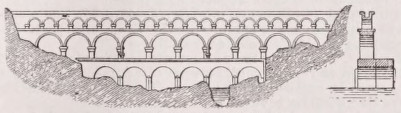
If, to obtain a proper incline, the water-course had to be carried above ground, the simple plan was to support it on a stone wall, and in this case the conduit itself was also built of blocks of stone, coated with a stucco impervious to water. But since a solid wall across a valley would have cut off the usual traffic, it was found necessary to break up the wall, by means of arches, into a series of pillars, and with this commenced the system of aqueduct bridges, which have proved to be the most striking monuments of the Roman empire. As perhaps the best known instance of this double purpose, of an archway under which traffic might pass, and over which water might be conveyed, there is the Porta Maggiore at Rome (Plate III.) The waters conveyed over it in two separate channels, are the Aqua Claudia and the Anio Novus, and from the three inscriptions above the arches it appears (1.)—that the Emperor Claudius had constructed the so-called Aqua Claudia Aqueduct from the springs Caeruleus and Curtius, 45 miles from Rome; (2.) that the same emperor had constructed the so-called Anio Novus Aqueduct from the 6 2d milestone from Rome; (3.) that the Emperors Vespasian and Titus had restored these splendid undertakings of Claudius. Both aqueducts had been begun by Caligula, 38 a.d., and were completed ten years after by Claudius. The two springs from which the Aqua Claudia took its rise were in the Sabine hills near the 35th milestone, on the Via Sub-lacensis. It was augmented by part of the Aqua Martia, famous for the goodness of its water, and, owing to bends in the course, reached the length of 45 miles, as stated in the inscription, 35 miles of it being under and 10 above ground. The Anio Novus, so called to distinguish it from an older aqueduct, the Anio Vetus, took its rise in the river Anio at the 62d milestone, on the road just named, the water being first collected in a large basin, where it was allowed to purify itself. At the 32d milestone it was augmented by the clearer water of the spring, rivus Herculaneus. The entire length of 62 miles was partly above and partly below ground. About 6 miles from Rome it approached the Aqua Claudia, and from that point the two waters travelled together to the city in two distinct channels, one above the other, and supported by a chain of arches, which at one place reached the height of 109 feet. But in height these arches must yield to those of the aqueduct at Nismes, the ancient Nemausus, erected in the time of Augustus, which rose to 180 feet. *Γhe Pont du Gard, as the aqueduct at Nismes is now called, consists, as will be seen from Plate IV., of three rows of arches striding acrose the valley of the river Gardon. In the lowermost row are six arches, of which one has a span of 75 feet, the others each 60 feet. In the second row are twelve arches, each with a span of 75 feet. In the third row are thirty-six smaller arches, immediately above which was the water-course. As a bridge, the Pont du Gard has no rival for lightness and boldness of design among the existing remains of works of this class carried out in Roman times.
Besides the two principal aqueducts at Rome already described, there remain to be noticed twelve more which assisted in the supply of water for the city. These are (1.) Aqua Appia, which took its rise at the foot of the Alban mountains on the Praeneste road, between the 7th and 8th milestones, and measured from its source to the Porta Trigemina 11,180 paces, of which 11,130 were below ground. It appears to have been the first important enterprise of the kind at Rome, and was the work of the old Censor Appius Claudius, from whom ‘it derived its name. The date of its construction was the year of Rome 442, according to Frontinus, an overseer of aqueducts (curator aquarum) under the empire, whose work De Aquoeduct. urb. Rornae we still possess. (2.) Anio Vetus, constructed forty years after the last-mentioned aqueduct, by the Censor Manlius Curius Dentatus, with the help of L. Papirius Censor, who finishedit. From its source near Tivoli, on the left side of the Anio, it flowed 43,000 paces, of which 42,779 were below ground, and 221 above. At the distance of 2 miles from Rome (Frontinus, i. 21) it parted into two courses, one of which led to the horti asiniani, and was thence distributed; while the other (rectus ductus) led by the temple of Spes to the Esquiline gate, the site of which was near the modern Villa Negroni, where, in 1861, was found a subterranean conduit and an inscribed stone, which left no doubt as to its having been one of the stones set up to mark the distances of the Anio Vetus. (3.) Aqua Martia, rising on the left side of the Via Valeria, traversed 61,710 paces, of which 54,247 were underground, and the remaining distance carried partly on solid wall and partly on arches. It was the work of Quintus Martius Rex, not of Ancus Martius the fourth king of Rome, as Pliny (N.H., xxxi. 3) fancied, and took its name from its constructor. Its waters were celebrated for their coolness and excellent quality. (4.) Aqua Tepula, from its source in the district of Tusculum, flowed 10,000 paces, mostly above ground, and on the 4 same series of arches as carried the Aqua Martia, but at a higher level. It was the work of the Censors Cn. Servilius Caepio and L. Crassus Longinus, and was completed in the year 126 b.c. Again, partly on the same structure of arches, and with a still higher channel, flowed—(5.) Aqua Julia, from a source near that of the last-mentioned aqueduct to within 7000 paces of the walls of Rome, where the joint waters were received in a reservoir, and thence distributed in various channels to the city. Its entire length was 15,426 paces. It was constructed in the year 34 b.c. by Marcus Agrippa, to whose zeal to meet public wants in this direction were due the two other aqueducts— (6.) Aqua Virgo, and (7.) Aqua Crabra or Damnata, the former as well known for the goodness of its water as was the latter for the inferiority which procured it the designation of Damnata. The Aqua Virgo, from its origin at a copious spring in a marsh on the Collatine way, not far from the ancient Gabii, measured 14,105 paces, along which it was conveyed in pipes, partly under and partly above ground, on a solid substructure or on arches. It was completed in the year 48 b.c. (8.) Aqua Alsie-tina or Augusta rose in Etruria, on the Via Claudia, and travelled 22,172 paces, of which 358 were on arches. It was the work of Augustus, whose object was to furnish by it water for gardens and other than drinking purposes. (9.) AquaTrajana, rising in Lake Sabatinus (Bracciano), was constructed by Trajan. (10.) Aqua Alexandrina, rising in the district of Tusculum, was the work of Alexander Severus. (11.) Aqua Septimi ana seems to have been only a branch led from the Aqua Julia to supply the baths of the emperor from whom it takes its name, Septimius Severus. (12.) Aqua Argentina rose on Mount Algidus; at whose instance it was made is unknown. Of the fourteen aqueducts which supplied ancient Rome, three remain in use at the present time, furnishing the modern city with abundance of water. The first of the three is the Aqua Virgo, now known as Fontana di Trevi, supplying the best water in Rome. It was restored by Pope Pius IV. The next is the Aqua Claudia, known as the Aqua Felice or di Termini, which was restored by Sixtus V. The third is the Aqua Trajana, called, from the Pope who restored it, viz., Paul V., Aqua Paole.
At regular intervals along the course of an aqueduct were built reservoirs (castella), to enable repairs to be made at any point, and also to let off water for the population of the district through which it passed. It was the law that material necessary for repairs should be supplied from the private property nearest to where the damage was, and should be conveyed at the cost of the owner of such property. Castella of smaller dimension were also required in many parts of the city. Of these, it was said, there were 247 in Rome. To allow the water to purify itself before being distributed in the city, large basins (piscinae limariae), were built outside the walls. For the process of purification salt was used (Vitruvius, viii.) These piscinae were covered in with a vaulted roof, and were usually on a colossal scale, as in the example still preserved at Fermo, which consists of two stories, each having three oblong basins communicating with each other; or the Piscina Mirabile at Baiae, which is covered in by a vaulted roof, supported on forty-eight pillars, and perforated to permit the escape of foul air. Two stairs lead by forty steps to the bottom of the reservoir. In the middle of the basin is a sinking to collect the deposit of the water. The walls and pillars are coated with a stucco so hard as to .resist a tool. The oversight of aqueducts was placed, in the times of the republic, under the aediles and censors, though the latter appear to have taken part in work of this kind rather from their financial interest in the matter. Under the empire this task devolved on special officials styled Curatores Aquarum.
Among aqueducts outside of Italy, constructed in Roman times and existing still, the most remarkable, next to the Pont du Gard at Nismes already described, are—(1.) The aqueduct bridges at Segovia and Tarragona in Spain, the former being 2400 feet long, with 159 arches of greatly admired masonry, in two tiers, and reaching the height of 102 feet. The bridge at Tarragona is 876 feet long, and 83 feet high. (2.) At Mayence are the ruins of an aqueduct 16,000 feet long, and carried on from 500 to 600 pillars. Similar witnesses of Roman occupation are to be seen in Dacia, Africa, and Greece. (3.) The aqueduct at Metz (figured on Plate IV.), which originally extended across the Moselle, here very broad, conveyed to the city an abundance of excellent water from Gorsa. From a large reservoir at the source of the aqueduct the water passed along subterranean channels built of hewn stone, and sufficiently spacious for a man to walk in them upright. Similar channels received the water after it had crossed the Moselle by this bridge, at the distance of about 6 miles from Metz, and conveyed it to the city. The bridge consisted of only one row of arches. The middle arches have given way under the force of the river, but the others are still perfectly solid. (4.) On Plate III. is figured one of the principal bridges of the aqueduct of Antioch, 700 feet long, and at the deepest point 200 feet high. The lower part consists almost entirely of solid wall, and the upper part of a series of arches with very massive pillars. The masonry and design are rude. The water supply was drawn from several springs at a place called Battelma, about 4 or 5 miles from Antioch. From these separate springs the water was conducted by channels of hewn stone into a main channel, similarly constructed, which traversed the rest of the distance, being carried across streams and valleys by means of arches or bridges. (5.) At the village of Morea, about an hour’s distance N.W. from the town of Mytilene, is the bridge of an aqueduct, figured on Plate III. The water-course is carried above massive pillars built of large hewn blocks of grey marble, and connected by means of three rows of arches, of which the uppermost is of brick. The bridge extended about 500 feet in length, and at the deepest was from 70 to 80 feet high. Judged by the masonry and the graceful design, it has been thought to be a work of the age of Augustus. Remains of this aqueduct are to be seen at Larisson Lamarousia, an hour’s distance from Morea, and at St Demetri, two hours and a half from Ayasso, on the road to Vasilika.
The aqueduct near Spoleto, which now serves also as a bridge, is deserving of notice as an early instance of the use of the pointed arch, belonging as it does to the 7th or 8th century. It has ten arches, remarkable for the elegance of their design and the airy lightness of their proportions, each over 66 feet in span, and about 300 feet in height. (See Plate IV.)
The aqueduct of Pyrgos, near Constantinople (figured on Plate III.), is a remarkable example of works of this class carried out in the later times of the Roman empire. It consists of two branches, of which only one is seen in elevation on the plate. The other branch stood nearly ^,t right angles to this, and is seen partly on the plan. From this circumstance it was called the Bended or Crooked Aqueduct, to distinguish it from another termed the Long Aqueduct, situated near the source of the waters. The branch seen in elevation extends 670 feet in length, and is 106 feet in height at the deepest part. It is composed of three rows of arches, those in each row increasing in width from the bottom to the top—an arrangement very properly introduced with the view of saving materials without diminishing the strength of the work. The two upper rows consisted of arches of semicircles, the lower of Gothic arches; and this circumstance serves to...