
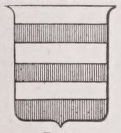
Divided into bars; -- said of the field.
BARRY, Sir Charles, a distinguished English architect, was born at Westminster, May 23, 1795. After pursuing his elementary professional studies for six years as apprentice to a firm of architects at Lambeth, he set out, in 1817, on the customary foreign tour, visiting Greece and Italy, Egypt and Palestine, and enriching his memory and imagination by the study of the great buildings and τemai∏3 of former ages. On his return to England in 1820 he settled in London, and was not slow in attaining distinction. One of the first works by which his abilities as an architect-became generally known was the church of St Peter at Brighton.—an attempt in Perpendicular Gothic completedin 1826. He built many other churches; but the marked preference for Italian architecture, which he acquired during his travels, showed itself in various important undertakings of his earlier years. In 1831 he erected the Travellers’ Club in Pall Mall, a splendid work in the Italian style, and the first of its kind built in London. In the same style and on a grander scale, he erected, some years later, the Reform Club. It is unnecessary to particularize the numerous private mansions on which he was engaged, one of the latest and most magnificent of which was Bridgewater House, the town residence of the earl of Ellesmere. Birmingham possesses one of his best works in the buildings of King Edward’s grammar school, in the Tudor style. For Manchester he designed the Athenaeum, in the Italian style; and for Halifax, the town-hall. He was engaged for some years in reconstructing the Treasury buildings, Whitehall. But his masterpiece, and perhaps, notwithstanding all unfavourable criticism, the masterpiece of English architecture of the 19th century, is the new palace at Westminster. 1 After the ...destruction of the old houses of parliament by fire in October 1834, Barry was the successful competitor for erecting the new palace. The first stone was laid in the spring of 1840; the work was steadily carried on in the face of many difficulties,'and through a maze of private dissensions and public complaints, and it was at length completed in 1860. Twenty years seemed long in passing, but once past the time assuredly will no more seem too long to have been employed in the erection, or, we might say, allowed for the growth of this stately and beautiful pile, one of the truest glories of the banks of the Thames. Barry was elected A.R.A. in 1840, and R.A. in the following year. His genius and achievements were recognized by the representative artistic bodies of the principal European nations; and his name was enrolled as a member of the academies of art at Rome, Berlin, St Petersburg, Brussels, and Stockholm. He was chosen F.R.S. in 1849, and was knighted by the Queen in 1852. He died suddenly at Clapham, near London, May 12, 1860, and his remains were interred in Westminster Abbey. In 1867 appeared a life of Sir Charles Barry by his son, Dr Alfred Barry, principal of King’s College, London. A claim was thereupon set up on behalf of Mr A. Welby Pugin deceased, -who had been Barry’s assistant, to a much larger share in the work of designing the Westminster Palace than was admitted in Dr Barry’s narrative. The controversy raged for a time, but without substantiating Mr Pugin’s claim.
BARRY, James, an eminent painter, was born at Cork on the lltlι October 1741. His father had been a builder, and, at one time of his life, a coasting trader between the two countries of England and Ireland. To this business of trader James was destined, and he actually made, when a boy, several voyages’; but these being forced upon him, he on one occasion ran away from the ship, and on all others manifested such an aversion to the life and habits of a sailor, as to induce his father to relinquish all hopes of him in this line, and to suffer him to pursue his inclinations, which led strongly towards drawing and study. At the schools in Cork to which he was sent, he was distinguished above his school-fellows by his talents and industry; his habits differed from those of ordinary boys; he seldom mixed in their games or amusements, but during play-hours stole off to his own room, where he worked at his pencil, or studied some book that he had borrowed or bought. As his industry was excessive, his advances in the acquisition of knowledge were rapid, and he was regarded as a prodigy by his school-fellows. About the age of seventeen he first attempted oil painting, and between that and the age of twenty-two, when he first went to Dublin, he produced several large pictures, which decorated his father’s house, and represented subjects net often chosen by young artists, such as Aeneas escaping with his family from the flames of Troy, Susanna and the elders, Daniel in the lions’ den, <fcc. At this period he also produced the painting which first brought him into public notice, and gained him the acquaintance and patronage of Edmund Burke. The picture was founded on an old tradition of the landing of St Patrick on the sea-coast of Cashel, and of the conversion and baptism of the king of that district by the patron saint of Ireland. Barry’s manner of treating it was such as to gain for him the applause and admiration of the connoisseurs of London, where it was exhibited in 1762 or 1763.
By the liberality of Burke and his other friends, Barry, in the latter part of 1765, was enabled to proceed to the Continent, where he remained till the beginning of 1771, studying his art with an enthusiasm which seemed to augur the highest success, and making observations on the different chefs d'oeuvre of Italy with equal independence of judgment and nicety of discrimination. He proceeded first to Paris, then to Rome, where he remained upwards of three years, from Rome to Florence and Bologna, and thence home through Venice. His letters to the Burkes, giving an account of Michel Angelo, Raffaelle, Titian, and Leonardo dα Vinci, show a complete insight into the characteristic merits of their works, and would make us wonder (if the case were at all singular) how he could enter with such force, delicacy, and feeling, into excellences of which he transplanted nothing into his own works.
Even in copying from the antique he manifested the same aversion to labour, or to that kind of labour which, by showing us our defects, compels us to make exertions to remedy them. He made all his drawings from the antique by means of a delineator, that is, a mechanical instrument, to save the trouble of acquiring a knowledge both of form and proportion. Barry painted two pictures while abroad, his Adam and Eve, and his Philoctetes. The first of these he sent home as a specimen of his progress in the art. It does not appear to have given much satisfaction. His Philoctetes he brought home with him. It is a coarse, unclassical performance,—the direct opposite, indeed, of all that he thought it to be. Soon after his return to England he produced his picture of Venus, which has been compared, though with little justice, to the Galatea of Raffaelle, the Venus of Titian, and the Venus de Medici. In 1773 he exhibited his Jupiter and Juno on Mount Ida, which was much praised by some critics of that day. His Death of General Wolfe, in which the British and French soldiers are represented in very primitive costumes, was considered as a falling off from his great style of art, the painting of Greek subjects, and, accordingly, it is said to “have obtained no praise.” His fondness for Greek costume was assigned by his admirers as the cause of his reluctance to paint portraits,—as if the coat were of more importance than the face. His fastidiousness in this respect, and his frequent excuses or blunt refusals to go on with a portrait of Burke which he had begun, caused a misunderstanding with his early patron, which does not appear to have been ever entirely made up. The difference between them is said to have been widened by Burke’s growing intimacy with Sir Joshua Reynolds, and by Barry’s feeling some little jealousy of the fame and fortune of his rival “in a humbler walk of the art.” About the same time he painted a pair of classical subjects, Mercury inventing the lyre, and Narcissus looking at himself in the water, the last suggested to him by Burke. He also painted an historical picture of Chiron and Achilles, and another of the story of Stratonice, for which last the duke of Richmond gave him a hundred guineas. In 1773 it was proposed to decorate the interior of St Paul’s with historical and sacred subjects; but the plan fell to the ground, from not meeting with the concurrence of the bishop of London and the archbishop of Canterbury. Barry was much mortified at the failure, for he had in anticipation fixed upon the subject he intended to paint,— the rejection of Christ by the Jews when Pilate proposes his release. In 1773 he published An Inquiry into the real and imaginary Obstructions to the Acquisition of the Arts in England, vindicating the capacity of the English for the fine arts, and tracing their slow progress hitherto to the Reformation, to political and civil dissensions, and, lastly, to the general direction of the public mind to mechanics, manufactures, and commerce. In the year 1774 a proposal was made, through Mr Valentine Green, to Reynolds, West, Cipriani, Barry, and other artists, to ornament the great room of the Society for the Encouragement of Arts, Manufacturers, and Commerce, in the Adelphi, with historical and allegorical paintings. This proposal was at the time rejected by the artists themselves; but, in 1777, Barry made an offer to paint the whole on condition of being allowed the choice of his subjects, and being paid by the society the expenses of canvas, paints, and models. His offer was accepted, and he finished the series of pictures at the end of seven years, instead of two, as he had proposed to himself, accomplishing his task to the entire satisfaction of the members of the society, who granted him two exhibitions, and at different periods voted him 50 guineas, their gold medal, and 200 guineas. Of the six paintings making up the series, only one, that of the Olympic Games, shows any artistic power.
Soon after his return from the Continent Barry had been chosen a member of the Royal Academy; and in 1782 he was appointed professor of painting, in the room of Mr Penny, with a salary of .£30 a year. The lectures which he delivered from the chair were full of strong sense and wholesome advice, both to the students and academicians. Among other things, he insisted much on the necessity of purchasing a collection of pictures by the best masters as models for the students, and proposed several of those in the Orleans collection. This recommendation was not relished by the academicians, and quarrels arose, which reached such a height, that, in 1799, Barry was expelled from the academy, soon after the appearance of his Letter to the Dilettanti Society, a very amusing but eccentric publication, full of enthusiasm for his art and at the same time of contempt for the living professors of it. After the loss of his salary, a subscription was set on foot by the earl of Buchan to relieve him from his difficulties, and to settle him in a larger house to finish bis picture of Pandora. The subscription amounted to £1000, with which an annuity was bought, but of this he was prevented from enjoying the benefit, for, on the 6th of February 1806, he was seized with a pleuritic fever, and died on the 22d of the same month. On the 14th of March his remains were interred in the cathedral of St Paul’s.
As an artist Barry is more distinguished for the strength of his conceptions, and for his resolute and persistent determination to apply himself only to great subjects, than for his skill in designing or for beauty in his colouring. His ideas were generally fine, but the realization of them was almost without exception unsuccessful. His drawing is rarely good, his colouring frequently wretched. This curious contradiction in his artistic powers λvas in complete harmony with his general character. He was extremely impulsive and unequal; sometimes morose, sometimes sociable and urbane; jealous of his contemporaries, and yet capable of pronouncing a splendid eulogy on Reynolds.