1. bred. [Gr. anything esculent. If the word signifies food in general, or that which is eaten, probably it is the Heb. and Ch., from barah, to eat or feed.]
13. Corn of which bread is made. This in most countries is wheat and rye; but in some countries bread is made of other grain, as of maize in some parts of America.
a term which in Scripture is used, as by us, frequently for food in general; but is also often found in its proper sense. Sparing in the use of flesh, like all the nations of the east, the chosen people usually satisfied their hunger with bread, and quenched their thirst in the running stream. Their bread was generally made of wheat or barley, or lentiles and beans. Bread of wheat flour, as being the most excellent, was preferred: barley bread was used only in times of scarcity and distress. So mean and contemptible, in the estimation of the numerous and well-appointed armies of Midian, was Gideon, with his handful of undisciplined militia, that he seems to have been compared to bread of this inferior quality, which may account for the ready interpretation of the dream of the Midianite respecting him: “And when Gideon was come, behold, there was a man that told a dream unto his fellow, and said, Behold, I dreamed a dream, and lo, a cake of barley bread tumbled into the host of Midian, and came unto a tent and smote it that it fell, and overturned it, that the tent lay along. And his fellow answered and said, This is nothing else save the sword of Gideon, the son of Joash, a man of Israel; for into his hand hath God delivered Midian, and all the host.” In the cities and villages of Barbary, where public ovens are established, the bread is usually leavened; but among the Bedoweens and Kabyles, as soon as the dough is kneaded, it is made into thin cakes, either to be baked immediately upon the coals, or else in a shallow earthen vessel like a frying-pan, called Tajen. Such were the unleavened cakes which we so frequently read of in Scripture; and those also which Sarah made quickly upon the hearth. These last are about an inch thick; and, being commonly prepared in ...woody countries, are used all along the shores of the Black Sea, from the Palus Mæotis to the Caspian, in Chaldea and Mesopotamia, except in towns. A fire is made in the middle of the room: and when the bread is ready for baking, a corner of the hearth is swept, the bread is laid upon it, and covered with ashes and embers; in a quarter of an hour, they turn it. Sometimes they use small convex plates of iron, which are most common in Persia, and among the nomadic tribes, as being the easiest way of baking, and done with the least expense; for the bread is extremely thin, and soon prepared. The oven is also used in every part of Asia: it is made in the ground, four or five feet deep, and three in diameter, well plastered with mortar. When it is hot, they place the bread (which is commonly long, and not thicker than a finger) against the sides: it is baked in a moment. Ovens, Chardin apprehends, were not used in Canaan in the patriarchal age: all the bread of that time was baked upon a plate, or under the ashes; and he supposes, what is nearly self-evident, that the cakes which Sarahbaked on the hearth were of the last sort, and that the shew bread was of the same kind. The Arabs about Mount Carmel use a great strong pitcher, in which they kindle a fire; and when it is heated, they mix meal and water, which they apply with the hollow of their hands to the outside of the pitcher; and this extremely soft paste, spreading itself, is baked in an instant. The heat of the pitcher having dried up all the moisture, the bread comes off as thin as our wafers; and the operation is so speedily performed, that in a very little time a sufficient quantity is made. But their best sort of bread they bake, either by heating an oven, or a large pitcher full of little smooth shining flints, upon which they lay the dough, spread out in the form of a thin broad cake. Sometimes they use a shallow earthen vessel, resembling a frying pan, which seems to be the pan mentioned by Moses, in which the meat-offering was baked. This vessel, Dr. Shaw informs us, serves both for baking and frying; for the bagreah of the people of Barbary differs not much from our pancakes; only, instead of rubbing the pan in which they fry them with butter, they rub it with soap, to make them like a honey-comb. If these accounts of the Arab stone pitcher, the pan, and the iron hearth or copper plate, be attended to, it will not be difficult to understand the laws of Moses in the second chapter of Leviticus: they will be found to answer perfectly well to the description which he gives us of the different ways of preparing the meat-offerings. As the Hebrews made their bread thin, in the form of little flat cakes, they did not cut it with a knife, but broke it; which gave rise to the expression, _breaking bread_, so frequent in Scripture.
The Arabians and other eastern people, among whom wood is scarce, often bake their bread between two fires made of cow dung, which burns slowly, and bakes the bread very leisurely. The crumb of it is very good, if it be eaten the same day; but the crust is black and burnt, and retains a smell of the materials that were used in baking it. This may serve to explain a passage in Ezekiel, iv, 9–13. The straits of a siege and the scarcity of fuel were thus intimated to the Prophet. During the whole octave of the passover, the Hebrews use only unleavened bread, as a memorial that at the time of their departure out of Egypt they wanted leisure to bakeleavened bread; and, having left the country with precipitation, they were content to bake bread which was not leavened, Exod. xii, 8. The practice of the Jews at this day, with relation to the use of unleavened bread, is as follows: They forbid to eat, or have in their houses, or in any place belonging to them, either leavened bread or any thing else that is leavened. That they may the better observe this rule, they search into all the corners of the house with scrupulous exactness for all bread or paste, or any thing that is leavened. After they have thus well cleansed their houses, they whiten them, and furnish them with kitchen and table utensils, all new, and with others which are to be used only on that day. If they are movables, which have served only for something else, and are made of metal, they have them polished, and put into the fire, to take away all the impurity which they may have contracted by touching any thing leavened. All this is done on the thirteenth day of Nisan, or on the vigil of the feast of the passover, which begins with the fifteenth of the same month, or the fourteenth day in the evening; for the Hebrews reckon their days from one evening to another. On the fourteenth of Nisan, at eleven o’clock, they burn the common bread, to show that the prohibition of eating leavened bread is then commenced; and this action is attended with words, whereby the master of the house declares that he has no longer any thing leavened in his keeping; that, at least, he believes so. In allusion to this practice, we are commanded to “purge out the old leaven;” by which “malice and wickedness” are intended; and to feed only on the “unleavened bread of sincerity and truth.”
SHEW BREAD, or, according to the Hebrews, _the bread of faces_, was bread offered every Sabbath day upon the golden table in the holy place, Exod. xxv, 30. The Hebrews affirm that these loaves were square, and had four sides, and were covered with leaves of gold. They were twelve in number, according to the number of the twelve tribes, in whose names they were offered. Every loaf was composed of two assarons of flour, which make about five pints and one-tenth. These loaves were unleavened. They were presented hot every Sabbath day, the old ones being taken away and eaten by the priests only. This offering was accompanied with salt and frankincense, and even with wine, according to some commentators. The Scripture mentions only salt and incense; but it is presumed that wine was added, because it was not wanting in other sacrifices and offerings. It is believed that these loaves were placed one upon another, in two piles of six each; and that between every loaf were two thin plates of gold, folded back in a semicircle the whole length of them, to admit air, and to prevent the loaves from growing mouldy. These golden plates, thus turned in, were supported at their extremities by two golden forks, which rested on the ground. The twelve loaves, because they stood before the Lord, were called לחם הפנים, ἄρτοι ϖροθέσεως, or ἐνωπίοι, the bread of faces, or of the presence; and are therefore denominated in our English translation _the shew bread_.
Since part of the frankincense put upon the bread was to be burnt on the altar for a memorial, even an offering made by fire unto the Lord; and since Aaron and his sons were to eat it in the holy place, Lev. xxiv, 5–9, it is probable that this bread typified Christ, first presented as a sacrifice to Jehovah, and then becoming spiritual food to such as in and through him are spiritual priests to God, even his Father, Rev. i, 6; v, 10; xx, 6; 1 Peter ii, 5. It appears, from some places in Scripture, (see Exodus xxix, 32, and Numbers vi, 15,) that there was always near the altar a basket full of bread, in order to be offered together with the ordinary sacrifices.
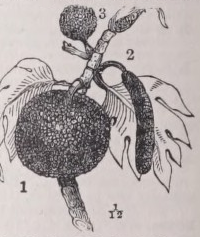
BREAD-FRUIT. This most important food staple of the tropical islands in the Pacific Ocean is the fruit of Artocarpus incisa (nat. ord. Artocarpaceae). The tree attains a moderate height, has very large, acutely lobed, glossy leaves, the male flowers in spikes, and the female flowers in a dense head, which by consolidation of their fleshy carpels and receptacles form the fruit. The fruit is globular in shape, about the size of a melon, with a tuberculated or (in some varieties) nearly smooth surface. Many varieties of the tree are cultivated, the fruits of some ripening numerous seeds, which are eaten as chestnuts; but in the best kinds the seeds are aborted, and it is only these that are highly prized as vegetables. The tree is a native of the South Sea Islands, where its fruit occupies the important position that is held by cereals in temperate latitudes. The fruit, which on distinct varieties ripens at different periods, affording a nearly constant supply throughout the year, is gathered for use just before it ripens, when it is found to be gorged with starchy matter, to which its esculent value is due. It may be cooked and prepared for use in a great variety of ways, the common practice in the South Sea Islands being to bake it entire in hot embers, and scoop out the interior, which when properly cooked should have a soft smooth consistence, fibrous only towards the heart, with a taste which has been compared to that of boiled potatoes and sweet milk. Of this fruit Mr A. R. Wallace, in his Malay Archipelago, says,—“With.meat and gravy it is a vegetable superior to anything I know either in temperate or tropical countries. With sugar, milk, butter, or treacle it is a deliciouspudding, having a very slight and delicate but characteristic flavour, which, like that ...of good bread and potatoes, one never gets tired of.” In the Pacific Islands the fruit is preserved for use by storing in pits, where the fruits ferment and resolve themselves into a mass similar in consistency to new cheese, in which state they emit an offensive odour; but after baking under hot stones they yield a pleasant and nutritious food. Another and more common method of preserving the fruit for use consists in cutting it into thin slices, whicl·j, are dried in the sun. From such dried slices a flour may be prepared which is useful for the preparation of puddings, bread, and biscuits, or the slices may be baked and eaten without grinding. The tree yields other products of economic value, such as native cloth from the fibrous inner bark of young trees; the wood is used for canoes and articles of furniture; and a kind of glue and caulking material are obtained from the viscidmilky juice which exudes from incisions made in the stem.
The bread-fruit is now found throughout the tropical regions of both hemispheres, and its first introduction into the West Indies is connected with the famous mutiny of the “Bounty,” and the remarkable history of a small company of the mutineers at Pitcairn Island. Attention was directed to the fruit in 1688 by Captain Dampier, and later by Captain Cook, who recommended its transplantation to the West Indian colonies. In 1787 the “Bounty’’was fitted out under command of Lieutenant Bligh to proceed to Tahiti to carry plants thence to the West Indian Islands; and it was after the cargo had been secured and the vessel was on her way that the mutiny broke out, and Lieutenant Bligh and some of his crew were turned adrift in a small boat in the open sea. The mutineers returned with the vessel to Tahiti, whence a number of them, with a few native men and women, sailed to the desolate and loneislet of Pitcairn. Lieutenant Bligh ultimately reached England, and was again commissioned to undertake the work of transplanting the plants, which in the year 1792-3 "he successfully accomplished.
A somewhat similar but much inferior fruit is produced by an allied species, the Jack or Jak, Artocarpus integri- fqlia,' growing in South India, Ceylon, and the Eastern Archipelago. This tree is chiefly valuable on account of its timber, which has a grain very similar to mahogany, and although at first light coloured it gradually assumes much of the appearance of that wood.
9th ed. Encyclopædia Britannica, vol. 4, p. 241 [731 words — estimated reading time: 5 minutes]
1. An apartment in a ship's hold, where the bread is kept.
2. The bread-fruit tree, or Artocarpus, a tree which grows in the isles of the Pacific ocean, of the size of an apple-tree, producing a fruit shaped like a heart, and as large as a small loaf of bread, which is eaten as food.
1. The fruit of a tree (Artocarpus incisa) found in the islands of the Pacific, esp. the South Sea islands. It is of a roundish form, from four to six or seven inches in diameter, and, when baked, somewhat resembles bread, and is eaten as food, whence the name.
2. The tree itself, which is one of considerable size, with large, lobed leaves. Cloth is made from the bark, and the timber is used for many purposes. Called also breadfruit tree and bread tree.
The root of a leguminous plant (Psoralea esculenta), found near the Rocky Mountains. It is usually oval in form, and abounds in farinaceous matter, affording sweet and palatable food.
bredth. The measure or extent of any plain surface from side to side; a geometrical dimension, which, multiplied into the length, constitutes a surface; as, the length of a table is five feet, and the breadth three; 5x3=15 feet, the whole surface.
In the sweat of thy face shalt thou eat bread, till thou return unto the ground; for out of it wast thou taken: for dust thou art, and unto dust shalt thou return.
By the sweat of your brow you will eat your bread, until you return to the ground— because out of it were you taken. For dust you are, and to dust you shall return.”
And this is the fashion which thou shalt make it of: The length of the ark shall be three hundred cubits, the breadth of it fifty cubits, and the height of it thirty cubits.
And this is how you are to build it: The ark is to be 300 cubits long, 50 cubits wide, and 30 cubits high.
And I will fetch a morsel of bread, and comfort ye your hearts; after that ye shall pass on: for therefore are ye come to your servant. And they said, So do, as thou hast said.
And I will bring a bit of bread so that you may refresh yourselves. This is why you have passed your servant’s way. After that, you may continue on your way.” “Yes,” they replied, “you may do as you have said.”
And he pressed upon them greatly; and they turned in unto him, and entered into his house; and he made them a feast, and did bakeunleavened bread, and they did eat.
But Lot insisted so strongly that they followed him into his house. He prepared a feast for them and bakedunleavened bread, and they ate.
And Abraham rose up early in the morning, and took bread, and a bottle of water, and gave it unto Hagar, putting it on her shoulder, and the child, and sent her away: and she departed, and wandered in the wilderness of Beer-sheba.
Early in the morning, Abraham got up, took bread and a skin of water, put them on Hagar’s shoulders, and sent her away with the boy. She left and wandered in the Wilderness of Beersheba.
And Jacob vowed a vow, saying, If God will be with me, and will keep me in this way that I go, and will give me bread to eat, and raiment to put on,
Then Jacob made a vow, saying, “If God will be with me and watch over me on this journey, and if He will provide me with food to eat and clothes to wear,
Then Jacob offered sacrifice upon the mount, and called his brethren to eat bread: and they did eat bread, and tarried all night in the mount.
Then Jacob offered a sacrifice on the mountain and invited his relatives to eat a meal. And after they had eaten, they spent the night on the mountain.
And they sat down to eat bread: and they lifted up their eyes and looked, and, behold, a company of Ishmeelites came from Gilead with their camels bearing spicery and balm and myrrh, going to carry it down to Egypt.
And as they sat down to eat a meal, they looked up and saw a caravan of Ishmaelites coming from Gilead. Their camels were carrying spices, balm, and myrrh on their way down to Egypt.
And he left all that he had in Joseph’s hand; and he knew not ought he had, save the bread which he did eat. And Joseph was a goodly person, and well favoured.
So Potiphar left all that he owned in Joseph’s care; he did not concern himself with anything except the food he ate. Now Joseph was well-built and handsome,
When the chief baker saw that the interpretation was good, he said unto Joseph, I also was in my dream, and, behold, I had three white baskets on my head:
When the chief baker saw that the interpretation was favorable, he said to Joseph, “I too had a dream: There were three baskets of white bread on my head.
And the seven years of dearth began to come, according as Joseph had said: and the dearth was in all lands; but in all the land of Egypt there was bread.
the seven years of famine began, just as Joseph had said. And although there was famine in every country, there was food throughout the land of Egypt.
And when all the land of Egypt was famished, the people cried to Pharaoh for bread: and Pharaoh said unto all the Egyptians, Go unto Joseph; what he saith to you, do.
When extreme hunger came to all the land of Egypt and the people cried out to Pharaoh for food, he told all the Egyptians, “Go to Joseph and do whatever he tells you.”
And they set on for him by himself, and for them by themselves, and for the Egyptians, which did eat with him, by themselves: because the Egyptians might not eat bread with the Hebrews; for that is an abomination unto the Egyptians.
They separately served Joseph, his brothers, and the Egyptians. They ate separately because the Egyptians would not eat with the Hebrews, since that was detestable to them.
This site uses cookies to remember your display preferences (search sources and editions, Bible version, auto-link, images, light/dark theme). No personal data whatsoever is collected. Privacy Policy