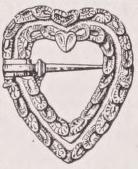
2. An ornamental utensil for fastening the vest, or the bosom of a shirt, as formerly used in America. It is usually made of silver, often round, with a tongue crossing its diameter, sometimes with two tongues. It formerly was used in England, as it was in America, and is still in the highlands of Scotland.
1. An ornament, in various forms, with a tongue, pin, or loop for attaching it to a garment; now worn at the breast by women; a breastpin. Formerly worn by men on the hat.
2. A painting all of one color, as a sepia painting, or an India painting.
BROOCH, or Broach, (from the French broche}, an awl or bodkin. A spit is sometimes called a broach, and hence the phrase “to broach a barrel.” The term is now used to denote a clasp or fastener for the dress provided with a pin, having a hinge or spring at one end, and a catch and loop at the other. Brooches were universally used among the more civilized nations of antiquity. They were made of many materials, and in innumerable varieties of ornamental design, the forms varying according to the period of their manufacture, or the taste and culture of the people using them. They are unknown in the Swiss Lake settlements of the Bronze Age, though pins and bracelets are abundant. Brooches of the Bronze Age are extremely rare in Britain, although they occur in considerable numbers and of elegant forms in North Germany and Scandinavia. The simplest is similar to that which has been reproduced in modern times as the “patent safety-pin,” but having the ends prolonged into flat spirals and the clasp flattened and engraved with ornamental designs. Another characteristic form was produced by winding a long wire into a flat double-spiral, of which one end formed the pin and the other the catch. A third form consisted of two round ornamented plates connected by a bow-shaped centre piece. In the early Iron Age the brooches of Central Europe exhibit an immense variety of forms, which are for the most part bow-shaped or harp-shaped, with spring-pins, akin to the types found in the Etruscancemeteries of Certosa aud Villanova recently explored. The Frankish group exhibits three well-defined types, viz., an imitation of animal forms, a simple disc, and a cruciform type, of which there are innumerable varieties of form. The Merovingian brooches were made in gold, silver, or ...bronze, adorned with precious stones, filagree-work, or enamel; but whatever the richness of the brooch, the pin was always of iron. The Scandinavian or Northern group exhibits a similar cruciform variety more massive in form and richly chased, the terminating knobs fashioned into the similitude of animals’ heads. This form occurs also in Anglo-Saxon graves in England. The Anglo-Saxon brooches were exquisite works of art, ingeniously and tastefully constructed. In Kent the circular form predominates. They are often of gold, with a central bossexquisitely decorated, the flat part of the brooch being a mosaic of turquoises, garnets on gold-foil, mother of pearl, <fcc., arranged in geometric patterns, and the gold work enriched with filagree or decorated with dragonesque engravings. Sometimes the brooch was cruciform and ornamented with chased work and settings of paste or precious stones. The Scandinavian brooches of the Viking time were oval and bowl-shaped, formed of an under shell of impure bronze gilt on the convex side, and covered by an upper shell of open chased-work ornamented with bosses, or open crown-like ornaments, or animals’ heads. The geographical distribution of these peculiar brooches indicates the extent of the conquests of the Northmen. They occur in northern Scotland, England, Ireland, Iceland, Normandy, and Livonia. The Celtic group is characterized by the penannπlar form of the ring of the brooch and the greater length of the pin. They are usually of bronze or silver, chased or engraved with intricate designs of interlaced or dragonesque work in the style of the illuminated Celtic manuscripts of the 7th, 8th, and 9th centuries. The Hunterston brooch, which was found at HawkingCraig in Ayrshire, is a well-known example of this style. Silver brooches of immense size, some having pins 15 inches in length, and the penannular ring of the brooch terminating in large knobs resembling thistle heads, are occasionally found in Viking hoards of this period, consisting of bullion, brooches, and Cufic and Anglo-Saxon coins buried on Scottish soil. In mediaeval times the form of the brooch was usually a simple, flat circular disc, with open centre, the pin being equal in length to the diameter of the brooch. They were often inscribed with religious and talismanic formulae. The Highland brooches were commonly of this form, but the disc was broader, and the central opening smaller in proportion to the size of the brooch. They were ornamented in the style so common on Highland powder-horns, with engraved patterns of interlacing work and foilage, arranged in geometrical spaces, and sometimes mingled with figures of animals.
9th ed. Encyclopædia Britannica, vol. 4, p. 369 [742 words — estimated reading time: 5 minutes]
And they came, both men and women, as many as were willing hearted, and brought bracelets, and earrings, and rings, and tablets, all jewels of gold: and every man that offered offered an offering of gold unto the LORD.
So all who had willing hearts, both men and women, came and brought brooches and earrings, rings and necklaces, and all kinds of gold jewelry. And they all presented their gold as a wave offering to the LORD.
This site uses cookies to remember your display preferences (search sources and editions, Bible version, auto-link, images, light/dark theme). No personal data whatsoever is collected. Privacy Policy