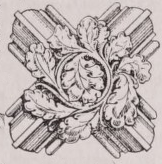
1. Any protuberant part; a round, swelling part or body; a knoblike process; as, a boss of wood.
2. A protuberant ornament on any work, either of different material from that of the work or of the same, as upon a buckler or bridle; a stud; a knob; the central projection of a shield. See Umbilicus.
3. A projecting ornament placed at the intersection of the ribs of ceilings, whether vaulted or flat, and in other situations.
4. A wooden vessel for the mortar used in tiling or masonry, hung by a hook from the laths, or from the rounds of a ladder.
5. The enlarged part of a shaft, on which a wheel is keyed, or at the end, where it is coupled to another.
BOSS IT, René le, an eminent French critic, born at Paris, March 16, 1631. He studied at Nanterre, and in 1649 entered among the regular canons of Sainte-Geneviève. After having acted as professor in different religious houses for twelve years, he withdrew into retirement. His first publication was Parallèle des Principes de la Physique d' Aristote et de celle de Lené Descartes, which appeared in 1674, but met with little success. His next work, entitled Traité du Poème Epique, was published in 1675, and often reprinted afterwards. Its leading doctrine is that the subject should be chosen before the characters, and that the action should be arranged without reference to the personages who are to figure in the scene. Boileau, in his Third Reflexion on Longinus, pronounced this work “l’un des meilleurs livres de poétique qui, du consentement de tous les habiles gens, aient été faits en nôtre langue.” It may be mentioned, however, that Bossu is said to have defended Boileau against Saint-Sorlin, and to have received his thanks for that service; and a sense of obligation may perhaps have dictated the commendation which Boileau bestowed on the work. Bossu died March 14, 1680.
9th ed. Encyclopædia Britannica, vol. 4, p. 69 [203 words — estimated reading time: 2 minutes]
1. A stone in a building which has a projecture, and is laid rough, to be afterwards carved into moldings, capitals, coats of arms, etc.
2. Rustic work, consisting of stones which advance beyond the naked or level of the building, by reason of indentures or channels left in the joinings; chiefly in the corners of edifices, and called rustic quoins. The cavities are sometimes round, sometimes beveled or in a diamond form, sometimes inclosed with a cavetto, and sometimes with a listel.
BOSSI, Giuseppe, an Italian painter and writer on art, was born at the village of Busto Arsizio in the Milanese, in 1776 or 1777 He was educated at the college of Monza; and his early fondness for drawing was fostered by the director of the college, who supplied him with prints after the works of Agostino Carracci for copies. Passing next to the academy of Brera at Milan, he there pursued his special artistic studies, and about 1795 went to Rome. Here he studied for five or six years, associating with many artists of the Italian school, and especially forming an intimate friendship with Canova. On his return to Milan he was named assistant secretary of the Academy of Fine Arts, and on the death of Bianconi succeeded him in the office of secretary. He rendered important service in the organization of this new institution. In 1804, in conjunction with Oriani, he drew up the rules of the three academies of art of Bologna, Venice, and Milan, and soon after was rewarded with the decoration of the Iron Crown. On the occasion of the visit of Napoleon I. to Milan in 1805, Bυssi exhibited a drawing of the Last Judgment of Michael Angelo, and pictures representing Aurora and...
Night, (Edipus and Creon, and the Italian Parnassus. By command of Prince Eugene, viceroy of Italy, Bossi undertook to make a copy of the Last Supper of Leonardo, then almost obliterated, for the purpose of getting it rendered in mosaic. The drawing was made from the remains of the original with the aid of copies and the best prints. The mosaic was executed by Raffaelli, and was placed in the Imperial Gallery of Vienna. Bossi made another copy in oil, which was placed in the museum of Brera. This museum owed to him a fine collection of casts of great works of sculpture acquired at Paris, Rome, and Florence. Bossi devoted a large part of his life to the study of the works of Leonardo; and his last work was a series of drawings in monochrome representing incidents in the life of that great master. He left unfinished a large cartoon in black chalk of the Dead Christ in the bosom of Mary, with John and the Magdalene. In 1810 he published a special work in large quarto, entitled Del Cenacolo di Leonardo da Vinci, which had the merit of greatly interesting Goethe. His other works are Delie Opinioni di Leonardo intorno alia simmetria de' corpi umani (1811), and Del Tipodell' arte della pittura (1816). Bossi died at Milan, December 15, 1816. A monument by Canova was erected to his memory in the Ambrosian library, and a bust was placed in the Brera.
BOSSI, Giuseppe Carlo Aurelio, Baron de, an Italian poet and diplomatist, was born at Turin, November 15, 1758. He made his first appearance as poet at the age of eighteen by the publication of two tragedies, Lea Silvia and I C ir cassi ; and four years later he took the degree of doctor of laws. In 1781, in consequence of his ode in praise of the edict of tolerationpromulgated by the Emperor Joseph IL, he was banished the kingdom; but having rendered during his exile an important service to his countrymen he was recalled and appointed undersecretary of state for foreign affairs. In 1792, on occasion of the French invasion, he was sent to the court of Prussia to negotiate an alliance, and thence went as ambassador to St Petersburg. Dismissed by the emperor in consequence of the treaty of alliance between Sardinia and France (1797), he was named ambassador to Venice, which he reached only in time to witness the fall of the republic. He was next appointed envoy to General Bonaparte in Italy. After the conquest of Sardinia Bossi was a member of the Provisional Government, and one of the three deputies sent to Paris to petition for annexation to France. The Russian invasion of 1799 drove him to take refuge in the Vaudois valleys. He was afterwards a member of the Provisional. Government, but retired in 1802. Three years later he was made prefect of the Ain; he was created baron by Napoleon I. in 1810, and was afterwards transferred to the prefecture of La Manche. Deprived on the second return of the Bourbons, he came to England, but returned to France the following year. He spent his remaining years in retirement. Besides the works above mentioned Bossi was author of a long poem entitled Oromasia, on the events of the French revolution; Monaca, a poem on the secularization of convents (1787); and various lyrical pieces, among which are Independenza Americana (1785), 0landa Pacificata (1788), Vision (1799), &c. He died at Paris, January 20, 1823.
9th ed. Encyclopædia Britannica, vol. 4, p. 69 [452 words — estimated reading time: 3 minutes]
Bossing[Present participle and verbal noun]Webster's Dictionary 1913
BOSSUET, Jacques Bénigne, the celebrated orator and prelate, was born at Dijon, within a short distance of the cathedral, on the 27th September 1627. He was the fifth son of Bénigne Bossuet and Madeleine Mochette. The family of which he came, though of bourgeois rank, had long taken an honourable part in the public and official life of Burgundy. He was destined from infancy for the church, and grew up amid influences eminently favourable to the unfolding of his powers, for, although at six years of age, on his father’s appointment to be president in the parliament of Metz, he was left at Dijon, yet his education had been wisely confided to an uncle, Claude Bossuet, a large-hearted man, ardently devoted to literature, whose delight it was to foster his nephew’s intellectual gifts. These soon gave token of exceptional brilliancy, and in the Jesuits’ College, where he went to school, he distanced all competitors in the facility with which he mastered the Greek and Latin classics, Virgil and Homer being his especial favourites, for whose writings he contracted an unalterable attachment, just as Horace became the life-long companion of his rival Eénélon. It was from a higher source, however, that Bossuet’s genius, which was essentially of the Hebrew type, caught its finest inspiration; and one day reading a Bible left open by accident at the prophecies of Isaiah, he was so thrilled by their poetry that thenceforth he became virtually “a man of one book,” and in Holy Scripture, read and re-read until learned ultimately almost by heart, he found the field in which his mind could best expatiate and gather light and power. In Bossuet, says Lamartine, the Bible was transfused into a man. With that keen-sighted appreciation of talent which they uniformly display, ...the Jesuits sought to enlist him in their order, but family influence being against the proposal, in 1642 he was sent to Paris; nor could the circumstances of his arrival there fail profoundly to impress the fervid imagination of the boy, for it chanced to be on the very day on which Richelieu, then near his end, was borne into the city in a splendid movable chamber, at the close of the vengeance-taking campaign, which terminated in the execution of De Thou. Bossuet entered the college of Navarre, the oldest in the University, where, under Nicholas Cornet, the presiding genius of the place, and in midst of the intellectual quickening imparted to it in common with the whole of learned Europe by the new philosophy of Descartes, he achieved distinction in every department except mathematics, for which he seems to have possessed neither the taste nor the faculty. At sixteen his attainments were the talk of the town. He became the pet of the lettered aristocracy of Paris, and it argues his strength of character that he was unspoiled by their caresses. The applause which greeted the delivery of his thesis for the bachelor’s degree encouraged him to perfect his superboratorical gifts, nor did he count it unlawful then to be a frequent spectator when the chefs-d , oeuvres of Corneille were played, although, later, he was not sparing in his criticism of the stage. At twenty-four he was appointed archdeacon of Metz. In Lent 1652, after a season of retreat at St Lazare, he received priest’s orders, and immediately quitted the gay capital, and the career already opening to him there, to fulfil the duties awaiting him in the comparative obscurity of the provinces. Six years were spent in unwearied pastoral activity, as well as in exhaustive private study of Scripture and of the Fathers, notably St Augustine, although even in the less read Patristic writings he was at home, and quickly put his knowledge to use in a work of controversy, entitled Refutation du Catéchisme de Paul Ferry, a Protestant minister of Metz. It is of interest principally because it outlines even at that early date the doctrine afterwards vigorously defended by Bossuet of the limited authority of the popes in matters of faith. The echo of his pulpit eloquence had already begun to reach beyond Lorraine; during a short residence at Metz it fascinated Anne of Austria, the Queen Mother, and for the next ten years (1659-69) he was in perpetual request in the metropolis. Wherever he appeared court and city flocked to listen; the queens went from the palace and the nuns of Port Royal from their seclusion; Condé, Turenne, Madame de Sevigné, and other famous contemporaries mingled with the crowd; while, in 1662, the preacher’s triumph reached a climax, when after hearing him for the first time at the Louvre, Louis XIV., in a moment of rarely awakened enthusiasm, despatched a royal message to Bossuet’s father—“pour le feliciter d’avoir un tel fils.”
According to Lachet, these matchless discourses may be classified as belonging to three periods:—that of Metz, showing a considerable measure of crudeness both of thought and expression; that of Paris, distinguished by strength and splendour (for, as Sainte-Beuve observes, every trace of immaturity or questionable taste disappears from the moment when Bossuet enters the circle of the king’s influence); and that of Meaux, in which faultless grace of composition is purchased at the expense of vigour. On ordinary occasions, and for an audience that loved the practical truths of religion marshalled with logical force and distinctness, Bourdaloue was, perhaps, equally attractive as a preacher—there is even more contemporary talk about him; but in the Oraisons Funèbres Bossuet is unapproachable. In this species of oratoryMascaron and Flechier had preceded him, but he is the veritablecreator of it, and nowhere does his genius take such wing as at the grave’s mouth, when, recounting the virtues of the illustrious dead, he pictures, with wonderful sweep of imagination and mastery of detail, the historical events and personages of the epoch in which they lived, the more impressively to demonstrate that all earthly pomp and renown “are shadows, not substantial things.” Not that he altogether escapes the vice of the French pulpit of that age, for occasionally he does elevate into types of excellence those who fell far short of it; but, as compared with other offenders, the adulation which he offers is, even in the hearing of royalty, measured and temperate. His funeral orations at the death of Henrietta of England, of her daughter, the duchess of Orleans, and of the great Condé, are commonly deemed his finest efforts of the kind.
In 1669 Bossuet was appointed to the diocese of Condom, and in the year following he became preceptor to the Dauphin; but being unable, in conscience, to retain both offices he resigned the former, and, in consideration of the pecuniary sacrifice involved, obtained the revenues of the Abbey of St Lucien at Beauvais. Convinced that on the culture of the Dauphin might depend the future welfare of the French people, he threw himself with incredible energy into the novel duties of the preceptorship, and resumed his own education the better to educate his august but indolent pupil. He lacked that sweetness of nature, however, which afterwards gave to Fénélon such sway over the Dauphin’s son. For the edification of his royal charge Bossuet wrote several able works, such as L'Histoire abrégée de la France; La Politique sacrée; Traité de la connaissance de Dieu et de soimême; and most celebrated of aL. Le Discours sur l'histoire universelle. This work, originally meant to be a mere abridgment for use in tne royal schoolroom, grew as he wrote into a magnificent historical narrative. It consists of three parts :— (1), a sketch of history from Genesis to the birth of the modern world under Charlemagne; (2), an account of the Mosaic and Christian economies; (3), a series of reflections on tho vicissitudes of human government,—the whole being characterized by splendour of colouring and vast range of plan, although this latter feature is less striking in iate editions than in the earliest, which was not broken up into chapters. In the composition of it Leibnitz greatly helped him, by forwarding from Germany every book bearing on the subject on which he could lay hands. Its central thought is that of all changes in history being overruled with sole reference to the progress and universality of true religion; but Bossuet’s treatment of this theme, notwithstanding a host of striking and unchallengeable observations, is vitiated by his identification of the Christian faith exclusively with the Papal form of it, and by the way in which he ignores the place and value of pagan antiquity in the world’s development, so as to invite, if not to justify, the sneer of Voltaire: “Il parait avoir écrit uniquement pour insinuer que tout a été fait dans le monde pour la nation juive.’'
It was not until the close of 1679 that Bossuet’s official duties as preceptor came to an end, but in the interval his industry otherwise did not slacken. He was elected a member of the Academy of France in 1671. About this time, too, he gave to the world the most frequently revised, most bitterly attacked, and most widely translated of all his books, L’Exposition de la doctrine catholique. Composed in 1669, and originally circulated in manuscript, it had been credited with effecting in this shape not a few conversions, among others that of Turenne. But Jean Daillé and other Reformers having charged it with toning down the harshness of Roman dogma with the purpose of ensnaring their flocks, Bossuet resolved to publish it. The book created a wide-spread flutter of excitement, as may be inferred from the terms employed in speaking of it by Jurieu, perhaps the ablest of Bossuet’s opponents,—“Everybody is gone mad over the Exposition; everywhere one hears of the most disgraceful perversions.” It twice received the imprimatur of the Pope in despite of the author’s undisguised opinions with respect to infallibility. Curiously enough, it was this treatise that brought about in 1678 the conference between Bossuet and Claude, the learned pastor of Charenton. Floquet informs us that wherever he could obtain a face to face encounter, Bossuet preferred it to controversial writing. On the present occasion the discussion lasted five hours, turning on the authority of the church, with what result is, perhaps, not unfairly described by Bayle in the pithy remark—“That as at the battle of Seneff, both sides claimed the victory.”
During the latter years of the preceptorship Bossuet, with a few genial associates, busied himself with Notes and Annotations of the Books of Scripture. Many pleasant hours were spent in these round-table stud⅛s, and it is proof of his inexhaustible energy that he did not hesitate, even so late in life, to acquire a knowledge of Hebrew, though there may be a touch of exaggeration in what was said of him by an admirer,—“that he was not less familiar with the language of Moses than with that of Homer.” His life at court was not without its shadows. His very position involved him unwillingly in the miserable transactions springing out of the unhallowed relation in which the king stood to his successive favourites. But Bossuet never forgot the bishop in the courtier. He remonstrated often and seriously with the profligate Louis. As spiritual adviser of the beautiful but unhappy La Valliere, his Christian gentleness and wisdom shine out conspicuously in the interviews and correspondence which issued in her retirement to the convent of the Carmelites. If, in the case of Madame de Montespan, his actions are more open to misconstruction, yet further investigation tends towards his acquittal of the charges advanced by various historians.
Appointed in 1681 to the bishopric of Meaux, Bossuet had scarcely been installed when he was summoned to take part in the memorable assembly of the French clergy with which his name will always be associated. This council was convoked by royal edict, at the instance of the clergy themselves, for the purpose of finding a way out of the conflict, yearly growing fiercer, between Louis and Rome. The strife arose about the regalia, or claim of the Crown to administer the affairs of a vacant see until such time as its new occupant should take the oath of fidelity. But in the course of its discussions the council was agitated by questions far wider than that in which it took its rise, and embracing eventually the whole subject of the extent and limits of Papal authority. Bossuet preached the opening sermon. He gave fearless utterance to his cherished opinions. Referring to the aggressive disposition of the Papacy he declared—“Ocean itself, immense though it is, has its limits, and to break through at its own caprice would be to lay desolate the world.” At the same time, seeing the heated state of the public mind, he counselledmoderation, occupying a middle place between Ultramontanists and ultra-Gallicans, and was even opposed to any formal declaration of the Gallican position. Being overruled in this chiefly through the influence of Harlay, archbishop of Paris, he next directed his efforts towards issuing the assembly’s decision in the most temperate and conciliatory form. He was himself appointed to draw it up, and there resulted the famous four articles which were in substance these :—I. The civil authority is not subject to the ecclesiastical in temporal things; II. As decreed by the Council of Constance, a general council is superior to the Pope; III. The exercise of the apostolic power ought to be tempered by the usage of particular churches; IV. Except with the consent of the church the judgment of the Pope is not unalterable in matters of faith. Being virulently attacked, these propositions were defended by Bossuet in his great Defense de la doctrine du clergé de France, which, however, was not printed until 1735.
Bossuet applauded the shameful revocation of the Edict of Nantes (1685), but his English biographer reminds us that, stern as was his character, he did his utmost to secure to Protestants as much liberty as was possible under the existing law; and, further, that no military execution took place during his episcopate at Meaux.
In 1688 there appeared L'Histoire des Variations des Eglises Protestantes, a review and analysis, in fifteen books, of the confessions of faith emitted by Protestant churches during the epoch of the Reformation, in which Bossuet aims at demonstrating their incoherency and self-contradiction, even on cardinal points, as contrasted with the doctrinal stability of Rome. Forcible and learned as it undoubtedly is, this work is grievously lacking in candour, and in the paramount love of truth, the treatment of Luther and his writings being especially unscrupulous and vindictive. Indeed, from first to last, it is executed in the spirit less of an upright judge than of an unprincipled partisan. These less attractive features of Bossuet’s character, over which one would gladly throw the veil, became still more prominent when in 1689 there broke out the bitter quarrel on the subject of “Quietism,” the melancholy and fluctuating history of which may be best embraced under that of Fénélon. Boasuet, by his attitude, alike unjust and ungenerous, has left an indelible stain upon his otherwise brilliant reputation, while the man for whose condemnation he resorted to violence and intrigue conducted himself with the meekness and charity of a saint. Attacked by a painful disorder, of which the premonitory symptoms appeared in 1696, the venerable prelate lingered on until the 12th of April 1704, when he died at Paris in his 77th year, amid the tokens of universal regret.
Of unrivalled eloquence and consummate learning, an intrepidcontroversialist and defender of the faith, as well as the most conscientious and diligent of bishops, he will probably be remembered longest as the champion of the ancient rights and liberties of the Gallican Church, and the representative of a phase of Catholicism which the Vatican council has for ever banished from within the Roman pale.
The best edition of Bossuet’s works is that of Lachat in thirty-one vols., Paris (Vives). See also Life of Bossuet, by Cardinal de Bossuet; Studies of his Life, by Floquet; and the Memoirs of the Abbé le Dieu. There is a full and admirable English Life of Bossuet, by the author of the Life of St Francis de Sales, 1874. For Brougham’s estimate of Bossuet as an orator, which is very depreciatory, see his Works, iii. 262-269. For a criticism of L ’ Histoire Universelle see Flint’s Philosophy of History. (A. B. C. )
9th ed. Encyclopædia Britannica, vol. 4, p. 70 [2,794 words — estimated reading time: 16 minutes]
V. direct, manage, govern, conduct, order, prescribe, cut out work for, bead, lead, lead the way, show the way, take the lead, lead on, regulate, guide, steer, pilot, tackle take the helm, be at the helm, have the reins, handle the reins, hold the reins, take the reins, drive, tool, superintend, supervise, overlook, control, keep in order, look after, see to, legislate for, administer, ministrate, matronize, have the care of, have the charge of, be in charge of, have charge of, take the direction, boss, boss one around, pull the strings, pull the wires, rule, have the direction, hold office, hold the portfolio, preside, preside at the board, take the chair, occupy the chair, be in the chair, pull the stroke oar
V.authorize, warrant, dictate, be at the head of, hold office, be in office, fill an office, hold master, occupy master, a post master, be master, have the upper hand, get the upper hand, have the whip, get the whip, gain a hold upon, preponderate, dominate, rule the roost, boss, override, overrule, overawe, lord it over, hold in hand, keep under, make a puppet of, lead by the nose, turn round one's little finger, bend to one's will, hold one's own, wear the breeches, have the ball at one's feet, have it all one's own way, have the game in one's own hand, have on the hip, have under one's thumb, be master of the situation, take the lead, play first fiddle, set the fashion, give the law to, carry with a high hand, lay down the law, "ride in the whirlwind and direct the storm", rule with a rod of iron
Adj. at the head, dominant, paramount, supreme, predominant, preponderant, in the ascendant, influential, arbitrary, compulsory : stringent, at one's command, in one's power, in one's grasp, under control
Adv. in the name of, by the authority of, de par le roi, in virtue of, under the auspices of, in the hands of, at one's pleasure, by a dash if the pen, by a stroke of the pen, ex mero motu, ex cathedra
Phr. the gray mare the better horse, "every inch a king"
This site uses cookies to remember your display preferences (search sources and editions, Bible version, auto-link, images, light/dark theme). No personal data whatsoever is collected. Privacy Policy