
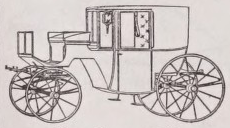
A light, close carriage, with seats inside for two or four, and the fore wheels so arranged as to turn short.
BROUGHAM, Henry, first Lord Brougham and Vaux, man of letters, man of science, advocate, orator, statesman, aud Lord High Chancellor of England, was born at Edinburgh on the 19th September 1778, and died at Cannes in France on the 7th May 1868. During a great portion of a life extended to the unwonted term of ninety years, but especially in the third and fourth decades of the present century, from 1820 to 1840, no Englishman in any civil career played so conspicuous a part in public affairs or enjoyed so wide a fame as Henry Brougham. His indomitable energy, his vehement eloquence, his enthusiastic attachment to the cause of freedom, progress, and humanity, to which he rendered so many signal services, caused him to be justly regarded as one of the most extraordinary and illustrious men of his age and of his country. He brought to all he undertook a vigour and variety of intellect almost unparalleled; for his ambition was to excel in all things, and he seemed to aspire to universal fame. “There go,” said Mr Rogers, as he drove off one morning from Panshanger, “Solon, Lycurgus, Demosthenes, Archimedes, Sir Isaac Newton, Lord Chesterfield, and a great many more iu one post-chaise.” No man ever commanded with more effect the applause of listening senates, or could better rouse the depths of popular enthusiasm. His boundless command of language, his audacity, his memory stored with every sort of knowledge, his animal spirits and social powers, gave him the lead everywhere, and he was not slow to take advantage of his splendid talents and acquirements in every mode of life. His striking and almost grotesque personal appearance added to the effect of his voice and manner;— a tall disjointed frame, with strong bony limbs and hands, that seemed to interpret the power ...of his address; strange augular motions of his arms; the incessant jerk of his harsh but expressive features; the exquisite modulations of his voice, now thundering in the loudest tones of indignation, and now subdued to a whisper which penetrated to the very walls of the House of Commons and riveted the attention of the audience; a power of mingling tenderness and scorn, argument and invective, in sentences which rose in accumulated involutions, but righted themselves at last, all contributed to give him the magical influence which a great actor exerts over a crowded theatre. Yet in the midst of all his triumphs, the companions of his early life and those who were best acquainted with his character, knew that his extraordinary gifts and powers did not include all the elements of true greatness. He wanted that moral elevation which inspires confidence and respect, and which is even more essential than genius to the highest achievements and the most lasting fame. At times his eccentricity rose to the verge of insanity, as if the reins by which he guided his fiery temper had slipped from his hand. At the bar there were greater and better advocates; on the bench there were more sure and learned judges; in science he made no real discoveries; in letters, notwithstanding the prodigious activity of his pen, he has left no work of lasting celebrity; and although as an orator he was in his best days unequalled, he himself outlived the evanescent glories of his eloquence. Hence it has come to pass, that within fifty years of his most brilliant period, and within ten years of his death, the figure of Lord Brougham has already become somewhat indistinct. The generation which was fascinated by bis eloquence and amused by the endless coruscations and evolutions of his character is passing away, and it has become a task of difficulty to preserve a faithful record of so strange and wonderful a phenomenon. That, however, which remains, and must ever remain as the noblest memorial of his life, is his unvarying devotion to the progress of liberal opinions, to the reform of the law, to popular education, to the emancipation of the negro race from slavery, and to the maintenance of peace. In this sense, he was, as he was once portrayed by an accomplished caricaturist of the day, a citizen of the world. Of every human right, Brougham was a champion; of every human wrong, an avenger.
We shall not attempt in this notice of his life to follow the innumerable incidents of his long and varied career, or to enumerate the speeches and writings which he threw off like sparks on every imaginable occasion. Our object is rather to convey to the reader a just impression of the man, as he appeared to those who knew him as he was, and who still recall the transcendent effects of his energy. Lord Brougham has been unfortunate in his biographers. The memoir of him prepared by Lord Campbell, and published after the death of the author and of the subject of it, is written in a carping and derisive tone, unworthy of a distinguished rival. Lord Brougham’s autobiography, which also appeared after his death, was begun when he had passed his eightieth year; his faculties were impaired, his memory was failing, and the work is full of inaccuracies, which his successors were not authorized to correct. Yet we are indebted to it for some interesting particulars of his early life, which no one but himself could have preserved.
In his later years, after Lord Brougham had taken his seat in the House of Peers, he was wont to trace his paternal descent to Udardus de Broham, in the reign of Henry II., and some memorials of that doughty crusader still decorate the baronial hall at Brougham. He claimed, besides, an infusion of pure Norman blood from Harold, Lord of Vaux in Normandy, whose title he added to his own. But these were the delusions of an enthusiastic mind. No real connection has been established between the ancient lords of Brougham Castle, whose inheritance passed by marriage from the Viponts into the family of the De Cliffords, and the Broughams of Scales Hall, from whom the chancellor was really descended. Brougham Hall was purchased from one Janies Bird by Brougham’s great-granduncle, who-left it to his grandfather, an active attorney and agent to the duke of Norfolk for his grace’s Cumberland property. His father, Henry Brougham, was sent to Eton, and afterwards travelled on the Continent. The sudden death of a young lady to whom this gentleman was about to be married, deeply aff⅛cted him: he started in 1777 for a short tour in Scotland, but as fate would have it he never recrossed the border or revisited Brougham. In Edinburgh he took lodgings at the house ol Mrs Syme, the widow of a clergyman, and a sister of Principal Robertson, the historian. This lady had a daughter of singular beauty and merit. Mr Brougham fell in love with her and agreed to settle in Edinburgh as a condition of obtaining her hand. They were married by Dr Robertson, and in the following year the eldest son, the illustrious subject of this notice, was born at No. 19 St Andrew Square. No feeling in life was more deeply rooted in the heart of Lord Brougham than his intense affection and veneration for his admirable mother. He repaid her early care and judicious guidance by the most ardent and unvarying devotion. He willingly laid all the triumphs of his career at her feet; and she lived to see him attain the proudest heights of fame and power. Nor was he less attached to the memory of his great uncle, the principal. To his dying day he would retrace with affectionate emotion the influence that accomplished scholar and excellent man had upon his own education. He well remembered his person and his precepts, for Dr Robertson only died in 1793, and nearly seventy years afterwards Lord Brougham, presiding over the Social Science meeting at Glasgow, was touched bv hearing a “paraphrase,” by his great kinsman, sung in Glasgow cathedral, the authorship of which was probably known only to himself. His parentage on his mother’s side being Scotch, and Scotland the place of his birth and education—and, indeed, of his entry into life—he naturally retained many Scottish peculiarities of manner and intonation; yet Brougham was not a Scotchman, he was somewhat eager to throw off his Scottish character, and he said in after life that there was no place he should visit so unwillingly as Edinburgh.
From his earliest age Brougham showed signs of extraordinary talents and energy. His mother averred that he spoke distinctly several words when he was eight months and two weeks old. In his cradle he was the terror of his nurses, and as he grew older his grandmother compared him to the admirable Crichton from his excelling in everything he undertook. When barely seven he was sent to the High School of Edinburgh, where he gained a triumph over Luke Fraser, his tutor, by successfully justifying the use of some Latin words which Fraser had condemned in an exercise, and in August 1791, when he was not yet thirteen, he left the school as dux, or head of the fifth form, taught by the headmaster, Dr Adam. He entered the university of Edinburgh in the winter of 1792, and in addition to the study of Greek under Professor Dalzell, he applied himself to the natural sciences under Professor Playfair, and especially to mathematics. At twelve one of his cousins met him with a huge quarto under his arm, which turned out to be Laplace’s Mécanique Céleste, in French. In the mathematical class he hit upon the binomial theorem before he had been taught it; and he was soon conversant with the Principia of Newton. It was characteristic of his astonishing memory that he carried with him through life all he had learned in boyhood. We have seen him in later years vary the monotony of a legal argument by working a problem in algebra, or exchanging a Greek epigram with Lord Wellesley, in the midst of grave debates of politics or of laws. In 1794 he set to work to master the fluxional calculus; and in the following year he sent a paper to the Royal Society on some new phenomenon of light and colours, which was printed in the Transactions of that learned body. A paper on porisms was published in the same manner in 1798, and in 1803 his scientific reputation was so far established that he was elected a fellow of the society. But these efforts were more remarkable for their precocity than for their novelty. In spite of his taste for mathematical reasoning Brougham’s mind was not an accurate or exact one; and his pursuit of the physical sciences was rather a favourite recreation than a solid advantage to him. He continued his experiments in optics through life, however, and would sometimes impart observations, which he took for discoveries, to the French Academy of Science. An enthusiastic discourse on Newton and the Newtonian philosophy was written by him in his eighty-fifth year, when a statue of the great philosopher was erected at Grantham, and at that age he was still fond of commenting upon the Principia.
But whilst Henry Brougham was following lectures in every branch of knowledge at the university, his inherent animal spirits and sociable nature made him the ringleader of the gayest and wildest youths of the time. Practical jokes, wrenching knockers, braving the watch, and wasting the small hours of the night, were pastimes as familiar to him as the gravest discussions. “Looking back,” says he, in his Memoirs, “ to these pranks reminds me of the inexhaustible fund of spirits one possessed, and how that capital foundation of never-tiring energy and endless restlessness enabled some of us to work on with unfailing strength to the end of life; and even now, writing at nearly uinety years of age, I can recall them—not boys’ but young men’s freaks—with pleasure and even exultation; yet I agree with the old beggar Ochiltree, in the best of all Scott’s works, saying—‘Aye, aye! they were daft days thae, but they were a’ vanity and waur. ’” The spirit of these “daft days,” these mad-cap hours, clung to Brougham through life; and long after he had held his great seal of England, perhaps while he held it, he was just as ready to play his part in scenes of the wildest merriment as he had been at the university.
As early as 1792 he founded a debating society of a very juvenile character, to which several persons afterwards distinguished in life belonged. This society, however, subsequently merged in the “Speculative Society,” which had a hall and library of its own in the college. Here Brougham, Horner, Jeffrey, Cockburn, Murray, and Moncreiff tried their early powers, and gave the promise of that eloquence which eventually placed them all in Parliament or on the bench of justice. Brougham surpassed them all, not, indeed, in depth of knowledge or soundness of reasoning, but in the astonishing flow of his language, his readiness in reply, the grace of his elocution, and his withering gift of sarcasm and ridicule. Of all the remarkable powers he possessed that of oratory was unquestionably the first. Conscious of his natural strength and of the advantages to be derived from this faculty in a country which is largely governed and swayed by rhetoric, he applied himself with peculiar· zeal to the art of public speaking. He made himself perfectly conversant with the great masterpieces of ancient eloquence, which he knew to a great extent by heart; he ever maintained that the highest effects of the orator could only be achieved by diligent preparation and constant study; he bestowed extreme care upon the modulation of his voice, which was one of extraordinary compass and strength; even his gestures and attitudes were the result of thought, and it was remarked that in concluding ths elaborate peroration of his speech on the queen’s trial, he assumed the majestic bearing with which a minister of the Scottish Church invokes the blessing of God in dismissing his congregation. Both by study and by practice, then, oratory was his chief art, and he continued through life to cultivate it with the enthusiasm of an actor, who never entirely attains to the fulfilment of his own ideal. No doubt, in the resistless torrent of his invective, in appeals to the passions of his audience, in the rapid and lucid exposition of facts, in the skilful arrangement of his discourse, which was highly artificial, and in the power of wielding enormous and intricate sentences, Brougham was unrivalled. He entered the House of Commons, as we shall presently see, soon after the voices of Fitt and Fox had been hushed for ever. Except Canning, there was no one in Parliament who could be compared to Brougham, and he rapidly rose to a height of distinction which became at one moment supremacy. Yet on looking back, even to the most celebrated and successful of his efforts, subsequently revised and published by himself, little remains which can lay any claim to the dignity of classic eloquence. Notwithstanding Lord Brougham’s study and enthusiastic admiration of Demosthenes, nothing was more unlike the stern simplicity and grandeur of the great Athenian—“Densus, et brevis, et semper instans sibi ” —than the declamation of Lord Brougham. The force of the current was wasted in a flood which overleapt its banks and broke its barriers. The effect was more intense than permanent. Even in the judgment of his own contemporaries, Canning surpassed him in wit; Plunket in felicity of diction; Lyndhurst in terseness, policy, and cogency of argument; Ellenborough in dignity: but none of them possessed his marvellous versatility, and it seemed as if he had borrowed from each of these great speakers a share in some gift, which they possessed in higher perfec tion than himself. Of all the branches of human knowledge to which Brougham directed his attention, and in which he attained to more or less proficiency, the study of the law was the least congenial to him. He speaks of it in early life as “the cursedest of all cursed professions,” and even in 1808, when he had come to England and acquired a certain degree of fame, he writes to Lord Grey: “Odious as that profession is (as God knows there are few things so hateful), I am quite clear that it would be folly in me to neglect so certain a prospect.” He added that he was setting out on the Northern Circuit with too slender a provision of law,—his stock of practice being so small that he had never yet seen a nisi prius trial,—but thought he might push through the thing with a little presence of mind and quickness. Fortunately for his future career, he had followed for two years the lectures of the professor of civil law in the university of Edinburgh; and, as Lord Campbell admits, so far legalized his mind that he had gained a considerable insight into both Roman and feudal jurisprudence. These seeds of law, implanted in a powerful intellect, gave him a breadth of view not always combined with the technicalities of the English bar.
On the 23d May 1800 he was admitted to the Faculty of Advocates. It does not appear that he ever held a brief in the Court of Session, but he went a circuit or two, where he defended or prosecuted a few prisoners, and played a series of tricks on the presiding judge, Lord Esk-grove, which almost drove that learned person to distraction. The Scottish bar, however, as he soon perceived, offered no field sufficiently ample for his talents and his ambition. He resolved to transfer himself to London. He had already appeared as junior counsel in a Scotch appeal to the House of Lords. In 1803 he was entered at Lincoln’s Inn, and on the 22d November 1808 he was called to the English bar by that learned society. It is a curious indication of the importance already attached to him as a party man, that the Tory attorney-general and the solicitor-general of the day thought it worth while to come down to Lincoln’s Inn to endeavour to oppose his special call, which had been asked for, but was defeated by a single vote. He was called in the ordinary course in the ensuing term.
In this interval of time, however, he had struck a fresh vein which ensured to him power, popularity, celebrity, and for the time a subsistence. The Edinburgh Review was founded in the autumn of 1802, under circumstances which have often been related, by the young and aspiring lights of the northern metropolis. The polished style and judgment of Jeffrey, the wit of Sydney Smith, the wisdom of Horner, were suddenly brought to bear on the literature and politics of the day, and amongst them all Brougham was the most ready, the most versatile, the most satirical, and eager to fly at any game which might be on foot. To the first four numbers of the Review Brougham contributed twenty-one articles; to the first twenty numbers eighty articles, wandering through every imaginable subject—science, politics, colonial policy, literature, poetry, surgery, mathematics, and the fine arts. The article on Lord Byron’s Hours of Idleness, which stung the poet into a satirist, and gave the world English Bards and Scotch Reviewers, was attributed to his pen and Lord Cockburn used to relate that on one occasion Brougham wrote off an entire number, including one article on the operation of lithotomy and another on the music of the Chinese. What, however, was of more importance to the youthful author and to the world, was that Brougham stood henceforth iudissolubly pledged to the cause of the Liberal party, and to those principles of progress and reform to which he was destined to render so many signal services. The Edinburgh Review is the standard of that cause, and Brougham never rested until he had planted it on the loftiest battlements of the fortress. The prodigious success of the Review, and the power he was known to wield in it, made him a man of mark from his first arrival in London. He was welcomed at Holland House. He obtained the friendship of Lord Grey and the leading Whig politicians. His wit and gaiety made him an ornament of society, and he sought to extend his literary reputation by the publication of an elaborate work on the colonial policy of the empire. But his hopes of obtaining a seat in Parliament were not yet realized. He was still eating his commons at Lincoln’s Inn. He was still in search of a career. Thus it fell out that, in 1806, Mr Fox being then Secretary of State, he was appointed secretary to a mission of Lord Rosslyn and Lord St Vincent to the court of Lisbon, with a view to counteract the anticipated French invasion of Portugal. The mission lasted two or three...