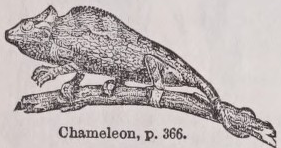
An animal of the genus Lacerta, or lizard, with a naked body, a tail and four feet. The body is six or seven inches long, and the tail five inches; with this it clings to the branches of trees. The skin is cold to the touch, and contains small grains or eminences, of a bluish gray color, in the shade, but in the light of the sun, all parts of the body become of a grayish brown, or tawny color. It is a native of Africa and Asia.
A lizardlike reptile of the genus Chamaeleo, of several species, found in Africa, Asia, and Europe. The skin is covered with fine granulations; the tail is prehensile, and the body is much compressed laterally, giving it a high back.
CHAMELEON, the common name of a well-defined family of Lizards, forming the tribe Dendrosaura, and containing the single genus Chamoelo, which includes about twenty known species, bearing a close family resemblance to each other, and differing very widely from all other lizards. They are small creatures, not usually exceeding 7 inches in length exclusive of the tail, which in general is as long as the body. The body is greatly compressed, often with a crest—toothed or otherwise—along the back and belly, and the skin is covered with granular specks, giving it the appearance of shagreen. The large pyramidal head is supported by a short neck composed of five vertebrae, instead of eight, as in the majority of saurians; and there is no true sternum, although the anterior ribs are joined to the mesial line, which thus takes the place of a breast-bone, while the ribs which follow are so connected together as to form a bony circle for the protection of the abdominal region. Unlike other lizards, the chameleon has the body raised high on its legs, and the toes, which are five in number on both posterior and anterior limbs, are divided into two opposable groups or bundles, closely resembling those of a parrot, and equally serving the purpose of prehension. The tail, by the greater thickness of which at the base the male is distinguishable from the female, is also prehensile, and is of the greatest service in giving support and security to the climbing chameleon. The lungs are large, and are connected with air-vessels distributed throughout the body, by the inflation of which a certain transparency is given to the body, as well as a plumpness which at once disappears on their collapse, and this, together with the fact that the chameleon can live apparently in a thriving...condition for weeks without food, seems to have given rise to the ancient belief that this singular creature lived on air. The eyes of the chameleon are large, globular, and covered with a circular disk formed by the junction cf the two lids and having a central aperture which acts as an external pupil, being capable of dilatation or contraction at will. In moving, the eyes act independently of each other, so that while the one stares upwards the other may be eagerly following the motions of an insect beneath, or the one may even be directed backwards while the other watches in front. This extraordinary range of vision amply compensates for the small degree of mobility in the neck and the general slowness of motion characteristic of the chameleon. The tongue is equally remarkable, being sub-cylindrical, worm-like, and extremely extensile, with the end somewhat enlarged and hollow, and supplied with a glutinous secretion. It is by means of this organ, which is capable of being protruded to a length of six or seven inches, that chameleons obtain their food. They are arboreal in their habits, supporting themselves on the branches of trees by their grasping hand-like feet and prehensile tails. In their movements they are slow and deliberate, and when watching for the insects which form their sole food, they remain motionless for hours, partly concealed by the foliage, and still more by the exercise of the faculty which they possess above all other creatures of changing their colour so as to resemble surrounding objects. Their power in this direction has, however, been greatly exaggerated. They cannot, as was at one time supposed, assume in succession all the colours of the rainbow; but under certain conditions, by no means well ascertained, their normal bluish ash colour may give place to a green or yellowish hue, with irregular spots of a dull red, or it may become considerably paler so as to approach to whiteness. Thus an observer reports recently that he saw a chameleon making its way along the top of an old wall near Ephesus, the stones of which were of a dark colour, occasionally varied by a block of white marble, and he noticed that no sooner did the creature rest on one of the latter than it gradually became less visible, owing evidently to its assumption of a colour somewhat harmonizing with the marble on which it rested. This curious phenomenon was observed by the earliest writers on natural history, and gave rise to much speculation. Aristotle held that the change of colour only took place when the chameleon was inflated with air, to which therefore it was owing; Pliny that its varying colours were borrowed from surrounding objects; while Wormius was the first to attribute those variations to the play of the emotions and passions; but Milne Edwards, in a paper published in the Annales des Sciences, showed that, whatever the exciting cause of these changes in colour, whether due to the emotions, the inflation of the lungs, or exposure to the sun’s rays, they were rendered possible only by the presence in the skin of the chameleon of two layers of differently-coloured pigment, placed one over the other, and so arranged that both may appear simultaneously on the surface, or the one may be displaced to a greater or less extent by the other, the colour varying with the amount of such displacement. Thus protected by its colouring, the chameleon awaits the coming of its prey, and no sooner does an insect place itself within reach of its worm-like tongue than that organ, leaping forth from its sheath with lightning speed, fixes its victim on the glutinoustip, which is forthwith engulphed with equally astonishing rapidity. The eggs of the chameleon are deposited under leaves on the ground. They are numerous, round, and covered with an exceedingly porous shell formed of calcareous matter. The species composing the family are inhabitants chiefly of Africa and the islands adjacent, notably of Madagascar, to which about a third of all the known species are confined. The latter include such curious forms as the Rhinoceros Chameleon, the male of which has a horn-like tubercle at the end of the muzzle; also a form recently described by Günther, in which the tail is so short as to be almost useless for prehension, a defect which seems compensated for by the presence of an additional denticle at the inner base of each claw, and of a spine projecting from the side of each finger and toe, which must add greatly to the creature’s prehensile power. Owing to this peculiarity Günther proposes to make it the type of a new genus (Proceedings of the Zoological Society, 1874). Fernando Po is the home of the Three-Horned Chameleon (Chamaeleo Oιveni), which has a long conical horn over each eye, and another at the extremity of the muzzle; but the best known and most widely distributed species is the Common Chameleon (C. vulgaris), found in Southern Asia and the north of Africa, and naturalized in the southern countries of Europe. It is often brought to England, but owing to the coldness of the climate it exists there in a more or less torpid condition, and soon dies.
9th ed. Encyclopædia Britannica, vol. 5, p. 381 [1,191 words — estimated reading time: 7 minutes]
This site uses cookies to remember your display preferences (search sources and editions, Bible version, auto-link, images, light/dark theme). No personal data whatsoever is collected. Privacy Policy