CINNA, LuciusCornelius, a Roman patrician, conspicuous in the contest between Marius and Sulla. After serving in the war with the Marsi as pretorianlegate, he was elected consul in 87 b.c. Breaking the oath he had sworn to Sulla that he would not attempt any revolution in the state, Cinna allied himself with Marius, raised an army of Italians, and took possession of the city. Soon after his triumphant entry and the massacre of the friends of Sulla, by which he had satisfied his vengeance, Marius died. L. ValeriusFlaccus became Cinna’s colleague, and on the murder of Flaccus, Cn. Papirius Carbo. In 84, however, Cinna, who was still consul, was forced to advance against Sulla; but while embarking his troops he was killed in a mutiny. See Roman History.
9th ed. Encyclopædia Britannica, vol. 5, p. 785 [133 words — estimated reading time: 1 minute]
Red sulphuret of mercury. Native cinnabar is an ore of quicksilver, moderately compact, very heavy, and of an elegant striated red color. It is called native vermilion, and its chief use is in painting. The intensity of its color is reduced by bruising and dividing it into small parts. It is found amorphous, or under some imitative form, or crystalized. Factitious cinnabar is a mixture of mercury and sulphur sublimed, and thus reduced into a fine red glebe.
CINNABAR, the κwvαβαpις of Theophrastus, is the native sulphide of mercury, and the only commercial source of that metal and its compounds. It crystallizes in the rhombohedral form, in which condition it is sometimes found; but generally it occurs in fibrous or amorphous masses bedded in slate rocks and shales, and more rarely in veins in granitic or porphyritic rocks. In hardness it is intermediate between gypsum and calcspar; its specific gravity is 8 ’ 998, and its colour varies from a fine bright red to a reddish-brown and leaden-grey hue. It possesses the same composition as the ordinary vermilion of commerce for which it may, when pure and fine in colour, sometimes be used after simple lévigation, although the greater part of that brilliant pigment is artificially prepared. Pure cinnabar should contain 86 ’ 21 per cent, of mercury, combined with 13*79 of sulphur; but in its native state the ore is frequently contaminated with oxide of iron, clay, and bituminous matter. The principal European localities for cinnabar are at Idria in Carniola, and at Almaden in Spain, whence the British demand is mainly supplied. It is also extensively worked at New Almaden and several other localities in California, in the southern part of Peru, and in Borneo, Japan, and China. See Vermilion.
9th ed. Encyclopædia Britannica, vol. 5, p. 785 [217 words — estimated reading time: 2 minutes]
1. The bark of two species of Laurus. The true cinnamon is the inner bark of the Laurus Cinnamomum, a native of Ceylon. The base cinnamon is from the LaurusCassia. The true cinnamon is a most gratefularomatic, of a fragrant smell, moderately pungent taste, accompanied with some degree of sweetness and astringency. It is one of the best cordial, carminative and restorative spices. The essential oil is of great price.
2. CINNAMON stone, called by Hauy, Essonite, is a rare mineral from Ceylon, of a hyacinth red color, yellowish brown or honey yellow; sometimes used in jewelry.
3. CINNAMON -water, is made by distilling the bark, first infused in barley water, in spirit of wine, brandy or white wine.
4. Clove-cinnamon, is the bark of a tree growing in Brazil, which is often substituted for real cloves.
5. White-cinnamon, or Winters bark, is the bark of a tree, growing in the West Indies, of a sharp biting taste, like pepper.
1. The inner bark of the shoots of Cinnamomum Zeylanicum, a tree growing in Ceylon. It is aromatic, of a moderately pungent taste, and is one of the best cordial, carminative, and restorative spices.
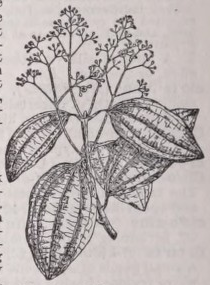
CINNAMON is the inner bark of Cinnamomum Zeylani- ¢um, a small evergreen tree belonging to the Natural Order Lauroeeoe. The leaves are large ovate-oblong in shape, and the flowers, which are arranged in panicles, have a greenish colour and a rather disagreeable odour. Cinnamon has been known from the most remote antiquity, and it was so highly prized among ancient nations that in very small quantities it was regarded as a present fit for monarchs and other great potentates. It is mentioned in Exod. xxx. 23, where Moses is commanded to use both sweet cinnamon (Kinnamon and cassia. It is likewise alluded to by Herodotus under the name κοwαμωμov, and it is frequently mentioned by many other classical writers. It is now almost exclusively a product of Ceylon, but the origin of the plant and the derivation of its name are matters of considerable doubt and dispute. The Arab traders, by whom the trade in this and other Oriental spices was conducted in ancient times, surrounded the history and production of these precious and lucrative products with grotesque tales of mystery. It is contended by some that cinnamon was originally obtained from the promontory of Gardafui (the regio dnnarnomifera of classical geographers), while others lean to the opinion that it was brought from China, whence the chief portion of the closely allied cassia bark is still derived. Although as the produce of Ceylon, cinnamon did not come prominently into the market till the settlement of the Portuguese in the island, it is the opinion of the best authorities that the tree yielding it is indigenous, and certainly no other situation and climate have yet been found where the trees flourish so well and yield a bark so fine and so delicately aromatic....
The cinnamon gardens are confined to a strip of country in the neighbourhood of Colombo. When the trade was at its best, five of the principal gardens measured from 15 to 20 miles in circumference, but now the area of cultivation is very much restricted, and plants which were at one time tended with the greatest care, and guarded with inhuman jealousy, are choked with the natural profusion of jungle vegetation. The bark is taken from shoots of eighteen months or two years growth, in which time they attain a length of from 6 to 10 feet, and a thickness of from ½ to 2 inches. The plants are managed on the coppice system, and only four or five shoots are allowed to grow up from each stool. The shoots are cut down twice a year after the rains, and the bark is detached in lengths of about a foot. After lying in bundles as taken from the shoots for about a day, each separate piece is carefully scraped to remove the outer and middle layers of the bark, and the remaining portion is thereby often reduced to the thickness of one-hundredth part of an inch. The pieces are then made up into composite quills by placing the smaller pieces inside the larger, and thus the cinnamon is often formed into straight firm rods of from 3 to 4 feet in length. After drying in the sun the bark is ready to make up into bundles for exportation.
Cinnamon of an inferior quality is grown in Southern India at Tellicherry and Tinnevelly; and in Java the cultivation was introduced by the Dutch about the year 1825. The plant has also been grown in the colony of French Guiana, and in other localities. The produce of none of these places, however, approaches in quality to the cinnamon of Ceylon, whence also the largest proportion of the entire consumption is supplied. Nearly the whole quantity prepared in Ceylon is brought to the British market. The value of Ceylon cinnamon submitted to the English Board of Trade, was in 1874 more than 2s. 2d. per lb, that from other localities being estimated at about 10d.
Ceylon cinnamon of fine quality is a very thin smooth bark, with a light-yellowish brown colour, a highly fragrant odour, and a peculiarly sweet, warm, and pleasing aromatic taste. Its peculiar flavour is due to an aromatic oil which it contains to the extent of from 0 ’ 5 to 1 per cent. The essential oil of cinnamon, as an article of commerce, is prepared chiefly in Ceylon, where the coarser pieces of bark are used for its extraction. These are roughly powdered and macerated in sea water for two days, when the whole is quickly distilled. The oil is of a golden-yellow colour, with the peculiar odour of cinnamon and a very hot aromatic taste. It consists essentially of cinnamicaldehyde or the hydride of cinnamyl, and by the absorption of oxygen as it becomes old it darkens in colour and develops resinous compounds with cinnamic acid.
Cinnamon is principally employed in cookery as a condiment and flavouring material, being largely used in the preparation of some kinds of chocolate and liqueurs. In medicine it acts as an aromaticstimulant and cordial; but it is chiefly prescribed for improving the flavour of bitter substances and to correct the griping action of purgatives. Being a much more costly spice than cassia, that comparatively harsh-flavoured substance is frequently substituted for or added to cinnamon. The two barks when whole are easily enough distinguished, and their microscopical characters are also quite distinct. When powdered bark is treated with tincture of iodine, little effect is visible in the case of pure cinnamon; but with cassia a deep-blue tint is produced, the intensity of the coloration depending on the proportion of the cassia.
9th ed. Encyclopædia Britannica, vol. 5, p. 785 [938 words — estimated reading time: 6 minutes]
קינמון, an agreeable aromatic; the inward bark of the _canella_, a small tree of the height of the willow. It is mentioned, Exodus xxx, 23, among the materials in the composition of the holy anointing oil; and in Proverbs vii, 17; Canticles iv, 14; Ecclesiasticus xxiv, 15; and Revelation xviii, 13, among the richest perfumes. This spice is now brought from the east Indies; but as there was no traffic with India in the days of Moses, it was then brought, probably, from Arabia, or some neighbouring country. We learn, however, from Pliny, that a species of it grew in Syria.
Take thou also unto thee principal spices, of pure myrrh five hundred shekels, and of sweet cinnamon half so much, even two hundred and fifty shekels, and of sweet calamus two hundred and fifty shekels,
“Take the finest spices: 500 shekels of liquid myrrh, half that amount (250 shekels) of fragrantcinnamon, 250 shekels of fragrant cane,
And cinnamon, and odours, and ointments, and frankincense, and wine, and oil, and fine flour, and wheat, and beasts, and sheep, and horses, and chariots, and slaves, and souls of men.
of cinnamon, spice, incense, myrrh, and frankincense; of wine, olive oil, fine flour, and wheat; of cattle, sheep, horses, and chariots; of slaves and souls of men.
This site uses cookies to remember your display preferences (search sources and editions, Bible version, auto-link, images, light/dark theme). No personal data whatsoever is collected. Privacy Policy