
A substance, of the consistence of butter or honey, taken from a bag under the tail of the civet-cat. It is of a clear, yellowish, or brownish color; of a strong smell, and offensive when undiluted, but agreeable when a small portion is mixed with another substance. It is used as a perfume.
Word of the Day: Catachrestical
1. A substance, of the consistence of butter or honey, taken from glands in the anal pouch of the civet (Viverra civetta). It is of clear yellowish or brownish color, of a strong, musky odor, offensive when undiluted, but agreeable when a small portion is mixed with another substance. It is used as a perfume.
2. The animal that produces civet (Viverra civetta); -- called also civet cat. It is carnivorous, from two to three feet long, and of a brownish gray color, with transverse black bands and spots on the body and tail. It is a native of northern Africa and of Asia. The name is also applied to other species.
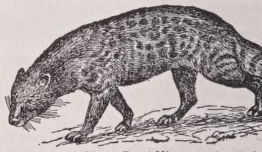
Civet
Encyclopedia Britannica
CIVET (Viverra), a genus of Carnivorous Mammals forming with the genet and ichneumon the family Viverridce r and characterized by the possession of a deep pouch situated in the neighbourhood of the genital organs (divided into two sacs each about the size of an almond), into which the substance known as civet is poured from the glandular follicles secreting it. This fatty substance is at first semifluid and of a yellow colour, but afterwards acquires the consistency of pomade and becomes darker. It has a strong musky odour, exceedingly disagreeable to those unaccustomed to it, but “when properly diluted and combined with other scents it produces a very pleasing effect, and possesses a much more floral fragrance than musk, indeed it would be impossible to imitate some flowers without it” (RimmeΓs Art of Perfumery). There are three species of civet-producing Viverridoe. The Civet ( Viverra civetta) is a native of North Africa and extends as far south and west as Fernando Po. It is from 2 to 3 feet in length, exclusive of the tail, which is half the length of the body, and stands from 10 to 12 inches high. It is covered with long hair, that on the middle line of the back being longest and capable of being raised or depressed at will, of a dark-grey colour, with numerous transverse black bands and spots. It is chiefly nocturnal, and is by preference carnivorous, feeding on birds and the smaller quadrupeds, in pursuit of which it climbs trees, but it is said also to eat fruits, roots, and other vegetable matters. In a state of captivity it is never completely tamed, and is only thus kept for the sake of the civet, which is obtained in largest quantity from the male, especially when he is in good condition and is subjected to irritation. It is scraped from the pouch with ...a small spoon usually twice a week. The Zibeth (Viverra zibetha) is a widely distributed species extending from Arabia to Malabar, and throughout several of the larger islands of the Indian Archipelago. It is smaller than the civet, and wants the dorsal crest. In the wild state it is exceedingly ferocious, doing great damage among poultry, and frequently making off with the young of the swine and sheep. “To the rapacity of the wolf,” says Captain Williamson, “it joins the agility of the cat and the cunning of the fox.” When hunted it makes a determined resistance, and emits a scent so strong as even to sicken the dogs, who nevertheless are exceedingly fond of the sport, and cannot be got to pursue any other game while the stench of the zibeth is in their nostrils. In confinement, however, it becomes comparatively tame, and civet is obtained from it in considerable quantity. In preparing this for the market it is usually spread out on the leaves of the pepper plant in order to free it from the hairs that have become detached from the pouch. The Rasse (Viverra rasse) is the fiercest and most carnivorous of its kind, and remains untamed in confinement. It is a native of Java, where it is found not unfrequently in forests at a moderate elevation above the sea level. It is almost 3 feet long including the tail, and is prettily marked with dark longitudinal stripes, and with spots which have a distinctly linear arrangement. Its perfume, which is extracted in the same way as in the two preceding species, is highly valued and much used by the Javanese, who, according to Dr Horsfield, apply it to their dresses, and by means of various unguents and mixtures of flowers to their persons. British imports of civet are chiefly from the Indian Archipelago, and when pure it is worth about £2 per ounce. It is frequently adulterated with butter or lard. Fossil remains of extinct civets are found in the Miocene strata of Europe.
9th ed. Encyclopædia Britannica, vol. 5, p. 796
[653 words — estimated reading time: 4 minutes]
[653 words — estimated reading time: 4 minutes]
Fragrance Roget’s Thesaurus §400
N. fragrance, aroma, redolence, perfume, bouquet, essence, scent, sweet smell, aromatic perfume, agalloch, agallochium, aloes wood, bay rum, calambac, calambour, champak, horehound, lign-aloes, marrubium, mint, muskrat, napha water, olibanum, spirit of myrcia, essential oil, incense, musk, frankincense, pastil, pastille, myrrh, perfumes of arabia, otto, ottar, attar, bergamot, balm, civet, potpourri, pulvil|, nosegay, scentbag, sachet, smelling bottle, vinaigrette, eau de cologne, toilet water, lotion, after-shave lotion, thurification, perfumer, eucalyptus oil, pinene
Adj. fragrant, aromatic, redolent, spicy, savory, balmy, scented, sweet-smelling, sweet-scented, perfumed, perfumatory, thuriferous, fragrant as a rose, muscadine, ambrosial
No Bible verses found for "Civet".