
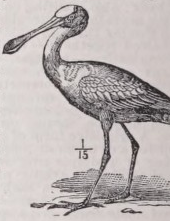
SPOONBILL. The bird now so called was formerly known in England as the Shovelard or Shovelar, while that which used to bear the name of Spoonbill, often amplified into Spoon-billed Duck, is the Shoveler (see vol. xxi. p. 842) of modern days—the exchange of names having been effected, as already stated (loc. cit.) about 200 years ago, when the subject of the present notice—the Platalea leucorodia of Linnaeus as well as of recent writers—was doubtless far better known than now, since it evidently was, from ancient documents, the constant concomitant of Herons, and with them the law attempted to protect it. Mr Harting (Zoologist, 1886, pp. 81 et seqj) has cited a case from the “Year-Book” of 14 Hen. VIII. (1523), wherein the then bishop of London (Cuthbert Tunstall) maintained an action of trespass against the tenant of a close at Fulham for taking Herons and “Shovelars” that made their nests on the trees therein growing, and has also printed {Zoologist, 1877, pp. 425 et seq.) an old document showing that “Shovelars” bred in certain woods in west Sussex in 1570. Nearly one hundred years later (circa 1662) Sir Thomas Browne, in his Account of Birds found in Norfolk (Works, ed. Wilkin, iv. pp. 315, 316), stated of the “Platea or Shouelard ” that it formerly “built in the Hernerie at Claxton and Reedham, now at Trimley in Suffolk.” This last is the latest known proof of the breeding of the species in England; but more recent evidence to that effect may be hoped for from other sources. That the Spoonbill was in the fullest sense of the word a “native” of England is thus incontestably shown; but for many years past it has only been a more or less regular visitant, though not seldom in considerable numbers, which would doubtless, if allowed, once ...more make their home there; but its conspicuous appearance renders it an easy mark for the greedy gunner and the contemptible collector. What may have been the case formerly is not known, except that, according to Belon, it nested in his time (1555) in the borders of Britanny and Poitou; but as regards north-western Europe it seems of late years to have bred only in Holland, and there it has been deprived by drainage of its favourite resorts, one after the other, so that it must shortly become merely a stranger, except in Spain or the basin of the Danube and other parts of south-eastern Europe.
The Spoonbill ranges over the greater part of middle and southern Asia, and breeds abundantly in India, as well as on some of the islands in the Red Sea, and seems to be resident throughout Northern Africa. In Southern Africa its place is taken by an allied species with red legs, Ρ. cristata or tenuiroslris, which also goes to Madagascar. Australia has two other species, P. regio, or melanorhynchus, with black bill and feet, and P. flaνipes, in which those parts are yellow. The very beautiful and wholly different P. ajaja is the Roseate Spoonbill of America, and is the only one found on that continent, the tropical or juxta-tropical parts of which it inhabits. The rich pink, deepening in some parts into crimson, of nearly all its plumage, together with the yellowish green of its bare head and its lake-coloured legs, sufficiently marks this bird; but all the other species are almost wholly clothed in pure white, though the English has, when adult, a fine buff pectoral band, and the spoon-shaped expanse of its bill is yellow, contrasting with the black of the compressed and basal portion. Its legs are also black. In the breeding season, a pendent tuft of white plumes further ornaments the head of both sexes, but is longest in the male. The young of the year have the primary quills darkcoloured.
The Spoonbills form a natural group, Plataleidse, allied, as before stated (Ibis, vol. xii. p. 606), to the Ibididae, and somewhat more distantly to the Storks (see Stork), —all belonging to the Pelargomorphse of Prof. Huxley. They breed in societies, not only of their own kind, but in company with Herons, either on trees or in reed-beds, making large nests in which are commonly laid four eggs, —white, speckled, streaked, or blotched, but never very closely, with light red. Such breeding-stations have been several times described, and among the more recent accounts of one of them are those of Messrs Sclater and W. A. Forbes (Ibis, 1877, p. 412), and Mr Seebohm {Zoologist, 1880, p. 457), while a view of another has been attempted by Schlegel {Vog. Nederland, taf. xvii.). The latest systematic revision of the group is by Dr Reichenow (Journ, fur Ornithologie, 1877, pp. 156-159), but his views have not been wholly accepted in the present article. (a. n.)
[809 words — estimated reading time: 5 minutes]