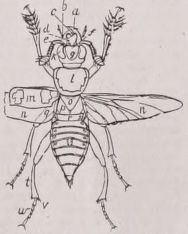
COLEOPTERA, or Beetles, a vast and remarkably homogeneous order of Insects, characterized, as the name implies (κoλ∈o ’ s, a sheath, and τrτepα, wings), by the structure of the upper wings, or elytra, as they are called, which are so modified as to form shields for the protection of the under wings—the true organs of flight in those insects. The name was given, and the principal characters of the order defined, by Aristotle; and owing doubtless to their singular and varied forms and habits, the brilliant colouring and great size of numerous species, and that solid consistence which renders their collection and preservation comparatively easy, Coleopterous insects have since the days of the Stagirite received the special attention of entomologists....
The body in Coleoptera is enclosed in a chitinous integument of a more or less rigid consistence, and is somewhat oval in form, although in most cases greatly longer than broad. In this respect, however, the utmost diversity prevails even among the members of the same family, the form being modified to suit the habits of the insect. Thus, according to Bates, among the South American forms of Dermestidae, the species of one group are cubical in shape, and live in dung; those of another, inhabiting the stems of palm trees, are much flatter; those of a third, only found under the bark of trees, are excessively depressed, some species being literally “as thin as a wafer;” while the members of a fourth group of the same family are cylindrical in shape, and are woodborers, “looking,” says Bates, “like animated gimlets, their pointed heads being fixed in the wood, while their glossy bodies work rapidly round so as to create little streams of saw-dust from the holes” (Naturalist on the Amazons). The body, in common with that of all other insects, is divided into three parts,—head, thorax, and abdomen. The head, which is usually rounded or somewhat triangular in shape (except in the Weevil tribe, where it is produced into an elongated rostrum or snout), bears the organs of the senses. The eyes of beetles are two in number and compound, and in predaceous species are somewhat protuberant, thus affording greater range of vision. The simple eyes, or ocelli, common among butterflies and moths, are almost unknown among beetles, although present in the larvae. In many species, especially of Lamellicorn Beetles, these organs are more or less completely divided by a process known as the cantfius; and in the Gyrinidae, or Whirligigs, the intersection is so complete as to give the appearance of a pair of eyes on each side. In burrowing and cave-dwelling species, whose lives are spent in almost total darkness, the eyes, although distinctly visible in the young, become more or less atrophied in the adult forms. The two antennae, supposed by some to be organs of hearing, and by others of smell, are placed between or in front of the eyes, and usually consist of 11 joints. These differ greatly in form and size, not only in different species, but in the two sexes of the same species, the most prevalent forms being the setaceous, moniliform, serrate, pectinate, clavate, and lamellate. In many groups the antennae are exceedingly short, while in such forms as the Longicorn Beetles they, in a few cases, measure four times the length of the body.
The parts which go to form the mouth are typically developed in beetles, and for this among other reasons the order Coleoptera has generally been placed at the head of the class of insects. It is known as the masticatory mouth, and consists of the four parts (Plate VI. fig- 1). (1) The labrum, or upper lip, is usually a continuation of the upper surface of the head. (2) The mandibles, or true masticatory organs, consist of two powerful arched jaws generally dentated, moving horizontally and opposed to each other, the teeth in some cases interlocking, in others, as in the Tiger Beetles, crossing like the blades in a pair of scissors. In many species they are so small as to be almost concealed within the cavity of the mouth, while in such forms as the Stag Beetles they measure half the length of the entire body. The form and texture of the mandibles are largely dependent on the nature of the insect’s food, being acute and sharply dentated in predaceous species, and thick and blunt in vegetable feeders. Their margins are soft and flexible in those which feed on decaying animal and vegetable matters, while the entire mandibles are soft and flattened in those which live on fluids. (3) The maxillae, or lesser jaws, placed beneath the mandibles, and like them moving horizontally, serve to hold the food and guide it to the mouth. Their extremities are in many cases furnished with a movable claw, and their inner surfaces with a series of bristles, which are probably of use in straining the juices from their food. The maxillae are provided with a pair of appendages called maxillary palps—delicate organs that vibrate intensely, and are supposed to be principal organs of touch. (4) Tlιe labium, or lower lip, also provided with palps.
The thorax bears the organs of locomotion, consisting of three pairs of legs and two pairs of wings (Plate VI. fig. 2). The legs vary in their structure and development according to the habits of the species; thus in running and walking beetles these organs are usually of equal length, and generally similar in other respects, the anterior pair, however, being often stronger in the male than in the female; and in a few species, as the Harlequin Beetle, the anterior legs are enormously elongated and proportionately thickened. In burrowing beetles the anterior legs are developed into fossorial organs with broad and strongly dentated tarsi, and in arboreal forms the under side of the tarsi is usually covered with hair, forming a cushion-like sole terminating in toothed claws, by which they are enabled to keep their footing on the leaves and branches of trees. Water beetles generally have the posterior pair of legs elongated, flattened, and ciliated, so as to form swimming organs; those known as Whirligigs using the middle and posterior pairs for this purpose, while the anterior limbs are employed as rudders; and jumping beetles, as Halticidae, have the thighs of the posterior pair of legs greatly thickened for saltatory purposes (Plate VIII. fig. 10). The two anterior wings become solidified in beetles, and are thus rendered useless as organs of flight. They are termed elytra (eλυτpov, a shield), and serve to protect the delicate wings beneath, as well as the stigmata, or breathing pores, placed ¾loug the sides of the abdomen. The elytra are always present except in the females of a few species, as the Glow-worm, and are generally large enough to cover the upper surface of the abdomen and to conceal the under wings when at rest. In Brachelytrυus Beetles, however, they are exceedingly short, and the wings in these are only shielded by being folded more than once beneath them. The elytra when at rest meet on the middle of the back, their internal margins forming a straight longitudinal line or suture highly characteristic of the Coleoptera; but even this character is not universal, as in the Oil Beetles (Meloë) and a few others the one elytron partly folds over the other. The posterior wings are large, veined, and membranaceous and form the true organs of flight, but they are much more frequently absent than the elytra, and where this occurs, as in manyCarabideous Beetles, the latter are more or less soldered together. During flight the elytra are either extended horizontally or merely raised without being separated, as in the Rose-Chafers (Cetonia); and as might be expected from their general stoutness of body and comparative deficiency of wings, the flight of beetles is heavy and seldom long sustained. Their weakness in this respect is further shown in the apparent inability of many species suddenly to alter their course so as to avoid collision with any object that may unexpectedly come in their way, a defect popularly but erroneously attributed, in. the phrase “as blind as a beetle,” to weakness of sight rather than of wing. In certain water beetles fDytiscidae) a pair of aslulae, or winglets, are developed at the inner angle of the elytra.
The colouring of the chitinous integument of beetles is often exceedingly brilliant, and the elytra and other parts of many species are largely used in the manufacture of personal ornaments. This colouring can in many instances be shown to bear a close resemblance to that of surrounding nature; thus burrowing beetles, and those which dwell in subterranean .caves, are generally black or brown; "Weevils, found on the ground, are earth-coloured; while arboreal species of this and other groups are of various shades of green. Bates found a species of beetle, on a particular tree in South America, which so resembled the bark on which it spent its existence as to be, when motionless, no longer visible. This assimilation in colour to surrounding nature is probably useful in assisting them to elude their enemies; and when the markings are such as to render the beetle conspicuous it is often provided with, and no doubt protected by, an offensive odour or nauseous juices; thus the naturalist already mentioned found on a sandy beach two species of Tiger Beetles, the one of a pallid hue like the sand it ran upon, the other of a brilliant and conspicuous copper colour, but having “a strong, offensive, putrid, and musky odour,” from which the other was entirely free. Fireflies, a group of Coleopterous insects, are also exceedingly conspicuous, but are similarly protected. The phenomena of mimicry, or the imitation of one animal by another for protective purposes, have been, observed in several instances among beetles. Mr Belt, in his interesting work, The Naturalist in Nicaragua, states that he captured what he supposed was a hairy caterpillar, but on closer inspection he found it to be a Longicorn Beetle, the antennae being concealed among the hair. Hairy caterpillars are almost universally rejected by insecteating animals, and thus probably this beetle shared in the immunity from attack accorded to its model. A species of beetle found in South America closely resembles a bee found in the same locality, its body being covered with hair and its legs similarly tufted; another, with yellow banded abdomen, sufficiently resembled a wasp as to make its captor both cautious and. timid in handling it at first. One of the Chrysomfilidae (Crioceris merdigera} is said to disguise itself by covering its upper surface with its own dung; while many species to be afterwards noticed, when in danger, simulate death. Brilliant colouring in beetles is not as in some orders of animals a characteristic mainly of the male sex, both sexes being usually similar in this respect, while iu those cases in which they differ, the female is generally the more gaudy insect. The chief external difference, however, between the sexes in many beetles is to be found in the presence of horns on the head and thorax of the males. These vary exceedingly in their development even in individuals of the same species, while in their form they resemble the horns of the rhinoceros, and the antlers of the stag; and as among mammals the reindeer is exceptional in the possession of antlers by both sexes, so among beetles there is at least one species, Phanaeus lancifor, in which both male and female are similarly equipped. The male beetle has not been observed to use its horns either for purposes of offence or defence, some of the most pugnacious species being entirely destitute of them; and in Darwin’s opinion these appendages have been acquired merely as ornaments.
The abdomen of Coleopterous insects is sessile, that is, attached to the‘thorax by its largest transverse diameter. On the under side it is always of a firm horny consistence, while the upper surface is generally soft, being protected by the elytra and wings; when these, however, are absent or abbreviated, it is as hard above as below. It bears the organs of generation as well as the respiratory openings, or stigmata, which form the apertures of the tracheae by means of which air is disseminated through all parts of the insect system. Beetles belonging to several distinct families possess stridulating organs, and these are generally found in both sexes. The apparatus by which the sound, loud enough to be heard in many cases at some yards distance, is produced, consists of a couple of delicate rasps placed on the upper surface of the abdomen, on the elytra, or on the prothorax, and a scraper formed by the margins of the elytra, the edges of the abdominal segments, or the mesothorax, the rapid motion of the latter over the rasps producing the sound. In many cases, according to Darwin, the males only stridulate, the females being destitute of those organs, and in such cases the sound is employed as a call to the female; with most beetles, however, the stridulation proceeds from both sexes and serves as a mutual call. Beetles are entirely destitute of stinging organs, but a few are furnished with a retractile tube, or ovipositor, at the extremity of the abdomen, by means of which they deposit their eggs in the cracks of wood and other suitable localities.
The eggs of beetles are deposited in a great variety of situations, and in the case of a certain group of Staphylinidae found in the nests of white ants in South America, it was recently discovered by Schödte that the eggs are not deposited at all, but remain in the abdomen until they are hatched. These ovo-viviparous beetles are only one-tenth of an inch in length, and have the abdominal region enormously distended and turned over so as to rest on the back. Dung beetles deposit their eggs in the midst of the manure on which the future larvae feed; the Sacred Beetle of Egypt rolling each of hers about until a globular pellet is formed, when the whole is buried in the ground; while the Sexton Beetle finds an appropriate nidus for her eggs in the dead bodies of animals. One species of Cleridae selects the nest of the solitary bee, another (Plate VII. fig. 31) that of the hive bee, while several species of Rose Beetles choose the nest of the ant for this purpose. The water beetles belonging to the genus Hydrophilus deposit their eggs in a single mass, which they surround with a oocoon, formed of a silky substance secreted by certain glands in the abdomen, and then either fix this to the leaf of an aquatic plant or leave it to float on the surface of the water. Certain species of the Weevil tribe deposit their eggs on the leaves of trees, splitting the median nervures in several places, and afterwards rolling them up. In its progress from the egg to the perfect insect the beetle undergoes complete metamorphosis, passing from the larval to the pupa stage, and remaining totally quiescent during the latter. Coleopterous larvae generally consist of 13 segments, of which those forming the head and thorax are usually of a hard horny texture,—the mouth, as in the perfect insect, being masticatory, and the eyes, when present, simple, or ocelli. They have usually six legs, and prolegs, as in caterpillars, are occasionally present; but the larvae of many species are legless grubs, while in others the limbs are but feebly developed. In those groups in which the elytra are abbreviated, the larvae are exceedingly active and closely resemble the perfect insect. Like their parents the larvae of beetles feed on living animals, on plants, or on decaying animal and vegetable substances, but greatly exceed the perfect insect in the quantity of food which they consume, and it is in this condition that beetles do most injury to field crops and forest trees. The larvae of burrowing beetles, known as “White Worms,” spend their existence in the earth, and are destitute of eyes; those of the Stag Beetles and other wood-boring groups live in the trunks of decaying trees; mealworms—the larvae of Tenebrio molitor — live enveloped in flour, and those of the Corn Weevil in the heart of the wheat grain; while those of another species of Weevil make their homes in the fleshy parts of the receptacles of composite flowers. The larvae of Oil Beetles (Melo'e), or at least certain species of them whose life-history has been observed, after leaving the egg, which the perfect insect has deposited just beneath the surface of the ground, climb upon the stems of plants, and take the first opportunity of attaching themselves to any insect that may happen to alight near them, and in this way they are occasionally conveyed into the hives of bees, in which alone they meet with their appropriate food. Only a few of them are thus fortunate, the majority of the larvae getting attached to the wrong insect, and so perishing of hunger. The species probably owes its preservation to the great number of eggs, amounting to upwards of 4000, deposited by a single female. The larvae of one group of water beetles, Hydrophilus, swim readily by means of their ciliated legs, those of another group, Dytiscus, make use also of their flexible abdomen provided at its extremity with a pair of leaf-like appendages (Plate VII. fig. 6); while the Whirligig larvae (Gyrinus), in addition to ciliated swimming organs, are provided with four movable hooks on the posterior segment, by which they are enabled to take extensive leaps (Plate VII. fig. 17). The duration of the larval state varies in different groups of beetles, being comparatively short in leaf-eating species, but lasting for three or four years in those which burrow in the earth or in wood. The larvae in the latter case pass the winter in a torpid state, abstaining almost entirely from food, until awakened from their temporary trance by the return of genial weather, when they greedily attack their favourite food, and grow rapidly. In passing from the condition of a larva, the beetle does not, like the butterfly, assume a form altogether different from that of the perfect insect, but in the pupa or nymph state shows all the parts of the future insect, only in a condition of almost complete immobility. In preparing for this quiescent period, the larvae of many species surround themselves with a cocoon, consisting, in the case of the Scarabaeidae, of earth and small pieces of wood glued together with saliva, and in that of the Goliath Beetles, of mud. Others resemble the larvae of moths in constructing tubes in which to undergo their transformations, while the Jarvae of Lady-Birds— Coccinella— suspend themselves by the tail and make use of their larval covering as a protection to the nymph within. When the condition of nymph is assumed in autumn, no further change takes place till the ensuing spring, but under suitable conditions of heat this stage does not last usually for more than three or four weeks, after which it emerges a full-blown beetle.
The number of known species of beetles is estimated at J0,000, and these are probably not more than one-half of the total number in existence—Great Britain alone possessing 3614 indigenous species. They occur in greatest abundance in the wooded parts of tropical regions. “A large proportion of the beetles of the tropics,” says Wallace, “are more or less dependent on vegetation and particularly on timber, bark, and leaves in various stages of decay. In the untouched virgin forest the beetles are found at spots where trees have fallen through decay and old age.” The number gradually decreases towards the poles, only a few species occurring as far north as Greenland. The six zoological provinces proposed by Mr Sclater in 1859 as applicable to the existing distribution of birds, have lately been shown by Mr A. R. Wallace, in his admirable work on the Geographical Distribution of Animals (1876), to mark off equally characteristic groups of Coleopterous insects, a conclusion arrived at from a study of the distribution of the following six important families :—
[table]
The Palaearctic Region, which comprises Europe, Africa north of the Sahara, and Northern Asia, possesses about 20,000 species of beetles, and is specially characterized by abundance of Carabidae, nearly two-fifths of the entire number belonging to this region; Longicorns are also well represented by 196 genera, of which 51 are peculiar to it. The Coleoptera of the Canary Islands, Madeira, and the Azores are Palaearctic, but are peculiar in the total absence of such forms as the Tiger Beetles, the Chafers, and the Rose-Chafers, also in the great number of wingless species. The latter are specially numerous in groups of beetles peculiar to those islands, but they also occur in other cases, 22 genera which either usually or at least sometimes are winged in Southern Europe having only wingless species...