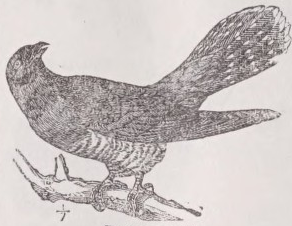
CUCKOO, or Cucκow, as the word was formerly and more correctly spelt—changed without any apparent warrant except that accorded by custom, while some of the more scholarly English ornithologists, as Montague and Jenyns, have kept the older form—the common name of a well-known and often-heard bird, the Cuculus canorus of Linnaeus. Iiι some parts of the United Kingdom it is more frequently called Gowk, and it is the Greek κo'xκυξ, the Italian Cuculo or Cucco, the French Coucou, the German Kuckuk, the Dutch Koekkoek, the Danish Kulcker or Gsòg, and the Swedish Gök. The oldest English spelling of the name seems to have been Cuccu.
No single bird has perhaps so much occupied the attention both of naturalists and of those who are not naturalists, or has had so much written about it, as the common Cuckow, and of no bird perhaps have more idle tales been told. Its strange and, according to the experience of most people, its singular habit of intrusting its offspring to foster-parents is enough to account for much of the interest which has been so long felt in its history; but, as will presently appear, this habit is shared probably by many of its Old-World relatives, as well as in the New World by birds which are not in any near degree related to it. In giving here a short account of this species, there will be no need to refute much of the nonsense about it which has found access to works even of respectable authority; but, besides the known facts of its economy, there are certain suppositions in regard to parts of its history that are unknown, which suppositions are apparently probable enough to deserve notice....
To begin with the known facts. The Cuckow is a summer-visitant to the whole of Europe, reaching even far within the Arctic circle, and crossing the Mediterranean from its winter-quarters in Africa at the end of March or beginning of April. Its arrival is at once proclaimed by the peculiar and in nearly all languages onomatopoeic cry of the cock—a true song in the technical sense of the word, since it is confined to the male sex and to the season of love. In a few days the cock, is followed by the hen, and amorous contests between keen and loud-voiced suitors are to be commonly noticed, until the respective pretensions of the rivals are decided Even by night they are not silent; but as the season advances the song is less frequently heard, and the Cuckow seems rather to avoid observation as much as possible, the more so since whenever it shews itself it is a signal for all the small birds of the neighbourhood to be up in its pursuit, just as though it were a Hawk, to which indeed its mode of flight and general appearance give it an undoubted resemblance—a resemblance that misleads some beings, who ought to know better, into confounding it with the Birds-of-prey, instead of recognizing it as a harmless if not a beneficial destroyer of hairy caterpillars. Thus pass away some weeks. Towards the middle or end of June its “plain-song” cry alters; it becomes rather hoarser in tone, and its first syllable or note is doubled. Soon after it is no longer heard at all, and by the middle of July an old Cuckow is seldom to be found in these islands, though a stray example, or even, but very rarely, two or three in company, may occasionally be seen for a month longer. This is about as much as is apparent to most people of the life of the Cuckow with us. Of its breeding comparatively few have any personal experience. Yet there are those who know that diligent search for and peering into the nests of several of our commonest little birds—more especially the Pied Wagtail (Motacilla lugubris), the Titlark (Anthus pratensis), the Reed-Wren (Acrocepha lus streperus), and the Hedge-Sparrow (Accentor modularis) — will be rewarded by the discovery of the egg of the mysterious stranger which has been surreptitiously introduced therein, and waiting till this egg is hatched they may be witnesses (as was the famous Jenner in the last century) of the murderous eviction of the rightful tenants of the nest by the intruder, who, hoisting them one after another on his broad back, heaves them over to die neglected by their own parents, of whose solicitous care he thus becomes the only object In this manner he thrives, and, so long as he remains in the country of his birth, his wants are anxiously supplied by the victims of his mother’s dupery. The actions of his foster-parents become, when he is full grown, almost ludicrous, for they often have to perch between his shoulders to place in his gaping mouth the delicate morsels he is too indolent or too stupid to take from their bill. Early in September he begins to shift for himself, and then follows the seniors of his kin to more southern climes.
Of the way in which it seems possible that this curious habit of the Cuckow may have originated something has been already said (see Birds, vol. iii. p. 772). But in connection with its successful practice a good deal yet remains tobe determined, most of which, however probable, is still to be proved. So much caution is used by the hen Cuckow in choosing a nest in vhich to deposit her egg that the act of insertion has been but seldom witnessed. The nest selected is moreover often so situated, or so built, that it would be an absolute impossibility for a bird of her size to lay her egg therein by bitting upon the fabric as birds commonly do; and there have been a few fortunate observers who have actually seen the deposition of the egg upon the ground by the Cuckow, who, then takirg it in her bill, introduces it into the nest. Of these, so far at least as this country is concerned, the earliest seem to be two Scottish lads, sons of Mr Tripeny, a farmer in Coxmuir, who. as recorded by Macgillivray (Brit. Birds, iii. pp. 130, 131), from information communicated to him by Mr Durham Weir, saw most part of the operation performed, June 24, 1838. But perhaps the most satisfactory evidence <n the point is that of Herr Adolf Müller, a fores j er at Gladenbach in Darmstadt, who says (Zoolog. Garten, 1866, pp. 374, 375) that through a telescope he watched a Cuckow as she laid her egg on a bank, and then conveyed the egg in her bill to a Wagtail’s nest. Cuckows too have been not unfrequently shot as they were carrying a Cuckow’s egg, presumably their own, in their bill, and this has probably given rise to the vulgar, but seemingly groundless, belief that they suck the eggs of other kinds of birds. More than this, Mr Rowley, who has had much experience of Cuckows, declares (Ibis, 1865, p. 186) h:s opinion to be that traces of violence and of a scuffle between the intruder and the owners of the nest at the time of introducing the egg often appear, whence we are led to suppose that the Cuckow ordinarily, when inserting her egg, excites the fury (already stimulated by her Hawk ∏ke appearance) of the owners of the nest by turning out one or more of the eggs that may be already laid therein, and thus induces the dupe to brood all the more readily and more strongly what is left to her. Of the assertion that the Cuckow herself takes any interest in the future welfare of the egg she has foisted on her victim, or of its product, there is no evidence worth a moment’s attention.
But a much more curious assertion has also been made, and one that at first sight appears so incomprehensible as to cause little surprise at the neglect it long encountered. To this currency was first given more than a hundred years ago by Salerne (L ’ Hist. Nat. Ac., Paris: 1767, p. 42), who was, however, hardly a believer in it, and it is to the effect, as he was told by an inhabitant of Sologne, that the egg of a Cuckow resembles in colour that of the eggs normally laid by the kind of bird in whose nest it is placed. In 1853 the same notion was prominently and independently brought forward by Dr Baldamus (Naumannia, 1853, pp. 307-325), and in time became known to English ornithologists, most of whom were sceptical as to its truth, as well they might be. since no likeness whatever is ordinarily apparent in the very familiar case of the bluegreen egg of the Hedge-Sparrow and that of the Cuckow, which is so often found beside it. Dr Baldamus based his notion on a series of eggs in his cabinet, a selection from which he figured in illustration of his paper, and, however the thing may be accounted for, it seems impossible to resist, save on one supposition, the force of the testimony these specimens afford, This one supposition is that the eggs have been wrongly ascribed to the cuckow, and that they are only exceptionally large examples of the eggs of the birds in the nests of which they were found, for it cannot be gainsaid that some such abnormal examples are occasionally to be met with. But it is well known that abnormally-large eggs are not only often deficient in depth of colour, but still more often in stoutness of shell. Applying these rough criteria to Dr Baldamus’s series, most of the specimens stand the test very well, and, though tìo doubt more precise and delicate examination, than any to which they seem to have been submitted, were desirable, there are some other considerations to be urged. For instance, Herr Braune, a forester at Greiz in the principality of Reuss (Naumannia, tom. cit. pp. 307, 313), shot a hen Cuckow as she was leaving the nest of an Icterine Warbler (JIypolais icterina). In the oviduct of this Cuckow he found an egg coloured very like that of the Warbler, and on looking into the nest he found there an exactly similar egg, which there can be no reasonable doubt had just been laid by that very Cuckow. Moreover Herr Grunack (Journ. für 0rn., 1873, p. 454) has since found one of the most abnormally-coloured specimens, quite unlike the ordinary egg of the Cuckow, to contain an embryo so fully formed as to show the characteristic zygodactyl feet of the bird, thus proving unquestionably its parentage. Now these being both of them extreme cases, Dr Baldamus may fairly claim attention to his assertion; for short of absolutely disbelieving his word we must admit that he has ground for it.
On the other hand, we must bear in mind the numerous instances in which not the least similarity can be traced— as in the not uncommon case of the Hedge-Sparrow already mentioned, and if we attempt any explanatory hypothesis it must be one that will fit all round. Such a one then seems to be this. We know that certain kinds of birds resent interference with their nests much less than others, and among them it may be asserted that the Hedge-Sparrow will patiently submit to various experiments. She will brood with complacency the egg of a Redbreast (Eriilιacus rubecula), so unlike her own, and for aught we know to the contrary may even be colour-blind. In the case of such a species there would be no need of anything further to insure success—the terror of the nest-owner at seeing her home invaded by a Hawk-like giant, and some of her treasures tossed out, would be enough to stir her motherly feelings so deeply that she would without misgiving, if not with joy that something had been spared to her, resume the duty of incubation so soon as the danger was past. But w ith other species it may be, nay doubtless it is, different. Here assimilation of the introduced egg to those of the rightful owner may be necessary, for there can hardly be a doubt as to the truth of Dr Baldamus’s theory (the only theory, by the way, he has put forth), as to the object of the assimilation being to render the Cuckow’s egg “less easily recognized by the foster-parents as a substituted one.” But in this place it is especially desirable to point out that theιe is not the slightest ground for imagining that the Cuckow, or any other bird, can voluntarily influence the colour of the egg she is about to lay. Over that she can have no control, but its destination she can determine. It would seem also impossible that a Cuckow having laid an egg, should look at it, and then decide from its appearance in what bird’s nest she should put it. That the colour of an egg-shell can be in some mysterious w ay affected by the action of external objects on the perceptive faculties of the mother is a notion too wild to be seriously entertained. Consequently, only one explanation of the facts can here be suggested. Every one who has sufficiently studied the habits of animals will admit the tendency of some of those habits to become hereditary. That there is a reasonable probability of each Cuckow mostcommonly putting her eggs in the nest of the same species of bird, and of this habit being transmitted to her posterity, does not seem to be a very violent supposition. Without attributing any wonderful sagacity to her, it does not seem unlikely that the Cuckow which had once successfully foisted her egg on a Reed-Wren or a Titlark should again seek for another Reed-Wren’s or another Titlark’s nest (as the case may be), when she had another egg to dispose of, and that she should continue her practice from one season to another. It stands on record (Zoologist, 1873, p. 3648) that a pair of Wagtails built their nest for eight or nine years running in almost exactly the same spot, and that in each of those years they fostered a young Cuckow, while many other cases of like kind, though not perhaps established on authority so good, are believed to have happened. Such a habit could hardly fail to become hereditary, so that the daughter of a Cuckow which always put her egg into a Reed-Wren’s, Titlark’s, or Wagtail’s nest would do as did her mother. Furthermore it is unquestionable that, whatever variation there may be among the eggs laid by different individuals of the same species, there is a strong family likeness between the eggs laid by the same individual, even at the interval of many years, and it can hardly be questioned that the eggs of the daughter would more or less resemble those of her mother. Hence the supposition may be fairly regarded that the habit of laying a particular style of egg is also likely to become hereditary. Combining this supposition with that as to the Cuckow’s habit of using the nest of the same species becoming hereditary, it will be seen that it requires but an application of the principle of “Natural Selection” to show the probability of this principle operating in the course of time to produce the facts asserted by the anonymous Solognot of the last century, and by Dr Baldamus and others since. The particular gens of Cuckow which inherited and transmitted the habit of depositing in the nest of any particular species of bird eggs having more or less resemblance to the eggs of that species would prosper most in those members of the gens where the likeness was strongest, and the other members would (caeteris paribus) in time be eliminated. As already shewn, it is not to be supposed that all species, or even all individuals of a species, are duped with equal ease. The operation of this kind of natural selection would be most needed in those cases where the species are not easily duped,—that is, in those cases which occur the least frequently. Here it is we find it, for observation shows that eggs of the Cuckow deposited in nests of the Red-Backed Shrike (Lanius collurio), of the Bunting (Emberiza miliaria), and of the Icterine Warbler approximate in their colouring to eggs of those species—species in whose nests the Cuckow rarely (in comparison with others) deposits eggs. Of species wshich are more easily duped, such as the Hedge-Sparrow, mention has already been made.
More or less nearly allied to our Cuckow are many other forms of the genus from various parts of Africa, Asia, and their islands, while one even reaches Australia. How many of these deserve specific recognition will long be a question among ornithologists which need not be discussed here. In some cases the chief difference is said to lie in the diversity of voice—a character only to be appreciated by those acquainted with the living birds, and though of course some regard should be paid to this distinction, the possibility of birds using different “dialects” according to the locality they inhabit (see Birds, vol. iii. p. 771, note 1) must make it a slender specific diagnostic. All these forms are believed to have essentially the same habits as our Cuckow, and, as regards parasiticism, the same is to be said of the large Cuckow of Southern Europe and North Africa (Coccystes glandarius) which victimizes Pies (Pica mauritanica and Cyanopica cooki) and Crows (Corvus comix). True it is that an instance of this species, commonly known as the Great Spotted Cuckow, having built a nest and hatched its young is on record, but the later observations of Dr A. E. Brehm, Canon Tristram, Stafford Allen, and others tend to cast doubt on the credibility of the ancient report. It is worthy of remark that the eggs of this bird so closely resemble those of one of the Pies ìn whose nest they have been found, that even expert zoologists have been deceived by them, only to discover the truth when the Cuckow’s embryo had been extracted from the supposed Pie’s egg. This species of Cuckow, easily distinguishable by its large size, long crest, and the primrose tinge of its throat, has more than once made its appearance as a straggler in the British Isles. Equally parasitic are many other Cuckows, belonging chiefly to genera which have been more or less clearly defined as Cacomantis, Chrysococcyx, Eudynamis, Oxylophus, Phaeni-cophaes, Polyphasia, Surniculus, and Zanclostoma, and inhabiting parts of the Ethiopian, Indian, and Australian Regions; but there are certain aberrant forms of Old-World Cuckows which unquestionably do not ,shirk parental responsibilities. Among these especially are the birds placed in or allied to the genera Centropus and Coua— the former having a wide distribution from Egypt to New
South Wales, living much on the ground and commonly called Lark-heeled Cuckows (an obvious misnomer)—the latter bearing no English name, and limited to the island of Madagascar. These build a nest, not perhaps in a highly-finished style of architecture, but one that serves its end.
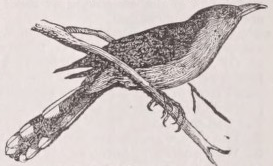
Respecting the Cuckows of America, the evidence, though it has been impugned, is certainly enough to clear them from the calumny which attaches to so many of their brethren of the Old World. There are two species very well known in parts of the United States and some of the West-Indian Islands (Coccyzus amerιcanus and C. erythrophthalmus), and each of them has occasionally visited Europe. They both build nests—remarkably small structures when compared with those of other birds of their size—and faithfully incubate their delicate sea-green eggs. In the south-western States of the Union and thence into Central America is found another curious form of Cuckow (Geococcyx)— the Chapparal-cock of northern and Paisano of southern settlers. The first of these names it takes from the low brushwood (chapparaï) in which it chiefly dwells, and the second is said to be due to its Pheasant-like (faisan corrupted into paisano, which is properly a countryman) appearance as it runs on the ground. Indeed, one of the two species of the genus was formerly described as a Phasianus. They both have short wings, and seem never to fly, but run with great rapidity. Returning to arboreal forms, the genera Neomorphus, Diplopterus, Saurothera, and Piaya (the last two commonly called Rain-birds, from the belief that their cry portends rain) may be noticed—all of them belonging to the Neotropical Region; but perhaps the most curious form of American Cuckows is the Ani (Crotophaga), of which three species inhabit the same Region. The best-known species C. ani) is found throughout the Antilles and on the opposite continent. In most of the British colonies it is known as the Black Witch, and is accused of various malpractices—it being, in truth, a perfectly harmless if not a beneficial bird. As regards its propagation this aberrant form of Cuckow departs as much in one directi¢nfrom the normal habit of birds as do so many of our...