
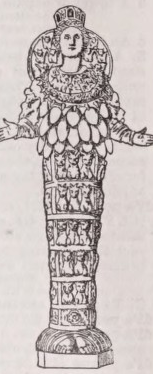
DIANA, who was at a later period reverenced as the Greek Artemis by the side of Apollo, was originally an independent deity of Italy, as, indeed, is shown by the name, which is the feminine form of Janus. She is essentially the moon goddess, and presides over wood, plain, and water, as well as κ over the changes of human character, and the special functions of the female sex, also over chase and war. Diana was worshipped by the Sabines, but more especially by the Aequi, Hernici, and Latins, whose united sanctuary lay in the wooded hills of Algidus beyond Tusculum. Diana had also a sanctuary in Anagnia, the capital of the Hernici, and another in Corne, near Tusculum. But more celebrated than all these was the grove and sanctuary of Diana of Aricia, on the Lake of Nemi, which gave the name of ’Nemorensis to Diana. Here she was worshipped side by side with a male deity Virbius. After the destruction of Alba Longa this grove was for a long time the united sanctuary of the neighbouring Latin and Rutulian cities, until at last it was extinguished beneath the supremacy of Rome. The festival of the goddess was on the ides of August, the full moon of the hot season. She was worshipped with torches, her aid was sought by women seeking a happy deliverance in childbirth, and many votive offerings have rewarded modern excavations on the site. Another celebrated sanctuary of Diana was that on the slopes of Mount Tifata, near Capua, where she was worshipped under the name of Tifatina. This sanctuary was specially favoured by Sulla and at a later period by Vespasian.' There were several ancient groves and sanctuaries of Diana in Rome, one in the Vicus Patricius between the Viminal and Esquiline, into which no man was admitted, another at the highest point of the Vicus Cyprius, ...another on the Caeliolus. But the most celebrated of all was the temple on the Aventine. This was originally a sanctuary of the Latin League, which accounts for the hill not being included in the original circuit of Rome, and for its being the refuge of the plebeians in political disturbances. The statue of the goddess was of the Ephesian type, the day of dedication was the ides of August, and the temple was especially frequented by slaves and their wives. Runaway slaves throughout Italy had a special dependence upon Diana. Such are the chief characteristics of the Roman Diana; but as early as 400 B,c. she began to be identified with the Greek Artemis, of which an account has already been given (see Artemis). For fuller information see Preller, Römische Mythologie.
[446 words — estimated reading time: 3 minutes]
a celebrated goddess of the Heathens, who was honoured principally at Ephesus, Acts xix. She was one of the number of the twelve superior deities, and was called by the several names of Hebe, Trivia, and Hecate. In the heavens she was the moon, upon earth she was called Diana, and in hell Hecate. She was worshipped in Palestine, Jeremiah vii, 18; xliv, 17, 18.
[65 words — estimated reading time: 1 minute]
DIANO, or Teggiano, a town of Italy in the province of Principato Citeriore, 45 miles south-east of Salerno, on an isolated eminence, above the upper part of the valley of the Negro, or Tanager, to which it gives the name of Val di Diano. It represents the ancient Tegianum, a municipal town of Lucania, of which the ruins ^can still be traced at the foot of the hill; and it possesses a castle, several churches of some interest, and three conventual buildings. In 1497 it was strong enough to resist, under Antonio Sanseverino of Salerno, the siege undertaken by Frederick of Aragon. Population in 1871, 6224.
[107 words — estimated reading time: 1 minute]