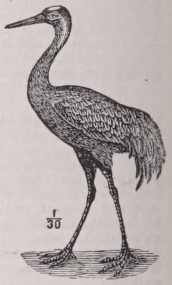
The nest is formed with little art on the ground in large open marshes, where the herbage is not very high—a tolerably dry spot being selected and used apparently year after year. Here the eggs, which are of a rich brown colour with dark spots, and always two in number, are laid. The young are able to run soon after they are hatched, and are at first clothed with tawny down. In the course of the summer they assume nearly the same grey plumage that their parents wear, except that the elongated plumes, which in the adults form a graceful covering of the hinder parts of the body, are comparatively undeveloped, and the clear black, white, and red (the last being due to a patch of papillose skin of that colour) of the head and neck are as yet indistinct. During this time they keep in the marshes, but as autumn approaches the different families unite by the rivers and lakes, and ultimately form the enormous bands which after much more trumpeting set out on their southward journey.
The Crane’s power of uttering the sonorous and peculiar trumpet-like notes, of which mention has been made, is commonly and perhaps correctly ascribed to the formation of its trachea, which on quitting the lower end of the neck passes backward between the branches of the furcula and is received into a hollow space formed by the bony walls of the carina or keel of the sternum. Herein it makes three turns, and then runs upwards and backwards to the lungs. The apparatus on the whole much resembles that found in the Whooping Swans {Cygnus musicus, C. buccinator, and others), though differing in some not unimportant details; but at the same time somewhat similar convolutions of the trachea occur in other birds which do not possess, so far as is known, the faculty of trumpeting. The Crane emits its notes both during flight and while on the ground. In the latter case the neck and bill are uplifted and the mouth kept open during the utterance of the blast, which may be often heard from birds in confinement, especially at the beginning of the year.
As usually happens in similar cases, the name of tho once familiar British species is now used in a general sense, and applied to all others which are allied to it. Though by many systematists placed near or even among the Herons, there is no doubt that the Cranes have only a superficial resemblance and no real affinity to the Ardeidae. In fact the Gruidae form a somewhat isolated group. Professor Huxley has included them together with the RalUdce in his Geranomorphae; but a more extended view of their various characters would probably assign them rather as relatives of the Bustards—not that it must bo thought that the two families have not been for a very long time distinct. Grus, indeed, is a very ancient form, its remains appearing in the Miocene of France and Greece, as well as in the Pliocene and Post-pliocene of North America. In France, too, during the “Reindeer Period” there existed a huge species—the G. primigenia of Μ. Alphonse Milne-Edwards—which has doubtless been long extinct. At the present time Cranes inhabit all the great zoogeographical Regions of the earth, except the Neotropical, and some sixteen or seventeen species are discriminated. In Europe, besides the G. communis already mentioned, we have as an inhabitant that which is generally known as the Numidian or Demoiselle-Crane {G. virgo), distinguished from every other by its long white ear-tufts. This bird is also widely distributed throughout Asia and Africa, and is said to have occurred in Orkney as a straggler. The eastern part of the Palaearctic Region is inhabited by four other species that do not frequent Europe {G. antigone, G. japonensis, G. monachus, and G.
letιcogeranus), cí which the last is perhaps the finest of tho family, with nearly the whole plumage of a snowy white. The Indian Region, besides being visited in winter by four of the species already named, has two that are peculiar to it (G. torquata and G. indica — both commonly confounded under the name of G. antigone). The Australian Region possesses a large species known to the colonists as the “Native Companion ” (G. australis)·, while the Nearctic is tenanted by three species (G. americana, G. canadensis, and G. fraterculus ), to say nothing of the possibility of a fourth (G. schlegeli), a little-known and somewhat obscure bird, finding its habitat here. In the Ethiopian Region we have two species (G. paradisea and G. carunculatd) which do not occur out of Africa, as well as two others forming the group known as “Crowned Cranes ”—differing much from other members of the family, and justifiably placed in a separate genus, Balearica. One of these (B. pavonina) inhabits Northern and Western Africa, while the other (B. regulorum) is confined to the eastern and southern parts of that continent.
With regard to the literature of this species, a paper “On the Breeding of the Crane in Lapland” (Ibis, 1859, p. 191), by the late M’r John Wolley, is one of the most pleasing contributions to natural history ever written, and an admirably succinct account of all the different species was communicated by the late Mr Blyth to The Field newspaper in 1873 (vol. xl. p. 631, vol. xli. pp. 7, 61, 136,∙ 189, 248, 384, 408, 418), which it is much to be regretted has not since been published in a more accessible form; while a beautiful picture representing a flock of Cranes, resting by the Rhine, during one of their annual migrations, is to be found in Mr Wolf’s Zoological Sketches.
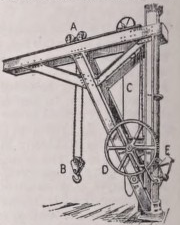
CRANE, a machine for raising and lowering heavy weights, and removing them from one place to another. Its chief parts are the jib, an inclined or horizontal beam at the end of which the weight is suspended; the upright crane post or stalk, on which the crane turns; the stay, beneath and supporting the jib; the barrel, round which the chain attached to the weight is coiled; and the winch, pinion, and handles. In place of a stay, chains or tensionbars above the jib are commonly employed; the latter at their upper end form eyes for the pivot of the sheave, or are pinned to the socket of the jib; below they are fixed to the cast-iron framing that carries the wheel-work. To prevent the acceleration of the movement of descending weights brakes are employed, in one form of which a lever causes friction by bringing a piece of wood, strengthened with iron, into contact with a plain wheel attached to the barrel of the crane. The winch handle has given it a radius of about 18 inches, and its centre is placed at 3 feet or 3 feet 2 inches from the ground; the limit of the average stress on it to be allowed for each labourer, working constantly at the rate of 220 feet a minute, has been found to be 1Õ lb. The length of the journals of the axles is made l⅛ to 2 times their diameter, which must be proportionate to the torsion of the wheels to be resisted. The diameter of the axles of the crane-barrel, if of cast-iron, should be proportional to tho cube root of the strain upon them in cwts; if of wrought iron, to τ 9 τ ths of the same. The chain or rope ought not to be worked with more than one-half the weight which it is estimated to be capable of bearing, The strength of the jib varies almost directly as the fourth power of its diameter, and inversely as the square of its length. In cranes for lifting great weights the jib may be made to rest against a circular rail let into masonry, instead of bearing against the crane post. The ends of the jib should not be rounded, but should be cut square, so as to lie evenly against the iron sockets into which they fit. In iron cranes the post is a hollow pillar of cast-iron, fixed by means of cross-shaped framings of the same material into a block of masonry; the jib is oí iron, or of wood with terminal sockets of that metal. A crane at Earl Grey’s Dock, Dundee Harbour, when worked by eight men, is capable of lifting 30 tons; it can be moved round by one man by the application of horizontal gearing; its total weight is not above 60 tons. The double crane for wharfs and pier-heads is framed and braced so as to balance exactly when turned on its pivot. In another double crane, used in the building of breakwaters, one jib is employed in laying, while the other lifts a stone. The derrick is a temporary crane consisting of a spar supported by guys or stays; in this crane the iron beam or derrick can, by raising or lowering, be set at any required angle.
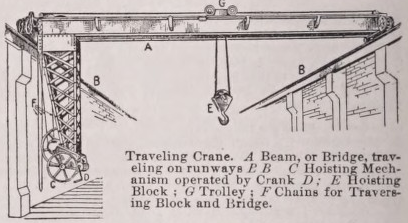
The cranes in general use in the earlier part of the last century were primitive contrivances worked by means of a large hollow wheel, within which a man walked -forwards or backwards according as goods were to be raised or lowered; the jib of the crane was fixed on a pivot, so as to turn round about ∣ths of a circle. After this a simpler form, still in use, was introduced, with the wheel fixed on a portion of the jib projecting behind the crane post. One of the first examples of traversing cranes was erected by Mr Rennie in the Mahogany Sheds at the West India Docks. For this kind of crane a railway is constructed on parallel frames of timber reaching across the roof of a building, and on this is a carriage supported on wheels, and capable, therefore, of being moved backwards or forwards by means of the machinery attached to it. The chain that bears the weight is connected with the carriage, and hangs down between the two lines of rails. By making the framework supporting the railway movable, as well as the carriage, goods can be transported in any required direction. The frames of railway traversing cranes are composed of two triangular timber structures, mounted on strong wheels; these by toothed wheels and pinions are caused to move along the railroad on which they are placed. At one time vacuum cranes were employed, to work which small oscillating cylinders, similar to those of high-pressure steam engines, were put in communication with a receiver exhausted of air by steam pumps. Afterwards steam came to be applied immediately as the motive power of cranes. In the direct-acting steam crane, the crane post itself is the steam cylinder, and the steel wire rope for lifting the load constitutes the piston-rod; to turn the crane round, steam is admitted to a cylinder beneath and forming part of the bed-plate. The first crane worked by pistons acted on by water-power was established at Newcastle-on-Tyne in 1846. Reservoirs at great heights for providing water-pressure can be dispensed with by the use of Sir W. Armstrong’s accumulator, an apparatus consisting of a cast-iron cylinder in which the water supplied by an engine is pressed upon by a loaded plunger. The excess of water pumped into the accumulator at any time is employed in raising the plunger; this, on reaching a certain height, begins to close a throttle-valve in the steam-pipe of the engine, and thus lessens its rate, until fresh demands are made upon the contents of the accumulator. The water discharged by the cranes may be led by a return-pipe to a cistern over the engine room, in order again to supply the force-pumps. To avoid jerks and concussions owing to the momentum of the jib after the closing of the water passages, a clack-valve is provided which opens up into the supply-pipe whenever the pressure in the cylinder of the hydraulic press becomes greater than that in the accumulator. The tubular cranes of Fairbairn are made of wrought-iron plates riτetted together. The jib, which is curved, is rectangular in crosssection, and tapers upwards to its extremity, and below the ground to a considerable depth, where it terminates in a shoe of cast-iron on which the crane revolves. The plates forming the edges of the jib are connected by means of angle iron, and those of its convex or upper side by chain rivetting. The curvature of the jib allows of the raising of weights to its highest point. The chain-barrels and the spindles for the tvheel-gearing are preferably inclosed within the jib.
See Mechanic and Engineer's Magazine, vol. ii. 2d ser. pp. 169, 190; Glynn, Rud. Treatise on the Construction of Cranes and Machinery, 1865; Laboulaye, Dictionnaire des Arts et Manuf., s.v. “Grue;” Cresy, Ency. of Civil Engineering.