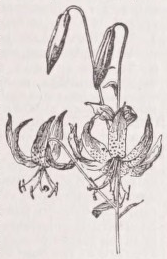
1. A genus of plants of many species, which are all bulbous-rooted, herbaceous perennials, producing bell-shaped, hexapetalous flowers of great beauty and variety of colors.
2. Lily of the valley, a plant of the genus convallaria, with a monopetalous, bell-shaped corol, divided at the top into six segments.
1. A plant and flower of the genus Lilium, endogenousbulbous plants, having a regular perianth of six colored pieces, six stamens, and a superior three-celled ovary.
2. A name given to handsome flowering plants of several genera, having some resemblance in color or form to a true lily, as Pancratium, Crinum, Amaryllis, Nerine, etc.
3. That end of a compass needle which should point to the north; -- so called as often ornamented with the figure of a lily or fleur-de-lis.
LILY, Lilium, the typical genus of Liliaceee, embraces nearly fifty species, all confined to the northern hemisphere, about fifteen being natives of Japan and China, six of the mountains of India, eight of south Europe, five of the east and nine of the west coasts of North America. The earliest in cultivation were described in 1597 by Gerard (Herball, p. 146), who figures eight kinds of European (true) lilies, viz., L. album (L ∣ . candidum, L.), and a variety, L. bizantinum, two umbellate forms of the type L. bulbiferum, Park., named L. aureum and L. cruentum latifolium, and three with pendulous flowers, apparently forms of the martagon lily. Parkinson, in his Paradisus (1629), described five varieties of martagon, six of umbellate kinds—two white ones, and L. pomponium, L. chalcedonicum, L. carniolicum, and L. pyrenaicum— together with one American, L. canadense, which had been introduced in 1629. For the ancient and mediaeval history of the lily, see Μ. de Cannart d’Hamale’s Monographie historique et littéraire des Lis (Malines, 1870). Since that period many new species have been added. The latest authorities for description and classification of the genus are J. G. Baker (“Revision of the Genera and Species of Tulipeae,” Journ. of Linn. Soc., xiv. p. 211, 1874) and J. H. Elwes (Monograph of the Genus Lilium, 1877-78), who first tested all the species under cultivation, and has published every one beautifully figured by W. H. Fitch, and some hybrids. With respect to the production of these latter, the genus is remarkable for its power of resisting the influence of foreign pollen, for the seedlings of any species, when crossed, generally resemble that which bears them. For the hardier kinds in cultivation, reference may be had to Hemsley’s Handbook...of Hardy Trees, <fcc∙, p. 501. The structure of a lily is of simple type, consisting of two whorls, of three free parts each, six free stamens, and a consolidatedpistil of three carpels, ripening into a three valved capsule containing many winged seeds. In form, the flower assumes three types :—trumpet-shaped, with a more or less elongated tube, e.g., L. loηgiflorum and L. candidum ; an open form with spreading perianth leaves, e.g., L. αuratum∙ 3 or assuming a pendulous habit, with the lips strongly reflexed, e.g., the martagon type. All have scaly bulbs, which in three west American species, as L. Humboldti, are remarkable for being somewhat intermediate between a bulb and a creepingrhizome. L. bulbiferum and its allies produce aerial reproductive bulbils in the axils of the leaves. The bulbs of several species are eaten, such as of L. avenaceum in Kamchatka, of L. Martagon by the Cossacks, and of L. tigrinum, the “tiger lily,” in China and Japan. Medicinal uses were ascribed to the species, but none appear to have any marked properties in this respect. See Horticulture, vol. xii. p. 257.
The white lily, L. candidum, the ∖Aρwν of the Greeks, was one of the commonest garden flowers of antiquity, appearing in the poets from Homer downwards side by side with the rose and the violet. According to Hehn, roses and lilies entered Greece from the east by way of Phrygia, Thrace, and Macedonia (.Kulturpflanzen und Ηaus-thiere, 3d ed., p. 217). The word λdριοv itself, from which lilium is derived by assimilation of consonants, appears to be Eranian (Ibid., p. 527), and according to ancient etymologists (Lagarde, Ges. Abh., p. 227) the town of Susa was connected with the Persian name of the lily s-ûsan (Gr. <τουσοv, Heb. shôshari). Mythologically the white lily, RοsaJunοnis, was fabled to have sprung from the milk of Hera. As the plant of purity it was contrasted with the rose of Aphrodite. The word κρίνον, on the other hand, included red and purple lilies, Plim, II. N., xxi. 5 (11,12), the red lily being best known in Syria and Judaea (Phaselis). This perhaps is the “red lily of Constantinople” of Gerarde, B. chdlcedonicum, L. The lily of the Old Testament (shδshan) may be conjectured to be a red lily from the simile in Cant. v. 13, unless the allusion is to the fragrance rather than the colour of the lips, in which case the white lily must be thought of. The “lilies of the field,” Matt. vi. 28, are κρίνα, and the comparison of their beauty with royal robes suggests their identification with the red Syrian lily of Pliny. Lilies, however, are not a conspicuous feature in the flora of Palestine, and the red anemone (Anemone coronaria), with which all the hill-sides of Galilee are dotted in the spring, is perhaps more likely to have suggested the figure. For the lily in the pharmacopoeia of the ancients see Adams’s Paid. Aegineta, iii. 196. It was usedin unguents and against the bites of snakes, &c. In the Middle Ages the flower continued to be common, and was taken as the symbol of heavenly purity. The three golden lilies of France are said to have been originally three lance-heads.
9th ed. Encyclopædia Britannica, vol. 14, p. 643 [844 words — estimated reading time: 5 minutes]
שישן, 1 Kings vii, 19, 22, 26; 2 Chron. iv, 5; Cant. ii, 2, 16; iv, 5; v, 13; vi, 2, 3; vii, 2; Hosea xiv, 5; κρίνον, Matt. vi, 28; Luke xii, 27; a well known sweet and beautiful flower, which furnished Solomon with a variety of charming images in his Song, and with graceful ornaments in the fabric and furniture of the temple. The title of some of the Psalms upon Shushan,” or Shoshanim,” Psalms xlv; lx; lxix; lxxx, probably means no more than that the music of these sacred compositions was to be regulated by that of some odes, which were known by those names or appellations. By the lily of the valley,” Cant. ii, 2, we are not to understand the humble flower, generally so called with us, the _lilium convallium_, but the noble flower which ornaments our gardens, and which in Palestine grows wild in the fields, and especially in the valleys. Pliny reckons the lily the next plant in excellency to the rose; and the gay Anacreon compares Venus to this flower. In the east, as with us, it is the emblem of purity and moral excellence. So the Persian poet, Sadi, compares an amiable youth to the white lily in a bed of narcissuses,” because he surpassed all the young shepherds in goodness. As, in Cant. v, 13, the lips are compared to the lily, Bishop Patrick supposes the lily here instanced to be the same which, on account of its deep red colour, is particularly called by Pliny _rubens lilium_, and which, he tells us, was much esteemed in Syria. Such may have been the lily mentioned in Matt. vi, 28–30; for the royal robes were purple: Consider the lilies of the field, how they grow; they toil not, neither do they spin: and yet I say unto you, that Solomon in all his glory was not arrayed like one of these:” so in Luke xii, 27. The scarcity of fuel in the east ...obliges the inhabitants to use, by turns, every kind of combustible matter. The withered stalks of herbs and flowers, the tendrils of the vine, the small branches of rosemary, and other plants, are all used in heating their ovens and bagnios. We can easily recognize this practice in that remark of our Lord, If God so clothe the grass of the field, which to-day is, and to-morrow is cast into the oven, shall he not much more clothe you, O ye of little faith?” Matt. vi, 30. The grass of the field, in this passage, evidently includes the lilies of which he had just been speaking, and, by consequence, herbs in general; and in this extensive sense the word χόρτος is not unfrequently taken. Those beautiful productions of nature, so richly arrayed, and so exquisitelyperfumed, that the splendour even of Solomon is not to be compared to theirs, shall soon wither and decay, and be used as fuel. God has so adorned these flowers and plants of the field, which retain their beauty and vigour but for a few days, and are then applied to some of the meanest purposes of life: will he not much more take care of his servants who are so precious in his sight, and designed for such important services in the world? This passage is one of those of which Sir Thomas Browne says, The variously interspersed expressions from plants and flowers elegantly advantage the significancy of the text.”
Mr. Salt, in his Voyage to Abyssinia,” says, “At a few miles from Adowa, we discovered a new and beautiful species of _amaryllis_, which bore from ten to twelve spikes of bloom on each stem, as large as those of the _belladonna_, springing from one common receptacle. The general colour of the corolla was white, and every petal was marked with a single streak of bright purple down the middle. The flower was sweet scented, and its smell, though much more powerful, resembled that of the lily of the valley. This superb plant excited the admiration of the whole party; and it brought immediately to my recollection the beautiful comparison used on a particular occasion by our Saviour: ‘I say unto you, that Solomon in all his glory was not arrayed like one of these.’” And Sir James E. Smith observes, “It is natural to presume the divine Teacher, according to his usual custom, called the attention of his hearers to some object at hand; and as the fields of the Levant are overrun with the _amaryllis lutea_, whose golden lilaceous flowers in autumn afford one of the most brilliant and gorgeous objects in nature, the expression of ‘Solomon in all his glory not being arrayed like one of these,’ is peculiarly appropriate. I consider the feeling with which this was expressed as the highest honour ever done to the study of plants; and if my botanical conjecture be right, we learn a chronological fact respecting the season of the year when the sermon on the mount was delivered.”
LILYE, William (c.1466-1523), one of the introducers of a knowledge of the Greek language into England, was born at Odiham, in or about the year 1466. He entered the university of Oxford in 1484, became a demy of Magdalen in 1486, and after taking his first degree in arts went on a pilgrimage to Jerusalem. On his return he put in at Rhodes, which was still occupied by the Knights, under whose protection many Greeks had taken refuge after the taking of Constantinople by the Turks. Here he laid the foundation of a knowledge of the Greek language. We next hear of him in Italy, following the lectures of John Sulpitius and Pomponius Laetus at Rome. From this he passed on to Venice, from which place he writes to his friend and patron Thomas Starkey, that “he is assiduously attending the lectures of Egnatius in Latin, but that he finds no one in Venice who can assist him in the study of Greek. He reads, however, Greek by himself, and has read seven plays of Sophocles, five of Euripides, three of Aristophanes, besides extracts from Xenophon and Plutarch, by himself without a teacher.” After his return he settled in London, as a private teacher of grammar, and is believed to have been the first who taught Greek in that city. In 1510 Colet, dean of St Paul’s, who was then founding the school which afterwards became famous, appointed Lilye the first highmaster. He held this office only twelve years, dying of the plague in February 1523....
Lilye’s name deserves commemoration, not only as one of the pioneers of Greek learning, but as one of the joint authors of a book, familiar to many generations of students, down to the present century, the old Eton Latin grammar. The Brevissima Institutio, a sketch by Colet, corrected by Erasmus, and worked upon by Lilye, contains two portions, the authorship of which is indisputably Lilye’s. These are the lines on the genders of nouns, beginning “Propria quae maribus,” and those on the conjugation of verbs, beginning “As in praesenti.” The “Carmen de moribus” bears Lilye’s name in the early editions: but Hearne asserts that it was written by Leland, who was one of his scholars, and that Lilye only adopted it. Besides the Brevissima Institutio, Lilye wrote a variety of Latin pieces both in prose and verse. Some of the latter are printed along with the Latin verses of Sir Thomas More in Progymηasmata Thomee Mori et Gulielmi Lylii Sodalium, Basel, 1518. Another volume of Latin verse directed against a rival schoolmaster and grammarian, Whittington, whose grammar that of Lilye superseded, is entitled Antibossicon ad Gulielmum Horrnαηnum *1521.
The only authority for the few facts which make up the above life of Lilye is a short sketch furnished by his son George to PaulusJovius, who was collecting for his history the lives of the learned men of Great Britain. All the other names, such as Bale, Pits, Fuller, Wood, which figure in the dictionaries as authorities, are only transcripts of George Lilye. To these scanty memoranda the present article adds an extract from three letters of Lilye’s preserved in the British Museum, Cotton. Nero, B. vi. fol. 157, now printed for the first time.
9th ed. Encyclopædia Britannica, vol. 14, p. 643 [550 words — estimated reading time: 4 minutes]
V. be beautiful, shine, beam, bloom, become one, set off, grace, render beautiful, beautify, polish, burnish, gild, set out, "snatch a grace beyond the reach of art"
Phr. auxilium non leve vultus habet, "beauty born of murmuring sound", "flowers preach to us if we will hear", gratior ac pulchro veniens in corpore virtus, "none but the brave deserve the fair", "thou who hast the fatal gift of beauty"
And the thickness of it was an handbreadth, and the brim of it like the work of the brim of a cup, with flowers of lilies; and it received and held three thousand baths.
It was a handbreadth thick, and its rim was fashioned like the brim of a cup, like a lily blossom. It could hold three thousand baths.
And give ye a sweet savour as frankincense, and flourish as a lily, send forth a smell, and sing a song of praise, bless the Lord in all his works.
This site uses cookies to remember your display preferences (search sources and editions, Bible version, auto-link, images, light/dark theme). No personal data whatsoever is collected. Privacy Policy