
One of several species of flowering plants, much admired for their beauty, and some for their fragrance.
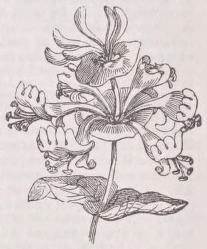
HONEYSUCKLE (M.E., lωny socle, i,e., any plant from which honey may be sucked,— cf. Ang.-Sax., huηi-suge, privet; Germ., Geissblatt', Fr., Chèvrefeuille), Lonicerus, L., a genus of climbing, erect, or prostrate shrubs, of the natural order Caprifo- liaceoe, so named after the German botanist Adam Lonicer. The British species are L. Periclymenum, the woodbine, L. Caprifolium, and L. Xy-losteτιm. Some of the garden varieties of the woodbine are very beautiful, and are held in high esteem for their delicious fragrance; even the wild plant, with its pale flowers, compensating for its sickly looks “with never - cloying odours.” The North American subevergreen L. semper- virens, with its fine heads of blossoms, commonly tailed the trumpet honeysuckle, is a distinct and beautiful species pro ducing both scarlet and yellow flowered varieties, and the Japanese L. brachypoda aureo-reticulata is esteemed for its charmingly variegated leaves. The fly honeysuckle, L. Xylosteum, a hardy shrub of dwarfish erect habit, and L. tatarica, of similar habit, both European, are amongst the oldest English garden shrubs, and bear axillary flowers of various colours, occurring two on a peduncle. There are numerous other species, many of them introduced to our gardens, and well worth cultivating in shrubberies or as climbers on walls and bowers, either for their beauty or the fragrance of their blossoms....
In the western counties of England, and generally by agriculturists, the name honeysuckle is applied to the meadow clover, Trifolium pratense. Another plant of the same leguminous family, Hedysarum coronarium, a very handsome hardy biennial often seen in old-fashioned collections of garden plants, is commonly called the French honeysuckle. The name is moreover applied with various affixes to several other totally different plants. Thus white honeysuckle and false honeysuckle are names for the North American Azalea viscosa ; Australian or heath honeysuckle is the Australian Banksia serrata, Jamaica honeysuckle the Passiflora laurifolia, dwarf honeysuckle the widely spread Cornus suecica, Virgin Mary’s honeysuckle the European Pulmonaria officinalis, while West Indian honeysuckle is the T écorna capensis, and is also a name applied to Desmodium.
The wood of the fly honeysuckle is extremely hard, and the clear portions between the joints of the stems, when their pith has been removed, are stated by Linnaeus to be utilized in Sweden for making tobacco-pipes. The wood is also employed to make teeth for rakes; and, like that of L. tatarica, it is a favourite material for walking-sticks.