TARTAGLIA, Niccolô (c. 1500-1557), a self-taught mathematician, was born at Brescia about 1500. His father, Michele Fontana, was a postal messenger between Brescia and the neighbouring towns, who, dying in 1506, left two sons and a daughter to the care of their penniless mother. Niccold’s childhood was accordingly passed under the stress of dire poverty, and was marked by a cruel misfortune. During the sack of Brescia in 1512 he was, in the cathedral where he had vainly sought a refuge, horribly mutilated by some infuriated French soldiers. His skull was laid open in three places, his palate cloven, both jawbones fractured. Yet he recovered with no further assistance than his mother’s patient care. He, however, long continued to stammer in his speech, whence the nickname, adopted by himself, of “Tartaglia.” His education remains a mystery. Save for the barest rudiments of reading and writing, he tells us that he had no master; yet we find him at Verona in 1521 an esteemed teacher of mathematics. In 1534 he transferred his residence to Venice, and was there met by Antonio del Fiore with a challenge to one of the intellectual duels then customary. Del Fiore relied on his possession of an undivulged formula by Scipione del Ferro for the solution of a particular case of cubic equations. But Tartaglia had attained in 1530 a similar result, which he now, in February 1535, greatly extended. His consequent triumph over his adversary gave him a high reputation, and his house became the resort of the learned of all grades and nations. The mystery in which he chose to shroud his method of dealing with cubic equations promised him a highly effective weapon in future contests, as well as leisure to perfect, before publishing, the coveted rules. But in 1539 Cardan enticed ...him to Milan, and there, by unremitting solicitations, procured from him the rude verses in which he had enshrined his discovery (see Algebra, vol. i. p. 513). The Milanese physician’s breach of his oath of secrecy gave rise to a bitter and lifelong quarrel, the most conspicuous incident in which was a public disputation at Milan, August 10, 1548, at which Cardan shrank from appearing. In 1548 Tartaglia accepted a situation as professor of Euclid at Brescia, but returned to Venice at the end of eighteen months. He died at Venice December 13, 1557. Acrid and emulous in disposition, he incurred abundant enmities; yet his honesty, uprightness, and the morality of his life remain unimpeached. He was keen-witted, diligent, and ingenious, and by his discoveries in the solution of equations helped to initiate the rapid progress of modern mathematics.
Tartaglia’s first printed work, entitled Nova Scientia (Venice, .1537), dealt with the theory and practice of gunnery, to which his attention had been drawn in 1531 by the question of a bombardier at Verona as to the elevation giving the greatest range. He easily found it to be 45° (true only in vacuo), but failed to demonstrate the correctness of his intuition. Indeed, he never shook off the erroneous ideas of his time regarding the paths of projectiles, further than to see that no part of them could be a straight line. He nevertheless inaugurated the scientific treatment of the subject, and his propositions reappeared in most ballistical treatises down to Blondel’s in 1683. The publication of the Nova Scientia was determined by the menacing attitude of Soliman II. Unless in the interests of Christendom, Tartaglia regarded it as a crime to promote arts of destruction. Inquiries rendered lawful by necessity were, however, resumed in his Quesiti et Invenzioni Diverse, a collection of the author's replies to questions addressed to him by persons of the most varied conditions, published in 1546, with a dedication to Henry VIII. of England. Problems in artillery occupy two out of nine books; the sixth treats of fortification; the ninth gives several examples of the solution of equations of the third degree. His last years were full of activity. He published in 1551 Rcgola Generate per sollevare ogni affondata Nave, intitolata la Travagliata Invenzionc (an allusion to his personal troubles at Brescia), setting forth a method for raising sunken ships, and describing the diving-bell, then little known in western Europe. He pursued the subject in Ragionarnenti sopra la Travagliata Invenzionc (May 1551), adding a table of specific gravities. Of his largest work, entitled General Trattato di Numeri e Misure, two parts appeared at Venice in 1556, the remaining four posthumously in 1560. This is a comprehensive mathematical treatise, including arithmetic, geometry, mensuration, and algebra as far as quadratic equations. He designed to embody the results of his original investigations in a separate form; but his Algebra Nova remained unwritten. He published the first Italian translation of Euclid (1543) and the earliest version from the Greek of some of the principal works of Archimedes (1543). These included the tract De Insidentibus Aguae, of which his Latin now holds the place of the lost Greek text. An Italian version of it is appended to his Ragionarnenti. Tartaglia was the first Italian writer on fortification, and claimed the invention of the gunner’s quadrant.
Tartaglia’s own account, of his early life is contained in his Quesiti, lib. vi. p. 74. See also Bittanti’s Discorso di Niccolô Tartaglia, Brescia, 1871; Buoncompagni, Intorno ad un Testamento inedito di N. Tartaglia, Milan, 1881; Libri, Hist, des Sciences Mathématiques, t. iii. p. 149; Montucιa, Hist, des Math., vol. i. p. 567; Marie, Hist, des Sciences, t. ii.p. 242; Hankel, Zur Gesell, d. Math., 1874, p. 360; Rossi, Elogi di Bresciani Illustri, p. 386. Tartaglia’s writings on gunnery were translated into English by Lucar in 1588, and into French by Rieffel in 1845. Thos. Sainsbury published (London, 1564) an English version of his Travagliata Inventione, and a selection from his writings appeared at Venice in 1606 with the title oρere del Famosissimo Niccolô Tartaglia, 1 vol. 8vo.
[999 words — estimated reading time: 6 minutes]
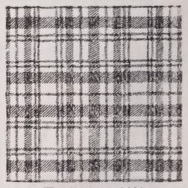
TARTAN is a worsted cloth woven with alternate stripes or bands of coloured warp and weft, so as to form a chequered pattern in which the colours alternate in “sets” of definite width and sequence. The weaving of particoloured and striped cloth cannot be claimed as peculiar to any special race or country’ for indeed such checks are the simplest ornamental form into which dyed yarns can be combined in the loom. But the term tartan is specially applied to the variegated cloth used for the principal portions of the distinctive costume of the Highlanders of Scotland. For this costume, and the tartan of which it is composed, great antiquity is claimed, and it is asserted that the numerous clans into which the Highland population were divided had each from time to time a special tartan by which it was distinguished. After the rebellion of 1745 various Acts of Parliament were passed for disarming the Scottish Highlanders and for prohibiting the use of the Highland dress in Scotland, under severe penalties. These Acts remained nominally in force till 1782, when they were formally repealed, and since that time clan tartan has, with varying fluctuations of fashion, been a highly popular article of dress, by no means confined in its use to Scotland alone; and many new and imaginary “sets’’have been invented by manufacturers, with the result of introducing confusion in the heraldry of tartans, and of throwing doubt on the reality of the distinctive “sets” which at one time undoubtedly were more or less recognized as the badge of various clans. The manufacture has long been carried on at Bannockburn, in the neighbourhood of Stirling, and it still continues to be a feature of the local industries there....
Undoubtedly the term tartan was known, and the material was woven, “of one or two colours for the poor and more varied for the rich,” as early as the middle of the 15th century. In the accounts of John, bishop of Glasgow, treasurer to King James III. in 1471, there occurs, with other mention of the material, the following:—“Ane eine and ane halve of blue Tartane to lyne his gowne of cloth of Gold.” It is here obvious that the term is not restricted to particoloured chequered textures. In 1538 accounts were incurred for a Highland dress for King James V. on the occasion of a hunting excursion in the Highlands, in which there are charges for “variant cullorit velvet,” for “ane schort Heland coit,” and for “Heland tartane to be hose to the kinge’s grace.” Bishop Lesley, in his De Origine, Moribus, et Rebus Gestis Scotorum, published in 1578, says of the ancient and still-used dress of the Highlanders and islanders, “all, both noble and common people, wore mantles of one sort (except that the nobles preferred those of several colours).” George Buchanan, in his Rerum Scoticarum Historia (1582), as translated by Monypenny (1612), says of the Highlanders, “they delight in marled clothes, specially that have any long stripes of sundry colours; they love chiefly purple and blue. Their predecessors used short mantles or plaids of divers colours sundry ways divided; and amongst some the same custom is observed to this day.” A hint of clan tartan distinctions is given by Martin in his Western Isles of Scotland (1703), which work also contains a minute description of the dress of the Highlanders and the manufacture of tartan. “Every isle,” he observes, “differs from each other in their fancy of making plaids, as to the stripes in breadth and colours. This humour is as different through the mainland of the Highlands, in so far that they who have seen those places is able at the first view of a man’s plaid to guess the place of his residence.”
See W. and Ä. Smith, Tartans of the Clans of Scotland, 1850; J. Sobieski Stuart, Vestiarium Scoticum, 1842; R. R. M'Ian, Clans of the Scottish Highlands, 1845-46; J. Grant, Tartans of the Clans of Scotland, Edinburgh, 1885.
[669 words — estimated reading time: 4 minutes]
TARTARIC ACID, in its ordinary acceptation, refers to one acid, (C 4 H 4 O e )H 2 , which occurs in most acid fruit juices, in association generally with malic or citric, or both. Grape-juice owes its sourness almost entirely to acid tartrate of potash. While the juice ferments into wine, the greater part of the acid tartrate separates out, along with tartrate of lime, colouring matter, and other impurities, as a hard crust adhering to the sides of the cask. Such impure acid tartrate of potash is known commercially as “argol.” It was known to the Greeks as τpvξ, to the Romans as faex vini. The alchemists from the 11th century called it tartarus, which name has survived in familiar chemical parlance to this day. The true constitution of tartarzιs vini was discovered by Scheele in 1769. He was the first to isolate the acid from its acid potash salt by a method which is still used for its industrial extraction.
Manufacture.— Crude tartar (10 to 14 cwts.) is placed in a tank, and dissolved in sufficient water with the help of steam. The surplus acid is then neutralized by addition of powdered chalk, and precipitated as lime salt:— 2(C 4 H 4 0 6 )KH = (C 4 H 4 0 6 )K 2 + (C 4 H 4 0 β )H 2 ; normal salt. acid
(C 4 H 4 O 6 )H 2 + Ca CO 3 =(C 4 H 4 O 6 )Ca + H 2 O + CO 2 .
The other half of the tartaric acid which remains dissolved as normal potash salt is then precipitated in the same form by addition of chloride of calcium :—
(C 4 H 4 O 6 )K 2 +CaCl 2 = 2KC1 + (C 4 H 4 O β )Ca.
The tartrate of lime precipitate is collected, washed, and decomposed by an excess of sulphuric acid at 75° C. :— (C 4 H 4 O β )Ca + H 2 SO 4 =CaSO 4 + (C 4 H 4 O 6 )H 2 ....
The sulphate of lime is removed by decanting and filtering. and the acid solution evaporated in leaden pans to a sufficient degree to deposit crystals on standing in the cold. The crystals are purified by redissolving them in hot water, decolorizing the solution with animal charcoal, and causing the acid to crystallize a second time after addition of sulphuric acid, which promotes the formation of large crystals. The crystals contain a little sulphuric acid and a trace of lead; if intended for internal use, they must be recrystallized from pure water.
Tartaric acid forms hard colourless transparent monoclinic prisms of L764 spec, grav., easily soluble in cold and abundantly in hot water. It has a strong but agreeable sour taste. At 15° C. 100 parts of water dissolve 138 parts of the acid, 100 of alcohol (absolute) 20 ’ 4, and 100 of ether 0 ’ 39. It fuses at 135° C. and passes into an amorphous modification known as meta-tartaric acid; when heated more strongly it loses water, and passes into the forms of anhydrides. At high temperatures it is decomposed with formation of charcoal and volatile products, which smell pretty much like those formed from sugar in the same circumstances. Most oxidizing agents produce formic from the aqueous acid. Boiling with oxide of silver and excess of caustic alkali produces oxalate.
Tartaric acid is used largely in calico printing as a discharge. In pharmacy and households it serves, conjointly with bicarbonate of soda or potash, for the extemporaneous preparation of effervescing drinks. The so-called German effervescing powders are a combination of weighed-out doses of tartaric acid and of bicarbonate of soda. In the so-called “seltzogènes” (glass apparatus in which carbonic acid is produced in one compartment, to be forced by its own pressure into a mass of water, wine, &c., in the other) the gas is similarly produced.
Tartrates.— The acid potash salt, (C 4 H 4 0g)HK, “cream of tartar,” is prepared from crude tartar (argol) by dissolving it in hot water, filtering off what remains of tartrate of lime and other impurities, and allowing the filtrate to crystallize. The crystals are generally contaminated with a little of the lime-salt, for the removal of which the best method is to treat the powdered crystals with cold dilute hydrochloric acid and then wash them with cold water by displacement. The lime passes into the filtrate. Cream of tartar forms small colourless hard crystals which dissolve in about 200 parts of cold and in 15 parts of boiling water. In alcohol the salt is even less soluble than in water.
Υ∖∖c normal (neutral) potash salt, (C 4 H 4 O 6 )K 2 + ⅜H 2 O, is prepared by dissolving powdered cream of tartar in hot solution of carbonate of potash until a neutral or slightly alkaline solution is produced. The salt, being extremely soluble in water, does not crystallize very readily. In former times the carbonate of potash required used to be made by igniting one half of the cream of tartar to be operated upon in a crucible. Hence the name of tartarus tartaris-atus, which is still familiar in pharmacy. The salt is used medicinally, and also for removing free acid from excessively sour wine by formation of relatively insoluble bitartrate (Liebig’s method).
Rochelle salt, (C 4 H 4 O 6 )KNa + 4H 2 O, is prepared by not quite neutralizing hot solution of carbonate of soda with powdered cream of tartar. The (filtered) hot solution deposits on cooling magnificent crystals, readily soluble in water, though less so than the unmixed potash salt. Rochelle salt is used as a mild purgative. The so-called Seidlitz powders are effervescing powders with a considerable addition of Rochelle salt to the bicarbonate.
The normal tartrates of lime, baryta, &c., are insoluble precipitates producible by double decompositions.
Tartar emetic, (C 4 H 4 O 6 )K(SbO) + ⅜H 2 O, is produced by boiling 4 parts of oxide of antimony, Sb 2 O 3 , and 5 of powdered cream of tartar with 50 of water for about an hour. The filtered solution, on cooling, deposits crystals of the above composition soluble in 15 parts of cold and 2 - 8 of boiling hot water. The crystals generally exhibit the appearance of tetrahedra; yet they are rhombic prisms combined with pyramids. The process going on in the formation of the salt is easily understood if we remember that Sb 2 O 3 often acts on aqueous acids as if it were the monoxide, (SbO) 2 O, of a radical (SbO) antimonyl. (SbO) 2 O + H 2 O is equivalent to 2(SbO)OH, and
(C 4 H 4 O 6 )KH + OH(SbO) = H 2 O + (C 4 H 4 O 6 )K(SbO).
Tartar emetic has long had a standing in medicine. In doses of 1-3 grains it acts as a powerful emetic; very small doses (5 ⅛ to τ ⅛ grain) induce perspiration. Large doses produce poisonous effects.
Analysis.— Tartaric acid is characterized chiefly by the relative insolubility of its acid potash salt. To produce it from a solution of a neutral tartrate, add acetic acid and acetate of potash, and stir vigorously; the salt gradually separates out as a crystalline precipitate. Neutral tartrate solutions, with chloride of calcium, give a precipitate of tartrate of lime, which is at first amorphous, and in this condition dissolves pretty readily in excess of reagent or tartrate, but in general re-separates in the crystalline form (the undissolved tartrate likewise becomes crystalline) on standing.
Anhydrides.— Tartaric acid, when kept at 135°, fuses and becomes meta-tartaric acid without change of weight, and on continued application of 140-150° C., ditartrylic acid, C 8 H 10 O 11 = 2C 4 H 6 O β -H 2 θ5 and at 180° tartrelic acid, C 8 H 8 O 10 = 2C 4 H 6 O β - 2H 2 O, is produced. All these three acids form salts of their own, which, however, tend to become tartrates in the presence of water. At 180° real tartaric anhydride (like tartrelic, C 8 H 8 Oj 0 = 2C 4 H 4 O s ) is produced, in addition to tartrelic acid, as an infusible yellowish mass, insoluble in water and in ether. By continued contact with water it is converted finally into tartaric acid solution.
Isomeric Modifications.— Among these racemic acid has long been known as an occasional bye-product in the manufacture of tartaric acid. It used to be believed that racemic acid is present ready formed in certain grape-juices, and thus comes to make its appearance occasionally; but it is well known now that the bulk of it at any rate is produced from what was originally tartaric acid, by the continued action of high temperatures and water. Racemic acid is almost identical with tartaric acid; the only purely chemical point of difference is that corresponding salts of the two acids often crystallize with different proportions of water. The two acids, however, are easily distinguished by their action on polarized light (see Polarity, vol. xix. p. 314). A solution of tartaric acid turns the plane of polarization to the right; racemic acid is, in this sense, optically inactive. These long-known facts led Pasteur to the discovery of the true relations of the two acids. If the double racemate, (C 4 H 4 O 6 )Na(NH 4 ), is allowed to crystallize slowly, two kinds of crystals are produced, both bearing herniedric faces, but differing from each other in the situation of these, exactly as the right hand differs from the left. Pasteur separated the two kinds of crystals, and found that one kind is identical with the ordinary (dextro-) tartrate of soda and ammonia, while the other contains a new kind of tartaric acid, which he called leevo-tartaric acid because it turns the plane of polarization to the left. Equal weights of the two acids, when dissolved separately in water and mixed, unite, with perceptible evolution of heat, into optically neutral racemic acid. Racemic acid, then, is laevo-and dextro-tartaric united (loosely) into one molecule. There are a number of optically inactive tartaric acids, not susceptible of decomposition in the sense in which racemic acid is.
[1,708 words — estimated reading time: 10 minutes]
TARTARS (more correctly Tatars, but Tartars is the form generally current), a name given to nearly three million inhabitants of the Russian empire, chiefly Moslem and of Turkish origin. The majority—in European Russia—are remnants of the Mongol invasion of the 13th century (see Mongols), while those who inhabit Siberia are survivals of the once much more numerous Turkish population of the Ural-Altaic region, mixed to some extent with Finnish and Samoyedic stems, as also with Mongols. The name is derived from that of the Ta-ta Mongols, who in the 5th century inhabited the northeastern Gobi, and, after subjugation in the 9th century by the Tungus Kidans, migrated southward, there founding the Mongolian empire under Jenghiz Khan {q.v.). Under the leadership of his grandson (Batu) they moved westwards, driving with them many stems of the Turkish Ural-Altaians towards the plains of Russia. The ethnographical features of the present Tartar inhabitants of European Russia, as well as their language, show that they contain no admixture (or very little) of Mongolian blood, but belong to the Turkish branch of the Ural-Altaic stock, necessitating the conclusion that only Batu, his warriors, and a limited number of his followers were Mongolians, while the great bulk of the 13th-century invaders were Turks. On the Volga they mingled with remnants of the old Bulgarian Turkish empire, and elsewhere with Finnish stems, as well as with remnants of the ancient Italian and Greek colonies in Crimea and Caucasians in Caucasus. The name of Tatars, or Tartars, given to the invaders, was afterwards extended so as to include different stems of the same Turkish branch in Siberia, and even the bulk of the then little known inhabitants of the high plateau of Asia and its north-western slopes, ...which was described under the general name of Tartary. This last name has almost disappeared from geographical literature, but the name Tartars, in the above limited sense, remains in full use.
The present Tartar inhabitants of the Russian empire form three large groups,—those of European Russia and Poland, those of Caucasus, and those of Siberia. The discrimination of the separate stems included under the name is still far from completion. The following subdivisions, however, may be regarded as established. (1) The Kazan Tartars, descendants of the Kiptchaks settled on the Volga in the 13th century, where they mingled with survivors of the Bulgar Turks and partly with Finnish stems. They number about half a million in the government of Kazan, about 100,000 in each of the governments of Ufa, Samara, and Simbirsk, and about 300,000 in Vyatka, Saratoff, Tamboff, Penza, Nijni-Novgorod, Perm, and Orenburg; some 15,000 belonging to the same stem have migrated to Ryazan, or have been settled as prisoners in the 16th and 17th centuries in Lithuania (Vilna, Grodno, and Podolia); and there are some 2000 in St Petersburg. In Poland they constitute 1 per cent, of the population of the district of l·’tock. The Kazan Tartars speak a pure Turkish dialect; they are middle-sized, broad-shouldered, and strong, and mostly have black eyes, a straight nose, and salient cheek bones. They are Mohammedans; polygamy is practised only by the wealthier classes and is a waning institution. Excellent agriculturists and gardeners, very laborious, and having a good reputation for honesty, they live on the best terms with their Russian peasant neighbours. It may be added that, according to Μ. Yuféroff {Étude éthn. mir les Bachkirs, 1881), those Bashkirs who live between the Kama, Ural, and Volga are not of Finnish origin, but in virtue of their history, language, anthropological features, and customs must be regarded as Tartars. (2) The Astrakhan Tartars (about 10,000) are, with the Mongol Kalmucks, all that now remains of the once so powerful Astrakhan empire. They also are agriculturists and gardeners; while some 12,000 Kundrovsk Tartars still continue the nomadic life of their ancestors. (3) The Crimean Tartars, who occupied the Crimea in the 13th century, have preserved the name of their leader, Nogai. During the 15th, 16th, and 17 th centuries they constituted a rich empire, which prospered until it fell under Turkish rule, when it had to suffer much from the wars fought between Turkey and Russia for the possession of the peninsula. The war of 1853 and the laws of 1860-63 and 1874 caused an exodus of the Crimean Tartars; they abandoned their admirably irrigated fields and gardens and moved to Turkey, so that now their number falls below 100,000. Those of the south coast, mixed with Greeks and Italians, are well known for their skill in gardening, their honesty, and their laborious habits, as well as for their fine features, presenting the Tartar type at its best. The mountain Tartars closely resemble those of Caucasus, while those of the steppes—the Nogais—are decidedly of a mixed origin from Turks and Mongolians.
The Tartars of Caucasus, who inhabit the upper Kuban, the steppes of the lower Kuma and the Kura, and the Araxes, number about 1,350,000. Of these (4) the Nogais on the Kuma show traces of an intimate mixture with Kalmucks. They are nomads, supporting themselves by cattle-breeding and fishing; few are agriculturists. (5) The Karatchais (18,500) in the upper valleys about Elburz live by agriculture. (6) The mountain Tartars (about 850,000), divided into many tribes and of an origin still undetermined, are scattered throughout the provinces of Baku, Erivan, Tiflis, Kutais, Daghestan, and partly also of Batum. They are certainly of a mixed origin, and present a variety of ethnological types, all the more so as all who are neither Armenians nor Russians, nor belong to any distinct Caucasian tribe, are often called Tartars. As a rule they are well built and little behind their Caucasian brethren. They are celebrated for their excellence as gardeners, agriculturists, cattletenders, and artisans. Although most fervent Shi'ites, they are on very good terms both with their Sunnite and with their Russian neighbours. Polygamy is rare with them, and their women go to work unveiled.
The Siberian Tartars, mostly mixed with Finnish stems, are the most difficult to classify. They occupy three distinct regions,—a strip running west to east from Tobolsk to Tomsk, the Altai and its spurs, and South Yeniseisk. They originated in the agglomerations of Turkish stems which in the region north of the Altai succeeded the Ugro-Samoyedic civilization (see Siberia), and reached a relatively high degree of culture between the 4th and the 8th centuries, but were subdued and enslaved by the Mongols. In the meantime the following subdivisions of the Siberian Tartars may be accepted. (7) The Baraba Tartars, who take their name from one of their stems (Barama), number about 50,000 in the government of Tobolsk and about 5000 in Tomsk. After a strenuous resistance to Russian conquest, and much suffering at a later period from Kirghiz and Kalmuck raids, they now live by agriculture, either in separate villages or along with Russians. (8) The Tcholyτn or Tchulym Tartars on the Tcholym and both the rivers Yus speak a Turkish language with many Mongolian and Yakut words, and are more like Mongols than Turks. In last century they paid a tribute for 2550 arbalètes, but they now are rapidly becoming fused with Russians. (9) The Abakan or Minusinsk Tartars occupied the steppes on the Abakan and Yus in the 17th century, after the withdrawal of the Kirghizes, and represent a mixture with Koibals (whom Castrén considers as partly of Ostiak and partly Samoyedic origin) and Beltirs—also of Finnish origin. Their language is also mixed. They are known under the name of Sagais, who numbered 11,720 in 1864, and are the purer Turkish stem of the Minusinsk Tartars, Koibals, and Kyzyl or Red Tartars. Formerly Shamanists, they now are, nominally at least, adherents of the Greek Orthodox Church, and support themselves mostly by cattle-breeding. Agriculture is spreading but slowly among them; they still prefer to plunder the stores of bulbs of Lilium Martagon, Paeonici, and Brythroniιιm Dens canis laid up by the steppe mouse {Mus socialis'). The Soyotes, or Soyons, of the Sayan Mountains, who are Finns mixed with Turks, the Uryankhes of north-west Mongolia, who are of Turkish origin but follow Buddhism, and the Karagasses, also of Turkish origin but much like the Kirghizes, and reduced now to a few hundreds, are akin to the above. (10) The Tartars of the northern slopes of the Altai (nearly 20,000 in number) are of Finnish origin. They comprise some hundreds of Kumandintses, the Lebed Tartars, the Tchernevyie or Black-Forest Tartars, and the Shors (11,000), descendants of the Kuznetsk or Iron-Smith Tartars. They are chiefly hunters, passionately loving their taiga, or wild forests, and have maintained their Shaman religion and tribal organization into suoks. They live partly also on cedar-nuts and honey collected in the forests. Their dress is that of their former rulers, the Kalmucks, and their language contains many Mongolian words. (11) The Altai Tartars, or “Altaians,” comprise—(α∙) the Mountain Kalmucks (12,000), to whom this name has been given by mistake, and who have nothing in common with the Kalmucks except their dress and mode of life, while they speak a Turkish dialect, and (δ) the Teleutes, or Telenghites (5800), a remainder of a formerly numerous and warlike nation who have migrated from the mountains to the lowlands, where they now live along with Russian peasants.
Finally, there are a number of Tartars in Turkestan and Central Asia. Without including under this name the ·.Sarts and the Kuramintses of Turkestan, still less the Kirghiz-Kazaks, it may be reckoned that there are still nearly 30,000 survivors of the Uigurs in the valley of the Ili, about Kuldja, and in the Khami oasis.
As is evident from the above, although the name Tartars originated in an indiscriminate application of the word to the Turkish and Mongolian stems which invaded Europe six centuries ago, and its gradual extension to the Turkish stems mixed with Mongolian or Finnish blood in Siberia, it still represents an aggregate of characters which warrant at least a provisional use of this genetic name, if those to whom it is given are properly subdivided. It embodies stems which, although widely distinct, still have some common ethnographical and philological features, besides being to some extent of like origin and history.
The literature of the subject is very extensive, and bibliographical indexes may be found in the Geographical Dictionary of P. Semenoff, appended to the articles devoted respectively to the names given above, as also in the yearly indexes by Μ. Mezhoff. Besides the well-known works of Castrén, which are a very rich source of information on the subject, Schiefner (St Petersburg academy of science), Donner, Ahlqvist, and other explorers of the Ural-Altaians, as also those of the Russian historians Solovieff, Kostomaroff, Bestιιzheff-Riumin, Schapoff, and Ilovaiskiy, the following containing valuable information may be mentioned the publications of the Russian Geographical Society and its branches; the Russian Etnographicheskiy Sbornik∖ the Izvestia of the Moscow society of the amateurs of natural science; the works of the Russian ethnographical congresses; KostrofΓs researches on the Siberian Tartars in the memoirs of the Siberian branch of the geogr. soc.; Radloff , s Reise durch den Altai, Aus Sibirien; “Picturesque Russia ’ (Jivopisnaya Rossiya) ; Semenoff’s and Potanin’s “Supplements” to Ritter’s Asien ; Harkavi’s report to the congress at Kazah; Hartakhai’s “Hist, of Crimean Tatars,” in Vyestnik Evropy, 1866 and 1867; “Katchinsk Tartars," in Izvestia Russ. Geogr. Soc., xx., 1884.

[1,942 words — estimated reading time: 12 minutes]
TARTARUS, in the Iliad (viii. 13 sq., 481), is a dark underground prison with iron gates, as far below Hades as earth is below heaven, whither Cronus and the Titans were thrust down by Zeus (vol. xxi. p. 321), and to which the sovereign of Olympus threatens to consign other gods who may disobey his behests. Later writers make Tartarus the place of punishment of the wicked after death: Aeneas, in his visit to the abode of the shades, comes to a point where the road divides, the branch to the right leading to Elysium and that on the left to the prison-house of Tartarus, girt about by a triple wall, with the fiery Phlegethon as a moat, and guarded by the fury Tisiphone (Tn., vi. 540 sq.). Tartarus is personified as the son of Aether and Ge, and father of the giants Typhoeus and Echidna.
[147 words — estimated reading time: 1 minute]