
An instrument to measure the gravity, density, velocity, force, etc. of water and other fluids, and the strength of spirituous liquors.
HYDROMETER. The object of the hydrometer is the determination of the density of bodies, generally of fluids, but some forms of the instrument are adapted to the determination of the density of solids.
It is shown in the article Hydromechanics that, when a body floats in a fluid under the action of gravity, the weight of the body is equal to that of the fluid which it displaces. It is upon this principle that the hydrometer is constructed, and it obviously admits of two modes of application in the case of fluids: either we may compare the weights of floating bodies which are capable of displacing the same volume of different fluids, or we may compare the volumes of the different fluids which are displaced by the same weight. In the latter case, the densities of the fluids will be inversely-proportional to the volumes thus displaced....
Perhaps the simplest method of experimentally determining the densities of different liquids is afforded by the series of areometrical glass beads, or hollow balls, first proposed by Dr Wilson, professor of astronomy in the university of Glasgow. As subsequently improved by Mrs Lovi, these beads were constructed in sets, each bead in the set differing in density from its predecessor by Ό02 (of the density of water). Each bead is numbered according to its density, and in order to determine the specific gravity of a liquid it is only necessary to throw into it the set of beads, or so many of them as are known to include between their extremes the density of the liquid, when all the beads whose densities exceed that of the liquid will sink, while those whose densities are less than that of the liquid will float. If there is a bead of exactly the same density as the liquid, it will rest in any position, provided it is completely immersed. Failing this, all that is immediately apparent is that the density is intermediate between that of the lightest bead that sinks and that of the heaviest that floats. For example, if all the beads numbered 1 ’ 466 and upwards sink, while those below 1 ’ 466 float, it is obvious that the density of the liquid is intermediate between 1 ’ 464 and 1∙466. In the case of most fluids the intervals may be divided approximately by slightly warming the liquid. Thus, if on heating the liquid 6° C. it is found that the bead 1’466 begins to sink, and on heating it still farther through 12° C. (i.e., through 18° C. altogether) the bead 1 ’ 468 begins to sink, then the density of the liquid is approximately 1 465.
The hydrometer is said by Synesius Cyreneus in his fifth letter to have been invented by Hypatia at Alexandria, but appears to have been neglected until it was reinvented by Robert Boyle, whose “New Essay Instrument,” as described in the Phil. Trane, for June 1675, differs in no essential particular from Nicholson’s hydrometer. This instrument was devised for the purpose of detecting counterfeit coin, especially guineas and half-guineas. In the first section of the paper {Phil. Trans., No. 115, p. 329) the author refers to a glass instrument exhibited by himself many years before, and “consisting of a bubble furnished with a long and slender stem, which was to be put into several liquors, to compare and estimate their specific gravities.” This seems to be the first reference to the hydrometer in modern times.
In fig. 1 C represents the instrument used for guineas, the circular plates A representing plates of lead, which are used as ballast when lighter coins than guineas are examined. B represents “a small glass instrument for estimating the specific gravities of liquors,” an account of which was promised by Boyle in the following number of the Phil. Trans., but did not appear.
The instrument represented at B (fig. 1), which is copied from Robert Boyle’s sketch in the Phil. Trans, for 1675, is generally known as the common hydrometer. It is usually made of glass, the lower bulb being loaded with mercury or small shot which serves as bal last, causing the instrument to float with the stem vertical. The quantity of mercury or shot inserted depends upon the density of the liquids for which the hydrometer is to be employed, it being essential that the whole of the bulb should be immersed in the heaviest liquid for which the instrument is used, while the length and diameter of the stem must be such that the hydrometer will float in the lightest liquid for which it is required. The stem is usually divided into a number of equal parts, the divisions of the scale being varied in different instruments, according to the purposes for which they are employed.
Let V denote the volume of the instrument immersed (i.e., of liquid displaced) when the surface,of the liquid in which the hydrometer floats coincides with the lowest division of the scale, A the area of the transverse section of the stem, l the length of a scale division, n the number of divisions on the stem, and W the weight of the instrument. Suppose the successive divisions of the scale to be numbered 0, 1, 2 . . . . n starting with the lowest, and let w 0 , w 1 , w 2 . . . w n be the weights of unit volume of the liquids in which the hydrometer sinks to the divisions 0, 1, 2 . . . . n respectively. Then, by the principle of Archimedes,
W = Vw 0 ;
™ W
or «’ο-γ.
Also W = (V + ZA)w 1
W
or w '~ + τa*
ςj W
So rr»
r V +plA ΛV and *f"∙=≡F ττ i V + nlA or the densities of the several liquids vary inversely as the respective volumes of the instrument immersed in them; and, since the divisions of the scale correspond to equal increments of volume-immersed, it follows that the densities of the several liquids in which the instrument sinks to the successive divisions form a harmonic series.
If V = NZA then N expresses the ratio of the volume of the instrument up to the zero of the scale to that of one of the scaledivisions. If we suppose the lower part of the instrument replaced by a uniform bar of the same sectional area as the stem and of volume V, the indications of the instrument will be in no respect altered, and the bottom of the bar will be at a distance of N scaledivisions below the zero of the scale.
In this case we have w ρ W ; p (N+j>)ZA ’ or the density of the liquid varies inversely as N +p, that is, as the whole number of scale-divisions between the bottom of the tube and the plane of flotation.
If we wish the successive divisions of the scale to correspond to equal increments in the density of the corresponding liquids, then the volumes of the instrument, measured up to the successive divisions of the scale, must form a series in harmonical progression, the lengths of the divisions increasing as we go up the stem.
The greatest density of the liquid for which the instnιment described above can be employed is y, while the least density is W W
∙,-= —, or =7—, where v represents the volume of the stem between
V + nZA V + √
the extreme divisions of the scale. Now, by increasing v, leaving W and V unchanged, we may increase the range of the instrument indefinitely. But it is clear that if we increase Λ, the sectional area of the stem, we shall diminish I, the length of a scale-division corresponding to a given variation of density, and thereby proportionately diminish the sensibility of the instrument, while diminishing the section A will .increase l and proportionately increase the sensibility, but will diminish the range over which the instrument can be employed, unless we increase the length of the stem in the inverse ratio of the sectional area. Hence, to obtain great sensibility along with a considerable range, we require very long slender stems, and to these two objections apply in addition to the question of portability; for, in the first place, an instrument with a very long stem requires a very deep vessel of liquid for its complete immersion, and, in the second place, when most of the stem is above the plane of flotation, this diminishes or may destroy the stability of the instrument when floating. The various devices which have been adopted to overcome this difficulty will be described in the account given of the several hydrometers which have been hitherto generally employed.
The plan commonly adopted to obviate the necessity of inconveniently long stems is to construct a number of hydrometers as nearly alike as may be, but to load them differently, so that the scaledivisions at the bottom of the stem of one hydrometer just overlap those at the top of the stem of the preceding. By this means a set of six hydrometers, each having a stem rather more than five inches long, will be equivalent to a single hydrometer with a stem of thirty inches. But, instead of employing a number of instruments differing only in the weights with which they are loaded, we may employ the same instrument, and alter its weight either by adding mercury or shot to the interior (if it can be opened) or by attaching weights to the exterior. These two operations are not quite equivalent, since a weight added to the interior does not affect the volume of liquid displaced when the instrument is immersed up to a given division of the scale, while the addition of weights to the exterior increases the displacement. This difficulty may be met, as in Keene’s hydrometer, by having all the weights of precisely the same volume but of different masses, and never using the instrument except with one of these weights attached.
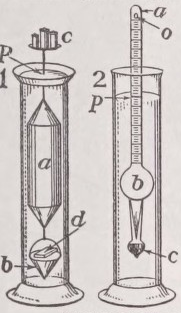
The first hydrometer intended for the determination of the densities of liquids, and furnished with a set of weights to be attached when necessary, was that constructed by Mr Clarke, and described by Dresaguliers in the Philosophical Transactions for March and April 1730, No. 413, p. 278. The following is Desaguliers’s account of the instrument (fig. 2) :—
“After having made several fruitless trials with ivory, because it imbibes spirituous liquors, and thereby alters its gravity, he (Mr Clarke) at last made a copper hydrometer, represented in fig. 2, having a brass wire of about 1 inch thick going through, and soldered into the copper ball BA The upper part of this wire is filed flat on one side, for the stem of the hydrometer, with a mark at m, to which it sinks exactly in proof spirits. There are two other marks, A and B, at top and bottom of the stem, to show whether the liquor be 1 ⅛th above proof (as when it sinks to A), or ,⅛th under proof (as when it emerges to B), when a brass weight such as C has been screwed on to the bottom at c. There are a great many such weights, of different sizes, and marked to be screwed on instead of C, for liquors that differ more than τ ⅛th from proof, so as to serve for the specific gravities in all such proportions as relate to the mixture of spirituous liquors, in all the variety made use of in trade. There are also other balls for showing the specific gravities quite to common water, which make the instrument perfect in its kind.”
Clarke’s hydrometer, as afterwards constructed for the purposes of the excise, was provided with thirty-two weights to adapt it to spirits of different specific gravities, and eleven smaller weights, or “weather weights” as they were called, which were attached to the instrument in order to correct for variations of temperature. The weights were adjusted for successive intervals of 5° Fahr., but for degrees intermediate between these no additional correction was applied. The correction for temperature thus afforded was not sufficiently accurate for excise purposes, and Mr Speer in his essay on the hydrometer (Tilloch’s Phil. May., vol. xiv.) mentions cases in which this imperfect compensation led to the extra duty payable upon spirits which were more than 10 per cent, over proof being demanded on spirits which were purposely diluted to below 10 per cent, over proof in order to avoid the charge.
Desaguliers himself constructed a hydrometer of the ordinary type for comparing the specific gravities of different kinds of water (Desaguliers’s Experimental Philosophy, vol. ii. p. 234). In order to give great sensibility to the instrument, the large glass ball was made nearly 3 inches in diameter, while the stand consisted of a wire 10 inches in length and only τ ⅛ inch in diameter. The instrument weighed 4000 grains, and the addition of a grain caused it to sink through an inch. By altering the quantity of shot in the small balls the instrument could be adapted for liquids other than water.
To an instrument constructed for the same purpose, but on a still larger scale than that of Desaguliers, M. De· parcieux added a small dish on the top of the stem for the reception of the weights necessary to sink the instrument to a convenient depth. The effect of weights placed in such a dish or pan is of course the same as if they were placed within the bulb of the instrument, since they do not alter the volume of that part which is immersed.
The first important improvement in the hydrometer after its reinvention by Boyle was introduced by Fahrenheit, who adopted the second mode of construction above referred to, arranging his instrument so as always to displace the same volume of liquid, its weight being varied accordingly. Instead of a scale, only a single mark is placed upon the stem, which is very slender, and bears at the top a small scale pan into which weights are placed until the instrument sinks to the mark upon its stem. The volume of the displaced liquid being then always the same, its density will be proportional to the whole weight supported, that is, to the weight of the instrument together with the weights required to be placed in the scale pan.
Nicholson’s hydrometer (fig. 3) combines the characteristics of Fahrenheit’s hydrometer and of Boyle’s essay instrument. 1 The following is the description given of it by Nicholson in the Manchester Memoirs, vol. ii. p. 374.
“A A represents a small scale. It may be taken off at D. Diameter 1⅜ inch, weight 44 grains.
“Ba stem of hardened steel wire. Diameter τ ⅜ π inch.
“E a hollow copper globe. Diameter 2 τ ⅞ inches. Weight with stem 369 grains.
“FF a stirrup of wire screwed to the globe at C.
“G a small scale, serving likewise as a counterpoise. Diameter 1⅜ inch. Weight with stirrup 1634 grains.
“The other dimensions maybe had from the drawing which is one-sixth of the linear magnitude of the instrument itself.
“In the construction, it is assumed that the upper scale shall constantly carry 1000 grains when the lower scale is empty, and the instrument sunk in distilled water at the temperature of 60° Fahrenheit to the middle of the wire or stem. The length of the stem is arbitrary, as is likewise the distance of the lower scale from the , surface of the globe. But, the length of the stem son s y rome ‘ being settled, the lower scale may be made lighter, and, consequently, the globe less, the greater its distance is taken from the surface of the globe; and the contrary.”
In comparing the densities of different liquids, it is clear that this instrument is precisely equivalent to that of Fahrenheit, and must be employed in the same manner, weights being placed in the top scale only until the hydrometer sinks to the mark on the wire, when the specific gravity of the liquid will be proportional to the weight of the instrument together with the weights in the scale.
In the subsequent portion of the paper above referred to, 1 Nicholson s Journal, vol. i. ρ. 111, footnote.
Nicholson explains how the instrument may be employed as a thermometer, since, fluids generally expanding more than the solids of which the instrument is constructed, the instrument will sink as the temperature rises.
To determine the density of solids heavier than water with this instrument, let the solid be placed in the upper scale pan, and let the weight now required to cause the instrument to sink in distilled water at standard temperature to the mark B be denoted by w, while W denotes the weight required when the solid is not present. Then W -w is the weight of the solid. Now let the solid be placed in the lower pan, care being taken that no bubbles of air remain attached to it, and let w i be the weight now required in the scale pan. This weight will exceed w in consequence of the water displaced by the solid, and the weight of the water thus displaced will be w 1 - w, which is therefore the weight of a volume of water equal to that of the solid. Hence, since the weight of the
W — w solid itself is W - w, its density must be .
w 1 -w
The above example illustrates how Nicholson’s or Fahrenheit’s hydrometer may be employed as a weighing machine for small weights.
In all hydrometers in which a part only of the instrument is immersed, there is a liability to error in consequence of the surface tension, or capillary action, as it is frequently called, along the line of contact of the instrument and the surface of the liquid (see Capillary Action). This error diminishes as the diameter of the stem in reduced, but is sensible in the case of Hie thinnest stem which can be employed, and is the chief source of error in the employment of Nicholson’s hydrometer, which otherwise would be an instrument of extreme delicacy and precision. The following is Nicholson’s statement on this point:—
“One of the greatest difficulties which attends hydrostatical experiments arises from the attraction or repulsion that obtains at the surface of the water. After trying many experiments to obviate the irregularities arising from this cause, I find reason to prefer the simple one of carefully wiping the whole instrument, and especially the stem, with a clean cloth. The weights in the dish must not be esteemed accurate while there is either a cumulus or a cavity in the water round the stem.”
It is possible by applying a little oil to the upper part of the bulb of a common or of a Sikes’s hydrometer, and carefully placing it in pure water, to cause it to float with the upper part of the bulb and the whole of the stem emerging as indicated in fig. 4, when it ought properly to sink almost to the top of the stem, the surface tension of the water around the circumference of the circle of contact, AA', providing the additional support required.
The universal hydrometer of Mr G. Atkins, described in the Phil. Mag. for 1808, vol. xxxi. p. 254, is merely Nicholson’s hydrometer with the screw at C projecting through the collar into which it is screwed, and terminating in a sharp point above the cup G. To this point soft bodies lighter than water (which would float if placed in the cup) could be attached, and thus completely immersed. Atkins’s instrument was constructed so as to weigh 700 grains, and when immersed to the mark on the stem in distilled water at 60° F., it carried 300 grains in the upper dish. The hydrometer therefore displaced 1000 grains of distilled water at 60° F., and hence the specific gravity of any other liquid was at once indicated by adding 700 to the number of grains in the pan required to make the instrument sink to the mark on the stem. The small divisions •on the scale corresponded to differences of τ ⅛th of a grain in the weight of the instrument.
The “Gravimeter,” constructed by Citizen Guyton and described in Nicholson's Journal, 4to, vol. i. p. 110, differs from Nicholson’s instrument in being constructed of glass, and having a cylindrical bulb about 21 centimetres in length and 22 millimetres in diameter. Its weight is so adjusted that an additional weight of 5 grammes must be placed in the upper pan to cause the instrument to sink to the mark on the stem in distilled water at the standard temperature. The instrument is provided with an additional piece, or “plongeur,” whose weight exceeds 5 grammes by the weight of water which it displaces; that is to...