
This name has been given to a hugh quadruped, now extinct, whose bones are found on both continents.
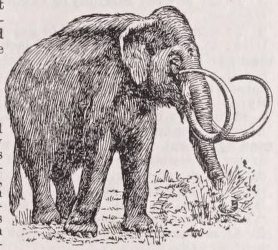
MAMMOTH, a name commonly given to one of the numerous extinct forms of Elephant, Elephas primigenius of Blumenbach and most subsequent authors. Probably no animal which has not survived to the historic period has left such abundant and well-preserved evidence of its former existence. The discovery of immense numbers, not only, as in the case of most extinct creatures, in the form of fragmentary bones and teeth, but often as more or less entire carcases, or “mummies” as they may be called, with the flesh, skin, and hair ⅛ situ, in the frozen soil of the tundras of northern Siberia, has for a long time given great interest to the species, and been the cause of many legendary stories among the natives of the lands in which they occur. Among these one of the most prevailing is that the Mammoth was, or still is, an animal which passes its life habitually in burrows below the surface of the ground, and which immediately dies if by any chance it comes into the upper air.
The general characteristics of the animals of the order Proboscidea, to which the Mammoth belongs, are given in the article Mammalia (p. 423). Its position is also there indicated as a member of the most highly specialized section of the group of Elephants, that called by Falconer Euelephas, which also contains the modern Asiatic species. Of the whole group it is in many respects, as in the size and form of the tusks, and especially the characters of the molar teeth, the farthest removed from the primitive Mastodon-like type, while its nearest surviving relative, E. indicus, has retained the slightly more generalized characters of the Mammoth’s contemporaries of more southern climes, E. columbi of America, and E. armeniacus of the Old World, if, indeed, it can be specifically distinguished from them....
The tusks or upper incisor teeth were doubtless present in both sexes, but probably of smaller size in the female. In the adult males they often attained the length of from 9 to 10 feet measured along the outer curve. Upon leaving the head they were directed at first downwards and outwards, then upwards and finally inwards at the tips, and generally with a tendency to a spiral form not seen in other species of Elephant. Different specimens, however, present great variations in curve, from nearly straight to an almost complete circle.
It is chiefly by the characters of the molar teeth that the various extinct modifications of the Elephant type are distinguished. Those of the Mammoth (see fig. 2) differ from the corresponding organs of allied species in (1) great breadth of the crown as compared with the length, (2) the narrowness and crowding or close approximation of the ridges, (3) the thinness of the enamel and its straightness, parallelism, and absence of “crimping” as seen on the worn surface, or in a horizontal section of the tooth. The molars, as in other Elephants, are six in number on each side above and below, succeeding each other from before backwards. Of these Dr Falconer gave the prevailing “ridge-formula” (or number of complete enamelled ridges in each tooth) as 4, 8, 12, 12, 16, 24, as in E. indicus. Dr Leith Adams, working from more abundant materials, has shown that the number of ridges of each tooth, especially those at the posterior end of the series, is subject to very great individual variation, ranging in each tooth of the series within the following limits: 3 to 4, 6 to 9, 9 to 12, 9 to 15, 14 to 16, 18 to 27,—excluding the small plates called “talons” at each end of the tooth. Besides these variations in the number of ridges or plates of which each tooth is composed, the thickness of the enamel varies so much as to have given rise to a distinction between a “thick-plated” and a “thin-plated” variety, —the latter being most prevalent among the specimens from the Arctic regions, and most distinctively characteristic of the species. From the specimens with thick enamel plates the transition to the other species or varieties mentioned above, including E. indicus, is almost imperceptible.
The bones of the skeleton generally more resemble those of the Indian Elephant than of any other known species, but the skull differs, in the narrower summit, narrower temporal fossae, and more prolonged incisive sheaths, required to support the roots of the enormous tusks. Among the external characters by which the Mammoth was distinguished from either of the existing species of Elephant was the dense clothing, not only of long coarse outer hair, but also of close under woolly hair, of a reddish-brown colour, evidently in adaptation to the colder climate which it inhabited. This character, for a knowledge of which we are indebted to the well-preserved remains found in northern Siberia, is also represented in the rude but graphic drawings of prehistoric age, found in caverns in the south of France. In size different individuals varied considerably, but the average height does not appear to have exceeded that of either of the existing species of Elephant.
The geographical range of the Mammoth was very extensive. There is scarcely a county in England in which some of its remains have not been found either in alluvial deposits of gravel or in caverns, and numbers of its teeth are from time to time dredged up from the bottom of the sea by the fishermen who ply their trade in the German Ocean, having been washed out of the water-worn cliffs of the eastern counties of England. In Scotland and Ireland its remains are less abundant, but they have been found in vast numbers at various localities throughout the greater part of central Europe (as far south as Santander in Spain and Rome), northern Asia, and the northern part of the American continent, though the exact distribution of the Mammoth in the New World is still a question of debate. It has not hitherto been met with in any part of Scandinavia or Finland.
In point of time, the Mammoth belongs exclusively to the post-Tertiary or Pleistocene epoch of geologists, and it was undoubtedly contemporaneous with man in France, and probably elsewhere. There is evidence to show that it existed in Britain before, during, and after the glacial period.
As before indicated, it is in the northern part of Siberia that its remains have been found in the greatest abundance, and in quite exceptional conditions of preservation. For a very long period there has been from that region a regular export of Mammoth ivory in a state fit for commercial purposes, both eastward to China and westward to Europe. In the middle of the 10th century an active trade was carried on at Khiva in fossil ivory, which was fashioned into combs, vases, and other objects, as related by Abd Ί Kâsim, an Arab writer of that period. Middendorff reckoned that the number of tusks which have yearly come into the market during the last two centuries has been at least a hundred pairs, and Nordenskiöld from personal observation considers this calculation as probably rather too low than too high. They are found at all suitable places along the whole line of the shore between the mouth of the Obi and Behring’s Straits, and the farther north the more numerous do they become, the islands of New Siberia being now one of the most favourite collecting localities. The soil of Bear Islands and of Liachoff Islands is said to consist only of sand and ice with such quantities of Mammoth bones as almost to compose its chief substance. The remains are not only found around the mouths of the great rivers, as would be the case if the carcases had been washed down from more southern localities in the interior of the continent, but are imbedded in the frozen soil in such circumstances as to indicate that the animals had lived not far from the localities in which they are now found, and they are exposed either by the melting of the ice in unusually warm summers or by the washing away of the sea cliffs or river banks by storms or floods. In this way the bodies of more or less perfect animals, often standing in the erect position, with the soft parts and hairy covering entire, have frequently been brought to light.
References to the principal recorded discoveries of this kind, and to the numerous speculations to which they have given rise, both among the ignorant peasants and learned academicians, will be found in Nordenskiöld’s Voyage of the Vega (English translation, vol. i. 1881, p. 398 sq.) and a series of papers in the Geological Magazine for 1880 and 1881, bv H. H. Howorth. For the geo graphical distribution and anatomical characters, see Falconer’s Palaeontological Memoirs, vol. ii,, 1868; Boyd Dawkins, “Elephas primigenius, its range in space and time,” Quart. Jour. Geol. Soc., XXXV. p. 138 (1879); and Leith Adams, “Monograph of British Fossil Elephants,” part ii., Palaeontographical Society, 1879.
MAMMOTH CAVE, iu Edmondson county, Kentucky, United States, 37° 14' N. lat. and 86° 12' W. long., by rail 85 miles south-south-west of Louisville, was discovered, in 1809, by a hunter named Hutchins, while in pursuit of a wounded bear. Its mouth is in a forest ravine, 194 feet above Green river, and 600 feet above the sea. This aperture is not the original mouth, the latter being a chasm a quarter of a mile north of it, and leading into what is known as Dixon’s Cave. The two portions are not now connected, though persons in one can make themselves heard by those in the other. Saltpetre was formerly made from the nitrous earth in which the cave abounded; but it is now mainly turned to account as a place of exhibition.
The cavernous limestone of Kentucky covers an area of 8000 square miles, is massive and homogeneous, and belongs to the Subcarboniferous period. It shows few traces of dynamic disturbance, but has been carved, since the Miocene epoch, into many caverns, of which the Mammoth Cave is the noblest specimen known. The region is undulating, "but its valleys are mostly funnel-shaped depressions emptying through fissures into subterranean streams, which feed rivers, often of navigable size, and whose waters are never frozen over, even in severe winters. Such valleys are called sink-holes....
The natural arch that admits one to Mammoth Cave has a span of 70 feet, and from a ledge above it a cascade leaps 50 feet to the rocks below, where it disappears. A winding flight of stone steps leads the way down to a narrow passage, through which the air rushes with violence, outward in summer, and inward in winter. The temperature of the cave is uniformly 54° Fahr, throughout the year, and the atmosphere is both chemically and optically of singular purity. While the lower levels are moist from the large pools that have secret connexion with Green river, the upper galleries are extremely dry. These conditions led, at one time, to the erection of thirteen cottages, at a point about 1 mile under ground, for the use of invalids, especially consumptives. The experiment ended in failure, and only two cottages now remain.
The Main Cave, from 40 to 300 feet wide, and from 35 to 125 feet high, has several vast rooms, e.g. t the Rotunda, where are the ruins of the old saltpetre works; the Star Chamber, where the protrusion of white crystals through a coating of the black oxide of manganese creates an optical illusion of great beauty; the Chief City, where an area of 2 acres is covered by a vault 125 feet high, and the floor is strewn with rocky fragments, among which are found numerous half-burnt torches made of canes, and other signs of prehistoric occupancy. Two skeletons were exhumed near the Rotunda; but no other bones of any description have been found. The so-called Mammoth Cave “mummies” (i.e., bodies kept by being inhumed in nitrous earth), with accompanying utensils, ornaments, braided sandals, and other relics, were found in Short and Salt caves near by, and removed to Mammoth Cave for exhibition. The Main Cave, which abruptly ends 4 miles from the entrance, is joined by winding passages, with spacious galleries on different levels; and, although the diameter of the area of the whole cavern is less than 10 miles, the combined length of all accessible avenues is supposed to be about 150 miles.
The chief points of interest are arranged along two lines of exploration, besides which there are certain side excursions. The “short route” requires about four hours, and the “long route” nine. Audubon’s Avenue, the one nearest the entrance, is seldom visited, except by the bats that hang from the walls in clusters like swarms of bees. The Gothic Avenue contains numerous large stalactites and stalagmites, and an interesting place called the Chapel, and ends in a small double dome and cascade. Among the most surprising features of cave scenery are the vertical shafts that pierce through all levels, from the uppermost galleries, or even from the sink-holes, down to the lowest floor. These are styled pits or domes, according to the position occupied by the observer. A crevice behind a block of stone 40 feet long by 20 wide, called the Giant’s Coflin, admits the explorer to a place where six pits, varying in depth from 65 feet to 220 feet, exist in an area of 600 yards. This includes Gorin’s Dome, which is viewed from a point midway in its side, and is by many regarded as the finest room in the cavern. Others admire more the Mammoth Dome, at the termination of Spark’s Avenue, where a cataract falls from a height of 250 feet amid walls wonderfully draped with stalactitic tapestry. The Egyptian Temple, which is a continuation of the Mammoth Dome, contains six massive columns, two of them quite perfect, and 80 feet high and 25 feet in diameter. The combined length of these contiguous chambers is 400 feet. By a crevice above they are connected with an arm of Audubon’s Avenue. Lucy’s Dome, about 300 feet high, is supposed to be the loftiest of all these vertical shafts. A pit called “the Maelstrom,” in Croghan’s Hall, is the spot most remote from the mouth of the cave; a son of Prentice, the poet, permitted himself to be lowered 190 feet by a rope to the bottom, in 1859. There are some fine stalactites near this pit, and others in the Fairy Grotto and in Pensico Avenue; but, considering the magnitude of Mammoth Cave, its poverty of stalactitic ornamentation is remarkable. The wealth of crystals is, however, surprising. These are of endless variety and fantastic beauty. Besides the sparkling vault of the Star Chamber (300 feet long and 80 high), there are halls canopied by fleecy clouds, or studded with mimic snowballs, and others displaying various grotesque resemblances on the walls and ceiling.
Cleveland’s Cabinet and Marion’s Avenue, each a mile long, are adorned by myriads of gypsum rosettes and curiously twisted crystals, called “oulopholites.” These cave flowers are unfolded by pressure, as if a sheaf were forced through a tight binding, ami the crystal fibres curl outward from the centre of the group. Thus spotless arches of 50 feet span are embellished by floral clusters and garlands, hiding nearly every foot of the grey limestone. The botryoidal formations hanging by thousands in Mary’s Vineyard resemble mimic clusters of grapes, as the oulopholites resemble roses. Again there are chambers with drifts of snowy crystals of the sulphate of magnesia, the ceilings so thickly covered with their efflorescence that a loud concussion of the air will cause them to fall like the flakes of a snow storm.
Many small rooms and tortuous paths, where nothing of special interest can be found, are avoided as much as possible on the regular routes; but certain disagreeable experiences are inevitable. There is peril also in the vicinity of the deep pits. The one known as the Bottomless Pit was for many years a barrier to all further exploration, but is now crossed by a wooden bridge. Long before the shaft had been cut as deep as now, the water flowed away by a channel gradually contracting to a serpentine way, so extremely narrow as to be called the Fat Man’s Misery. The walls, only 18 inches apart, change direction eight times in 105 yards, while the distance from the sandy path to the ledge overhead is but 5 feet. The rocky sides are finely marked with waves and ripples, as if running water had suddenly been petrified. This winding way conducts one to River Hall, beyond which lie the crystalline gardens that have been described. It used to be said that, if this narrow passage were blocked up, escape would be impossible; but lately an intricate web of fissures, called the Corkscrew, has been discovered, by means of which a good climber, ascending only a few hundred feet, lands 1000 yards from the mouth of the cave, and cuts off one or two miles.
The waters, entering through numerous domes and pits, and falling, during the rainy season, in cascades of great volume, are finally collected in River Hall, where they form several extensive lakes, or rivers, whose connexion with Green riveι ’ is known to be in two deep springs appearing under arches on its margin. Whenever there is a freshet in Green river the streams in the cave are joined in a continuous body of water, the rise sometimes being 60 feet above the low-water mark. The subsidence within is less rapid than the rise; and the streams are impassable for about seven months in each year. They are navigable from May to October, and furnish interesting features of cave scenery. The first approached is called the Dead Sea, embraced by cliffs 60 feet high and 100 feet long, above which a path has been made, whence a stairway conducts us down to the banks of the River Styx, a body of water 40 feet wide and 400 feet long, crossed by a natural bridge. Lake Lethe comes next—a broad basin enclosed by walls 90 feet high, below which a narrow path leads to a pontoon at the neck of the lake. A beach of the finest yellow sand extends for 500 yards to Echo river, the largest of all, being from 20 to 200 feet wide, 10 to 40 feet deep, and about three-quarters of a mile long. It is crossed by boats. The arched passage-way is very symmetrical, varying in height from 10 to 35 feet, and famous for its musical reverberations,—not a distinct echo, but an harmonious prolongation of sound for from 10 to 30 seconds after the original tone is produced. "The long vault has a certain keynote of its own, which, when firmly struck, excites harmonics, including tones of incredible depth and sweetness.
The fauna of Mammoth Cave has been classified by Putman, Packard, and Cope, who have catalogued twenty-eight species truly subterraneous, besides those that may be regarded as stragglers from the surface. They are distributed thus:— Vertebrata, 4 species; Insecta, 11; Arachnida, 6; Myriapoda, 2; Crustacea, 2; Vermes, 3. Ehrenberg adds a list of 8 Polygastric Infusoria, 1 fossil infusorian, 5 Phytolitharia, and several microscopic fungi. A bed of Agaricus was found by the writer near the River Styx; and upon this hint an attempt has been made to propagate edible fungi in this locality. The most interesting inhabitants of Mammoth Cave are the blind, wingless grasshoppers, with extremely long antennae; blind, colourless crayfish {Cambar us pellucidus, Telk.); and the blind fish, Amblyopsis spclaeus, colourless and viviparous, from 1 inch to 6 inches long. The Cambarus and Amblyopsis have wide distribution, being found in many other caves, and also in deep wells, in Kentucky and Indiana. Fish not blind are occasionally caught, which are apparently identical with species existing in streams outside. The true subterranean fauna may be regarded as chiefly of Pleistocene origin; yet certain forms are possibly remnants of Tertiary life. The strongly marked divergence of these animals from those found outside convinced the elder Agassiz that they were specially created for the limits within which they dwell. But the opinion now held is that they are modified from allied species existing in the sunlight, and that their peculiarities may all be accounted for on principles of evolution,—the process being accelerated (or retarded) by their migration from the outer world to a realm of absolute silence and perpetual darkness.
The literature of Mammoth Cave is extensive, though scattered through manyperiodicals, volumes of travels, and scientific reports. See especially Bullitt, Rambles by a Visitor, 1844; Collins, History of Kentucky, 1847; Forwood, The Mammoth Cave, 1870; Packard and Putnam, Inhabitants of Mammoth Cave, 1872; Shaler, Memoirs of Geological Survey of Kentucky, 1876; Hovey, “In Mammoth Cave," Scribner's Magazine, 1880; Celebrated Caverns, 1882.