
1. The fruit of the mango tree, a native of the East Indies, of the genus Mangifera. It is brought to us only when pickled. Hence mango is the green fruit of the tree pickled.
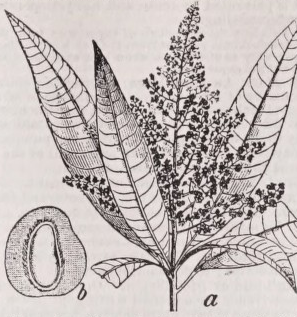
MANGO. The mango-tree {Mangifera indica, I.., natural order Anacardiaceae or Terebinthaceae) is a native of tropical Asia, but during the last hundred years has been extensively cultivated in the tropical and subtropical regions of the New as well as the Old World. It grows rapidly to a height of 30 to 40 feet, and its dense, spreading, and glossy foliage would secure its cultivation for the sake çf its shade and beauty alone. Its fruit, a drupe, though in the wild variety (not to be confused with that of Spσndias mangifera, Pers., belonging to the same order, also called wild mango in India) stringy and sour from its containing much gallic acid, and with a disagreeable flavour of turpentine, has become sweet and luscious through culture and selection, to which we owe many varieties, differing not only in flavour but also in size, from that of a plum to that of an apple. When unripe, they are used to make pickles, tarts, and preserves; ripe, they form a wholesome and very agreeable dessert. In times of scarcity, the kernels also are eaten. Not only the flesh and kernel of the fruit, but also the bark and resin are of some medicinal value; and the timber, although soft and liable to decay, serves for common purposes, and, mixed with sandal wood, is employed in cremation by the Hindus. It is usually propagated by grafts, or by layering or inarching, rather than by seed. See Drury’s Useful Plants of India,
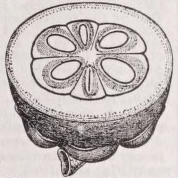
MANGOSTEEN, Garcinia Mangostana, I.., is a tree belonging to the gamboge order (Clusiaceae or Guttiferae). It is a native of the Molucca Islands, but has been introduced into the other islands of the eastern archipelago, Ceylon, and southern Asia, and even the Antilles, though not without difficulty. It grows about 20 feet high, and is somewhat fir-like in general form, but the leaves are large, oval, entire, coriaceous, and glistening. Its fruit, the much-valued mangosteen, is about the size and shape of an orange, and is somewhat similarly partitioned, but is of a reddish-brown to chestnut colour. Its thick rind yields a very astringent juice, rich in tannin, and containing a gamboge-like resin. The soft and juicy pulp is snow-white or rose-coloured, and of exceedingly delicious and subtle flavour and perfume. Being perfectly wholesome, it may be eaten freely, and administered in fever. G. purpurea is known in India as mate mangosteen, and Embryopteris glutinifera, an ebenaceous tree, as wild mangosteen. See Drury’s Useful Plants of India.