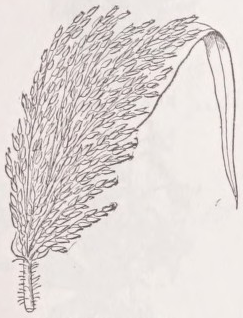
Polish Millet isP. digitaria; P. frumentaceum, Roxb., Slιamalo, a Deccan grass, is probably a native of tropical Africa; while the perennial P. sarmentosum, Roxb., also largely cultivated in tropical countries, is from Sumatra. P. decomposition is the Australian millet, its grains being made into cakes by the aborigines. P. maximum, Jacq., is the Guinea Grass; it is perennial, grows 8 feet high, and yields abundance of highly nutritious grain. P. spectabile, Nees., is the Coapim of Angola, but has been acclimatized in Brazil and other tropical countries. Other gigantic species 6 or 7 feet high form the field crops on the banks of the Amazons. Of species belonging to allied genera, Pennisetum thyρhoideum, Rich. (Pcni- cellaria spicata, Willd.), Bajree, sometimes also called Egyptian Millet, a Guinea corn, is largely cultivated in tropical Asia, Nubia, and Egypt. P. distichum grows south of the Sahara. Species of Paspalum, Eleusine, and Milium are also cultivated as millets.
But the most important dry grain of the tropical countries of Africa and Asia, particularly of India, is Sorghum vulgare, Pers. (Holcus Sorghum, I.., Andropogon Sorghum, Roxb.), Durra, Great Millet, Indian Millet, Turkish Millet, or Guinea Corn (the French sorgho, German Mohrenhirse or Kaffernkom, Tamil Cholum, Bengalese Joιvari). It ranges probably as extensively as wheat, being also largely cultivated in southern Europe, the United States, and the West Indies. In Asia Minor, Arabia, Italy, and Spain it may be said to replace oats and barley. It is annual, and may reach 12 feet in height; it is extremely prolific, even rivalling maize, of which it is a near congener. Its flour is very white, but does not easily make good bread; it is largely used in cakes and puddings and for feeding cattle and poultry. The panicles are used for brooms, and the roots for velvet-brushes.
S. bicolor, S. nigrum, S. rubrum, S. Kajfrorum (Kaffre Corn), S. saccharatum, and other species or varieties are also of economic importance, the last-named (the “Chinese sugar-cane”) being much cultivated in the United States as a source of molasses, the juice, which contains much glucose but comparatively little cane sugar, being simply expressed and concentrated by evaporation. S. vulgare is the grain referred to by Pliny as millet.
For systematic and economic purposes, see Grasses ; Luerssen, Med.-Pharm. Botanik, Leipsic, 1880; Drury, Useful Plants of India, London, 1873; F. v. Müller, Select Plants for Naturalization in Victoria, Melbourne, 1876. For archaeology, see Hehn’s Kulturpflanzen, kc., Berlin, 1877. On Sorghum cerunum (“rice corn,” &c., of western Kansas) see Drummond’s “Report” in Pari. Papers, No. 2570 (1880).
MILLET, Jean François (1814-1875), was a painter of French peasant life, and it may be questioned whether France has produced in our day any greater or more original artist. He himself came of a peasant family, and was born on the 4th of October 1814 in the hamlet of Gruchy, near Gréville (La Manche), in the wild and picturesque district called La Hague. His boyhood was passed working in his father’s fields, but the sight of the engravings in an old illustrated Bible set him drawing, and thenceforth, whilst the others slept, the daily hour of rest was spent by Millet in trying to render the familiar scenes around him. From the village priest the lad learnt to read the Bible and Virgil in Latin, and acquired an interest in one or two other works of a high class which accompanied him through life; he did not, however, attract attention so much by his acquirements as by the stamp of his mind. The whole family seems, indeed, to have worn a character of austerity and dignity, and when Millet’s father finally decided to test the vocation of his son as an artist, it was with a gravity and authority which recalls the patriarchal households of Calvinist France. Two drawings were prepared and placed before a painter at Cherbourg named Mouchel, who at once recognized the boy’s gifts, and accepted him as a pupil; but shortly after (1835) Millet’s father died, and the eldest son, with heroic devotion, took his place at home, nor did he return to his work until the pressing calls from without were solemnly enforced by the wishes of his own family. He accordingly went back to Cherbourg, but after a short time spent there with another master (Langlois) started with many misgivings for Paris. The council-general of the department had granted him a sum of 600 francs, and the town council promised an annual pension of 400, but in spite of friendly help and introductions Millet went through great difficulties. The system of the École des Beaux Arts was hateful to him, and it was not until after much hesitation that he decided to enter an official studio—that of Delaroche. The master was certainly puzzled by his pupil; he saw his ability, and, when Millet in his poverty could not longer pay the monthly fees, arranged for his free admission to the studio, but he tried in vain to make him take the approved direction, and lessons ended with “Eh, bien, allez à votre guise, vous êtes si nouveau pour moi que je ne veux rien vous dire.” At last, when the competition for the Grand Prix came on, Delaroche gave Millet to understand that he intended to secure the nomination of another, and thereupon Millet withdrew himself, and with his friend Marolle started in a little studio in the Rue de l ’ Est. He had renounced the beaten track, but he continued to study hard whilst he sought to procure bread by painting portraits at 10 or 15 francs a piece and producing small “pastiches” of Watteau and Boucher. These works are classed as those of his “flowery manner,” and Millet has been reproached—-he whose whole life was an act of conviction—with having sacrificed his convictions to curry favour with the public. It is true that he himself has recorded his aversion to both these masters. “In the Louvre,” he said, “I received vivid impressions from Mantegna, complete from Michelangelo; after Michelangelo and Poussin I have remained faithful to the early masters.” Boucher was for him an object of “repulsion,” and in Watteau “I saw,” he said, “a little theatrical world which oppressed me.” Thus it was then that Millet naturally felt and saw, but the strongest genius knows moments of self-doubt. Later in life Millet was heard to say that were it not for the small group who believed in him he should have lost faith in himself. In earlier years, before he was certain of his own leading, he was naturally influenced by the advice of others whose arguments were enforced by the pressure of dire poverty. Even so from time to time the native vein showed strong. In 1840, as soon as he had despatched a portrait to the Salon, Millet went back to Gré ville, where he painted Sailors Mending a Sail and a few other pictures—reminiscences of Cherbourg life. His first success was obtained in 1844 when his Milkwoman and Lesson in Riding (pastel) attracted notice at the Salon, and friendly artists presented themselves at his lodgings only to learn that his wife had just died, and that he himself had disappeared. Millet was at Cherbourg; there he remarried, but having amassed a few hundred francs he went back to Paris and presented his St Jerome at the Salon of 1845. This picture was rejected and exists no longer, for Millet, short of canvas, painted over it Oedipus Unbound, a work which during the following year was the object of violent criticism. He was, however, no longer alone; Diaz, Eugène Tourneux, Rousseau, and other men of note supported him by their confidence and friendship, and he had by his side the brave Catharine Lemaire, his second wife, a woman who bore poverty with dignity and gave courage to her husband through the cruel trials in which he penetrated by a terrible personal experience the bitter secrets of the very poor. To this date belong Millet’s Golden Age, Bird Nesters, Young Girl and Lamb, and Bathers; but to the Bathers (Louvre) succeeded The Mother Asking Alms, The Workman’s Monday, and The Winnower. This last work, exhibited in 1848, obtained conspicuous success, but did not sell till Ledru Rollin, informed of the painter’s dire distress, gave him 500 francs for it, and accompanied the purchase with a commission, the money for which enabled Millet to leave Paris for Barbizon, a village on the skirts of the forest of Fontainebleau. There he settled in a three-roomed cottage for the rest of his life—twenty-seven years, in which he wrought out the perfect story of that peasant life of which he alone has given a “complete impression.” Jules Breton has coloured the days of toil with sentiment; others, like Courbet, whose eccentric Funeral at Ornans attracted more notice at the Salon of 1850 than Millet’s Sowers and Binders, have treated similar subjects as a vehicle for protest against social misery; Millet alone, a peasant and a miserable one himself, saw true, neither softening nor exaggerating what he saw. In a curious letter written to Μ. Sensier at this date (1850) Millet expressed his resolve to break once and for all with mythological and undraped subjects, and the names of the principal works painted subsequently will show how stedfastly this resolution was kept. In 1852 he produced Girls Sewing, Man Spreading Manure; 1853, The Reapers; 1854, Church at Gréville (Luxembourg); 1855—the year of the International Exhibition, at which he received a medal of second class— Peasant Grafting a Tree; 1857, The Gleaners; 1859, The Angelus (Louvre, engraved Waltner), The Woodcutter and Death; 1860, Sheep Shearing; 1861, Woman Shearing Sheep, Woman Feeding Child; 1862, Potato Planters, Winter and the Crows; 1863, Man with Hoe, Woman Carding; 1864, Shepherds and Flock, Peasants Bringing Home a Calf Born in the Fields; 1869, Knitting Lesson; 1870, Buttermaking; 1871, November—recollection of Gruchy. Any one of these works will show how great an influence Millet’s previous practice in the nude had upon his style. The dresses worn by his figures are not clothes, but drapery through which the forms and movements of the body are strongly felt, and their contour shows a grand breadth of line which strikes the eye at once. Something of the imposing unity of his work was also, no doubt, due to an extraordinary power of memory, which enabled Millet to paint (like Horace Vernet) without a model; he could recall with precision the smallest details of attitudes or gestures which he proposed to represent. Thus he could count on presenting free from after thoughts the vivid impressions which he had first received, and Millet’s nature was such that the impressions which he received were always of a serious and often of a noble order, to which the character of his execution responded so perfectly that even a Washerwoman at her Tub will show the grand action of a Medea. The drawing of this subject is reproduced in Souvenirs de Barbizon, a pamphlet in which Μ. Piédagnel has recorded a visit paid to Millet in 1864. His circumstances were then less evil, after struggles as severe as those endured in Paris. A contract by which he bound himself in 1860 to give up all his work for three years had placed him in possession of 1000 francs a month. His fame extended, and at the exhibition of 1867 he received a medal of the first class, and the ribbon of the Legion of Honour, but he was at the same moment deeply shaken by the death of his faithful friend Rousseau. Though he rallied for a time he never completely recovered his health, and on the 20th January 1875 he died. He was buried by his friend’s side in the churchyard of Chailly.
See A. Sensier, Vic et Oeuvre de J. F. Millet, 1874; Piédagnel, Souvenirs de Barbizon, &c.