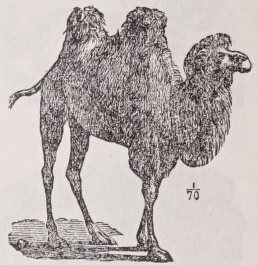
CAMEL, the Djemal of the Arabs and Gamal of the Hebrews, a genus of Ruminant Mammals, which, with the South American llamas, form the family Camelidoe, and which in their dentition, in the absence of horns and of hoofs completely enveloping the toes, and in the separation of the navicular and cuboid bones of the tarsus, show an affinity with certain of the Perissodactyle Ungulata. In common with the llamas, and unlike all other ruminants, the camel has two upper incisor teeth, conical and laterally compressed, and somewhat resembling canine teeth, of which in the upper jaw there are two, in addition to twelve molars. Beneath there are six incisors, two canines, and ten molar teeth, the whole forming a dentition admirably suited for the tearing asunder and mastication of the coarse dry shrubs on which the camel usually feeds. It possesses besides many other peculiarities in form and structure specially adapted to its mode of life. Its nostrils are in the form of oblique slits, which can be opened or shut at will, and thus the organ of smell, which in the camel is of extraordinary acuteness, is preserved from contact with the hot acrid sand that, like a “pillar of cloud,” frequently sweeps across the desert. The extremities only of the two toes which form the foot are free, and are each terminated by a short and somewhat curved nail, the rest of the toes being connected together by means of a broad elastic pad on which the foot rests, and which buoys the camel up as it moves on the soft and ever-shifting surface. The horny callosities on the breast and limb-joints, on which the camel rests when being loaded, may possibly have resulted from the long ages of servitude to which it has been subjected, but whether they existed in the wild camel or not, traces of them are ...said to be now found on the new-born young. The hump or humps on the camel’s back are mere masses of fat, without any corresponding curve on the vertebral column of the animal, and form a reserve of nourishment to be used when other supplies fail; consequently during lengthened periods of privation, and during the rutting season, when the males almost cease to eat, these masses greatly diminish in size. The camel driver knows well the value of this natural storehouse, and takes care before starting on a lengthened journey to have the humps of his beasts well distended. In its native deserts, however, the camel is more liable to suffer from lack of water than of food, and accordingly the stomach is so modified as to allow of a certain quantity of water being stored for future use. On the walls of the paunch or first stomach, little pouches with narrow mouths are developed; these are the so called “water cells,” the biggest of which in an adult camel measures when dilated about three inches in width and depth, and these serve to strain off a considerable quantity of water from the contents of the paunch, retaining it for future use by means of powerful sphincter muscles. The upper divided lip of the camel is slightly extensile, and is used as a feeler with which to touch and examine its food before turning the same into its mouth. The animal is further characterized externally by its long neck, the dusky colour of its fur, the shaggy masses of long woolly hair on certain parts of its body, and the disproportionate shortness of its legs. These, together with the peculiarities already mentioned, combine to make it one of the most ungainly of known animals, and almost justify the recent description given of it by Dr Russell, the Times correspondent, as “an abominably ugly necessary animal.” Nevertheless, it is as indispensable where great deserts are to be traversed as is the ship on the ocean highway, and this fact seems to have completely blinded the Arab to its undoubted déficiences in form, for in his poetry allusion is sometimes made to the motions of the camel as to a recognized standard of elegance.
The camel is one of the oldest mammals now living, and fossil remains have been found in the Miocene of the Seva-lik Hills of a species (Camelus sivαlensis) somewhat larger, but otherwise scarcely distinguishable from recent forms. “The difference is so slight,” says Andrew Murray, “it pleases us to think that we may have here, in this most ancient animal, a species which saw the Miocene epoch, and which has survived all the chances and changes which have taken place since then.” That it was one of the earliest of domesticated animals is evident from the frequent allusions made to it in the oldest written records of the human race Six thousand camels are said to have formed part of the wealth of the patriarch Job; they also formed part of the present which Pharaoh gave to Abraham, and it was to a company of Ishmaelites travelling from Gilead to Egypt on camels, laden with spices, much as their Arabian descendants do at the present day, that Joseph was sold by his brethren. Naturalists are able to indicate with more or less certainty the wild progenitors of most of the domestic animals, but they have hitherto failed to obtain any reliable evidence of the existence, at the present day, of the wild ancestor of the camel. In the eastern hemisphere it stands alone, sole representative of the family to which it belongs, its only allies, the llamas, being confined to the slopes of the Andes and the southern parts of South America. Palaeontologists, however, by the discovery of several fossil forms, have been able to bridge over the geographical gap which at present separates the two branches of the Camelidae
During the rutting season the male camel becomes exceedingly savage and dangerous, and engages in fierce contests with its fellows The gravid female carries her young for fully eleven months, and produces only one calf at a time, which she suckles for a year. Eight days after birth the Arabian camel stands three feet high, but it does not reach its full growth till its sixteenth or seventeenth year. It lives from forty to fifty years. The flesh of the young camel resembles veal, and is a favourite food of the Arabs, while camel’s milk forms an excellent and highly nutritious beverage, although, according to Layard, it does not furnish butter. The woolly hair, which grows to a great length on the under side of the neck, the upper part of the legs, and on the humps, is shorn every summer, and is woven into a variety of stuffs used by the Arab for clothing himself and his family, and in covering his tent. It was in raiment of camel’s hair that John the Baptist appeared as a preacher. The hair imported into this country is chiefly used in the manufacture of small brushes used by painters, while the thick hide is formed into a very durable leather. The dung is used as fuel, and from the incinerated remains of this sal-ammoniac is extracted, which was at one time largely exported from Egypt.
But it is as “the ship of the desert,” without which vast tracts of the earth’s surface would probably have remained for ever unexplored, that the camel is chiefly valuable. In its fourth year its training as a beast of burden begins, when it is taught to kneel down and to rise at a given signal, and is gradually accustomed to bear increasing loads. These vary in weight from 500 to 1000 lb, according to the variety of camel employed, for of the Arabian camel there are almost as many breeds as there are of the horse in more temperate regions. When crossing a desert the camels are expected to carry their load 25 miles a day for three days without drink, getting a supply of water, however, on the fourth; but the fleeter varieties will carry their rider and a bag of water 50 miles a day for five days without drinking. When too heavily laden the camel refuses to rise, but on the march it is exceedingly patient under its burden, only yielding beneath it to die; relieved from its load it does not, like other animals, seek the shade, even when that is to be found, but prefers to kneel beside its burden in the broad glare of the sun, seeming to luxuriate in the burning sand. When overtaken by the deadly simoom it falls on its knees, and stretching its snake-like neck along the sand, closes its nostrils, and remains thus motionless till the atmosphere clears; and in this position it affords some shelter to its driver, who, wrapping his face in his mantle, crouches behind his beast. Of still greater service is it, when, the whole caravan being on the point of perishing for want of water, the acute sense of smell which the camel possesses enables it to perceive the presence of water more than a mile off; then it will break its halter and make an unerring track for the well. The food of the camel consists chiefly of the leaves of trees, shrubs, and dry hard vegetables, which it is enabled to tear down and masticate by means of its upper incisors and powerful canine teeth. It is, however, fond of luxurious living when such is to be had, and, according to Sir Samuel Baker, when it arrives in good pasture, after several days of sharp desert marching, it often dies in a few hours of inflammation caused by repletion; but when other animals are starving, the camel, according to the same authority, thrives “on the ends of barren leafless twigs, the dried sticks of certain shrubs, and the tough dry paper-like substance of the dome palm, about as succulent a breakfast as would be a green umbrella and a Times newspaper.” The docility of the camel has become wellnigh proverbial throughout Europe, but recent travellers who have studied the animal in Arabia and Africa have said much to lessen, if not to extinguish, its reputation in this particular. “If docile means stupid,” says Palgrave, who had ample opportunity of observing the camel during his romantic sojourn in Arabia, “well and good; in such a case the camel is the very model of docility. But if the epithet is intended to designate an animal that takes an interest in its rider so far as a beast can, that in some way understands his intentions, or shares them in a subordinate fashion, that obeys from a sort of submissive or half-fellow-feeling with his master, like the horse or elephant, then I say that the camel is by no means docile—very much the contrary. He takes no heed of his rider, pays no attention whether he be on his back or not, walks straight on when once set agoing, merely because he is too stupid to turn aside, and then should some tempting thorn or green branch allure him out of the path, continues to walk on in the new direction simply because he is too dull to turn back into the right road. In a word, he is from first to last an undomesticated and savage animal rendered serviceable by stupidity alone, without much skill on his master’s part, or any co-operation on his own, save that of an extreme passiveness. Neither attachment nor even habit impress him never tame, though not wide-awake enough to be exactly wild.” So also Sir S. Baker, in his recent work The A lbert Nyanza, bears testimony to its extreme dulness, for while other nuninants in feeding select wholesome herbs, the camel is stupid enough to eat indiscriminately every green vegetable; it is thus often poisoned through eating a plant known to the Arabs as “camel poison,” and on this account it is customary to set watchers over them while grazing in districts where this plant is found. The camel, however, is revengeful, and in satisfying this passion is said to display a far-thoughted malice scarcely consistent with the extreme stupidity attributed to it by Palgrave. Of this vindictiveness the camel driver is well aware, and of the certainty that sooner or later it will seek revenge; accordingly it is customary for the person who has reason to fear its malice to throw his clothes before the camel, meanwhile concealing himself until the infuriated animal has expended its rage in tossing and trampling upon them, when the injury, real or supposed, is immediately forgotten.
The camel is probably a native of the desert countries of the south-west of Asia, whence it has spread into most of the arid regions of the eastern hemisphere, carrying with it wherever it goes a mark of its desert origin in the antipathy which it shows to cross a stream of water. It has lately been introduced into Australia, the great central desert of which was recently crossed by Warburton with a caravan of camels. It has now also obtained a footing in the New World, ten camels having been landed at New York some years ago, all of them, however, with the exception of a single male and female, dying soon after. The surviving pair were transferred to Nevada, where the soil was sandy and sterile, producing abundance of prickly shrubs which no other animal would touch, but on which the pair of camels flourished and bred. This female has already given birth to twenty-four young, all of which are still (1875) alive, and some of these having also bred, there are now ninety-six camels, all, with the exception of the original couple, born in Nevada. In Europe the camel is only reared in the neighbourhood of Pisa, having been introduced there by one of the dukes of Tuscany, and is employed as a beast of burden, but is said to be gradually deteriorating.
There are two species of camel—the Arabian and the Bactrian. The former or single-humped species (Camelus dromedarius) is found in greatest perfection in Arabia, whence it has spread eastwards to India, where it is now extensively used, although the stony nature of much of the ground it has to pass over does not give it in India that superiority over other beasts of burden, which it undoubtedly possesses in desert countries. It seems to have spread westwards with the Koran along the North African shores, and to have been introduced by the Moors into Spain, where, however, it did not succeed in establishing itself. It also accompanied the followers of Mahomet into European Turkey. Iu Arabia several breeds, each possessing special qualities, are carefully cultivated. The chief of these are the thick-built, heavy-footed, and slow-paced variety, used for carrying heavy loads, and the dromedary— a name often applied to all the members of the single-humped species, but properly belonging only to a thin, comparatively elegant, and fine-haired breed, celebrated for its fleetness, carrying its rider when necessary 100 miles a day. The dromedary, says Palgrave, “is the race-horse of its species,” and the difference between it and the heavy variety is exactly the same “as between the race-horse and a hack.” Another breed, belonging to a tribe of Arabs who dwell near the western shores of the Red Sea, is specially adapted for journeying with loads over mountainous districts,and Baker, who made use of them, states that they accomplished feats in mountain climbing which would have been impossible to any other domestic animal so loaded. The Bactrian or two-humped camel (Camelus bactrianus) is a somewhat larger and more robust species, and is much rarer than the Arabian. It is found throughout the region lying to the north and east of that inhabited by the dromedary, from the Black Sea to China and northward to Lake Baikal, where in winter it sustains severe ccld, subsisting meanwhile upon the leaves and twigs of the willow and birch. The pads on its feet are harder than in the other species, and are thus better fitted to bear the changes wrought on the soil by the frequent alternations of rain and drought, while its fur is also thicker and more plentiful. In Central Asia both species occur, and hybrids are not uncommon, the latter being, it is alleged, occasionally fertile among themselves. (j. gi. )