
The general name of all sorts of cabbage or brassica; but we generally use it in its compounds, cole-wort, cauliflower, etc.
Word of the Day: Catachrestical
A small fish, less than the common perch.
1. The seed of the navew, napus sativa, or long-rooted, narrow-leafed rapa; reckoned a species of brassica or cabbage.
2. Cabbage seed.
Colebrooke
Encyclopedia Britannica
COLEBROOKE, Henry Thomas (1765-1837), an eminent Oriental scholar, the third son of Sir George, the second baronet of that name, was born in London. He was educated at home; and when only fifteen he had made considerable attainments in classical and mathematical studies. From the age of twelve to sixteen he resided in France, and in 1782 was appointed to a writership in India. About a year after his arrival there he was placed in the Board of Accounts in Calcutta; and three years later he was removed to a situation in the revenue department at Tirhoot, where he pursued his studies in Eastern science and literature. In 1789 he was removed to Purneah, where he investigated the resources of that part of the country, and published his Remarks on the Husbandry and Commerce of Bengal, in which he advocated free trade between Great Britain and India. After eleven years’ residence in India, Colebrooke began the study of Sanskrit; and to him was confided the translation of the great digest of Hindu law, which had been left unfinished by Sir William Jones. After filling a number of important offices, and publishing some works on Oriental literature, including a Sanskrit grammar and dictionary, he returned to London, where he died, March 18, 1837. He was a director of the Asiatic Society, and many of the most valuable papers iu the Society’s Transactions were communicated by him.
9th ed. Encyclopædia Britannica, vol. 6, p. 125
[237 words — estimated reading time: 2 minutes]
[237 words — estimated reading time: 2 minutes]
The coleopters, in Linnes system of entomology, are an order of insects, having crustaceous elytra or shells, which shut and form a longitudinal suture along the back, as the beetle.
One of the Coleoptera.
An order of insects having the anterior pair of wings (elytra) hard and horny, and serving as coverings for the posterior pair, which are membranous, and folded transversely under the others when not in use. The mouth parts form two pairs of jaws (mandibles and maxillae) adapted for chewing. Most of the Coleoptera are known as beetles and weevils.
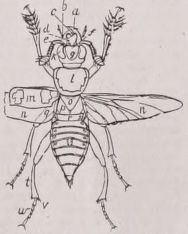
Coleoptera
Encyclopedia Britannica
COLEOPTERA, or Beetles, a vast and remarkably homogeneous order of Insects, characterized, as the name implies (κoλ∈o ’ s, a sheath, and τrτepα, wings), by the structure of the upper wings, or elytra, as they are called, which are so modified as to form shields for the protection of the under wings—the true organs of flight in those insects. The name was given, and the principal characters of the order defined, by Aristotle; and owing doubtless to their singular and varied forms and habits, the brilliant colouring and great size of numerous species, and that solid consistence which renders their collection and preservation comparatively easy, Coleopterous insects have since the days of the Stagirite received the special attention of entomologists....
The body in Coleoptera is enclosed in a chitinous integument of a more or less rigid consistence, and is somewhat oval in form, although in most cases greatly longer than broad. In this respect, however, the utmost diversity prevails even among the members of the same family, the form being modified to suit the habits of the insect. Thus, according to Bates, among the South American forms of Dermestidae, the species of one group are cubical in shape, and live in dung; those of another, inhabiting the stems of palm trees, are much flatter; those of a third, only found under the bark of trees, are excessively depressed, some species being literally “as thin as a wafer;” while the members of a fourth group of the same family are cylindrical in shape, and are woodborers, “looking,” says Bates, “like animated gimlets, their pointed heads being fixed in the wood, while their glossy bodies work rapidly round so as to create little streams of saw-dust from the holes” (Naturalist on the Amazons). The body, in common with that of all other insects, is divided into three parts,—head, thorax, and abdomen. The head, which is usually rounded or somewhat triangular in shape (except in the Weevil tribe, where it is produced into an elongated rostrum or snout), bears the organs of the senses. The eyes of beetles are two in number and compound, and in predaceous species are somewhat protuberant, thus affording greater range of vision. The simple eyes, or ocelli, common among butterflies and moths, are almost unknown among beetles, although present in the larvae. In many species, especially of Lamellicorn Beetles, these organs are more or less completely divided by a process known as the cantfius; and in the Gyrinidae, or Whirligigs, the intersection is so complete as to give the appearance of a pair of eyes on each side. In burrowing and cave-dwelling species, whose lives are spent in almost total darkness, the eyes, although distinctly visible in the young, become more or less atrophied in the adult forms. The two antennae, supposed by some to be organs of hearing, and by others of smell, are placed between or in front of the eyes, and usually consist of 11 joints. These differ greatly in form and size, not only in different species, but in the two sexes of the same species, the most prevalent forms being the setaceous, moniliform, serrate, pectinate, clavate, and lamellate. In many groups the antennae are exceedingly short, while in such forms as the Longicorn Beetles they, in a few cases, measure four times the length of the body.
The parts which go to form the mouth are typically developed in beetles, and for this among other reasons the order Coleoptera has generally been placed at the head of the class of insects. It is known as the masticatory mouth, and consists of the four parts (Plate VI. fig- 1). (1) The labrum, or upper lip, is usually a continuation of the upper surface of the head. (2) The mandibles, or true masticatory organs, consist of two powerful arched jaws generally dentated, moving horizontally and opposed to each other, the teeth in some cases interlocking, in others, as in the Tiger Beetles, crossing like the blades in a pair of scissors. In many species they are so small as to be almost concealed within the cavity of the mouth, while in such forms as the Stag Beetles they measure half the length of the entire body. The form and texture of the mandibles are largely dependent on the nature of the insect’s food, being acute and sharply dentated in predaceous species, and thick and blunt in vegetable feeders. Their margins are soft and flexible in those which feed on decaying animal and vegetable matters, while the entire mandibles are soft and flattened in those which live on fluids. (3) The maxillae, or lesser jaws, placed beneath the mandibles, and like them moving horizontally, serve to hold the food and guide it to the mouth. Their extremities are in many cases furnished with a movable claw, and their inner surfaces with a series of bristles, which are probably of use in straining the juices from their food. The maxillae are provided with a pair of appendages called maxillary palps—delicate organs that vibrate intensely, and are supposed to be principal organs of touch. (4) Tlιe labium, or lower lip, also provided with palps.
The thorax bears the organs of locomotion, consisting of three pairs of legs and two pairs of wings (Plate VI. fig. 2). The legs vary in their structure and development according to the habits of the species; thus in running and walking beetles these organs are usually of equal length, and generally similar in other respects, the anterior pair, however, being often stronger in the male than in the female; and in a few species, as the Harlequin Beetle, the anterior legs are enormously elongated and proportionately thickened. In burrowing beetles the anterior legs are developed into fossorial organs with broad and strongly dentated tarsi, and in arboreal forms the under side of the tarsi is usually covered with hair, forming a cushion-like sole terminating in toothed claws, by which they are enabled to keep their footing on the leaves and branches of trees. Water beetles generally have the posterior pair of legs elongated, flattened, and ciliated, so as to form swimming organs; those known as Whirligigs using the middle and posterior pairs for this purpose, while the anterior limbs are employed as rudders; and jumping beetles, as Halticidae, have the thighs of the posterior pair of legs greatly thickened for saltatory purposes (Plate VIII. fig. 10). The two anterior wings become solidified in beetles, and are thus rendered useless as organs of flight. They are termed elytra (eλυτpov, a shield), and serve to protect the delicate wings beneath, as well as the stigmata, or breathing pores, placed ¾loug the sides of the abdomen. The elytra are always present except in the females of a few species, as the Glow-worm, and are generally large enough to cover the upper surface of the abdomen and to conceal the under wings when at rest. In Brachelytrυus Beetles, however, they are exceedingly short, and the wings in these are only shielded by being folded more than once beneath them. The elytra when at rest meet on the middle of the back, their internal margins forming a straight longitudinal line or suture highly characteristic of the Coleoptera; but even this character is not universal, as in the Oil Beetles (Meloë) and a few others the one elytron partly folds over the other. The posterior wings are large, veined, and membranaceous and form the true organs of flight, but they are much more frequently absent than the elytra, and where this occurs, as in manyCarabideous Beetles, the latter are more or less soldered together. During flight the elytra are either extended horizontally or merely raised without being separated, as in the Rose-Chafers (Cetonia); and as might be expected from their general stoutness of body and comparative deficiency of wings, the flight of beetles is heavy and seldom long sustained. Their weakness in this respect is further shown in the apparent inability of many species suddenly to alter their course so as to avoid collision with any object that may unexpectedly come in their way, a defect popularly but erroneously attributed, in. the phrase “as blind as a beetle,” to weakness of sight rather than of wing. In certain water beetles fDytiscidae) a pair of aslulae, or winglets, are developed at the inner angle of the elytra.
The colouring of the chitinous integument of beetles is often exceedingly brilliant, and the elytra and other parts of many species are largely used in the manufacture of personal ornaments. This colouring can in many instances be shown to bear a close resemblance to that of surrounding nature; thus burrowing beetles, and those which dwell in subterranean .caves, are generally black or brown; "Weevils, found on the ground, are earth-coloured; while arboreal species of this and other groups are of various shades of green. Bates found a species of beetle, on a particular tree in South America, which so resembled the bark on which it spent its existence as to be, when motionless, no longer visible. This assimilation in colour to surrounding nature is probably useful in assisting them to elude their enemies; and when the markings are such as to render the beetle conspicuous it is often provided with, and no doubt protected by, an offensive odour or nauseous juices; thus the naturalist already mentioned found on a sandy beach two species of Tiger Beetles, the one of a pallid hue like the sand it ran upon, the other of a brilliant and conspicuous copper colour, but having “a strong, offensive, putrid, and musky odour,” from which the other was entirely free. Fireflies, a group of Coleopterous insects, are also exceedingly conspicuous, but are similarly protected. The phenomena of mimicry, or the imitation of one animal by another for protective purposes, have been, observed in several instances among beetles. Mr Belt, in his interesting work, The Naturalist in Nicaragua, states that he captured what he supposed was a hairy caterpillar, but on closer inspection he found it to be a Longicorn Beetle, the antennae being concealed among the hair. Hairy caterpillars are almost universally rejected by insecteating animals, and thus probably this beetle shared in the immunity from attack accorded to its model. A species of beetle found in South America closely resembles a bee found in the same locality, its body being covered with hair and its legs similarly tufted; another, with yellow banded abdomen, sufficiently resembled a wasp as to make its captor both cautious and. timid in handling it at first. One of the Chrysomfilidae (Crioceris merdigera} is said to disguise itself by covering its upper surface with its own dung; while many species to be afterwards noticed, when in danger, simulate death. Brilliant colouring in beetles is not as in some orders of animals a characteristic mainly of the male sex, both sexes being usually similar in this respect, while iu those cases in which they differ, the female is generally the more gaudy insect. The chief external difference, however, between the sexes in many beetles is to be found in the presence of horns on the head and thorax of the males. These vary exceedingly in their development even in individuals of the same species, while in their form they resemble the horns of the rhinoceros, and the antlers of the stag; and as among mammals the reindeer is exceptional in the possession of antlers by both sexes, so among beetles there is at least one species, Phanaeus lancifor, in which both male and female are similarly equipped. The male beetle has not been observed to use its horns either for purposes of offence or defence, some of the most pugnacious species being entirely destitute of them; and in Darwin’s opinion these appendages have been acquired merely as ornaments.
The abdomen of Coleopterous insects is sessile, that is, attached to the‘thorax by its largest transverse diameter. On the under side it is always of a firm horny consistence, while the upper surface is generally soft, being protected by the elytra and wings; when these, however, are absent or abbreviated, it is as hard above as below. It bears the organs of generation as well as the respiratory openings, or stigmata, which form the apertures of the tracheae by means of which air is disseminated through all parts of the insect system. Beetles belonging to several distinct families possess stridulating organs, and these are generally found in both sexes. The apparatus by which the sound, loud enough to be heard in many cases at some yards distance, is produced, consists of a couple of delicate rasps placed on the upper surface of the abdomen, on the elytra, or on the prothorax, and a scraper formed by the margins of the elytra, the edges of the abdominal segments, or the mesothorax, the rapid motion of the latter over the rasps producing the sound. In many cases, according to Darwin, the males only stridulate, the females being destitute of those organs, and in such cases the sound is employed as a call to the female; with most beetles, however, the stridulation proceeds from both sexes and serves as a mutual call. Beetles are entirely destitute of stinging organs, but a few are furnished with a retractile tube, or ovipositor, at the extremity of the abdomen, by means of which they deposit their eggs in the cracks of wood and other suitable localities.
The eggs of beetles are deposited in a great variety of situations, and in the case of a certain group of Staphylinidae found in the nests of white ants in South America, it was recently discovered by Schödte that the eggs are not deposited at all, but remain in the abdomen until they are hatched. These ovo-viviparous beetles are only one-tenth of an inch in length, and have the abdominal region enormously distended and turned over so as to rest on the back. Dung beetles deposit their eggs in the midst of the manure on which the future larvae feed; the Sacred Beetle of Egypt rolling each of hers about until a globular pellet is formed, when the whole is buried in the ground; while the Sexton Beetle finds an appropriate nidus for her eggs in the dead bodies of animals. One species of Cleridae selects the nest of the solitary bee, another (Plate VII. fig. 31) that of the hive bee, while several species of Rose Beetles choose the nest of the ant for this purpose. The water beetles belonging to the genus Hydrophilus deposit their eggs in a single mass, which they surround with a oocoon, formed of a silky substance secreted by certain glands in the abdomen, and then either fix this to the leaf of an aquatic plant or leave it to float on the surface of the water. Certain species of the Weevil tribe deposit their eggs on the leaves of trees, splitting the median nervures in several places, and afterwards rolling them up. In its progress from the egg to the perfect insect the beetle undergoes complete metamorphosis, passing from the larval to the pupa stage, and remaining totally quiescent during the latter. Coleopterous larvae generally consist of 13 segments, of which those forming the head and thorax are usually of a hard horny texture,—the mouth, as in the perfect insect, being masticatory, and the eyes, when present, simple, or ocelli. They have usually six legs, and prolegs, as in caterpillars, are occasionally present; but the larvae of many species are legless grubs, while in others the limbs are but feebly developed. In those groups in which the elytra are abbreviated, the larvae are exceedingly active and closely resemble the perfect insect. Like their parents the larvae of beetles feed on living animals, on plants, or on decaying animal and vegetable substances, but greatly exceed the perfect insect in the quantity of food which they consume, and it is in this condition that beetles do most injury to field crops and forest trees. The larvae of burrowing beetles, known as “White Worms,” spend their existence in the earth, and are destitute of eyes; those of the Stag Beetles and other wood-boring groups live in the trunks of decaying trees; mealworms—the larvae of Tenebrio molitor — live enveloped in flour, and those of the Corn Weevil in the heart of the wheat grain; while those of another species of Weevil make their homes in the fleshy parts of the receptacles of composite flowers. The larvae of Oil Beetles (Melo'e), or at least certain species of them whose life-history has been observed, after leaving the egg, which the perfect insect has deposited just beneath the surface of the ground, climb upon the stems of plants, and take the first opportunity of attaching themselves to any insect that may happen to alight near them, and in this way they are occasionally conveyed into the hives of bees, in which alone they meet with their appropriate food. Only a few of them are thus fortunate, the majority of the larvae getting attached to the wrong insect, and so perishing of hunger. The species probably owes its preservation to the great number of eggs, amounting to upwards of 4000, deposited by a single female. The larvae of one group of water beetles, Hydrophilus, swim readily by means of their ciliated legs, those of another group, Dytiscus, make use also of their flexible abdomen provided at its extremity with a pair of leaf-like appendages (Plate VII. fig. 6); while the Whirligig larvae (Gyrinus), in addition to ciliated swimming organs, are provided with four movable hooks on the posterior segment, by which they are enabled to take extensive leaps (Plate VII. fig. 17). The duration of the larval state varies in different groups of beetles, being comparatively short in leaf-eating species, but lasting for three or four years in those which burrow in the earth or in wood. The larvae in the latter case pass the winter in a torpid state, abstaining almost entirely from food, until awakened from their temporary trance by the return of genial weather, when they greedily attack their favourite food, and grow rapidly. In passing from the condition of a larva, the beetle does not, like the butterfly, assume a form altogether different from that of the perfect insect, but in the pupa or nymph state shows all the parts of the future insect, only in a condition of almost complete immobility. In preparing for this quiescent period, the larvae of many species surround themselves with a cocoon, consisting, in the case of the Scarabaeidae, of earth and small pieces of wood glued together with saliva, and in that of the Goliath Beetles, of mud. Others resemble the larvae of moths in constructing tubes in which to undergo their transformations, while the Jarvae of Lady-Birds— Coccinella— suspend themselves by the tail and make use of their larval covering as a protection to the nymph within. When the condition of nymph is assumed in autumn, no further change takes place till the ensuing spring, but under suitable conditions of heat this stage does not last usually for more than three or four weeks, after which it emerges a full-blown beetle.
The number of known species of beetles is estimated at J0,000, and these are probably not more than one-half of the total number in existence—Great Britain alone possessing 3614 indigenous species. They occur in greatest abundance in the wooded parts of tropical regions. “A large proportion of the beetles of the tropics,” says Wallace, “are more or less dependent on vegetation and particularly on timber, bark, and leaves in various stages of decay. In the untouched virgin forest the beetles are found at spots where trees have fallen through decay and old age.” The number gradually decreases towards the poles, only a few species occurring as far north as Greenland. The six zoological provinces proposed by Mr Sclater in 1859 as applicable to the existing distribution of birds, have lately been shown by Mr A. R. Wallace, in his admirable work on the Geographical Distribution of Animals (1876), to mark off equally characteristic groups of Coleopterous insects, a conclusion arrived at from a study of the distribution of the following six important families :— [table]
The Palaearctic Region, which comprises Europe, Africa north of the Sahara, and Northern Asia, possesses about 20,000 species of beetles, and is specially characterized by abundance of Carabidae, nearly two-fifths of the entire number belonging to this region; Longicorns are also well represented by 196 genera, of which 51 are peculiar to it. The Coleoptera of the Canary Islands, Madeira, and the Azores are Palaearctic, but are peculiar in the total absence of such forms as the Tiger Beetles, the Chafers, and the Rose-Chafers, also in the great number of wingless species. The latter are specially numerous in groups of beetles peculiar to those islands, but they also occur in other cases, 22 genera which either usually or at least sometimes are winged in Southern Europe having only wingless species...
9th ed. Encyclopædia Britannica, vol. 6, p. 126
[11,824 words — estimated reading time: 1.2 hours]
[11,824 words — estimated reading time: 1.2 hours]
Having wings covered with a case or sheath, which shuts as above.
Alt. of Coleopterous
One of the order of Coleoptera.
One versed in the study of the Coleoptera.
Having wings covered with a case or sheath; belonging to the Coleoptera.
Coleraine
Encyclopedia Britannica
COLERAINE, a municipal and parliamentary borough and market-town of Ireland, in the county of Londonderry, on the Bann, four miles from its mouth, and 145 miles north of Dublin. The town stands upon both sides of the river, which is there crossed by a handsome stone bridge of three arches, 288 feet in length by 32 in breadth. The principal part is on the east bank, and consists of a central square called the “Diamond,” and several diverging streets; the portion on the west side is called the Waterside, or Killowen. Coleraine has two parish churches, two Roman Catholic churches, a town-hall, a market-house, a work-house, an endowed school, a national model school, and free schools founded by the Irish Society of London. The linen trade has long been extensively carried on in the town, from which, indeed, a fine description of cloth is known as “Coleraines." Pork-curing and the salmon and eel fisheries are prosecuted. The mouth of the river, which was formerly obstructed by a bar, now admits vessels of 200 tons. The principal trade is carried on through Port Rush, where a harbour is formed by two moles, with an entrance of 200 feet wide, an area of 8 acres, and a depth of from 15 to 20 feet at the wharves. In 1873, 422 vessels entered with a tonnage of 46,589. The parliamentary borough has a population of 6552, and returns one member. Coleraine is reputed to have been the seat of a Christian bishop previous to the arrival of the great apostle of Ireland. It owes its modern importance mainly to the Company for the New Plantation of Ulster, on which it was bestowed in 1613. Though fortified only by an earthen wall, it managed to hold out against the rebels in 1641.
9th ed. Encyclopædia Britannica, vol. 6, p. 134
[304 words — estimated reading time: 2 minutes]
[304 words — estimated reading time: 2 minutes]
Coleridge
Encyclopedia Britannica
COLERIDGE, Hartley (1796-1849), the elder son of Samuel Taylor Coleridge, was born on the 19th of September 1796, at Clevedon, a small village near Bristol. His early years were passed at Keswick, where his education was conducted in a somewhat desultory manner. He gave promise of great mental power, but derived less advantage from systematic studies than from intercourse with S. T. Coleridge, Wordsworth, Southey, De Quincey, and Professor Wilson. In 1815 he went to Oxford, as scholar of Merton College, the means for his support being principally provided by Southey. His university career, however, was very unfortunate. He had inherited the weakness of purpose, as well as the splendid conversational powers, of his father, and, having never enjoyed the benefit of a regular discipline, lost all self-restraint amidst the gaieties of Oxford, and finally lapsed into habits of intemperance. He was successful in gaining an Oriel fellowship, but at the close of the probationary year was judged to have forfeited it. The authorities could not be prevailed on to reverse their decision; but they awarded to him a free gift of £300. With this, Hartley Coleridge came to London in 1821, and remained there for two years, during which he wrote short poems for the London Magazine. His next step was to set up school at Ambleside, but this scheme failed, after five years of struggle in a position for which he was wholly unfit. Coleridge then removed to Grasmere, where he lived in great seclusion,—writing between 1826 and 1831 Essays for Blackwood, and in 1832 his Biographia Borealis, or Lives of Northern Worthies. In 1839 appeared his last work, the Life of Massinger, an elaborate and artistic production. The closing decade of Coleridge’s life was wasted in what he himself calls “the ...woeful impotence of weak resolve.” In 1848 his health became sensibly affected, and he expired on the 6th of January 1849. The prose style of Hartley Coleridge is marked by much finish and vivacity; but his literary reputation must chiefly rest on his poetical remains. Of these the Sonnets, and Prometheus, an unfinished lyric drama, are the finest. The influence of Wordsworth is discernible in his poetry, but it does not on that account want originality. (See Memoir of Hartley Coleridge by Derwent Coleridge).
COLERIDGE, Sir John Taylor( 1790-1876), nephew of S. T. Coleridge, was born at Tiverton, and was educated, with Arnold and Keble, at Corpus Christi College, Oxford. In 1810 he won the Latin verse prize; in 1812 he obtained a first class in classics; and in 1813 both the English and Latin essay prizes were awarded him. He was soon after made a fellow of Exeter; in 1819 he was called to the bar, and practised for some years on the Western Circuit. In 1824, on Gifford’s retirement, he assumed the editorship of the Quarterly Review, resigning it a year afterwards in favour of Lockhart. In 1825 he published his excellent edition of Blackstone's Commentaries, and in 1832 he was made a serjeant-at-law. In 1835 he was appointed one of the judges of the King’s Bench. In 1852 his university created him a D.C.L., and in 1858 he resigned his judgeship, and was made a member of the Privy Council. In 1869, although in extreme old age, he produced his pleasant Memoir of the Rev. John Keble, M.Λ., a third edition of which was issued within a year.
COLERIDGE, Samuel Taylor (1772-1834), one of the most remarkable of English poets and thinkers, was born, on the 21st of October 1772, at his father’s vicarage of Ottery St Mary’s, Devonshire. His father was a man of some mark. He was known for his great scholarship, simplicity of character, and affectionate interest in the pupils of the grammar school, where he reigned until his promotion to the vicarage of the parish. He had married twice. The poet was the youngest child of his second wife⅛ Anne Bowden, a woman of great good sense, and anxiously ambitious for the success of her sons. On the death of his father, a presentation to Christ’s Hospital—acceptable in a family of ten—was procured for Coleridge by Judge Buller, an old pupil of his father’s. He had already begun to give evidence of a powerful imagination, and he has described in a letter to his valued friend, Mr Poole, the pernicious effect which the admiration of an uncle and his circle of friends had upon him at this period. For eight years he continued at Christ’s Hospital. Of these school-days Charles Lamb has given delightful glimpses in the Essays of Elia. The head master, Bowyer, though a severe disciplinarian, was on the whole respected by his pupils. Middleton, afterwards known as a Greek scholar, and bishop of Calcutta, reported Coleridge to Bowyer as a boy who read Virgil for amusement, and from that time Bowyer began to notice him, and encouraged his reading. Some compositions in English poetry, written at sixteen, and not without a touch of genius, give evidence of the influence which Bowles, whose poems, now forgotten, were then in vogue, had over his mind at this time. Before he left school his constitutional delicacy of frame, increased by imprudent bathing in the New River, began to give him serious discomfort.
In February 1791, he was entered at Jesus College, Cambridge. A school-fellow who followed him to the university has described in glowing terms evenings in his rooms, “when AEschylus, and Plato, and Thucydides were pushed aside, with a pile of lexicons and the like, to discuss the pamphlets of the day. Ever and anon a pamphlet issued from the pen of Burke. There was no need of having the book before us;—Coleridge had read it iu the morning, and in the evening he would repeat whole pages verbatim.”
Frend, a fellow of Jesus, accused of sedition and Unitarianism, was at this time tried and expelled from Cambridge. Coleridge had imbibed his sentiments, and joined the ranks of his partisans. He grew discontented with university life, and, pressed by debt, in a moment of spleen enlisted as a soldier. One of the officers of the dragoon regiment, finding a Latin sentence inscribed on a wall, discovered the condition of the very awkward recruit.
Shortly afterwards a Cambridge friend recognized him, and informed some members of his family, who with difficulty procured his discharge. He returned for a short time to Cambridge, but quitted the university without a degree in 1794. In the same year he visited Oxford, and made the acquaintance of Southey, who continued through life, in spite of Coleridge’s many misunderstandings, his firm friend and most devoted admirer. The French Revolution had stirred the mind of Southey to its depths. He received with rapture his new friend’s scheme of Pantisocracy. On the banks of Susquehanna was to be founded a brotherly community, where selfishness was to be extinguished, and the virtues were to reign supreme. No funds were forthcoming, and in 1795, to the chagrin of Coleridge, the scheme was dropped. In October of the same year, Coleridge was married to Sarah Fricker, and took up his residence at Clevedon on the Bristol Channel. A few weeks afterwards Southey married a sister of Mrs Coleridge, and on the same day quitted England for Portugal.
The cares of matrimony induced Coleridge to commence lectures. The Bristol public did not encourage his efforts on -politics and religion. Coleridge embodied these in his first prose publication, Condones ad Populum. The book contained much invective against Pitt, and in after life he declared that with this exception, and a few pages involving philosophical tenets which he afterwards rejected, there was little or nothing he desired to retract In the course of a summer excursion at this period, he met for the first time the brother poet with whose name his own will be for ever associated. Wordsworth and his sister had established themselves at Racedown in Dorsetshire,—a retired spot,—and it was here the friends first met. There are few things in literary history more remarkable than this meeting. The gifted Dorothy Wordsworth described Coleridge as “thin and pale, the lower part of the face not good, wide mouth, thick lips, not very good teeth, longish, loose, half-curling, rough, black hair,”—but all was forgotten in the magic charm of his utterance. Wordsworth, who declared, “The only wonderful man I ever knew was Coleridge,” seems at once to have desired to see more of his new friend. He and his sister soon removed to Coleridge’s neighbourhood, and in the most delightful and unrestrained intercourse the friends spent many happy days. It was the delight of each one to communicate to the other the productions of their minds, and the creative faculty of both poets was now at its best One evening, on the Quantock Hills, Tlιe Ancient Mariner first took shape. Coleridge was anxious to embody a dream of a friend, and the suggestion of the shooting of the albatross came from Wordsworth. A joint volume was planned. The poetry of common life was to be the work of Wordsworth, while Coleridge was to indulge in romance. From this sprang the Lyrical Ballads, and after much cogitation the book was published by the amiable but gossiping bookseller at Bristol, Cottle, to whose reminiscences, often indulging too much in detail, we owe the account of this remarkable time. Coleridge projected a periodical called The Watchman, and undertook a journey, well described in the Biographia Literaria, to enlist subscribers. The Watchman had a brief life of two months, and at this time, in the year 1796, the Juvenile Poems, for which Cottle, always ready to help his literary friends, gave thirty guineas, appeared. The volume met with success, but at this time Coleridge began to think of becoming a Unitarian preacher, and abandoning literature for ever. Hazlitt has recorded his very favourable impression of a remarkable sermon delivered at Birmingham; but there are other accounts of Coleridge’s preaching not so enthusiastic. In 1798 an annuity, granted him by the brothers Wedgwood, led him to abandon his scheme of life. For many years he had desired to see the Continent, and in September of the same year—the year in which the Lyrical Ballads appeared—in company with Wordsworth and his sister, he left England for Hamburg.
A new period in Coleridge’s life now began. He soon left the Wordsworths to attend lectures at Göttingen. A great intellectual movement had begun in Germany. Coleridge was soon in the full whirl of excitement. He learnt much from Blumenbach and Eichhorn, and took interest in all that was going on around him. During his stay of fourteen months in Germany, he made himself master of the language to such purpose that the translation of Wallenstein—his first piece of literary work after his return to England—was actually accomplished in six weeks. It was published in 1800, and, although it failed to make any impression on the general public, it became at once prized by Scott and others as it deserved. In several passages Coleridge has expanded and paraphrased the thought and expression of the original, but few, even amongst the greatest sticklers for accuracy, will be inclined to quarrel with the departure of the translator. It is matter for regret that a request to Coleridge that he should undertake to translate Faust never received serious attention from him. During the first two years of this century Coleridge wrote many papers for the Morning Post. He had vehemently opposed Pitt’s policy, but a change came over the spirit of his mind, and he found himself separated from Fox on the question of a struggle with Napoleon. Much has been written of this political attitude, but there is no real reason to doubt his own account of the matter. Like the first Lord Minto, Mr Windham, and many other Whigs, he felt that all questions of domestic policy must at a time of European peril be postponed. From this time, however, his value for the ordered liberty of constitutional government increased; and though never exactly to be found among the ranks of old-fashioned Constitutionalists, during the remainder of his life he kept steadily in view the principles which received their full exposition in his well-known work on Church and State. In the year 1801 Coleridge left London for the Lakes. His home was for a time with Southey. A temporary estrangement had entirely been forgotten, and Southey, it should be said, for many years extended to Coleridge’s wife and family the shelter and care of true friendship.
For fifteen years the record of Coleridge’s life is a miserable history. He sank under the dominion of opium. The Ode to Dejection and the poem of Youth and Age are sad evidences of the utter prostration of spirit, which was his terrible penalty for many a year. Few things are so sad to read as the letters in which he details the consequences of his transgression. He was occasionally seen in London during the first years of this century, and wherever he appeared he was the delight of admiring circles. A visit to Malta in 1804, when for a short time he acted as secretary to the governor, and a brief stay at Rome in the following year, were the chief events of what may be called the opium period. In 1809 he published The Friend, and during that and the two following years he lectured on Shakespeare and education. The tragedy of Remorse was produced in 1813, and met w ith considerable success. Three years after this, the evil habit against which he had struggled bravely but ineffectually, determined him to enter the family of Mr Gillman, who lived at Highgate. The letter in which he disclcses his misery to this kind and thoughtful man gives a real insight into his character. Under kind and judicious treatment the hour of mastery at last arrived. The shore was reached, but the vessel had been miserably shattered in its passage through the rocks. He hardly, for the rest of his life, ever left his home at Highgate. During his residence there, Christabel, written many years before, and known to a favoured sew, was first published. He read widely and wisely, in poetry, philosophy, and divinity. In 1816 and the following year, he gave his Lay Sermons to the world. The Biographia Liter aria and a revised edition of The Friend soon followed. Seven years afterwards his maturest and best prose work— The Aids to Reflection— first appeared. His last publication, in 1830, was the work on Church and State. In 1833 he appeared at the meeting of the British Association at Cambridge, and in the following year he passed away, and was buried in the churchyard close to the house of Mr Gillman, where he had enjoyed every consolation which friendship and love could render. Coleridge died in the communion of the Church of England, of whose polity and teaching he had been for many years a loving admirer. An interesting letter to his god-child, written twelve days before his death, sums up his spiritual experience in a most touching form.
Of the extraordinary influence which he exercised in conversation it is impossible to speak fully here. Many of the most remarkable among the younger men of that period resorted to Highgate as to the shrine of an oracle, and although one or two disparaging judgments, such as that of Mr Carlyle, have been recorded, there can be no doubt that since Samuel Johnson there had been no such power in England. His nephew, Henry Nelson Coleridge, gathered together some specimens of the Table Talk of the few last years. But remarkable as these are for the breadth of sympathy and extent of reading disclosed, they will hardly convey the impressions furnished in a dramatic form, as in Boswell’s great work. Four volumes of Literary Remains— lately reprinted and rearranged—were published after his death, and these, along with the chapters on the poetry of Wordsworth in the Biographia Literaria, may be said to exhibit the full range of Coleridge’s power as a critic of poetry. In this region he stands supreme. With regard to the preface, which contains Wordsworth’s theory, Coleridge has honestly expressed his dissent :— “With many parts of this preface, in the sense attributed to them, and which the words undoubtedly seem to authorize, I never concurred; but, on the contrary, objected to them as erroneous in principle, and contradictory (in appearance at least) both to other parts of the same preface, and to the author’s own practice in the greater number of the poems themselves.” This disclaimer of perfect agreement renders the remaining portion of what he says more valuable. Whoever desires to trace the real essential characteristics of poetry must turn to these pages, where the provinces of imagination and fancy are rightly discriminated. “Here,” as Principal Shairp has well said, “are canons of judgment, not mechanical but living.” Coleridge was in England the creator of that higher criticism which had already in Germany accomplished so much in the hands of Lessing and Goethe. It is enough to refer here to the fragmentary series of his Shakespearian criticisms, containing evidence of the truest insight, and a marvellous appreciation of the judicial “sanity” which raises the greatest name in literature far above even the highest of the poets who approached him.
As a poet Coleridge’s own place is safe. His niche in the great gallery of English poets is secure. Of no one can it be more emphatically said, that he was “of imagination all compact.” His peculiar touch of melancholy tenderness may prevent his attaining a high place in popular estimation. He does not possess the fiery pulse and humaneness of Burns, but the exquisite perfection of his metre and the subtle alliance of his thought and expression must always secure for him the warmest admiration of true lovers of poetic art. In his early poems m?y be found traces of the fierce struggle of his youth. The most remarkable is the Monody on the Death of Chatterton and the Religious Musings. In what may be called his second period, the ode entitled France, considered by Shelley the finest in the language, is most memorable. The whole soul of the poet is reflected in the Ode to Dejection. The well-known lines—
“0 Lady! we receive but what we give, And in our life alone does nature live; Ours is her wedding garment, ours her shroud,” with the passage which follows, contain more vividly, perhaps, than anything which Coleridge has written, the expression of the shaping and colouring function which he assigns, in the Biographia Literaria, to imagination. Christabel and the Ancient Mariner have so completely taken possession of the highest place, that it is needless to do more than allude to them. The supernatural has never received such treatment as in these two wonderful productions of his genius, and though the first of them remains a torso, it is the noblest torso in the gallery of English literature. Although Coleridge had, for many years before his death, almost entirely forsaken poetry, the few fragments of work which remain, written in later years, show little trace of weakness, although they are wanting in the unearthly melody which imparts such a charm to Kubla Khan, Love, and Youth and Age.
In one of the most remarkable of his republished essays, Mr Mill has contrasted Coleridge with Bentham, and called especial attention to his position as a political theorist. Few will be tempted to dispute the justice of Mr Mill’s exposition of Coleridge’s views. He regards him as having in his Lay Sermons done his best to establish principles involved in English opinions and institutions. He admits, moreover, that in bringing into prominence the trust inherent in landed property Coleridge has done service to those who desire to conserve much of the existing system.
The fifth chapter of the work on Church and State contains the exposition of Coleridge’s idea of a church establishment. The clerisy of the nation is with him the body of true leaders in all that concerns national life. Theology is only a part of the great province within national control—“it is no essential part of the being of the national church, however conducive, or even indispensable, it may be to its well-being.” This doctrine, however novel it may have been on its first appearance, has long been adopted by those who desire to preserve the endowments of establishments. In all his political writings Coleridge is at war with what has been called the laissez-faire doctrine, and no one has more emphatically declared what the real objects of a state are.
In everything which Coleridge wrote, there are traces of the philosophy which had become to him a second nature. After having abandoned the teaching of Hartley, he directed his attention for a time to Leibnitz and Spinoza. But the systems of these two great men never really captivated him. It was to Kant that he owed his initiation into the higher sphere of philosophy, and it is to Kant that he repeatedly refers as to a master who had moulded his thought. It is impossible to enter here upon the question as to whether Coleridge has represented Kant’s system completely. De Quincey, in one of his Letters to a Young Man, has referred to the modification and alteration which all things received in passing through Coleridge’s thoughts, and has declared that this “indocility of mind” has led Coleridge to make various misrepresentations of Kant. A similar accusation has been preferred by Dean Mansol; but to these charges it maybe answered that Coleridge nowhere professes to interpret or describe Kant’s teaching. He was content to adopt the distinction between the understanding and the reason, but it was to the doctrine of the practical reason dominating and controlling speculation that he was irresistibly attracted. The immediate contemplation of truth enjoyed by the reason was the sum and substance of his speculations in this province. This doctrine constituted in Coleridge’s mind the bridge of passage from metaphysics to theology. “There,” to use the words of Mr Hort, in an able essay on Coleridge, “he found an assurance that man’s reasoning powers are not man himself, and that he may rise above their impotence, and have direct faith in unseen realities.” At a time when low and grovelling ideas had obtained great predominance, Coleridge recalled men’s thoughts to the reality of spiritual truth, and attempted again to enlist interest for a reconciliation between metaphysics and ordinary modes of thought. The Friend contains an interesting application of the Platonic idea to induction. Coleridge declares that there is no real opposition between the method of Plato and that pursued by Bacon. It must, however, be acknowledged that the ground of his defence of Bacon hardly satisfies; and the observation of Dr Whewell, “thatBacon does not give due weight to the ideal element of our knowledge” will occur to the reader cf the Essays on Method, however he may admire the skill and finish of Coleridge’s treatment. Scattered throughout the fragmentary writings of Coleridge may be found remarkable protests against the school of moral philosophy of which Paley was the chief. The governing nature of the moral principle with him determined the quality of moral action. Morality and religion are in his system twin stars, never to be divided. The real code, imperatively demanding the subjugation of man, issues from the divine will, resident, in a measure, iu each man. He eagerly disclaims, however, all theories which would claim an inherent power in reason to determine questions of civil government His contention against Rousseau is most effective, and even at the present time must possess an interest for all engaged in political deliberation. Since the able defence of Sara Coleridge, contained in her edition of her father’s Biographia Literaria, discussions regarding the plagiarisms of Coleridge may be said to have been forgotten. The infirmity of his character, and the mental confusion caused by the unhappy habit which so long had dominion over him, indisposed him for the exactitude rightly demanded from all who undertake philosophical discussion. An interesting communication from Schelling to Dean Stanley declares that that great thinker vindicated Coleridge from the charge of plagiarism. In the latter part of his life, more than one of those admi tted to his confidence have given curious instances of his confusion between the words of an author and the marginalia which he had written in that author’s pages. A letter to Mr Cottle, written in the year 1807, describes in an interesting way Coleridge’s abandonment of Unitàri-auism and his final acquiescence in the creed of the church. As a theologian he contended earnestly for the selfevidencing nature of revealed religion. To historical and miraculous proof he may be said to have assigned a secondary place. Grasping the idea of the Incarnation, he held that miracles were the needful outcome of the great fact, and he taught that the adaptation of truth to the moral nature constituted its strongest evidence. For the teaching of Luther he had a profound admiration, and with the works of the great English divines he was thoroughly familiar In the Aids to Reflection— a work which has been the especial favourite of some of the most remarkable of recent divines—after discussing the difficulties of thought and speculation, he grapples with the moral impediments which surround the doctrines of original sin and atonement. His earnest, passionate yearning after truth is manifested in every page of this remarkable book. Whatever may be thought of the conclusions at which he arrives, the convictions of the writer, and his intense sympathy with all inquiring spirits, lift the book into a place in the affections of its readers. It is impossible almost to convey any adequate idea of the richness and variety of Coleridge’s speculations on theology and religion, scattered throughout his too fragmentary works. The Confessions of an Inquiring Spirit, published since his death, intended not to lessen but to increase the reverence with which Christians regard the Bible, has been more misunderstood than any portion of his writings. That the real object of Coleridge was to conserve and not to destroy, now that the mists of controversy are dispelled, must be apparent to every one who peruses this little volume. Much, indeed, that seemed startling in it on its first appearance has now been accepted as matter of familiar truth.
The fame of Coleridge as a philosophic thinker is undoubtedly, at present, not so great as it was during the twenty years immediately after his death. The generation of those who “owed” to his teaching “even their own selves” has nearly passed away. But the influence which he exerted as a stimulating force, and the intellectual activity of many of his disciples, remain to testify to the greatness of the services which he rendered to philosophy and religion. He was a true lover of light, and desired that all philosophical investigation should be conducted in the independent spirit which is reflected in the noble aphorism of his Aids to Reflection —“he who begins by loving Christianity better than truth will proceed by loving his own sect and church better than Christianity, and end in loving himself better than all.”
After Coleridge’s death several of his works were edited by his nephew, Henry Nelson Coleridge, the husband of Sara, the poet’s only daughter. In 1847 Sara Coleridge published the Biographia Literaria, enriched with annotations and biographical supplement from her own pen. Three volumes of political writings, entitled Essays on his own Times, were also published by Sara Coleridge in 1850. Besides the essay on Coleridge contained in the first volume of J. S. Mill’s Dissertations, there is a very complete study of Coleridge in Principal Shairp’s Studies in Poetry and Philosophy. Mr Hort’s Essay, in the Cambridge Essays of 1856, is full of interest. In Archdeacon Hare’s Mission of the Comforter will be found valuable reflections on the theological position of Coleridge.
COLERIDGE, Sara (1802-1852), was the fourth child and only daughter of Samuel Taylor Coleridge and his wife Sarah Fricker of Bristol. She was born December 22, 1802, at Greta Hall, Keswick, the residence of her parents, where they were shortly afterwards joined by Southey and his wife, who was Mrs Coleridge’s sister, and by Mrs Lovell, a third sister, and widow of the young quaker poet, Robert Lovell. Here, after 1803, they all lived together; but Coleridge was often away from home; and “Uncle Southey” was a pater familias. The Wordsworths at Grasmere were their neighbours; and the children of the three families grew up together. Wordsworth, in his poem, the Triad, has left us a description, or “poetical glorification,” as Sara Coleridge calls it, of the three girls—his own daughter Dora, Edith Southey, and Sara Coleridge, the “last of the three, though eldest born.” Greta Hall was Sara Coleridge’s home until her marriage; and the little Lake colony of poetical and speculative genius seems to have been her only school. Guided by Southey, and w ith his ample library at her command, she read by herself the chief Greek and Latin classics, and before she was five-and-twenty had learnt French, German, Italian, and Spanish.
In 1822 Sara Coleridge published a translation in three large volumes of Dobrizhoffer’s Account of the Ábipones, undertaken in connection with Southey’s Tale of Paraguay, which had been suggested to him by Dobrizhoffer’s volumes; and Southey alludes to his niece, the translator (canto iii. stanza 16), where he speaks of the pleasure the old missionary w ould have felt if
“ . . . .he could in Merlin’s glass have seen
By whom his tomes to speak our tongue were taught.” In less grandiloqent terms, Charles Lamb, writing about the Tale of Paraguay to Southey in 1825, says, “How she Dobrizhoffered it all out, puzzles my slender Latiuity to conjecture.” In 1825 her second work appeared, a translation from the mediaeval French, in 2 volumes, called The Right Joyous and Pleasant History of the Feats, Jests, and Prouesses of the Chevalier Bayard, the Good Knight without Fear and without Reproach: By the Loyal Servant.
In September 1829, at Crosthwaite Church, Keswick, after an engagement of seven years’ duration, Sara Coleridge was married to her cousin, Henry Nelson Coleridge, then a Chancery barrister in London. The first eight years of her married life were spent in a little cottage on Downshire Hill, in the town of Hampstead. There four of her children were born, of whom two survived. In 1834 Mrs Coleridge published her Pretty Lessons in Verse for Good Children; with some Lessons in Latin in Easy Rhyme. These were originally written for the instruction of her own children. On their publication they became very popular; aud a new edition has been lately published by Henry S. King & Co. In 1837 the Coleridges removed to Chester Place, Regent’s Park; and in the same year appeared Phantasmion, a Fairy Tale, Sara Coleridge’s longest original work. An edition of this also was published in 1874 by Henry S. King & Co., with a preface by Lord-Chief-Justice Coleridge. The Songs of Phantasmion were much admired at the time by Leigh 1 I unt and other critics; and Mr Justice Coleridge is not afraid to say of them in his preface that they are “surely worthy of any great lyrical writer.” Without meriting such praise as this, however, some of these songs, such as “Sylvan Stay” and “One Face Alone,” are extremely graceful and musical, and the whole fairy tale is noticeable for the beauty of the story and the richness of its language.
In 1843 Mr Henry Coleridge died, leaving to his widow the unfinished task of editing her father’s works. To these she added some compositions of her own, among which are the Essay on Rationalism, with a special application to the Doctrine of Baptismal Regeneration, appended to Coleridge’s Aids to Reflection, a Preface to the Essays on his Own Times, by S. T. Coleridge, and the Introduction to the Biographia Literaria. During the last few years of her life Sara Coleridge was a confirmed invalid. Shortly before she died she amused herself by writing a little autobiography for her daughter. This, which reaches only to her ninth year, was completed by her daughter, and published in 1873, together with some of her letters, under the title Memoirs and Letters of Sara Coleridge. These letters show a cultured and highly speculative mind. They contain many apt criticisms of known people and books, and are specially interesting for their allusions to Wordsworth and the Lake Poets. Sara Coleridge died at Chester Place, May 3, 1852, and was buried by the side of her father, mother, and husband, in Highgate churchyard.
9th ed. Encyclopædia Britannica, vol. 6, p. 135
[382 words — estimated reading time: 3 minutes]
[382 words — estimated reading time: 3 minutes]
No thesaurus entries found for "cole".
No Bible verses found for "cole".