
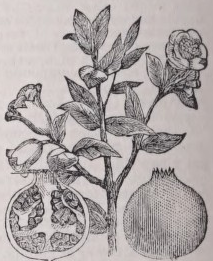
POMEGRANATE. The pomegranate (Punica Granatum) is of exceptional interest by reason of its structure, its history, and its utility. It forms a tree of small stature, or a bush with opposite, shining, lance-shaped leaves, from the axils of some of which proceed the brilliant scarlet flowers. These are raised on a short stalk, and consist of a thick fleshy cylindrical or bell-shaped calyx tube, with five to seven short lobes at the top. From the throat of the calyx proceed five to seven roundish, crumpled, scarlet or crimson petals, and below them very numerous slender stamens. The pistil consists of two rows of carpels placed one above another, both rows embedded in, and partially inseparate from, the inner surface of the calyx tube. The styles are confluent into one filiform thread. The fruit, which usually attains the size of a large orange, consists of a hard leathery rind, which is the enlarged calyx tube, enclosing a quantity of pulp derived from the coats of the numerous seeds. This pulp, filled as it is with refreshing acid juice, constitutes the chief value of the tree. The more highly cultivated forms contain more of it than the wild or half-wild varieties. The great structural peculiarity consists in the presence of the two rows of carpels one above another (a state of things which occurs exceptionally in apples and oranges), and in the fact that, while in the lower series (fig. 1 ) the seeds are attached to the inner border or lower angle of the cavity, they occupy the outer side in the upper series (fig. 2), as if, during growth, the upper whorl had become completely bent over....
By Bentham and Hooker the genus Punica is included under Lythraceae ; others consider it more nearly allied to the myrtles; while its peculiarities are so great as, in the opinion of many botanists, to justify its inclusion in a separate order. Not only is the fruit valuable in hot countries for the sake of its pulp, but the rind and the bark and the outer part of the root are valuable as astringentsowing to the large quantity of tannin that they contain. The bark of the root is likewise valued in cases of tape-worm.
The tree is without doubt wild in Afghanistan, north-western India, and the districts south and south-west of the Caspian, but it has been so long cultivated that it is difficult to say whether it is really native in Palestine and the Mediterranean region. It has been cited as wild in northern Africa, but this appears to be a mistake. Recently, however, Prof. Bayley Balfour met with a wild species, heretofore unknown, in the island of Socotra, the flowers of which have only a single row of carpels, which suggests the inference that it may have been the source of the cultivated varieties. But, on the other hand, in Afghanistan, where Aitchison met with the tree truly wild, a double row of carpels was present as usual. The antiquity of the tree as a cultivated plant is evidenced by the Sanskrit name Dâdimba, and by the references to the fruit in the Old Testament, and in the Odyssey, where it is spoken of as cultivated in the gardens of the kings of Phaeaeia and Phrygia. The fruit is frequently represented on ancient Assyrian and Egyptian sculptures, and had a religious significance in connexion with several Oriental cults, especially the Phrygian cult of Cybele (Arnob., v. 5 sq.∙, see also Baudissin, Studien, ii. 207 sq.). It was well known to the Greeks and Romans, who were acquainted with its medicinal properties an'd its use as a tanning material. The name given by the Romans, malum punicum, indicates that they received it from Carthage, as indeed is expressly stated by Pliny; and this circumstance has given rise to the notion that the tree was indigenous in northern Africa. On a review of the whole evidence, botanical, literary, and linguistic, Alphonse de Candolle (Origine des Plantes Cultivées) pronounces against its African origin, and decides in favour of its source in Persia and the neighbouring countries. According to Saporta the pomegranate existed in a fossil state in beds of the Pliocene epoch near Meximieux in Burgundy. The pomegranate is sometimes met with in cultivation against a wall in England, but it is too tender to withstand a severe winter. The double-flowered varieties are specially desirable for the beauty and long duration of their flowers.
[749 words — estimated reading time: 5 minutes]
רמון, Numbers xiii, 23; xx, 5; 1 Sam. xiv, 2, &c, a low tree growing very common in Palestine, and in other parts of the east. Its branches are very thick and bushy; some of them are armed with sharp thorns. They are garnished with narrow spear-shaped leaves. Its flowers are of an elegant red colour, resembling a rose. It is chiefly valued for the fruit, which is as big as a large apple, is quite round, and has the general qualities of other summer fruits, allaying heat and quenching thirst. The high estimation in which it was held by the people of Israel, may be inferred from its being one of the three kinds of fruit brought by the spies from Eshcol to Moses and the congregation in the wilderness, Num. xiii, 23; xx, 5; and from its being specified by that rebellious people as one of the greatest luxuries which they enjoyed in Egypt, the want of which they felt so severely in the sandy desert. The pomegranate, classed by Moses with wheat and barley, vines and figs, oil olive and honey, was, in his account, one principal recommendation of the promised land, Deut. viii, 8. The form of this fruit was so beautiful, as to be honoured with a place at the bottom of the high priest’s robe, Exodus xxviii, 33; Ecclus. xlv, 9; and was the principal ornament of the stately columns of Solomon’s temple. The inside is full of small kernels, replenished with a generous liquor. In short there is scarcely any part of the pomegranate which does not delight and recreate the senses.
[269 words — estimated reading time: 2 minutes]
POMERANIA (Germ. Pommern) is a maritime province of Prussia, bounded on the N. by the Baltic, on the W. by Mecklenburg, on the S. by Brandenburg, and on the E. by West Prussia. Its area is 11,620 square miles. The province is officially divided into the three districts of Stralsund, Stettin, and Cöslin; but more historical interest attaches to the names of Vorpommern and Hinter-pommern, or Hither and Farther Pomerania, applied to the territory to the west and to the east of the Oder respectively. As a whole Pomerania is one of the lowest and flattest parts of Germany, but to the east of the Oder it is traversed by a range of low hills, and there are also a few isolated eminences to the west. Off the west coast, which is very irregular, lie the islands of Rügen, Usedom, and Wollin; the coast of Farther Pomerania is smooth in outline and bordered with dunes or sandbanks. Besides the Oder and its affluents, there are several small rivers flowing into the Baltic, none of which, however, are navigable except for rafts. Many of these end in small littoral lakes, separated from the sea by a narrow strip of land, through which the water escapes by one or more outlets. The interior of the province is also thickly sprinkled with lakes, the combined area of which is equal to about one-twentieth of its entire surface. The soil of Pomerania is for the most part thin and sandy, especially to the east of the Oder; but patches of good soil occur here and there. About 55 per cent, of the surface is under tillage, while 19 per cent, consists of meadow and pasture and 20 per cent, is covered by forests. The principal crops are potatoes, rye, and oats, but wheat and barley are grown in the more fertile districts; tobacco and beetroot for sugar are also cultivated. Agriculture is still in ...many respects carried on in a somewhat primitive fashion, and the live stock is as a rule of an inferior quality. Large flocks of sheep are kept both for their flesh and wool, and geese and goose-feathers form lucrative articles of export. (A tabular view of the agricultural products of Pomerania will be found under Prussia.) Owing to the long coast-line and the numerous lakes, fishing forms a not unimportant industry, and large quantities of herring, eels, lampreys, <fcc., are sent from Pomerania to other parts of Germany. With the exceptions of its inexhaustible layers of peat or soft coal, the mineral wealth of Pomerania is insignificant. Its industrial activity is also of no great importance, though there are a few manufactories of machinery, chemicals, tobacco, sugar, and other articles, chiefly in or near the larger towns, and linen-weaving is practised as a domestic industry. Shipbuilding is carried on at Stettin and other places on the coast. Commerce, however, is relatively much more flourishing. Stettin is one of the chief seaports of Prussia, and Stralsund, Greifswald, and Colberg also possess a foreign trade, the exports consisting mainly of grain, timber, and fish.
In 1880 Pomerania contained 1,540,034 inhabitants, all of whom were Protestants except 23,877 Roman Catholics and 13,886 Jews. The Slavonic element in the population is now represented only by a few thousand Poles and a handful of the ancient Cassubians on the east border. Pomerania is the most sparsely populated province in Prussia, the ratio being 132 inhabitants per square mile. About 67 per cent, of the population belong to the rural districts, while the remainder live in communities of 2000 and upwards. There are only nine towns with more than 10,000 inhabitants, at the head of which stands Stettin with 91,000. The Pomeranians belong mainly to the old Saxon stock, and are, as a rule, tall, strong, and well-built. They somewhat resemble the Scots in their cautious and persevering character, their strong theological bias (which perpetuates the existence of numerous small Protestant sects), and their turn for dry humour; but they are by no means so enterprising or so open to new ideas. In 1883 only 0’32 per cent, of the Pomeranian recruits were illiterate, a fact which speaks well for the educational system of the province. There is a univeιsity at Greifswald. The province sends 16 members to the reichstag and 26 to the Prussian house of representatives. The heir-presumptive of the Prussian crown bears the title of governor of Pomerania.
History. — In prehistoric times the southern coast of the Baltic seems to have been occupied by Celts, who afterwards made way for tribes of Teutonic stock. These in their turn migrated to other settlements and were replaced, about the beginning of the 6th century of our era, by Slavonians. The name of Pomore or Pommern, meaning “on the sea,” was attached to the district by the last of these immigrant racés, and has often changed its political and geographical significance. Originally it seems to have denoted the coast district between the Oder and the Vistula, a territory which was at first more or less dependent on Poland, but which appears towards the end of the 12th century as divided between two native dukes owning the supremacy of the German emperor. Afterwards Pomerania spread much farther to the west, while correspondingly curtailed on the east, and a distinction was made between Slavinia, or modern Pomerania, and Pomerellen. The latter, corresponding substantially to the present province of West Prussia, remained subject to Poland down to the beginning of the 14th century, when part of it fell away to the Teutonic knights and part of it was annexed to the duchy of Pomerania-Wolgast. Christianity was introduced in the 12th century, and its advance went hand in hand with the Germanizing of the district. The later mediaeval history of Pomerania is occupied with an endless succession of subdivisions among different lines of the ducal houses, and with numerous expansions and contractions of territory through constant hostilities with the elector of Brandenburg, who claimed to be the immediate feudal superior of Pomerania, and with other neighbouring powers. The names Vorpommern and Hinterpom-mern were at first synonymous with Slavinia and Pomerellen, but towards the close of the 14th century they were transferred to the two duchies into which the former (Pomerania proper) was divided. In 1625 the whole of Pomerania became united under the sway of Bogeslaus XIV., and, on his death without issue in 1637, Brandenburg laid claim to the duchy in virtue of a compact of 1571. The Swedes, however, had in the meantime occupied the country, and at the peace of Westphalia (1648) the elector had to content himself with East Pomerania and see the other half awarded to Sweden. In 1720 Swedish Pomerania was curtailed by extensive concessions to Prussia, but the district to the west of the Peene remained in possession of Sweden down to the dissolution of the German empire. On the downfall of Napoleon, Sweden assigned her German possessions to Denmark in exchange for Norway, whereupon Prussia, partly by purchase and partly by the cession of Lauenburg, finally succeeded in uniting the whole of Pomerania under her sway.
[1,205 words — estimated reading time: 7 minutes]
POMEROY, a city of the United States, in Meigs county, Ohio, lies on the right bank of the Ohio about half-way between Pittsburgh and Cincinnati. It is the terminus of the Ohio River division of the Columbus, Hocking Valley, and Toledo Railway, and has extensive coal-mines dating from 1833, salt works (14,000,000 bushels per annum), and bromine factories. Incorporated as a village in 1841 and as a city in 1868, Pomeroy had 5824 inhabitants in 1870 and 5560 in 1880.
[84 words — estimated reading time: 1 minute]