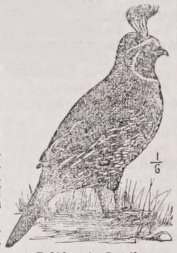
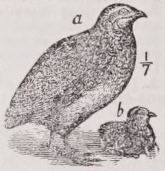
A bird of the genus Tetrao or grouse kind, or according to Latham's arrangement, of the genus Perdix, in which he comprehends the partridge and quail In New England, the name is applied to a peculiar species of the perdix, which is called partridge in the middle states, but it is neither the partridge nor quail of Europe.
1. Any gallinaceous bird belonging to Coturnix and several allied genera of the Old World, especially the common European quail (C. communis), the rain quail (C. Coromandelica) of India, the stubble quail (C. pectoralis), and the Australian swamp quail (Synoicus australis).
2. Any one of several American partridges belonging to Colinus, Callipepla, and allied genera, especially the bobwhite (called Virginia quail, and Maryland quail), and the California quail (Calipepla Californica).
3. Any one of numerous species of Turnix and allied genera, native of the Old World, as the Australian painted quail (Turnix varius). See Turnix.
4. A prostitute; -- so called because the quail was thought to be a very amorous bird.
2. To become quelled; to become cast down; to sink under trial or apprehension of danger; to lose the spirit and power of resistance; to lose heart; to give way; to shrink; to cower.
QUAIL (Old French Quaille, Mod. French Caille, Italian Quaglia, Low Latin Quaquila, Dutch Kwakkel, and Kwartel, German Wachtel, Danish Vagtel), a very well-known bird throughout almost all countries of Europe, Asia, and Africa,—in modern ornithology the Coturnix communis or C. dactylisonans. This last epithet was given from the peculiar three-syllabled call-note of the cock, which has been grotesquely rendered in several European languages, and in some parts of Great Britain the species is popularly known by the nickname of “Wet-my-lips” or “Wet-my-feet.” The Quail varies somewhat in colour, and the variation is rather individual than attributable to local causes; but generally the plumage may be described as reddish-brown above, almost each feather being transversely patched with dark brown interrupted by a longitudinal stripe of light buff; the head is dark brown above, with three longitudinal streaks of ochreous-white; the sides of the breast and flanks are reddish-brown, distinctly striped with ochreous-white; the rest of the lower parts are pale buff, clouded with a darker shade, and passing into white on the belly. The cock, besides being generally brighter in tint, not unfrequently has the chin and a double-throat band of reddish or blackish-brown, which marks are wanting in the hen, whose breast is usually spotted. Quails breed on the ground, as all gallinaceous birds commonly do, and lay from nine to fifteen eggs of a yellowish-white, blotched and spotted with dark brown. Though essentially migratory by nature, not a few Quails pass the winter in the northern hemisphere and even in Britain, and many more in southern Europe. In March and April they cross the Mediterranean from the south on the way to their breed- ...
ing homes in large bands, but these are said to be as nothing compared with the enormous flights that emigrate from Europe towards the end of September. During both migrations immense numbers are netted for the market, since they are almost universally esteemed as delicate meat. On capture they are placed in long narrow and low cages, darkened to prevent the prisoners from fighting, and, though they are often so much crowded as to be hardly able to stir, the loss by death that ensues is but trifling. Food, usually millet or hempseed, and water are supplied in troughs hung in front, and thus these little birds are transported by tens of thousands from the shores of the Mediterranean for consumption in the most opulent and populous cities of Europe. The flesh of Quails caught in spring commonly proves dry and indifferent, but that of those taken in autumn, especially when they have been kept long enough to grow fat, as they quickly do, is excellent. In no part of the British Islands at present do Quails exist in sufficient numbers to be the especial object of sport, though there are many places in which a few, and in some seasons more than a few, yearly fall to the gun. When made to take wing, which is not always easily done, they rise with great speed, but on such occasions they seldom fly far, and no one seeing them only thus would be inclined to credit them with the power of extensive migration that they possess, though this is often overtaxed, and the birds in their transmarine voyages frequently drop exhausted into the sea or on any vessel that may be in their way. In old days they were taken in England in a net, attracted thereto by means of a Quail-call,—a simple instrument, the use of which is now wholly neglected,—on which their notes are easily imitated.
Five or six other species of the restricted genus Coturnix are now recognized; but the subject of the preceding remarks is generally admitted to be that intended by the author of the book of Exodus (xvi. 13) as having supplied food to the Israelites in the wilderness, though a few ornithological writers have thought that bird to have been a Sand-Grouse (<∕.v.). In South Africa and India allied species, C. delegorguii and C. coromandelica, the latter known as the Rain-Quail, respectively occur, as well as the commoner one, which in Australia and Tasmania is wholly replaced by C. pectoralis, the Stubble-Quail of the colonists. In New Zealand another species, C. novae-zelandiae, was formerly very abundant in some districts, but is considered to have been nearly if not quite extirpated within the last twenty years by bush-fires. Some fifteen or perhaps more species of Quails, inhabiting the Indian and Australian Regions, have been separated, perhaps unnecessarily, to form the genera Synoecus, Perdicula, Excalphatoria, and so forth; but they call for no particular remark.
America has some fifty or sixty species of birds which are commonly deemed Quails, though by some authors placed in a distinct Family or Sub-family Odontophorinae. 1 The best known is the Virginian Quail, or Colin, as it is frequently called—that being, according to Hernandez, its old Mexican name. It is the Ortyx virginianus of modern ornithology, and has a wide distribution in North America, in some parts of which it is known as the “Partridge,” as well as by the nickname of “Bob-White,” aptly bestowed upon it from the call-note of the cock. Many attempts have been made to introduce this bird to England (as indeed similar trials have been made in the United States with Quails from Europe); but, though it has been turned out by hundreds, and has been frequently known to breed after liberation, its numbers rapidly diminish until it wholly disappears. The beautiful tufted Quail of Cali fornia, Lophortyx californica, has also been tried in Europe without success. All these American Quails or Colins seem to have the habit of perching on trees, which none of the Old-World forms possess.
Interesting from many points of view as is the group of Birds last mentioned, there is another which, containing a score of species (or perhaps more) often termed Quails or Button-Quails, is of still greater importance in the eyes of the systematist. This is that comprehended by the genus Turnix, or Hemipodius of some authors, the anatomical structure of which removes it far from the genera Coturnix, Ortyx, and their allies, and even from any of the normal Gallinae. Prof. Huxley, as already stated (Ornithology, vol. xviii. p. 36), would regard it as the representative of a generalized stock from which the Charadriomorpliae, and Alectoromorphae, to say nothing of other groups, have sprung. Want of space prevents our here dwelling upon these curious birds. One species, T. sylvatica, inhabits Barbary and southern Spain, and under the name of Andalucian Hemipode has been included (though on evidence not wholly satisfactory) among British Birds as a reputed straggler. The rest are natives of various parts of the Ethiopian, Indian, and Australian Regions. It is characteristic of the genus Turnix to want the hind toe; but the African Ortyxelus and the Australian Pedionomus which have been referred to its neighbourhood have four toes on each foot, and, since nothing is known of the anatomy or habits of the first and but little of those of the second, their position must at present be considered doubtful. (a. n.)
9th ed. Encyclopædia Britannica, vol. 20, p. 146 [1,213 words — estimated reading time: 7 minutes]
שלו, Exod. xvi, 13; Num. xi, 31, 32; Psalm cv, 10; a bird of the gallinaceous kind. Hasselquist, mentioning the quail of the larger kind, says, “It is of the size of the turtledove. I have met with it in the wilderness of Palestine, near the shores of the Dead Sea and the Jordan, between Jordan and Jericho, and in the deserts of Arabia Petrea. If the food of the Israelites was a bird, this is certainly it; being so common in the places through which they passed.” It is said that God gave quails to his people in the wilderness upon two occasions: first, within a few days after they had passed the Red Sea, Exod. xvi, 3–13. The second time was at the encampment at the place called in Hebrew, Kibroth-hataavah, the graves of lust, Num. xi, 32; Psalm cv, 40. Both of these happened in the spring, when the quails passed from Asia into Europe. They are then to be found in great quantities upon the coast of the Red Sea and Mediterranean. God caused a wind to arise that drove them within and about the camp of the Israelites; and it is in this that the miracle consists, that they were brought so seasonably to this place, and in so great number as to furnish food for above a million of persons for more than a month. The Hebrew word _shalav_ signifies “a quail,” by the agreement of the ancient interpreters. And the Chaldee, Syriac, and Arabic languages call them nearly by the same name. The Septuagint, Symmachus, and most of commentators, both ancient and modern, understand it in the same manner; and with them agree Philo, Josephus, Apollinaris, and the rabbins; but Ludolphus has endeavoured to prove that a species of locust is spoken of by Moses. Dr. Shaw answers, that the holy psalmist, in describing this particular food of the Israelites, by calling the animals ...feathered fowls, entirely confutes this supposition. And it should be recollected, that this miracle was performed in compliance with the wish of the people that they might have flesh to eat.
A pipe or call for alluring quails into a net; a kind of leathernpurse in the shape of a pear, partly filled with horse hair, with a whistle at the end.
V. fear, stand in awe of, be afraid, have qualms, apprehend, sit upon thorns, eye askance, distrust, hesitate, falter, funk, cower, crouch, skulk, "let 'i dare not' wait upon 'i would'", take fright, take alarm, start, wince, flinch, shy, shrink, fly, tremble, shake, shiver, shiver in one's shoes, shudder, flutter, shake like an aspen leaf, tremble like an aspen leaf, tremble all over, quake, quaver, quiver, quail, grow pale, turn pale, blench, stand aghast, not dare to say one's soul is one's own, inspire fear, excite fear, inspire awe, excite awe, raise aprehensions, be in a daze, bulldoze, faze, feeze, give an alarm, raise an alarm, sound an alarm, alarm, startle, scare, cry "wolf," disquiet, dismay, fright, frighten, terrify, astound, fright from one's propriety, fright out of one's senses, fright out of one's wits, fright out of one's seven senses, awe, strike all of a heap, strike an awe into, strike terror, harrow up the soul, appall, unman, petrify, horrify, pile on the agony, make one's flesh creep, make one's hair stand on end, make one's blood run cold, make one's teeth chatter, take away one's breath, stop one's breath, make one tremble &c. haunt, prey on the mind, weigh on the mind, put in fear, put in bodily fear, terrorize, intimidate, cow, daunt, overawe, abash, deter, discourage, browbeat, bully, threaten
Phr. ante tubam trepidat, horresco referens, one's heart failing one, obstupui steteruntque comae et vox faucibus haesit, "a dagger of the mind", expertus metuit, "fain would i climb but that i fear to fall", "fear is the parent of cruelty", "gorgons and hydras and chimeras dire", omnia tuta timens, "our fears do make us traitors"
Int. sauve qui peut, [French: every man for himself], devil take the hindmost, phr, ante tubam trepidat, one's courage oozing out, degeneres animos timor arguit
And there went forth a wind from the LORD, and brought quails from the sea, and let them fall by the camp, as it were a day’s journey on this side, and as it were a day’s journey on the other side, round about the camp, and as it were two cubits high upon the face of the earth.
Now a wind sent by the LORD came up, drove in quail from the sea, and brought them near the camp, about two cubits above the surface of the ground, for a day’s journey in every direction around the camp.
And the people stood up all that day, and all that night, and all the next day, and they gathered the quails: he that gathered least gathered ten homers: and they spread them all abroad for themselves round about the camp.
All that day and night, and all the next day, the people stayed up gathering the quail. No one gathered less than ten homers, and they spread them out all around the camp.
Instead of which punishment, dealing graciously with thine own people, thou preparedst for them meat of a strange taste, even quails to stir up their appetite:
For quails came up unto them from the sea for their contentment.
This site uses cookies to remember your display preferences (search sources and editions, Bible version, auto-link, images, light/dark theme). No personal data whatsoever is collected. Privacy Policy