
1. A wild fowl of the genus Tatrao. Latham arranges the partridge and quail in a genus under the name of Perdix, and assigns the grous to the genus Tetrao. The partridge is esteemed a great delicacy at the table.
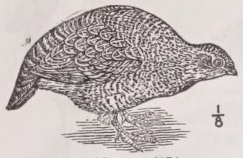
PARTRIDGE, in older English Pertriche, Dutch Ρatri i js, French Perdrix, all from the Latin Perdix, which word in sound does not imitate badly the call-note of this bird, so well known throughout the British Islands and the greater part of Europe as to need no description or account of its habits here. The English name properly denotes the only species indigenous to Britain, often nowadays called the Grey Partridge (to distinguish it from others, of which more presently), the Perdix cinerea of ornithologists, a species which may be regarded as the model game-bird—whether from the excellence of the sport it affords in the field, or the no less excellence of its flesh at table, which has been esteemed from the time of Martial to our own—while it is on all hands admitted to be wholly innocuous, and at times beneficial to the agriculturist. It is an undoubted fact that the Partridge thrives with the highest system of cultivation; and the lands that are the most carefully tilled, and bear the greatest quantity of grain and green crops, generally produce the greatest number of Partridges. Yielding perhaps in economic importance to the Red Grouse, what may be called the social influence of the Partridge is greater than that excited by any other wild bird, for there must be few rural parishes in the three kingdoms of which the inhabitants are not more or less directly affected in their movements and business by the coming in of Partridgeshooting, and therefore a few words on this theme may not be out of place....
From the days when men learned to “shoot flying” until some forty years ago, dogs were generally if not invariably used to point out where the “covey,” as a family party of Partridges is always called, was lodged, and the greatest pains were taken to break in the “pointers” or “setters” to their duty. In this way marvellous success was attained, and the delight lay nearly as much in seeing the dogs quarter the ground, wind and draw up to the game, helping them at times (for a thorough understanding between man and beast was necessary for the perfection of the sport) by word or gesture, as in bringing down the bird after it had been finally sprung. There are many who lament that the old-fashioned practice of shooting Partridges to dogs has, with rare exceptions, fallen into desuetude, and it is commonly believed that this result has followed wholly from the desire to make larger and larger bags of game. The opinion has a certain amount of truth for its base; but those who hold it omit to notice the wholly changed circumstances in which Partridgeshooters now find themselves. In the old days there were plenty of broad, tangled hedgerows which afforded permanent harbour for the birds, and at the beginning of the shooting-season admirable shelter or “lying” (to use the sportsman’s word) was found in the rough stubbles, often reaped knee-high, foul with weeds and left to stand some six or eight weeks before being ploughed, as well as in the turnips that were sown broadcast. Throughout the greater part of England now the fences are reduced to the narrowest of boundaries and are mostly trimly kept; the stubbles—mown, to begin with, as closely as possible to the ground—are ploughed within a short time of the corn being carried, and the turnips are drilled in regular lines, offering inviting alleys between them along which Partridges take foot at any unusual noise. Pointers in such a district—and to this state of things all the arable part of England is tending—are simply useless, except at the beginning of the season, when the young birds are not as yet strong on the wing, and the old birds are still feeble from moulting their quill-feathers. Of late years therefore other modes of shooting Partridges have had to be employed, of which methods the most popular is that known as “driving”—the “guns” being stationed in more or less concealment at one end of the field, or series of fields, which is entered from the other by men or boys who deploy into line and walk across it making a noise. It is the custom with many to speak depreciatingly of this proceeding, but it is a fact that as much knowledge of the ways of Partridges is needed to ensure a successful day’s “driving” as was required of old when nearly everything was left to the intelligence of the dogs, for the course of the birds’ flight depends not only on the position of the line of beaters, but almost on the station of each person composing it, in relation to the force and direction of the wind and to the points on which it is desired that the Partridges should converge. Again, the skill and alacrity wanted for bringing down birds flying at their utmost velocity, and often at a considerable height, is enormously greater than that which sufficed to stop those that had barely gone 20 yards from the dog’s nose, though admittedly Partridges rise very quickly and immediately attain great speed. Moreover, the shooting of Partridges to pointers came to an end in little more than six weeks, whereas “driving” may be continued for the whole season, and is never more successful than when the birds, both young and old, have completed their moult, and are strongest upon the wing. But, whether the new fashion be objectionable or not, it cannot be doubted that to go back to the old one with success would necessitate a reversion to the slovenly methods of agriculture followed in former years, and therefore is as impossible as would be a return to the still older practice of taking Partridges in a setting-net, described by Gervase Markham or Willughby.
The Grey Partridge has doubtless largely increased in numbers in Great Britain since the beginning of the present century, when so much down, heath, and moorland was first brought under the plough, for its partiality to an arable country is very evident. It has been observed that the birds which live on grass lands or heather only are apt to be smaller and darker in colour than the average; but in truth the species when adult is subject to a much greater variation in plumage than is commonly supposed, and the well-known chestnut horse-shoe mark, generally considered distinctive of the cock, is very often absent. In Asia our Partridge seems to be unknown, but in the temperate parts of Eastern Siberia its place is taken by a very nearly allied form, P. barbata, and in Tibet there is a bird, P. hodgsoniae, which can hardly with justice be generically separated from it. The relations of some other forms inhabiting the Indian Region are at present too obscure to make any notice of them expedient here.
The common Red-legged Partridge of Europe, generally called the French Partridge, Caccabis ruf a, seems to be justifiably considered the type of a separate group. This bird has been introduced into England within little more than one hundred years ago, and has established itself in various parts of the country, notwithstanding a widely-spread, and in some respects unreasonable prejudice against it. It has certainly the habit of trusting nearly as much to its legs as to its wings, and thus incurred the obloquy of old-fashioned sportsmen, whose dogs it vexatiously kept at a running point; but, when it was also accused of driving away the Grey Partridge, the charge only shewed the ignorance of those that brought it, for as a matter of fact the French Partridge rather prefers ground which the common species avoids—such as the heaviest clay-soils, or the most infertile heaths. But even where the two species meet, the present writer can declare from the personal observation of many years that the alleged antipathy between them is imaginary, and unquestionably in certain parts of the country the “head of game” has been increased by the introduction of the foreigner. The French Partridge has several congeners, all with red legs and plumage of similar character. In Africa north of the Atlas there is the Barbary Partridge, C. petrosa; in southern Europe another, C. saxatilis, which extends eastward till it is replaced by C. chukar, which reaches India, where it is a well-known bird. Two very interesting desert>forms, supposed to be allied to Caccabis, are the Ammoperdix lιeyi of North Africa and Palestine and the A. boηhami of Persia; but the absence of the metatarsal knob, or incipient spur, suggests (in our ignorance of their other osteological characters) an alliance rather to the genus Perdix. On the other hand the groups of birds known as Francolins and Snow-Partridges are generally furnished with strong but blunt spurs, and therefore probably belong to the Cacca-bine group. Of the former, containing many species, there is only room here to mention the Francolin, which used to be found in many parts of the South of Europe, Francolinus vulgaris, which also extends to India, where it is known as the Black Partridge. This seems to have been the Attagas or Attagen of classical authors, a bird so celebrated for its exquisite flavour, the strange disappearance of which from all or nearly all its European haunts has been before noticed (Birds, vol. iii. p. 736, note), and still remains inexplicable. It is possible that this bird has been gradually vanishing for several centuries, and if so to this cause may be attributed the great uncertainty attending the determination of the Attagen — it being a common practice among men in all countries to apply the name of a species that is growing rare to some other that is still abundant. Of the Snow-Partridges, Tetraogallus, it is only to be said here that they are the giants of their kin, and that nearly every considerable range of mountains in Asia seems to possess its specific form.
By English colonists the name Partridge has been very loosely applied, and especially so in North America. Where a qualifying word is prefixed no confusion is caused, but without it there is sometimes a difficulty at first to know whether the Ruffed Grouse (Bonasa umbellus) or the Virginian Colin (Ortyx virginianus) is intended, (a. n.)
קדא, 1 Samuel xxvi, 20; Jer. xvii, 11; ϖέρδιξ, Ecclus. xi, 30. In the first of these places David says, The king of Israel is come out to hunt a partridge on the mountains;” and in the second, The partridge sitteth,” on eggs, and produceth,” or hatcheth, not; so he that getteth riches, and not by right, shall leave them in the midst of his days, and at his end shall be contemptible.” This passage does not necessarily imply that the partridge hatches the eggs of a stranger, but only that she often fails in her attempts to bring forth her young. To such disappointments she is greatly exposed from the position of her nest on the ground, where her eggs are often spoiled by the wet, or crushed by the foot. So he that broods over his ill-gotten gains will often find them unproductive; or, if he leaves them, as a bird occasionally driven from her nest, may be despoiled of their possession. As to the hunting of the partridge, which, Dr. Shaw observes, is the greater, or red-legged kind, the traveller says: The Arabs have another, though a more laborious, method of catching these birds; for, observing that they become languid and fatigued after they have been hastily put up twice or thrice, they immediately run in upon them, and knock them down with their _zerwattys_, or bludgeons as we should call them.” Precisely in this manner Saul hunted David, coming hastily upon him, putting him up incessantly, in hopes that at length his strength and resources would fail, and he would become an easy prey to his pursuer. Forskal mentions a partridge whose name in Arabic is _kurr_; and Latham says, that, in the province of Andalusia in Spain, the name of the partridge is _churr_; both taken, no doubt, like the Hebrew, from its note. [Illustration: Map of the _COUNTRIES_ ...Travelled by the APOSTLES with the ROUTES OF ST. PAUL through _Asia & Europe_ ]