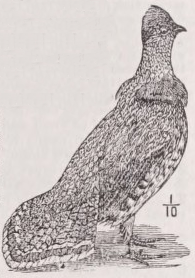
Grouse[Noun singular and plural]Webster's Dictionary 1913
Any of the numerous species of gallinaceous birds of the family Tetraonidae, and subfamily Tetraoninae, inhabiting Europe, Asia, and North America. They have plump bodies, strong, well-feathered legs, and usually mottledplumage. The group includes the ptarmigans (Lagopus), having feathered feet.
GROUSE, a word of uncertain origin, or Mooregame” {Diclionarie of the French and English Tongues, sub voce Poule). The most likely derivation seems to be from the old French word Griesche, Grcoche, or Griais (meaning speckled, and cognate with griseus, grisly or grey), which was applied to some kind of Partridge, or according to B∏ιnetto Latini ( Très., p 211) to a Quail, “porce que ele fu premiers trovée en Grece.” ] now used generally by ornithologists to include all the “rough-footed” Gallinaceous birds, but in common speech applied almost exclusively, when used alone, to the Tetrao scoticus of Linnaeus, the Lagopzιs scoticus of modern systematists—more particularly called in English the Red Grouse, but not a century ago almost invariably spoken of as the Moor-fowl or Moor-game. The effect which this species is supposed to have on the British legislature, and therefore on history, is well known, for it is the common belief that parliament in these days always rises when the season for Grouseshooting begins; but even of old time it seems to have excited on one occasion a curious kind of influence, for we may read in the Orkneyinga Saga (ed. Jonaeus, p. 356; ed. Anderson, p. 168) that events of some importance in the annals of North Britain followed from its pursuit in Caithness in the year 1157. The Red Grouse is found on moors from Monmouthshire and Derbyshire northward to the Orkneys, as well as in most of the Hebrides. It likewise inhabits similar situations throughout Wales and Ireland, but it does not naturally occur beyond the limits of the British Islands, and is the only species among birds peculiar to them. The word “species” may in this case be used advisedly (since the Red Grouse invariably “breeds true,” it admits of an easy ...diagnosis, and it has a definite geographical range); but scarcely any zoologist who looks further into the matter can doubt of its common origin with the Willow-Grouse, Lagopus albus {L. subalpinus or L. saliceti of some authors), that inhabits a subarctic zone from Norway across the whole continent of Europe and Asia, as well as North America from the Aleutian Islands to Newfoundland. The Red Grouse indeed is rarely or never found away from the heather on which chiefly it subsists, and with which in most men’s minds it is associated; while the Willow-Grouse in many parts of the Old World seems to prefer the shrubby growth of berry-bearing plants ( Vaccinium and others) that, often thickly interspersed with willows and birches, clothes the higher levels or the lower mountain-slopes, and it contrives to flourish in the New World where heather scarcely exists, and a “heath” in its strict sense is unknown. It is true likewise that the Willow-Grouse always becomes white in winter, which the Red Grouse never does; but then we find that in summer there is a considerable resemblance between the two species, the cockWillow-Grouse having his head, neck, and breast of nearly the same rich chestnut-brown as his British representative, and, though his back be lighter in colour, as is also the whole plumage of his mate, than is found in the Red Grouse, in other respects than those named above tl.e two species are precisely alike. No distinction can he discovered in their voice, their eggs, their build, nor in their anatomical details, so far as these have been investigated and compared. In connexion too with this matter it should not be overlooked that the Red Grouse, restricted as is its range, varies in colour not inconsiderably according to locality, so that game-dealers of experience are able to pronounce at sight the native district of almost any bird that comes to their hands.
Other peculiarities of the Red Grouse—the excellence of its flesh, and its economic importance, which is perhaps greater than that of any other wild bird in the world— hardly need notice here, and there is not space to dv ell upon that dire and mysteriousmalady to which it is frcm time to time subject, primarily induced, in the opinion of many, by the overstocking of its haunts and the propagation of diseased offspring by depauperized parents.
Though the Red Grouse does not, after the manner of other members of the genus Lagopus, beccme white in winter, Scotland possesses a species of the genus which does. This is the Ptarmigan, L. mutus or L. alρinus, which differs far more in structure, station, and habits from the Red Grouse than that does from the Willow-Grouse, and in Scotland is far less abundant, haunting only the highest and most barren mountains. It is said to have formerly inhabited both Wales and England, but there is no evidence of its appearance in Ireland. On the continent of Europe it is found most numerously in Norway, but at an elevation far above the growth of trees, and it occurs on the Pyrenees, and on the Alps. It also inhabits northern Russia, but its eastern limit is unknown. In North America, Greenland, and Iceland it is represented by a very nearly allied form— so much so indeed that it is only at certain seasons that the slight difference between them can be detected. This form is the L. rupestris of authors, and it would appear to be found also in Siberia {Ibis, 1879, p. 148). Spitsbergen is inhabited by a large form which has received recognition as L. hemileucurus, and the northern end of the chain of the Rocky Mountains is tenanted by a very distinct species, the smallest and perhaps the most beautiful of the genus, L. leucurus, which has all the feathers of the tail white The very curious and still hardly understood question of the moulting of the Ptarmigan could not possibly be dis cussed within these limits—reference has already been made to it in another article (Birds, vol. iii. p. 776).
The bird, however, to which the name of Grouse in all strictness belongs is probably the Tetrao tetrix of Linnaeus
—the Blackcock and Greyhen, as the sexes are with us respectively called, It is distributed over most of the heathcountry of England, except in East Anglia, where attempts to introduce it have been only partially successful. It also occurs in North Wales, and very generally throughout Scotland, though not in Orkney, Shetland, or the Outer
Hebrides, nor in Ireland. On the continent of Europe it has a very wide range, and it extends into Siberia. In Georgia its place is taken by a distinct species, on which a Polish naturalist {Proc. Zooh Society, 1875, p. 267) has unhappily conferred the name of T. mlokosiewiczi. Both these birds have much in common with their larger congener the Capercally (see vol. v. p. 53) and its eastern representative.
We must then notice the species of the genus Bonasa, of which the European B. sylvestris is the type. This does not inhabit the British Islands; unfortunately so, for it is perhaps the most delicate game-bird that comes to table. It is the Gelinotte of the French, the Haselhuhn of Germans, and Hjeτpe of Scandinavians. Like its transatlanticcongener B. umbellus, the Ruffed Grouse or Birch-Partridge (of which there are two other local forms, B. umbelloides and B. sabiηii), it is purely a forest-bird. The same may be said of the species of Canace, of which two forms .are found in America, C. canadensis, the Spruce-Partridge, and C. franklini, and also of the Siberian C. falcipennis. Nearly allied to these birds is the group known as Deηdragapus, containing three large and fine forms D. obscurus, f). fuliginosus, and D. richardsoni — all peculiar to North America. Then we have Centrocercu3 urophasianus, the Sage-cock of the plains of Columbia and California, and Pediοecetes, the Sharp-tailed Grouse, with its two forms P. phasianellus and P. columbiaηus, while finally Cuj)idonia, the Prairie-hen, also with two local forms, Û cupido and C. pallidicincta, is a bird that in the United States of America possesses considerable economic value, as. witness the enormou3 numbers that are not only consumed there, but exported to Europe. It will be seen that the great majority of Grouse belong to the northern part of the New World, and it is much to be regretted that space here fails to do justice to these beautiful and important birds, by enlarging on their interesting distinctions. They are nearly all figured in Elliot’s Monograph of the Tetraoninoe, and an excellent account of the American species is given in Baird, Brewer, and Ridgway’s North American Birds (iii. pp. 414-465). (a. n.)
9th ed. Encyclopædia Britannica, vol. 11, p. 221 [1,453 words — estimated reading time: 9 minutes]
This site uses cookies to remember your display preferences (search sources and editions, Bible version, auto-link, images, light/dark theme). No personal data whatsoever is collected. Privacy Policy