
TUR'KEY
Word of the Day: Catachrestical
Another name of the oil-stone, from turkey
2. Any large American gallinaceous bird belonging to the genus Meleagris, especially the North American wild turkey (Meleagris gallopavo), and the domestic turkey, which was probably derived from the Mexican wild turkey, but had been domesticated by the Indians long before the discovery of America.
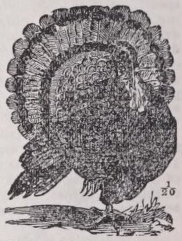
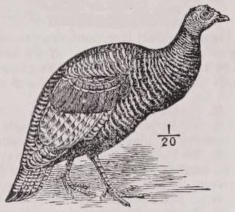
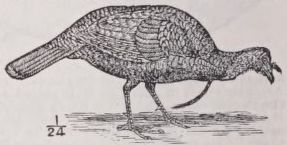
Turkey
Encyclopedia Britannica
TURKEYPart I.— History.
SOMEWHERE about the second decade of the 13th century the little Turkish tribe which in due course was to found the Ottoman empire fled before the Mongols from its original home in Central Asia, and, passing through Persia, entered Armenia, under the leadership of Suleymán Sháh, its hereditary chief. His son, Er-Toghrul, who succeeded him as head of the tribe, when wandering about the country with his warriors came one day upon two armies engaged in a furious battle. Er-Toghrul at once rode to the assistance of the weaker party, who were on the point of giving way, but who through the timely aid thus rendered not only regained what they had lost but totally defeated their enemies. The army thus saved from destruction proved to be that of 'Alá-ud-Dín, the Seljúk sultan of Asia Minor, and their adversaries to be a horde of marauding Mongols. By way of recompense for this service 'Alá-ud-Dín granted to Er-Toghrul a tract of land on the Byzantine frontier, including the towns of Sugut and Eski Shehr. 'Osmán, the son of Er-Toghrul and the prince from whom the race derives its name of 'Osmánli (see Turks, p. 661 below), corrupted by Europeans into Ottoman, was born in Sugut in 1258 (a.h. 656). While still young 'Osmán won from the Greeks Karaja Hisár (Karahissar) and some other towns, on which account he received from his suzerain, the Seljúk sultan of Konya (Konieh), the title of beg or prince, along with the drum and the horsetail standard, the symbols of princely rank....
In 1300 (699) the Seljúk empire (see Seljuks) fell to pieces under the onslaught of the Mongols, who were, however, powerless to replace it by any government of their own. Thereupon ten separate Turkish dynasties arose from its ruins: that of Karasi sprang up in ancient Mysia, the houses of Saru Khan and Aydin in Lydia, of Mentesha in Caria, of Tekka in Lycia and Pamphylia, of Hamid in Pisidia and Isauria, of Karaman in Lycaonia, of Kermiyan in Phrygia, of Kizil Ahmedli in Paphlagonia, and of 'Osmán in Phrygia Epictetus. These principalities were all eventually merged in that of the 'Osmánlis, once the least among them, and the inhabitants assumed the name of Ottoman. Hence by far the greater portion of the people called Ottomans owe their name to a series of political events. On the collapse of the Seljúk power the Greeks retained hardly any possessions in Asia except Bithynia and Trebizond. Armenia was abandoned for a time to roving Tatar or Turkman tribes, till some sixty or seventy years later one or two petty local dynasties sprang up and founded short-lived states.
The year 1301 (700), in which 'Osmán, who shortly before had succeeded his father, first coined money and caused the khutba, or public prayer for the reigning monarch, to be read in his name—the two prerogatives of an independent sovereign in the East—may be regarded as the birth-year of the Ottoman empire; and it was about this time that his followers and subjects began to call themselves 'Osmánlis, or, as we might render it, 'Osmanites. Having thoroughly established his authority in his capital of Yeni Shehr, 'Osmán began to wrest from the Greeks many of the neighbouring towns and strongholds, among others Ayina Göl and Koyun Hisári, routing before the last named a large Byzantine army. He then turned his attention to the administration of his state, and such was the feeling of security he succeeded in establishing that large numbers of people from the surrounding districts flocked into his dominions and became his subjects. After six years of peace several of the Byzantine castellans of the neighbourhood, instigated by the governor of Brusa (Broussa), made a simultaneous attack upon the Ottomans, but 'Omán totally defeated them and sent in pursuit Kara 'Alí Alp, who took possession of all their domains. Gházán, the khan of the Mongols, who had entered into an alliance with the emperor of Constantinople, sent to all the Turkish princes an arrogantly worded message forbidding them to do any hurt to the Byzantine territories. To show how light he held this menace, 'Osmán assembled an army forthwith, marched to Nicaea and thence to the Bosphorus, laying waste the country as he went and taking possession of a number of towns and villages. Michael, called by the Turkish historians Kösa Míkhál or Michael Scant-beard, the governor of one of these, embraced Islám and became one of the most trusted officers of 'Osmán and of his son and successor Orkhan. The descendants of this Michael were the hereditary commanders of the akinjis, a corps of light cavalry who played a great part in the early Ottoman wars. The first service on which Michael was employed was to destroy, along with Orkhan, a Mongol horde that had taken and pillaged the Ottoman town of Karaja Hisár. Meanwhile ‘Abd-ur-Rahmán and Akcha Koja, two of 'Osmán’s generals, were adding to the Ottoman dominions in the north, capturing several towns and laying siege to the city of Nicaea. The Ottoman chiefs next resolved to acquire Brusa, the natural capital of these parts. So they built round it a series of towers, in which they placed garrisons, with the view of intercepting communications and eventually starving the city into submission. At length, in 1326 (726), after a desultory siege of eight years, the keys were, through the intervention of Míkhál, handed over to Orkhan, who was in command of the Ottomans, and the townspeople were allowed to ransom themselves for 30,000 sequins. Very soon after this 'Osmán died, aged seventy, at Sugut, whence his remains were carried for burial to Brusa. 'Osmán was distinguished for piety and generosity as well as for equity and courage. He cared nothing for amassing wealth, and on his death his personal effects were found to consist of two or three suits of clothes, a few weapons, some horses, and a flock of sheep. And so high was his reputation for justice that, we are told, many of the Asiatic subjects of the Caesars fled to him for that protection which their own rulers would not or could not give them.
Orkhan, who succeeded his father 'Osmán, continued the war against the Greeks, taking from them Nicomedia, Nicaea, and many of the towns which they still retained in Asia. Hitherto the Ottomans had not interfered with the other Turkish states; but now Orkhan, granting a short respite to the Byzantines, took advantage of a dispute regarding the succession to the throne of Karasi, entered that principality, and annexed it to his own dominions. To his son Suleymán the Ottomans owe their first establishment in Europe: one night that prince, accompanied by a few companions, crossed the Hellespont on a raft and surprised the town of Galipoli (Gallipoli). The next day he brought over a number of Turkish troops, with whose assistance he possessed himself of many of the neighbouring towns and villages; but his career was cut short by a fatal fall from his horse when out hunting. Orkhan did not long survive his son, grief at whose untimely end is said to have hastened his own death, in 1359 (761). This monarch is celebrated for the number of mosques, colleges, and other public institutions that he founded. During his reign the Ottoman army was thoroughly organized, and a body of regular paid soldiers was raised, which formed the nucleus of the military power of the state, though the old irregular militia was still called out whenever a campaign was to be undertaken. The famous corps of the janissaries (Turkish yeni cheri, i.e., “new troop ”) was instituted at this time. It consisted of the children of Christian subjects, who were educated as Mussulmans and brought up to a military life.
Having taken the city of Angora from certain territorial lords who, incited by the prince of Karaman, had attacked the Ottoman dominions, Murád I., the son and successor of Orkhan, found himself free to extend his possessions across the Hellespont. He forthwith passed over into Europe, where he and his generals soon reduced almost all Roumelia, capturing Adrianople, Philippopolis, and many other places of importance. These successes alarmed the Christian princes, who determined to make a vigorous effort to drive the Turks back into Asia. The kings of Bosnia, Hungary, and Servia accordingly marched with a large army upon Adrianople, but were surprised during the night and completely defeated by an inferior Turkish force. Some time after this victory Murád returned to Asia, where he celebrated the wedding of his son Báyezíd with the daughter of the prince of Kermiyán, a large portion of whose territory was made over to the 'Osmánli monarch as the dower of the bride. Next year, when Murád set out to inspect his new possessions, he met the prince of Hamid, whom he constrained to sell all his dominions. The Karaman prince, ever the jealous rival of the Ottoman, now stirred up some of the Turkman tribes to ravage his enemy’s land; but Murád was beforehand with him, and, entering his country, defeated him and annexed the district of Ak-Shehr to his own kingdom. The Bosnian and Bulgarian princes having allied themselves against the sultan, the Turkish commander in Europe invaded Bulgaria, which was speedily subdued and added to the Ottoman possessions. Murád next entered Servia and advanced to the plain of Kosovo, where he found awaiting him the levies of Servia, Bosnia, Hungary, Albania, and Walachia. The Turks, though far inferior in number to their adversaries, gained a complete victory, 1389 (791), but it was purchased with their sovereign’s life. After the battle Murád was riding over the field with some of his people, when a wounded Servian, who was lying among the slain, sprang up and stabbed him so that he died almost immediately afterwards. In consequence of this battle Servia became subject to the Turk.
Báyezíd I., surnamed Yildirim, “Thunderbolt,”on account of the fury of his attack and the rapidity of his movements, received the oath of fealty on the battlefield of Kosovo. He did much to secure the position of the Ottomans, in Europe, taking many of the towns which still remained to the Christians in Roumelia. In Asia he annexed the remaining Turkish principalities, and pushed his conquests as far as Caesarea and Sívás. The Christians made another great effort to free themselves from their Eastern foes: whilst Báyezíd was absent in Asia, the king of Hungary led a powerful army, in the ranks of which were many knights of France and Germany, into the Ottoman dominions and laid siege to Nicopolis. Báyezíd sped to the rescue, and inflicted an overwhelming defeat on the Christians. He next turned his attention to Constantinople, the reduction and annexation of which he had long meditated, when he was summoned to meet Tímúr, the Tatar conqueror, who had invaded his Asiatic dominions and taken Sívás. The Ottoman and Tatar hosts encountered each other outside Angora, and there the former sustained their first disastrous overthrow, Báyezíd being taken prisoner and his army practically annihilated. Next year, 1403 (805), he died in captivity; the story of his having been imprisoned in an iron cage is not confirmed by the Turkish historians, and is most probably fictitious. After this victory Tímúr overran the Ottoman territories in Asia, taking and sacking Brusa, Nicaea, and many other cities. With a view to the complete annihilation of the 'Osmánli power, he restored the independence of the Turkish principalities which Báyezíd had annexed, and placed them under the rule of their former emirs.
On the withdrawal of Tímúr from Asia Minor the four surviving sons of Báyezíd fought for what was left of their father’s kingdom; after ten years of civil war success finally rested with Muhammed, who alone of the four is reckoned among the Ottoman sovereigns. The attention of the new sultan, whom his people called Chelebi Muhammed or Muhammed the Debonair, was turned rather to the restoration of his father’s empire than to the conquest of neighbouring countries. In Europe he lived on amicable terms with the Byzantine emperor, and the Christian kings further north did not venture to make any serious attack upon him. But in Asia he had to contend with many enemies, the most formidable of whom was the emir of Karaman, who, having been defeated and made prisoner, was generously pardoned and restored to liberty. Another difficulty with which Muhammed had to deal was a strange religious outbreak: a vast number of fanatic dervishes, headed by an apostate Jew and a Turkish adventurer of low birth, rose in revolt, and were only dispersed after several bloody battles. This sultan, who was much beloved by his subjects and is spoken of with praise by the Byzantine historians, was stricken with apoplexy while riding in Adrianople, and died almost immediately in the thirty-third year of his age, 1421 (824).
The first care of his son and successor Murád II. was: to rid himself of a pretender to the throne who, aided by the Greek emperor, had made a descent upon the Asiatic shore of the Dardanelles. This adventurer was soon defeated and pursued to Adrianople, where he was taken and hanged. In revenge for the assistance rendered to his enemy, the sultan invested Constantinople, but he was compelled to relinquish the siege in order to subdue a revolt headed by his brother, which had broken out in Asia. Murád again annexed all the Turkish principalities which had been restored by Tímúr, except those of Kizil Ahmedli and Karaman, which did not finally become incorporated with the empire till the time of Muhammed II. The Turks were now called upon to face the most formidable Christian enemy they had yet encountered, namely Hunyady, the illegitimate son of Sigismund, king of Hungary. This famous general, after having inflicted several severe though not very important defeats upon his adversaries, invaded European Turkey with a large army of Hungarians, Poles, Servians, Bosnians, Walachians, and Frankish crusaders, the last-named being under the command of Cardinal Julian. The Ottoman army was utterly routed, Sophia taken, and the chain of the Balkans forced; and Murád was compelled to sign a treaty for ten years, by which he resigned all claims to Servia and gave over Walachia to Hungary. Weary of the cares of state·, and thinking that peace was, for a time at least, secured, Murád abdicated in favour of his young son Muhammed and sought a quiet retreat in the town of Magnesia. But he was not allowed to enjoy repose for long: the Christian princes, incited by Cardinal Julian and in direct violation of the treaty, assembled their forces, and, under Hunyady as commander-in-chief, without declaring war, entered the Turkish dominions and took many of the Ottoman strongholds in Bulgaria. When the news reached Murád he resumed the imperial power, put himself at the head of his troops, and advanced to meet the invaders, who had just captured Varna. Outside that town a great battle was fought, in which a copy of the violated treaty, raised high upon a lance, formed one of the standards of the Ottomans. The conflict, which was long and bloody, resulted in the total overthrow of the Christians, the Polish king, Ladislaus, and Cardinal Julian being among the slain, 1444 (848). Murád again abdicated and sought the retirement of Magnesia; but once again he had to take up the reins of government. This time the janissaries and sipáhís, accustomed to the firm rule of the victor of Varna, had refused obedience to the young Muhammed. The sultan remained at the head of the state until his death, which occurred in 1451 (855).
Muhammed II., who now ascended the throne for the third time, determined to accomplish the long-cherished design of his house, and make Constantinople the capital of the 'Osmánli empire. He easily found a pretext for declaring war against Constantine Palaeologus and in the spring of 1453 (857) led an immense army to beleaguer the city. His troops covered the ground before the landward walls between the Sea of Marmora and the Golden Horn; but he found that even his monster cannon could do but little against the massive fortifications. At length he resolved to assail the city from its weakest side, that facing the Golden Horn. But the Greeks, having foreseen the likelihood of an attack from this quarter, had thrown a great chain across the entrance to the harbour, thereby blocking the passage against the hostile ships. The Ottomans, however, constructed a road of planks, five miles long, across the piece of ground between the Bosphorus, where their own fleet lay, and the upper part of the Golden Horn. Along this road they hauled a number of their galleys, with sails set to receive the aid of the favouring wind, and launched them safely in the harbour, whence they cannonaded with more effect the weaker defences of the city. This compelled the Greek emperor to withdraw a portion of his little garrison from the point where the more serious attack was being made, to repair the destruction wrought in this new quarter. At dawn on May 29 th the Ottomans advanced to storm the city. The Christians offered a desperate resistance, but in vain. The emperor died fighting in the forefront of the battle, and at noon Muhammed rode in triumph into his new capital and went straight to the cathedral of St Sophia; there, before the high altar, where the preceding night Constantine had received the Holy Sacrament, he prostrated himself in the Moslem act of worship. The capture of Constantinople is not the only exploit to which Muhammed owes his surname of Fátih, or the Conqueror: he also reduced Servia and Bosnia, overthrew and annexed the Greek empire of Trebizond and the Turkish principality of Karaman, acquired the suzerainty of the Crimea, and won many of the islands of the Greek Archipelago from the Venetians and Genoese. But before Belgrade, which he had besieged as the first step to an attack upon the northern kingdoms, he suffered a serious defeat, being driven wounded from the field by Hunyady and John Capistran, with the loss of 300 cannon and 25,000 men. Rhodes, whither an Ottoman force was despatched, was the scene of another failure: here the Knights of St John gallantly and successfully withstood their Muhammedan foes, and compelled them to retire from the island. In Albania a long and, for a time, successful resistance was offered to the Turkish arms by the famous George Castriot, the Iskender Beg of the Turks. This chieftain had been in his youth in the service of Murád II., and was by him appointed governor of his native Albania, whereupon he revolted and tried to restore the independence of his country. Among the favourite designs of Muhammed were the subjugation of Italy and the establishment of the Mussulman dominion in the capital of Western Christendom. A Turkish army crossed the Adriatic and stormed the city of Otranto; but its further progress was stopped, and for ever, by the death of the Conqueror, which occurred a few months later, in 1481 (886). The Muhammedan soldiers besieged in Otranto, being unsupported from Turkey, were, after a long and brave defence, forced to surrender.
Báyezíd II. was hardly seated on the throne before he was called upon to face a formidable revolt raised by his younger brother Jem. This youthful pretender, who was both talented and high-spirited, was, after a number of adventures, finally compelled to fly the country. He sought the protection of the Knights of St John at Rhodes, who, however, retained him a prisoner, and made an arrangement with Báyezíd whereby they received from that monarch a yearly sum of 45,000 ducats as the price of the compulsory detention of his brother. After thirteen years of captivity the unfortunate prince was murdered by Pope Alexander VI. (Borgia), who, it is said, received 300,000 ducats from the sultan as the reward of his crime. Though frequently compelled to engage in defensive wars, Báyezíd was of a peace-loving and unambitious disposition, and a few towns in the Morea were all the additions made to the empire while he was on the throne. It was during his reign, however, that the Ottoman fleet began to be formidable to Christendom, the desperate battle off Sapienza, won by Kemál Re’ís against the Venetians, being the first of the Turkish naval victories over the Mediterranean powers. Báyezíd, whose pacific habits had alienated the sympathies of the janissaries, was in 1512 (918) forced by these dreaded guards to abdicate in favour of Selim, the youngest of his three sons. This prince had already been in open revolt against his father; but his determined and warlike character had won for him the esteem of the Turkish praetorians. Báyezíd’s health, which had long been failing, gave way under this blow; and the old sultan died three days after his deposition, at a little village on the way to...
9th ed. Encyclopædia Britannica, vol. 23, p. 640 — signed E. J. W. G.
[24,426 words — estimated reading time: 2.4 hours]
[24,426 words — estimated reading time: 2.4 hours]
Turkish.
No thesaurus entries found for "Turkey".
No Bible verses found for "Turkey".