
A tree, usually growing in moist land, and belonging to the genus Alnus. The name is applied also to some species of other genera.
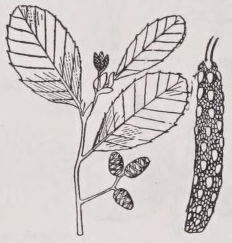
ALDER, a genus of plants (Alnus) belonging to the order Betulaceoe, the best known of which is the common alder (A. glutinosa). This tree thrives best in moist soils, has a shrubby appearance, and grows, under favourable circumstances, to a height of 40 or 50 feet. Under water the wood is very durable, and it is therefore used for piles. The supports of the Rialto at Venice, and many buildings at Amsterdam, are of alder-wood. Furniture is sometimes made from the wood, and it supplies excellent charcoal for gunpowder. The bark is astringent; it is used as a gargle, and also in tanning and dyeing.
ALDERMAN, a word derived from the Anglo-Saxon ealdorman, compounded of the comparative degree of the adjective eald (old) and man. The term implies the possession of an office of rank or dignity; and among the Anglo-Saxons, earls, governors of provinces, and other persons of distinction received this title. Thus we read of the aldermannus totius Anglioe, who seems to have corresponded to the officer afterwards styled capitalis justi-ciarius Angliae, or chief justice of England; the aldermannus regis, probably an occasional magistrate, answering to our justice of assize, or perhaps an officer whose duty it was to prosecute for the crown; and aldermannus comitatus, a magistrate with a middle rank between what was afterwards called the earl and the sheriff, who sat at the trial of causes with the bishop, and declared the common law, while the bishop proceeded according to ecclesiastical law. Besides these, we meet with the titles of aldermannus civitatis, burgi, castelli, hundredi sive wapentachii, &c. In modern times aldermen are office-bearers in the muncipal corporations of England and Wales, and Ireland. Before the passing of the Municipal Corporation Act their functions varied according to the charters of the different burghs. By the statute 5th and 6th Will. IV. c. 76, and 3d and 4th Vict. c. 118, the aldermen are elected by the councillors from among themselves (in Ireland, by the burgesses), for six years, one-half going out every three years. The number of councillors in each borough varies from 12 to 48, according to its magnitude. One-fourth of the municipal council consists of alderman, and three-fourths of councillors. In the municipal corporations of Scotland there is no such title as alderman, the office-bearers of corresponding rank there being termed ...bailies. The corporation of London was not included in the Burgh Reform Act, and the antiquated system remains there in full force. The Court of Aidermen consists of twenty-six, twenty-five of whom are elected for life by the freemen of the respective wards, who return two persons, one of whom the Court of Aidermen elect to supply the vacancy. The city is divided into twenty-six wards; twenty-four of these send up one alderman each, the other two combine to choose a twenty-fifth. The twenty-sixth alderman serves for the independent borough of Southwark, and is appointed by the other aidermen, who generally select the senior from among themselves when a vacancy occurs. The lord mayor is elected from such of the aidermen as have served the office of sheriff; of these the Common Hall, which consists of the freemen of the different wards, select two, and the aidermen elect one of these to the mayoralty. The Court of Aidermen act as magistrates for the city of London, and also possess authority of a judicial nature in the affairs of the corporation. The aidermen are members of the Court of Common Council, the legislative body of the corporation, which consists in all of 232 members, the remainder being elected annually by the freemen. In the United States aidermen form as a rule a legislative rather than a judicial body, although in some cities they hold courts and possess very considerable magisterial powers.
ALDERNEY, one of the Channel Islands, and the most northerly of the four, lies between 49° 41' and 49° 45' N. lat., and 2° 9' and 2° 14' W. long., 7 miles to the westward of Cape la Hogue, and is separated from the French coast by a narrow channel called the Race of Alderney. The passage through this strait is rendered very dangerous in stormy weather by its conflicting currents; but through it the scattered remnant of the French fleet under Tourville succeeded in escaping after the defeat of La Hogue in 1692. The harbour of Alderney is 20 miles distant from St Peter Port, Guernsey, 45 miles from St Helen’s, Jersey, and 60 miles from Portland Bill, the nearest point of England. There is regular steam communication with Guernsey. The length of the island from N.E. to S.W. is 3½ miles; its width about 1 mile; its greatest elevation is 280 feet; and the area is about 4 square miles....
The greater part of Alderney is a level table-land, more or less cultivated. The land continues flat to the edge of the south-eastern and southern cliffs, which present a magnificent succession of broken and perpendicular walls of rock. Towards the north-west, north, and east, the coast is less rocky, and is indented by several bays of tame and naked aspect, of which those of Crabby, Braye, and Longy are the most noticeable. Sandstone, granite, and porphyry are the chief geological formations. From the importance of the island in a military sense, it has been fortified by a chain of defensive works, extending round the northern coast from the Clanque Fort on the west to Fort Essex on the east. The cliffs of the southern shore form a very strong natural bulwark. An extensive granite breakwater has been constructed, protecting the bay of Braye towards the west, intended to form an additional defence, and to convert the bay into a secure harbour of refuge. The works have cost upwards of a million and a quarter sterling; but the new harbour is not much resorted to, and the value of the breakwater as a means of defence has been questioned. Fort Touraille stands on the eastern side of the new harbour, and is a strong fortification, mounting 50 heavy guns, with bomb-proof barracks and powder magazine.
The population of Alderney has increased rapidly of recent years, on account of the extensive public works. In 1841 it was only 1030, in 1871 it was 2738. The inhabitants are Protestants, and Alderney forms part of the diocese of Winchester. Though a French patois lingers in the island, English is generally spoken and universally understood. The climate is healthy, and there is abundance of good water. Corn is grown, but much of the sandy soil is in grass, affording excellent pasture to the diminutive but pretty cows for which Alderney is famous. The only exports are cattle and early potatoes. St Anne’s, the town of the island, is situated at some distance from the beach, overlooking the new harbour. It is plainly built, but has a fine new church in the early English style, erected as a memorial of the family of Le Mesurier, long the hereditary governors of the island. The only other architectural feature worthy of notice is a Gothic arch built as a memorial of the late Prince Albert of England.
Alderney seems to have been known to the Romans as Riduna, and Roman as well as Celtic remains have been discovered. It is subject to the British crown, and is a dependency of Guernsey. For its history and relation to English legislation, see the article on the Channel Islands. The internal government is vested in a judge appointed by the crown, and six jurats, chosen for life by the people; and these, with twelve douzainiers, who are popular representatives, but have not the power of voting, form the legislature. Justice is administered by the same judge jurats, and several other officers. In civil cases an appeal may be taken to the royal court of Guernsey, while all criminal cases are referred to Guernsey for decision. Two companies of infantry and a battery of artillery compose the local militia.
Off the western coast of Alderney there are many uninhabited rocky islands; and six miles to the westward lie the Casquets, a group of rocks extremely dangerous to ships coming up the English Channel. On these rocks there are three lighthouses, with revolving lights 112 feet above the water.
ALDERSHOTT CAMP, a standing garrison for a large force, situated about 35 miles from London, on the confines of Hampshire and Surrey. It was established in May 1855, and was intended as a military training school, especially for officers of the higher grades. Its germ is to be found in the temporary camp on Chobham Ridges, formed in 1853 by Lord Hardinge, then commander-in-chief, the success of which convinced him of the necessity of giving our troops practical instruction in the field, and affording our generals opportunities of manoeuvring large bodies of the three arms. He therefore advised the purchase of a tract of waste land whereon a permanent camp might be established. His choice fell on Aldershott, a spot also recommended by strategic reasons, being so placed that a force holding it covered the capital. Nothing came of Lord Hardinge’s proposal till the experience of the Crimean campaign fully endorsed his opinion. The lands at Aldershott—an extensive open heath country, sparsely dotted by fir woods and intersected by the Basingstoke canal—were then acquired by the Crown. The first occupants of the camp were two battalions of the Guards and seven of embodied militia. On the return of the Crimean army, cavalry, artillery, and infantry of the line arrived and took possession of the fines of wooden huts and the permanent barracks, which had by this time been erected. Since then Aldershott has varied little in its principal features. It is separated into two grand divisions, styled the north and south camps. Beyond the latter are the permanent cavalry and infantry barracks and the queen’s pavilion. Farnham is the nearest town, being only 4 miles from the south camp; Guildford and Godaiming are 10 and 12 respectively, Windsor 18½, and Reading 21 miles. The ...soil on which the camp stands is a light peat, and a fruitful source of discomfort to its inhabitants. A little wet turns it into tenacious mud, while a little sunshine produces a black dust, not soon forgotten by those who have campaigned in the “Long Valley.” The force stationed at Aldershott at the beginning of 1874 was composed of 1 cavalry and 3 infantry brigades; in the former there were 3 full regiments, in the latter a total of 11 battalions, with several depots of regiments abroad. Besides these, there were 2 batteries of horse and 6 of field artillery, 2 companies of Royal Engineers, and 4 troops of Royal Engineers’ train (with pontoon, &c.); 7 companies of the Army Service Corps and 2 of the Army Hospital Corps—to provide for transport, and the services of bakehouse and slaughterhouse and hospital—made up the total strength of all ranks, as shown in the returns dated 1st January 1874, to 10,601 men, 2198 horses, and 48 guns. It is a lieutenant-general’s command, and one highly prized, from its essentially military character and the practical experience it affords in handling a considerable force. Sir William Knollys (afterwards comptroller of the household to the Prince of Wales) was its first chief. He was succeeded by Sir John Pennefather; Sir James Scarlett followed; then Sir Hope Grant, who held the command in 1874. Naturally so large a military colony soon attracted other elements to Aldershott heath. Within a few years a town of Aldershott sprang up close by, and increased rapidly. Here the professions and all trades are well represented; there are respectable solicitors, surgeons, bankers, brewers, many schools, a steam printing press, a weekly military paper, and numerous shops. During the summer months or “drill season” the camp is a scene of incessant activity; field-days and parades follow in rapid succession, and owing to the camp’s accessibility from London, the troops are often turned out at a few hours’ notice to make a show for royalty or foreign visitors. Yet there is much to beguile vacant hours; many clubs—for cricket, croquet, racquets, and the drama—a gymnasium, and several excellent libraries. Admirable charities also exist for the assistance and relief of the soldiers’ wives and children. (a. g.)