
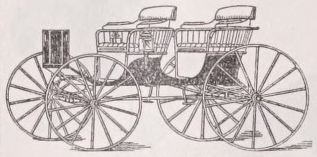
A four-wheeled pleasure carriage, (commonly two-seated) somewhat like a phaeton, but having a straight bottom.
SURREY, a metropolitan county of England, is bounded north by the Thames, which separates it from Berks and Middlesex, east' by Kent, south by Sussex, and west by Hampshire. Owing to the fact that it includes a portion of London, it ranks fourth among the counties of England in point of population, but in point of size it is only the thirtieth, the total area being 485,129 acres, or 758 square miles....
The geological structure of Surrey is reflected in its varied and picturesque scenery, the charms of which are enhanced by the large proportion of ground still remaining uncultivated. The extent of common land is also very great, a circumstance which, from its proximity to London, must be considered as specially fortunate. The northern portion of the county, in the London basin, belongs to the Eocene formation: the lower ground is occupied chiefly by the London clay of the Lower Eocene group, stretching (with interruptions) from London to Farnham; this is fringed on its southern edge by the plastic clays or Woolwich beds of the same group, which also appear in isolated patches at Headley near Leatherhead; and the Thanet sands of the same group crop out under the London clay between Beddington, Banstead, and Leatherhead. The north-western portion of the county, covered chiefly by heath and Scotch fir, belongs to the Middle Eocene group, or Bagshot sands: the Fox Hills and the bleak Chobham Ridges are formed of the upper series of the group, which rests upon the middle beds occupying the greater part of Bagshot Heath and Bisley and Pirbright Commons, while eastwards the commons of Chobham, Woking, and Esher belong to the lower division of the group. To the south of the Eocene formations the smooth rounded outlines of the chalk hills extend through the centre of the county from Farnham to Westerham (Kent). From Farnham to Guildford they form a narrow ridge called the Hog’s Back, about half a mile in breadth with a high northern dip, the greatest elevation reached in this section being 505 feet. East of Guildford the northern dip decreases, and the outcrop widens, throwing out picturesque summits, frequently partly wooded, and commanding widely variegated views, the highest elevation being Botley Hill near Titsey, 866 feet. The Upper Greensand or grey chalk marl, locally known as firestone, crops out underneath the Chalk along the southern escarpment of the Downs, and the Gault, a dark blue marl, rests beneath the Upper Greensand in the bottom of the long narrow valley which separates the chalk Downs from the well-marked Lower Greensand hills. Leith Hill of this formation reaches a height of 967 feet, and from its isolated position commands one of the finest views in the south of England, the next highest summits being Hindhead Hill (894 feet) and Holmbury Hill (857
feet). The southern part of the county belongs to the Wealden formation of freshwater origin: the lower strata or Hastings beds occupy a small portion at the southeastern corner, but the greater part consists of a blue or brown shaly clay, amid which are deposited river shells, plants of tropical origin, and reptilian remains.
The whole of the county north of the Downs is in the basin of the Thames. Besides a number of smaller streams, its chief affluents from Surrey are the Wey at Weybridge, the Mole at East Moulsey, and the Wandle at Wandsworth. The Eden, a tributary of the Medway, takes its rise in the south-east corner of Surrey.
According to the agricultural returns for 1886, of the total area of the county 299,034 acres were under cultivation, 77,553 being under corn crops, 44,998 under green crops, 26,741 rotation grasses, 138,117 permanent pasture, 2547 hops, and 9078 fallow. There are considerable varieties of soil, ranging from plastic clay to calcareous earth and bare rocky heath. The plastic clay is well adapted for wheat, the most largely grown of the corn crops, occupying 29,694 acres in 1886, while barley, oats, and pease’ which grow well on the loamy soils in different parts of the county, occupied respectively 15,439, 24,705, and 4587 acres, beans occupying 1872 and rye 1256. Of green crops there were 6432 acres under potatoes, 15,975 under turnips and swedes, 9995 mangolds, 860 carrots, 2660 cabbage, kohl-rabi, and rape, and 9076 vetches and other green crops. A considerable proportion of the area under green crops is occupied by the market gardens on the alluvial soil along the banks of the Thames, especially in the vicinity of London. The total area of nursery grounds in 1886 was 1466, and of market gardens 2953 acres. In early times the market gardeners were Flemings, who introduced the culture of asparagus at Battersea and of carrots at Chertsey, for which this district is still famous. The area under orchards in 1886 was 2144 acres. Rhododendrons and azaleas are largely grown in the north-western district of the county. In the neighbourhood of Mitcham various medicinal plants are extensively cultivated for the London herb-sellers and druggists, such as lavender, mint, camomile, anise, rosemary, liquorice, hyssop, &c. The calcareous soil in the neighbourhood of Farnham is well adapted for hops, but this crop in Surrey is of minor importance. There is a considerable area under wood (42,974 acres in 1881). Oak, chestnut, walnut, ash, and elm are extensively planted; alder and willow plantations are common; and the Scotch fir propagates naturally from seed on the commons in the north-west of the county. The extent of pasture land is not great, with the exception of the Downs, which are chiefly occupied as sheep-runs. Dairy-farming is a more important industry than cattle-feeding, large quantities of milk being sent to London. The number of horses in 1886 was 9930, of which 3273 were unbroken horses and mares kept solely for breeding; of cattle 49,986, of which 24,869 were cows and heifers in milk or in calf and 8699 other cattle two years old and above; of sheep 87,658; and of pigs 25,172.
According to the latest (1873) landowners Return for England, Surrey was divided among 17,293 proprietors possessing 398,746 acres at an annual value of £2,285,814, in addition to which there were 40,037 acres of common lands. Of the proprietors 12,712, or nearly two-thirds, possessed less than one acre each, the total which they owned being 2861 acres. The average annual rental per acre of the land all over was about £5,14s. 9d. The following proprietors held over 5000 acres each:—earl of Lovelace, 9958; crown, 7496; earl of Onslow, 6563; Sir W. R. Clayton, 6505; G. W. G. Leveson-Gower, 6368.
Manufactures.— The more important manufactures are chiefly confined to London and its immediate neighbourhood (see London, vol. xiv. p. 832). There are paper-mills at Wandsworth, and along the valley of the Wandle there are snuff, drug, and copper mills. Calico bleaching and printing are carried on to a small extent in the same valley, and there are also a few silk mills and tanneries. Ropes, snuff, and drugs are likewise manufactured along the banks of the Mole. Woollen goods and hosiery are made at Godaiming, and gunpowder is largely manufactured at Chilworth.
Communication.— In addition to the navigation by. barges, steamers ply on the Thames as far as Hampton. The Basingstoke Canal from Basingstoke to the Wey at Weybridge crosses the northwest corner of the county, and the Surrey and Sussex Canal passes southwards from the Wey near Guildford to the Arun. Surrey is more completely supplied by railways than any other county in England, the London, Chatham, and Dover, the South-Eastern, the London, Brighton, and South Coast, and the London and South-Western Railways intersecting it by their main lines as well as by various branches. .
Administration and Population.— Surrey contains 14 hundreds; the borough of Southwark (pop. 221,946), which has.no municipal government, but for certain purposes is connected with the city of London; and the municipal boroughs of Godaiming (2505), Guildford (10,858), Kingston-upon-Thames (20,648), and Reigate (18,662). A considerable portion (22,472 acres, with a population in 1881 of 980,522) is within the metropolitan district of London, in addition to which there are the following urban sanitary districts—Aidershot (20,l55), Croydon (78,953), Dorking (6328), East Moulsey (3289), Epsom (6916), Farnham (4488), Ham Common (1349), Hampton Wick (2164), New Malden (2δ38), Richmond (19,066), Surbiton (9406), Teddington (6δ99), and Wimbledon (l5,950). The county has one court of quarter sessions, and is divided into twelve petty and special sessional divisions. The central criminal court has jurisdiction over certain parishes in this county. The borough of Guildford has a separate court of quarter sessions and commission of the peace; the boroughs of Reigate and Kingston-upon-Thames have commissions of the peace; the borough of Southwark is included in the petty sessional division of Newington; and the borough of Godaiming, in which the mayor and ex-mayor are magistrates, forms part of the petty sessional division of Guildford, the county justices having concurrent jurisdiction. The county contains 152 civil parishes, with parts of two others. It is shared among the dioceses of Canterbury, Rochester, and Winchester. Until 1885 the county for parliamentary purposes was divided into East, Mid, and West Surrey; it is now rearranged in six divisions, viz., Kingston, Mid (Epsom), North-East (Wimbledon), NorthWest (Chertsey), South-East (Reigate), and South-West (Guildford). The portion of Surrey formerly included in the borough of Greenwich was in 1885 included in the borough of Deptford (Kent); the borough of Guildford was disfranchised; one member was given to Croydon; and instead of the two metropolitan boroughs of Lambeth and Southwark the following fifteen constituencies (each returning one member) were created: — Battersea and Clapham, constituting two divisions; Camberwell, embracing the divisions of North Camberwell, Dulwich, and Peckham; Lambeth, embracing the divisions of Brixton, Kennington, Lambeth North, and Norwood; Southwark, containing the divisions of Bermondsey, Rotherhithe, and Southwark West; Wandsworth; and Newington, with the divisions of Walworth and West Newington.
Since the beginning of the 19th century the population has increased nearly 600 per cent. From 268,233 in 1801 it had increased by 1821 to 399,417, by 1851 to 683,082, by 1871 to 1,091,635, and by 1881 to 1,436,899, of whom 683,228 were males and 753,671 females. The number of persons to an acre is 2·96 and of acres to a person 0·34. Within the last decade the increase has been 35·1 per cent.,—much greater than the increase in the general town population of England and Wales, which was 19·63 per cent., the increase in the whole population being only 14·34. Nearly two-thirds (980,522) of the population belong to the metropolitan district of London, but the suburbs of London extend practically throughout the greater part of the county, its increase in population being chiefly due to the building of residences for those who have business or professional interests in London.
History and Antiquities.— Notwithstanding its proximity to London, Surrey has been associated with few great events in English history. Roman remains have been discovered at Albury, Kingston, Titsey, Woodcote, and a few other places, but none are of much importance. On several of the hills there are remains of camps of either Roman or British origin. The Roman Stane Street from London to Chichester in Sussex passed by Kingston, Chessington, Leatherhead, Dorking (where its remains are specially well marked), Leith Hill, and Ockley. During the Saxon period Surrey was included in the dominions of the South Saxons and afterwards of Wessex. Its name Surrey or “south kingdom” has apparently reference to its position south of London or south of the Thames. Kingston in Surrey was in 838 the seat of a witana-gemot convened by Egbert; and after the capture of Winchester by the Danes it was from 901 to 978 the place where the Anglo-Saxon kings were crowned. Surrey was an earldom of Godwine; and after the conquest was bestowed on William de Warren, who had married Gundrada, supposed to have been a daughter of the Conqueror. From the time that the great charter was on 15th June 1215 signed by King John at Runnymede near Egham the historical annals of the county are a blank, until the period of the Civil War, when a skirmish took place, 7th June 1648, at Kingston.
The only ecclesiastical ruins worthy of special mention are the picturesque walls of Newark Priory, founded for Augustinians in the time of Richard Coeur de Lion; and the Early English crypt and part of the refectory of Waverley Abbey, the earliest house of the Cistercians in England, founded in 1128 by William Gifford, bishop of Winchester. The Annales Waverlicnscs, published by Gale in his Scriptores and afterwards in the Record series of Chronicles, are supposed to have suggested to Sir Walter Scott the name of his first novel. The church architecture is of a very varied kind, and has no peculiarly special features. Among the more interesting churches are Albury, the tower of which is of Saxon or very early Norman date; Beddington, a fine example of the Perpendicular, and containing monuments of the Carew family; Chaldon, remarkable for its fresco wall-paintings of the 12th century, discovered during restoration in 1870; Compton, which, though mentioned in Domesday, possesses little of its original architecture, but is worthy of notice for its two-storied chancel, and its carved wooden balustrade surmounting the pointed Transition Norman arch which separates the nave from the chancel; St. Mary’s, Guildford, containing examples of Norman, Early English, Decorated, and Perpendicular, but is of interest chiefly for the grotesque carving on the corbels of the aisles and the coloured medallions on the roof of the north chapel; Leigh, Perpendicular, possessing some very fine brasses of the 15th century; Lingfield, Perpendicular, containing ancient tombs and brasses of the Cobhams; Ockham, chiefly Decorated, with a lofty embattled tower, containing the mausoleum of Lord Chancellor King (d. 1734), with full-length statue of the chancellor by Rysbroeck; Reigate, chiefly Perpendicular, but with Transition Norman pillars in the nave; Stoke d’Abernon, Early English, with the earliest extant English brass, that of Sir John d’Abernon, 1277; and Woking, Decorated, with Early English chancel. Of old castles the only examples are Farnham, occupied as a palace by the bishops of Winchester, originally built by Henry of Blois, and restored by Henry III.; and Guildford, with a strong quadrangular Norman keep. Ancient domestic architecture is, however, well represented, the examples including Beddington Hall, now a female orphan asylum; the ancient mansion of the Carews, rebuilt in the reign of Queen Anne, hut still retaining the hall of the Elizabethan building; Crowhurst Place, built in the time of Henry VII., the ancient seat of the Gaynesfords, and frequently visited by Henry VIII.; portions of Croydon Palace, an ancient seat of the archbishops of Canterbury; the gate tower of Esher Place, built by William of Waynflete, bishop of Winchester, and repaired by Cardinal Wolsey; Archbishop Abbot’s hospital, Guildford, in the Tudor style; the fine old Elizabethan house of Losely near Guildford; Cowley House, Chertsey, originally of the time of James I., inhabited by the poet Cowley from the Restoration till his death; Smallfield Place, now a farmhouse, at one time the seat of Sir Edward Bysshe, garter king-at-arms; and Sutton Place, dating from the time of Henry VIII., possessing curious mouldings and ornaments in terra-cotta. Among the eminent persons specially connected with Surrey may be mentioned George Abbot, archbishop of Canterbury, the son of a cloth worker in Guildford; Arthur Onslow, born at Merrow in 1691, who became member for Guildford and speaker of the House of Commons; Sir William Temple, who had his residence at Moor Park, where he died in 1699; Sir Nicolas Carew, beheaded for conspiracy in 1539, and other members of the family, who had their ancestral seat at Beddington; John Evelyn, the diarist, who was horn at Wotton in 1620; Malthus, the political economist, who was born at the Rooke, near the same place, in 1766; William Cobbett, who was born near Farnham in 1762; Horne Tooke, who was born at Westminster, wrote his well-known book at Purley, and died at Wimbledon in 1812; the historian Gibbon, who was born at Putney in 1737, which was also the birthplace of Cromwell, the minister of Henry VIII.
See Topley’s Geology of the Weald and whitaker’s Geology of London Basin, forming part of the Memoirs of Geological Survey of United Kingdom; Surrey Archaeological Collections ; Aubrey, Natural History and Antiquities of Surrey, 5 vols., 1718-19; Manning and Bray, Hist. and Antiq. of Surrey, 1809-14; Brayley, Topograph. Hist. of Surrey, 5 vols., 1S41-46; Lysons, Environs of London, 5 vols., 1800-11; Baxter, Domesday Book of Surrey, 1876.
SURREY, Henry Howard, Earl of (1516?-1547), one of the leaders in the poetic movement under Henry VIIT. that heralded the great outburst of the Elizabethan period. Of his personal life outside his poetry only the barest outline is known, and till comparatively of late even that outline was not free from confusion. Three different men— the grandfather of the poet, his father, and the poet himself—bore the title within a period of ten or eleven years; and at one time the poet was confounded with his grandfather, and supposed to have been present at the battle of Flodden (1513). He was not born till at least two years after that event. It was his grandfather who distinguished himself at Flodden under the title of the earl of Surrey, and was created duke of Norfolk as a reward for his services, surrendering the title of Surrey to his son, the poet’s father, for his lifetime. Although the poet has always been most familiarly known as the earl of Surrey, he really held the title only by courtesy, succeeding to it on that footing in 1524, when his father became duke of Norfolk. In one of his poems he speaks of having passed “his childish years” at Windsor “with a king’s son.” This was Henry VIII.’s natural son, Henry Fitzroy, duke of Richmond, who was affianced to Surrey’s sister, Mary, but died before he was out of his teens. It is sometimes said that the two were educated together at Windsor; but the sweet companionship to which the poem refers, when the two youths “hoved” in the large green courts “with eyes cast up into the maiden’s tower,” belongs to the last year of Fitzroy’s short life. Whether or not Surrey was educated from literal childhood with a king’s son, he was certainly educated with the care for literary culture which about that time became common in the households of English noblemen; and, as the fashion was, he was sent, after passing through Cambridge, to complete his education in Italy. The tradition that he made the tour of Europe as a knight-errant, upholding against all comers the superiority of his mistress Geraldine, has no extrinsic evidence in its favour. If Geraldine was, as is commonly supposed, Elizabeth Fitzgerald, a daughter of the earl of Kildare, she was but a child of seven or eight years when Surrey set out on his travels. The legend about his knight-errantry is probably only a sign of the extent to which his chivalrous personality and poetry fascinated the imagination of his own and the next generation. The eminence of the Howards at Henry’s court was evidenced in many ways: in the festivities at the king’s marriage with Anne of Cleves, Surrey was the leader of one of the sides at the tournament, and two years later his cousin, Catherine Howard, became the king’s fifth wife. Surrey took an active part in the insignificant wars of Henry’s later years, accompanied the expedition, led by his father, which ravaged the south of Scotland in 1542, and held a command in the French expedition of 1544. When the king’s death was known to be near, the duke of Norfolk was suspected of aiming at the throne, and Surrey’s own haughty and ostentatious manners countenanced the suspicion. A month before the king’s death both were arrested and lodged in the Tower, and on 13th January 1547 Surrey was brought to trial for high treason. The main charge against him was that he had “falsely, maliciously, and treacherously set up and borne the arms of Edward the Confessor.” His plea that the arms belonged to his ancestors was probably not accepted as an extenua tion of the offence. A common jury found him guilty, and he was executed on Tower Hill on 19th January.
His poems, which had been one of the occupations of his crowded life, first appeared in print in Tottel's Miscellany in 1557. On the title-page of this memorable publication Surrey’s name stood first, but this was probably in deference to his rank; Wyatt was the first in point of time of Henry’s “courtly makers” (see Wyatt). Surrey,. indeed, expressly acknowledges λVyatt, who was several years his senior, as his master in poetry. Seeing, however, that their poems were first published in the same volume, many years after the death of both, their names can never be disassociated, and it must always be hard to say which was the leader in the various new and beautiful forms of verse which Toltel's Miscellany introduced into English poetry. Surrey’s only unquestionable distinction as a metrician lies outside the Miscellany : his translation of the second and fourth books of the Aeneid into blank verse — the first attempt at blank verse in English—was published separately by Tottel in the same year. But his sonnets (in various schemes of verse), his elegy on the death of Wyatt (in elegiac staves shut in by a final couplet), his pastoral poem (a lover’s complaint put into the mouth of a shepherd), and his lyrics in livelier measures are all extremely interesting experiments, and served as models for more than one generation of courtly singers and sonneteers. In form as well as in substance Surrey and his compeers were largely indebted to Italian predecessors; most of his poems are in fact translations or adaptations of Italian originals. The tone of the love sentiment was new in English poetry, very different in its earnestness, passion, and fantastic extravagance from the lightness, gaiety, and humour of the Chaucerian school. In this respect Tottel’s Miscellany helped to educate the English muse for the triumphs of the tragic drama. Surrey’s own contributions are distinguished by their copious and impetuous eloquence and sweetness.