
1. ARABESQUE ,
2. ARA'BIAN, adjective [See the noun.] Pertaining to Arabia.
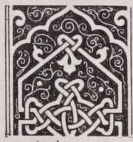
ARABESQUE, a term to which a meaning is now commonly given that is historically incorrect. We apply it to the grotesque decoration derived from Roman remains of the early time of the empire, not to any style derived from Arabian or Moorish work; the term is therefore a misnomer. Arabesque and Moresque are really distinct; the latter is from the Arabian style of ornament, developed by the Byzantine Greeks for their new masters, after the conquests of the followers of Mahomet; and the former is a term pretty well restricted to varieties of Cinquecento decoration, which have nothing in common with any Arabian examples in their details, but are a development derived from Greek and Roman grotesque designs, such as we find them in the remains of ancient palaces at Rome, and in ancient houses at Pompeii These were reproduced by Raphael and his pupils in the decoration of some of the corridors of the Loggie of the Vatican at Rome: grotesque is thus a better name for these decorations than Arabesque....
This technical Arabesque, therefore, is much more ancient than any Arabian or Moorish decoration, and has really nothing in common'with it except the mere symmetrical principles of its arrangement. Pliny and Vitruvius give us no name for the extravagant decorative wall-painting in vogue in their time, to which the early Italian revivers of it seem to have given the designation of grotesque, because it was first discovered in the arched or underground chambers {grotte) of Roman ruins—as in the golden house of Nero, or the baths of Titus. What really took place in the Italian revival was in some measure a supplanting of the Arabesque for the classical grotesque, still retaining the original Arabian designation, while the genuine Arabian art, the Saracenic, was distinguished as Moresque or Moorish. So it is now the original Arabesque that is called by its specific names of Saracenic, Moorish, and Alhambresque, while the term Arabesque is applied exclusively to the style developed from the debased classical grotesque of the Roman empire.
There is still much of the genuine Saracenic element in Renaissance Arabesques, especially in that selected for book-borders and for silver-work, the details of which consist largely of the conventional Saracenic foliations. But the Arabesque developed in the Italian Cinquecento work repudiated all the original Arabian elements and devices, and limited itself to the manipulating of the classical elements, of which the most prominent feature is ever the floriated or foliated scroll; and it is in this Cinquecento decoration, whether in sculpture or in painting, that Arabesque has been perfected.
We will first briefly describe the Saracenic, as the elder sister of the two styles, which was ingeniously developed by the Byzantine Greek artists for their Arabian masters in the early times of Mahometan conquest. Every natural object-was proscribed; the artists were, therefore, reduced to making symmetrical designs from forms which should have no positive meaning ; yet the Byzantine Greeks, who were Christians, managed to work even their own ecclesiastical symbols, in a disguised manner, into their tracery and diapers; as the lily, for instance. The cross was not so introduced; this, of course, was inadmissible; but neither was the crescent ever introduced into any of this early work in Damascus or Cairo. The crescent was itself not a Mahometan device till after the conquest of Constantinople in 1453 a.d. The crescent, as the new moon, was the symbol of Byzantium; and it was only after that capital of the Eastern empire fell into the hands of the Turks that this symbol was adopted by them. The crescent and the cross became antagonist standards, therefore, first in the 15 th century. And the crescent is not an element of original Moorish decoration.
The Alhambra diapers and original Majolica (Majorca) ware afford admirable specimens of genuine Saracenic or Moorish decoration. A conventional floriage is common in these diaper3; tracery also is a great feature in this work, in geometrical combinations, whether rectilinear or curvilinear; and the designs are rich in colour: idolatry was in the reproduction of natural forms, not in the fanciful combination of natural colours. These curves and angles, therefore, or interlacings, chiefly in stucco, constitute the prominent elements of an Arabian ornamental design, combining also Arabic inscriptions; composed of a mass of foliation or floral forms conventionally disguised, as the exclusion of all natural images was the fundamental principle of the style in its purity. The Alhambra displays almost endless specimens of this peculiar work, all in relief, highly coloured, and profusely enriched with gold. The mosque of Touloun, in Cairo, 876 a.d., the known work of a Greek, affords the completest example of this art in its early time; and Sicily contains many remains of this same exquisite Saracenic decoration.
Such is the genuine Arabesque of the Arabs, but a very different style of design is now implied by the term—the Arabesque of the Cinquecento, a purely classical ornamentation. This owes its origin to the excavation and recovery of ancient monuments, and was developed chiefly by the sculptors of the north, and the painters of Central Italy; by the Lombardi of Venice, by Agostino Busti of Milan, by Bramanti of Urbino, by Raphael, by Giulio Romano, and others of nearly equal merit.
Very beautiful examples in sculpture of this Cinquecento Arabesque are found in the churches of Venice, Verona, and Brescia; while in painting, the most complete specimens are those of the Vatican Loggie, and the Villa Madama at Rome and the ducal palaces at Mantua. The Vatican Arabesques, chiefly executed for Raphael by Giulio Romano, Gian Francesco Penui, and Giovanni da Udine, though beautiful as works of painting, are often very extravagant in their composition, ludicrous, and sometimes aesthetically offensive; as are also many of the decorations of Pompeii. The main features of these designs are balanced scrolls in panels; or standards variously composed, but symmetrically scrolled on either side, and on the tendrils of these scrolls are suspended or placed birds and animals, human figures and chimeras, of any or all kinds, or indeed any objects that may take the fancy of the artist. But he is limited by the laws of aesthetics; his designs must be symmetrical or they will want harmony, and they must not offend against mechanical possibility or the principle of gravitation, or they will be ridiculous: nothing that outrages aesthetic sensibility can ever be beautiful. The most perfect specimens of Cinquecento Arabesque aro certainly found in sculpture. As specimens of exquisite work may be mentioned the Martinengo tomb, in the church of the Padri Ri formati at Brescia, and the façade of the church of Santa Maria dei Miracoli there, by the Lombardi; and many of the carvings of the Château de Gaillon, France—all of which fairly illustrate the beauties and capabilities of the style.
This kind of decoration need not, however, be limited to architectural panels and pilasters; it is applicable for large surface decoration, and for manufactures, whether in wood or metal, or textile. It affords as much room also for the display of colour as of form: some of the surface decorations of Gaertner, in Munich, are splendid examples of delicacy of colour, showing how much may be effected by harmonious combinations in scroll-work of the most delicate gradations and tints. Good specimens of Arabesque, in manufactures, in casts, and in copies in colour, may now be seen in the South Kensington Museum. For fuller details of styie, see Wornum, Analysis of Ornament, <tc., 4to edition, 1874, illustrated. (r. n. w.)