
BAM or BEAM, as an initial syllable in names of places, signifies wood; implying that the place took its name from a grove, or forest.
Word of the Day: Catachrestical
Bamba
Encyclopedia Britannica
BAMBA, a province of Congo, on the western coast of Africa, lying to the S. of the River Ambriz. This district is fertile, abounds in gold, silver, copper, salt, Ac., and is said to be thickly populated. Its chief town, which bears the same name, was formerly of considerable importance, the climate being remarkably healthy for that region of Africa.
9th ed. Encyclopædia Britannica, vol. 3, p. 305
[60 words — estimated reading time: 1 minute]
[60 words — estimated reading time: 1 minute]
Bambarra
Encyclopedia Britannica
BAMBARRA, a country of inner Africa, on the Joliba or Upper Niger. The principal towns are Segu, Sansading, Jamima, Mursha, Jabbi, Sai, Kullikoro, Maraca-Duba, and Damba, in many of which the Mahometans have mosques. For further particulars see Africa, voL i. p. 271.
BAMBARRA, a town of western Africa on a backwater of the Niger, of considerable commercial importance, and situated in a fertile plain, 115 miles S.S.W. of Timbuctoo. (See Barth’s Travels in Central Africa, vol. iv. p. 354.)
9th ed. Encyclopædia Britannica, vol. 3, p. 305
[44 words — estimated reading time: 1 minute]
[44 words — estimated reading time: 1 minute]
Bamberg
Encyclopedia Britannica
BAMBERG, a town of Bavaria, in the circle of Upper Franconia, on the River Regnitz, 3 miles above its junction with the Maine, and 33 miles N. of Nuremberg, with which it is connected by railway. It is partially surrounded by walls and ditches, and is divided by the river and Ludwig’s canal into three districts, which are connected by handsome bridges. The town is well built, and the streets are well paved and lighted. The cathedral, a noble structure in the Byzantine style of architecture, is surpassed by few of the kind in Germany. It was founded in 1004 by the Emperor Henry IL, and finished in 1012, but was afterwards partially burnt, and rebuilt in 1110. It contains the tombs of the founder and his empress Cunigunde, Conrad III., Pope Clement IL, Ac., and numerous monuments and paintings by eminent masters. Among the other public buildings are St Martin’s church, the palace (formerly the residence of the prince-bishops), town-house, and theatre. The Benedictine convent of St Michael was turned, in 1803, into a charitable institution for poor citizens known as Ludwig’s hospital. Bamberg has numerous literary and charitable institutions, as the lyceum, gymnasium, polytechnic, normal, and medical schools, a library, museum, picture-gallery, hospital, and workhouse. The trade is considerable; cloths, sealing-wax, leather, tobacco, musical instruments, carriages, Ac., are manufactured, and there are numerous breweries. The whole of the neighbouring district is like a vast garden, and furnishes large supplies of liquorice, carrots, aniseed, coriander, and other seeds. Bamberg was formerly the capital of an independent bishopric, which was secularized in 1801, and assigned to Bavaria in 1803. Population, 25,738.
9th ed. Encyclopædia Britannica, vol. 3, p. 305
[279 words — estimated reading time: 2 minutes]
[279 words — estimated reading time: 2 minutes]
1. A child or baby; esp., a representation in art of the infant Christ wrapped in swaddling clothes.
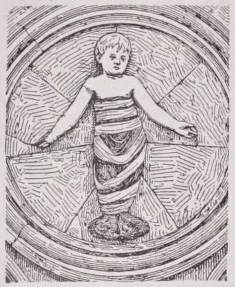
Bamboccio
Encyclopedia Britannica
BAMBOCCIO. See Laer, Peter Van.
9th ed. Encyclopædia Britannica, vol. 3, p. 305
[5 words — estimated reading time: 1 minute]
[5 words — estimated reading time: 1 minute]
A plant of the reed kind, or genus Arundo, growing in the East Indies, and in some other warm climates, and sometimes attaining to the height of 60 feet. From the main root, which is long, thick and jointed, spring several round, jointed stalks, which at 10 or 12 feet from the ground, send out from their joints several stalks which are united at their base. These are armed, at their joints, with one or two sharp rigid spines, and furnished with oblong, oval leaves, eight or nine inches long, on short footstalks. The flowers grow in large panicles, from the joints of the stalk, placed three in a parcel, close to their receptacles. Old stalks grow to five or six inches in diameter, and are so hard and durable, as to be used for building and for all sorts of furniture, for water pipes, and for poles to support palanquins. The smaller stalks are used for walking sticks, flutes, etc.
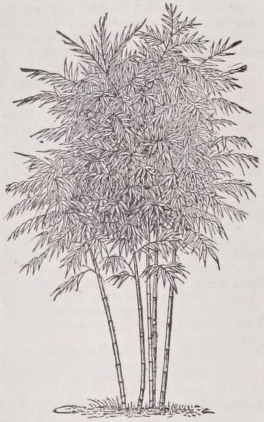
A plant of the family of grasses, and genus Bambusa, growing in tropical countries.
Bamboo
Encyclopedia Britannica
BAMBOO, a genus {Bambusa') of arborescent grasses very generally distributed throughout the tropical lands of the globe, but found and cultivated especially in India, China, and the East Indian Archipelago. There is a large number of species enumerated; but, as is the case with most plants under cultivation, much difficulty is found in distinguishing species from varieties produced by artificial selection. Bambusa arundinacea is the species most commonly referred to. It is a tree-like plant, rising to a height of 40, 60, or even 80 feet, with a hollow stem, shining as if varnished. The stem is extremely slender, not exceeding the thickness of 5 inches in some which are 50 feet high, and in others reaching 15 or 18 inches in diameter. The whole is divided into joints or septa called knots or internodes, the intervals between which in the case of some of the larger stems is several feet. These joints or divisions are formed by the crossing of the vascular bundles of fibres. They produce alternate lateral buds, which form small alternate branchlets springing from the base to the top, and, together with the narrow-pointed leaves issuing from them, give the plant an elegant feathered appearance as it waves in the wind. The rapidity of its growth is surprising. It attains its full height in a few months, and Mr Fortune records the observation of a growth of from 2 to 21 feet in a single day. In Malabar it is said to bear fruit when fifteen years old, and then to die....
The bamboo is cultivated with great care in regular plantations by the Chinese. The plant is propagated by shoots or suckers deposited in pits 18 inches or 2 feet deep at the close of autumn or the beginning of winter. Various expedients are followed to obtain good bamboos; one of the most usual being to take a vigorous root and transplant it, leaving only four or five inches above the joint next the ground. The cavity is then filled with a mixture of horselitter and sulphur. According to the vigour of the root, the shoots will be more or less numerous; they are destroyed at an early stage during three successive years; and those springing in the fourth resemble the parent tree. The uses to which all the parts and products of the bamboo are applied in Oriental countries are almost endless. The soft and succulent shoots, when just beginning to spring, are cut over and served up at table like asparagus. Like that vegetable, also, they are earthed over to keep them longer fit for consumption; and they afford a continuous supply during the whole year, though it is more abundant in autumn. They are also salted and eaten with rice, prepared in the form of pickles, or candied and preserved in sugar. As the plant grows older, a species of fluid is secreted in the hollow joints, in which a concrete substance, highly valued in the East for its medicinal qualities, called tabaxir or tabascheer, is gradually developed. This substance, which has been found to be a purely siliceous concretion, is possessed of peculiar optical properties. As a medicinal agent the bamboo is almost or entirely inert, and it has never been received into the European materia medica. A decoction of the leaves of the plant is, however, employed in the East for pectoral affections, and the leaf-buds are said to be diuretic. The grains of the bamboo are available for food, and the Chinese have a proverb that it produces seed more abundantly in years when the rice crop fails, which means, probably, that in times of dearth the natives look more after such a source of food. The Hindus eat it mixed with honey as a delicacy, equal quantities being put into a hollow joint, coated externally with clay, and thus roasted over a fire. It is, however, the stem of the bamboo which is applied to the greatest variety of uses. J oints of sufficient size form water buckets; smaller ones are used as bottles, and among the Dyaks of Borneo they are employed as cooking vessels. Bamboo is extensively used as a timber wood, and houses are frequently made entirely out of the products of the plant; complete sections of the stem form posts or columns; split up, it serves for floors or rafters; and, interwoven in lattice-work, it is employed for the sides of rooms, admitting light and air. The roof is sometimes of bamboo solely, and when split, which is accomplished with the greatest ease, it can be formed into laths or planks. It is employed in shipping of all kinds; some of the strongest plants are selected for masts of boats of moderate size, and the masts of larger vessels are sometimes formed by the union of several bamboos built up and joined together.
The bamboo is employed in the construction of all kinds of agricultural and domestic implements, and in the materials and implements required in fishery. Bows are made of it by the union of two pieces with many bands; and, the septa being bored out and the lengths joined together, it is employed, as we use leaden pipes, in transmitting water to reservoirs or gardens. From the light and slender stalks shafts for arrows are obtained; and in the south-west of Asia there is a certain species of equally slender growth, from which writing-pens or reeds are made. A joint forms a holder for papers or pens, and it was in a joint of bamboo that silk-worm eggs were carried from China to Constantinople during the reign of Justinian. The outer cuticle of Oriental species is so hard that it forms a sharp and durable cutting edge, and it is so siliceous that it can be used as a whetstone. This outer cuticle, cut into thin strips, is one of the most durable and beautiful materials for basket-making, and both in China and Japan it is largely so employed. Strips are also woven into cages, chairs, beds, and other articles of furniture, Oriental wicker-work in bamboo being unequalled for beauty and neatness of workmanship. In China the interior portions of the stem are beaten into a pulp, and used for the manufacture of the finer varieties of paper. Bamboos are imported to a considerable extent into Europe for the use of basket-makers, and for umbrella and walking-sticks. In short, the purposes to which the bamboo is applicable are almost endless, and well justify the opinion that “it is one of the most wonderful and most beautiful productions of the tropics, and one of Nature’s most valuable gifts to uncivilized man” (A. R. Wallace, The Malay Archipelago).
9th ed. Encyclopædia Britannica, vol. 3, p. 305
[1,126 words — estimated reading time: 7 minutes]
[1,126 words — estimated reading time: 7 minutes]
of Bamboozle
A cheat; one who plays low tricks.
of Bamboozle
Bamborough
Encyclopedia Britannica
BAMBOROUGH, a village in Northumberland, on the sea-coast, 14 miles N. of Alnwick. It was a royal borough previous to the Norman Conquest, and returned two members to parliament in the 23d year of Edward I. Its ancient castle stands close to the sea on an almost perpendicular rock, 150 feet in height, and is accessible only on the south-east side. The first erection is ascribed by the Saxon chronicles to King Ida of Northumberland, who is said to have named it Bebbanburh after his queen Bebbe (547 A.D.) The principal events in its early history are the siege by Penda in 642, the ravages of the Danes in 993, the unsuccessful defence by De Mowbray against William Rufus, and numerous sieges during the Wars of the Roses. In the reign of Henry VII. it fell into decay. At length, in the 18th century, it became the property of Lord Crewe, bishop of Durham, who, in 1720, vested the castle and manor in trustees for charitable purposes. In virtue of this bequest a patrol is kept on the coast, apartments are provided for shipwrecked seamen, and a storehouse for salvage-goods, and granaries are maintained in order to supply corn to the poor at a cheap rate in times of scarcity. An infirmary, a dispensary, and a large library bequeathed by Dr Sharp, are also maintained, while poor children receive gratuitous education at two “national” schools. Population in 1871,320 in the village, and 3751 in the parish.
9th ed. Encyclopædia Britannica, vol. 3, p. 306
[251 words — estimated reading time: 2 minutes]
[251 words — estimated reading time: 2 minutes]
Bambouk
Encyclopedia Britannica
BAMBOUK, a country in the interior of Western Africa, situated between the Senegal and its tributary the Falerne, and extending from lat. 12° 30' to 14° N., and from long. 10° to 12° 30' W. It is traversed from N.W. to S.E. by the steep and wall-like range of the Tamba-Ura Mountains. The soil in a large part of the country is of remarkable fertility; rice, maize, millet, melons, manioc, grapes, bananas, and other fruits, grow almost without cultivation; the forests are rich in a variety of valuable trees; and extensive stretches are covered with abundant pasturage of the long guinea-grass. As a∙ natural consequence there is great profusion of animal life. The inhabitants, a branch of the Mandingo race, have made but little progress in civilization. The one product of their country which really excites them to labour is gold; and even it is so common and accessible that the rudest methods of collection are deemed sufficient. The most remarkable deposit is at Natakoo, where a considerable hill seems to be wholly composed of auriferous strata. There is also a good mine at Kenieba. In exchange for the gold, cloth, ornaments, and salt—the last a most valuable article—are imported. The usual beast of burden is the ass, the horse being only possessed by the very wealthiest in the country. Sheep and cattle are both pretty numerous. Unfortunately, the climate is very unhealthy, especially in the rainy season, which lasts for about four months, from July or August. The chief towns are Bambouk, Salaba, and Konkuba. The Portuguese early penetrated into Bambouk, and were even for some time masters of the country; but the inhabitants made a general rising and completely drove them out. Remains of their buildings, however, are still to be seen. The French, soon after they ...had formed their settlement on the Senegal, turned their attention to this land of gold. It was not till 1716, however, that Compagnon, under the auspices of De la Brue, the governor of Senegal, succeeded, by great address, and not without risk, in visiting various parts of the auriferous region; and his explorations were followed up by David, Levens, and others. Raffenel visited the country in 1844, and Pascal, a naval lieutenant, was there in 1859. A few commercial stations or comptoirs have recently been established.
See Lubat, Rel. da l'Afr. occid. ; De Golbérv, Voy. en Afr. en 1785; Amédée Tardieu, “Sénégambie” in the Univers pittoresque; Raffenel, Voy. dans ÎAfr. occid., 1846; Revue algérienne et coloniale for March 1860; Faidherbe, Chapitres de géographie and Annuaire de Sénégal.
9th ed. Encyclopædia Britannica, vol. 3, p. 306
[443 words — estimated reading time: 3 minutes]
[443 words — estimated reading time: 3 minutes]
Bampton
Encyclopedia Britannica
BAMPTON, Rev. John, founder of the series of divinity lectures at Oxford known as the Bampton Lectures, appears to have been born in 1689 and to have died in 1751. He was a member of Trinity College, Oxford, and for some time canon of Salisbury. His will directs that eight lectures shall be delivered annually on as many Sunday mornings in full term, “between the commencement of the last month in Lent term and the end of the third week in Act term, upon either of the following subjects :—to confirm and establish the Christian faith, and to confute all heretics and schismatics—upon the divine authority of the Holy Scriptures—upon the authority of the writings of the primitive fathers, as to the faith and practice of the primitive Church—upon the divinity of our Lord and Saviour Jesus Christ—upon the divinity of the Holy Ghost—upon the articles of the Christian faith as comprehended in the Apostles’ and Nicene Creeds.” The lecturer, who must be at least a Master of Arts of Oxford or Cambridge, is chosen yearly by the heads of colleges, and no one can be chosen a second time. The series of lectures began in 1780, and has continued to the present time unbroken, with the exception of the years 1834 and 1835, when no lecturers were appointed, and 1841, when no lectures were delivered. Several of the lecturers have been men of great eminence and ability; Heber, for instance, was selected in 1815, Whately in 1822, Milman in 1827, Horne in 1828, Hampden in 1832, Goulburn in 1850, Mansel in 1858, Liddon in 1866. The institution has done much to preserve, at least in some quarters, a high standard in English theology; and the lectures as a whole form a very valuable body of apologetic literature.
9th ed. Encyclopædia Britannica, vol. 3, p. 307
[303 words — estimated reading time: 2 minutes]
[303 words — estimated reading time: 2 minutes]
BÂmiÂn
Encyclopedia Britannica
BÂMIÂN, a once renowned city in the territory now subject to the Afghans, in 34° 50' N. lat., 67° 44' E. long. Its remains lie in a valley of the Hazara country, on the chief road from Kâbul towards Turkestân, and immediately at the northern foot of that prolongation of the Indian Caucasus now called Koh-i-Baba (see vol. i. pp. 227, 241). The passes on the Kâbul side are not less than 11,000 and 12,000 feet in absolute height, and those immediately to the north but little inferior. The river draining the valley is one of the chief sources of the Surkhâb or Aksarai, an important tributary of the Upper Oxus (ibid. p. 241). The prominences of the cliffs which line the valley are crowned by the remains of numerous massive towers, whilst their precipitous faces are for 6 or 7 miles pierced by an infinity of ancient cave-dwellings, some of which are still occupied. The actual site of the old city is marked by mounds and remains of walls, and on an isolated rock in the middle of the valley are considerable ruins of what appears to have been the acropolis, now known to the people as Ghülgûlah. But the most famous remains at Bâmiân are two colossal standing idols, carved in the cliffs on the north side of the valley. Burnes estimates the height of the greater at 120 feet, the other at half as much. These images, which have been much injured, apparently by cannon-shot, are cut in niches in the rock, and both images and niches have been coated with stucco. There is an inscription, not yet interpreted or copied, over the greater idol, and on each side of its niche are staircases leading to a chamber near the head, which shows traces of elaborate ornamentation in azure and gilding. The surface of the niches also has been painted with figures. In one of the branch valleys ...is a similar colossus, somewhat inferior in size to the second of those two; and there are indications of other niches and idols. As seen from the rock of Ghülgûlah, Bâmiân, with its ruined towers, its colossi, its innumerable grottoes, and with the singular red colour of its barren soil, presents an impressive aspect of desolation and mystery.
That the idols of Bâmiân, about which so many conjectures have been uttered, were Buddhist figures, is ascertained from the narrative of the Chinese pilgrim, Hwen Thsang, who saw them in their splendour in 630 a.d. His description of the position of the city and images corresponds accurately with modern reports. He assigns to the greater image, which was gilt (the object, probably, of the plaster coating), a height of 140 or 150 feet, and to the second 100. The latter would seem from his account to have been sheathed with copper. Still vaster than these was a recumbent figure, 2 miles east of Bâmiân, representing Sakya Buddha entering Nin·dna, i.e., in act of death. This was “about 1000 feet in length.” No traces of this are alluded to by modem travellers, but in all likelihood it was only formed of rubble plastered (as is the case still with such NirυAna figures in Indo-China), and of no durability. For a city so notable Bâmiân has a very obscure history. It does not seem possible to identify it with any city in classical geography: Alexandria ad Caucasum it certainly was not. The first known mention of it seems to be that by Hwen Thsang, at a time when apparently it had already passed its meridian, and was the head of one of the small states into which the empire of the White Huns had broken up. At a later period Bâmiân was for half a century, ending 1214 A.p., the seat of a branch of the Ghori dynasty, ruling over Tokhâristân, or the basin of the Upper Oxus. The place was long besieged, and finally annihilated (1222) by Chinghiz Khan, whose wrath was exasperated at the death of a favourite grandson by an arrow from its walls. There appears to be no further record of Bâmiân as a city; but the character of ruins at Ghιilgulah agrees with traditions on the spot in indicating that the city must have been rebuilt after the time of the Mongols, and again perished. In 1840, during the British occupation of Kâbul, Bâmiân was the scene of an action in which Colonel Denny with a small force routed Dost Mahommed Khan, accompanied by a number of Uzbeg chiefs. (Burnes, Journey to Bokhara; Masson’s Journeys, and his papers in the J. As. Soc., Bengal; Julien, Pèlerins Bouddhistes·, E. Thomas in J. R. As. Soc., &c.)
9th ed. Encyclopædia Britannica, vol. 3, p. 307 — signed H. Y.
[822 words — estimated reading time: 5 minutes]
[822 words — estimated reading time: 5 minutes]
No thesaurus entries found for "bam".
King James Bible KJV Bible
Berean Standard Bible BSB Bible
4 KJV and 5 BSB verses contain “bam”
And from Mattanah to Nahaliel: and from Nahaliel to Bamoth:
and from Mattanah to Nahaliel, and from Nahaliel to Bamoth,
Then I said unto them, What is the high place whereunto ye go? And the name thereof is called Bamah unto this day.
So I asked them: ‘What is this high place to which you go?’ (And to this day it is called Bamah.)