
A mixture of several ingredients, as flour, eggs, salt, etc., beaten together with some liquor, used in cookery.
Word of the Day: Catachrestical
To swell, bulge or stand out, as a timber or side of a wall from its foundation.
1. To beat with successive blows; to beat with violence, so as to bruise, shake, or demolish; , as, to batter a wall.
3. To attack with a battering ram.
4. To attack with heavy artillery, for the purpose of making a breach in a wall or rampart.
1. A backward slope in the face of a wall or of a bank; receding slope.
To slope gently backward.
1. To beat with successive blows; to beat repeatedly and with violence, so as to bruise, shatter, or demolish; as, to batter a wall or rampart.
2. To wear or impair as if by beating or by hard usage.
4. A semi-liquid mixture of several ingredients, as, flour, eggs, milk, etc., beaten together and used in cookery.
5. Paste of clay or loam.
6. A bruise on the face of a plate or of type in the form.
Beaten; bruised, broken, impaired by beating or wearing.
One who batters or beats.
One who, or that which, batters.
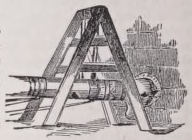
Battering ram
Encyclopedia Britannica
BATTERING RAM(Aries), a military engine used before the invention of gunpowder, for beating down the walls of besieged fortresses. It consisted of a long heavy beam of timber, armed at the extremity with iron fashioned something like the head of a ram. In its simplest form the beam was carried in the hands of the soliders, who assailed the walls with it by main force. The improved ram was composed of a longer beam, in some cases extending to 120 feet, shod with iron at one end, and suspended, either by the middle or from two points, from another beam laid across two posts. This is the kind described by Josephus as having been used at the siege of Jerusalem (B. J., iii. 7, 19). It was covered over with a roof, shell, or screen of boards (called the testudo) to protect the men employed in working it from the stones, darts, and other missiles discharged by the besieged from the walls. It was also provided with wheels, which greatly facilitated its operations. A hundred soldiers at a time, and sometimes even a greater number, were employed to work it, and the parties were relieved in constant succession. Josephus says that no wall could resist the continued application of the ram.
9th ed. Encyclopædia Britannica, vol. 3, p. 443
[212 words — estimated reading time: 2 minutes]
[212 words — estimated reading time: 2 minutes]
Battering train
Webster's Dictionary 1913
A train of artillery for siege operations.
In antiquity, a military engine used to beat down the walls of besieged places. It was a large beam, with a head of iron somewhat resembling the head of a ram, whence its name. It was suspended by ropes in the middle to a beam which was supported by posts, and balanced so as to swing backwards and forwards, and was impelled by men against the wall. It was sometimes mounted on wheels.
1. An engine used in ancient times to beat down the walls of besieged places.
2. A blacksmith's hammer, suspended, and worked horizontally.
1. The act of battering, or beating.
2. The instrument of battering.
3. In the military art, a parapet thrown up to cover the gunners and others employed about them, from the enemy's shot, with the guns employed. Thus, to erect a battery is to form the parapet and mount the guns. The term is applied also to a number of guns ranged in order for battering, and to mortars used for a like purpose.
4. Cross batteries are two batteries which play athwart each other, forming an angle upon the object battered.
5. Battery d'enfilade, is one which scours or sweeps the whole line or length.
6. Battery en echarpe, is that which plays obliquely.
7. Battery de revers, is that which plays upon the enemy's back.
8. Camerade battery is when several guns play at the same time upon one place.
9. In law, the unlawful beating of another. The least violence or the touching of another in anger is a battery
10. In electrical apparatus and experiments, a number of coated jars placed in such a manner, that they may be charged at the same time, and discharged in the same manner. This is called an electrical battery
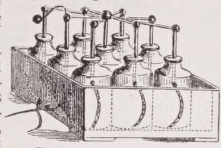
11. Galvanic battery a pile or series of plates of copper and zink, or of any substances suspectable of galvanic action.
1. The act of battering or beating.
2. The unlawful beating of another. It includes every willful, angry and violent, or negligent touching of another's person or clothes, or anything attached to his person or held by him.
3. Any place where cannon or mortars are mounted, for attack or defense.
4. Two or more pieces of artillery in the field.
5. A company or division of artillery, including the gunners, guns, horses, and all equipments. In the United States, a battery of flying artillery consists usually of six guns.
6. A number of coated jars (Leyden jars) so connected that they may be charged and discharged simultaneously.
7. An apparatus for generating voltaic electricity.
8. A number of similar machines or devices in position; an apparatus consisting of a set of similar parts; as, a battery of boilers, of retorts, condensers, etc.
9. A series of stamps operated by one motive power, for crushing ores containing the precious metals.
10. The box in which the stamps for crushing ore play up and down.
11. The pitcher and catcher together.
Battery
Encyclopedia Britannica
BATTERY is the tactical unit of artillery. It is the term applied to the largest number of fully equipped mobile guns which can be personally superintended by one man. Batteries may be divided into the four classes of horse, field, mountain, and position artillery batteries. In England, France, and Germany batteries consist of six guns; in Austria and Russia of eight guns each. The guns of horse field artillery are drawn by from four to eight horses, the usual number being six. Each battery has a certain number of men told off for the service of the gun called gunners, and others to mauage the draught called drivers. In the horse artillery the gunners are mounted on horses, in field batteries they are carried on the limbers and waggons, in mountain and position batteries both gunners and drivers usually walk. Both horse and field batteries are recognized tactical units of an army, and are maintained in an efficient state in time of peace. Position batteries are organized generally in time of war, are possessed of the heaviest guns consistent with mobility, and are useful in certain special cases, such as the attack or defence of a fortified position, the bombardment of a town, &c. Mountain batteries consist usually of light guns mounted on the backs of mules, and are adapted solely for warfare in mountainous countries. See Artillery. The term battery is also applied to the companies of dismounted artillerymen necessary to fight fortress and siege guns; to separate groups of guns in permanent works; and to the earthworks constructed for the protection of guns in siege operations.
BATTERY, as a law term, is the unlawful beating of another. See Assault, vol. ii. p. 724.
9th ed. Encyclopædia Britannica, vol. 3, p. 443
[268 words — estimated reading time: 2 minutes]
[268 words — estimated reading time: 2 minutes]
Ship Roget’s Thesaurus §273
N. ship, vessel, sail, craft, bottom, navy, marine, fleet, flotilla, shipping, man of war, transport, tender, storeship, merchant ship, merchantman, packet, liner, whaler, slaver, collier, coaster, lighter, fishing boat, pilot boat, trawler, hulk, yacht, baggala, floating hotel, floating palace, ocean greyhound, ship, bark, barque, brig, snow, hermaphrodite brig, brigantine, barkantine, schooner, topsail schooner, for and aft schooner, three masted schooner, chasse-maree, sloop, cutter, corvette, clipper, foist, yawl, dandy, ketch, smack, lugger, barge, hoy, cat, buss, sailer, sailing vessel, windjammer, steamer, steamboat, steamship, liner, ocean liner, cruisp, flap, dab, pat, thump, beat, blow, bang, slam, dash, punch, thwack, whack, hit hard, strike hard, swap, batter, dowse|, baste, pelt, patter, buffet, belabor, fetch one a blow, poke at, pip, ship of the line, destroyer, cruiser, frigate, landing ship, lst, aircraft carrier, carrier, flattop, nuclear powered carrier, submarine, submersible, atomic submarine, boat, pinnace, launch, life boat, long boat, jolly boat, bum boat, fly boat, cock boat, ferry oat, canal boat, swamp boat, ark, bully, bateau battery, broadhorn, dory, droger, drogher, dugout, durham boat, flatboat, galiot, shallop, gig, funny, skiff, dingy, scow, cockleshell, wherry, coble, punt, cog, kedge, lerret, eight oar, four oar, pair oar, randan, outrigger, float, raft, pontoon, prame, iceboat, ice canoe, ice yacht, catamaran, hydroplane, hovercraft, coracle, gondola, carvel, caravel, felucca, caique, canoe, birch bark canoe, dugout canoe, galley, galleyfoist, bilander, dogger, hooker, howker, argosy, carack, galliass, galleon, polacca, polacre, tartane, junk, lorcha, praam, proa, prahu, saick, sampan, xebec, dhow, dahabeah, nuggah, kayak, keel boat, log canoe, pirogue, quadrireme, trireme, stern-wheeler, wanigan, wangan, wharf boat, balloon, airship, aeroplane, biplane, monoplane, triplane, hydroplane, aerodrome, air balloon, pilot balloon, fire balloon, dirigible, zeppelin, aerostat, montgolfier, kite, parachute, jet plane, rocket plane, jet liner, turbojet, prop-jet, propeller plane, corporate plane, corporate jet, private plane, private aviation, airline, common carrier, fighter, bomber, fighter-bomber, escort plane, spy plane, supersonic aircraft, subsonic aircraft
Impulse Roget’s Thesaurus §276
N. impulse, impulsion, impetus, momentum, push, pulsion, thrust, shove, jog, jolt, brunt, booming, boost, throw, explosion, propulsion, percussion, concussion, collision, occursion|, clash, encounter, cannon, carambole, appulse, shock, crash, bump, impact, elan, charge, beating, blow, dint, stroke, knock, tap, rap, slap, smack, pat, dab, fillip, slam, bang, hit, whack, thwack, cuff, squash, dowse, swap, whap, punch, thump, pelt, kick, punce|, calcitration, ruade, arietation|, cut, thrust, lunge, yerk|, carom, carrom, clip *, jab, plug*, sidewinder*, sidewipe, sideswipe, hammer, sledge hammer, mall, maul, mallet, flail, ram, rammer, battering ram, monkey, pile-driving engine, punch, bat, cant hook, cudgel, ax, dynamics, seismometer, accelerometer, earthquake detector
V. give an impetus, impel, push, start, give a start to, set going, drive, urge, boom, thrust, prod, foin, cant, elbow, shoulder, jostle, justle, hustle, hurtle, shove, jog, jolt, encounter, run against, bump against, butt against, knock one's head against, run one's head against, impinge, boost, bunt, carom, clip y, fan, fan out, jab, plug *, strike, knock, hit, tap, rap, slap, flap, dab, pat, thump, beat, blow, bang, slam, dash, punch, thwack, whack, hit hard, strike hard, swap, batter, dowse|, baste, pelt, patter, buffet, belabor, fetch one a blow, poke at, pink, lunge, yerk, kick, calcitrate, butt, strike at, whip *c, (punish) 972, come into a collision, enter into collision, collide, sideswipe, foul, fall foul of, run foul of, telescope, throw
Phr. "a hit, a very palpable hit"
King James Bible KJV Bible
Berean Standard Bible BSB Bible
4 KJV and 5 BSB verses contain “batter”
And lay siege against it, and build a fort against it, and cast a mount against it; set the camp also against it, and set battering rams against it round about.
At his right hand was the divination for Jerusalem, to appoint captains, to open the mouth in the slaughter, to lift up the voice with shouting, to appoint battering rams against the gates, to cast a mount, and to build a fort.
And when neither sun nor stars in many days appeared, and no small tempest lay on us, all hope that we should be saved was then taken away.
When neither sun nor stars appeared for many days and the great storm continued to batter us, we abandoned all hope of being saved.