
The act of pushing or pressing against by strength, without a sudden impulse.
Word of the Day: Catachrestical
3. To shove off , to move from shore by pushing with poles or oars.
1. To push; to propel; to drive along by the direct application of strength without impulse; particularly, to push a body by sliding or causing it to move along the surface of another body, either by the hand or by an instrument; as, the shove a bottle along a table; to shove a table along the floor; to shove a boat along the water.
4. To push; to press against.
6. Arbuthnot .
7. To shove away , to push to a distance; to thrust off.
8. To shove by , to push away; to delay, or to reject; as, to shove by the hearing of a cause; or to shove by justice. [ Not elegant .]
9. To shove off , to thrust or push away.
10. To shove down , to overthrow by pushing.
Shove
Webster's Dictionary 1913
p. p. of Shove.
Alt. of Shovegroat
The same as Shovelboard.
shov'l . An instrument consisting of a broad scoop or hollow blade with a handle; used por throwing earth or other loole substances.
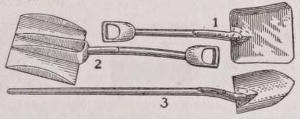
1. To take up and throw with a shovel; as, to shovel earth into a heap or into a cart, or out of a pit.
2. To gather in great quantities.
1. An implement consisting of a broad scoop, or more or less hollow blade, with a handle, used for lifting and throwing earth, coal, grain, or other loose substances.
2. To take up and throw with a shovel; as, to shovel earth into a heap, or into a cart, or out of a pit.
3. To gather up as with a shovel.
Shovel
Encyclopedia Britannica
SHOVEL, Sir Cloudesley (c. 1650-1707), English admiral, was according to some accounts a native of Yorkshire, but the most commonly accepted statement is that he was born of poor parents about 1650 in Clay, a fishing-village of Norfolk, where he was apprenticed to a shoemaker. Having run away to sea, he became cabin-boy on board a ship commanded by Sir Christopher Mynns. He set himself to study navigation, and, owing to his able seamanship and brave and open-hearted disposition, became a general favourite and obtained quick promotion. In 1674 he served as lieutenant under Sir John Narborough in the Mediterranean, where he burned four men-of-war under the castles and walls of Tripoli, belonging to the pirates of that place. He was present as captain of the “Edgar” at the first fight at Bantry Bay, and shortly afterwards was knighted. In 1690 he convoyed William III. across St George’s Channel to Ireland; the same year he was made rear-admiral of the blue, and was present at the battle of Beachy Head on 10th July. In 1692 he was appointed rear-admiral of the red, and joined Admiral Russell, under whom he greatly distinguished himself at La Hogue, having a principal share in burning twenty of the enemy’s men-of-war. Not long after, when Admiral Russell was dismissed from the service, Shovel was put in joint command of the fleet with Admiral Killigrew and Sir Ralph Delaval. In 1702 he was sent to bring home the spoils of the French and Spanish fleets from Vigo, after their capture by Sir George Rooke, and in 1704 he served under Sir George Rooke in the Mediterranean. In January 1705 he was named rear-admiral of England, and shortly afterwards commander-in-chief of the British fleets. He co-operated in the capture of Barcelona along with the earl of Peterborough in ...1705, and made an unsuccessful attempt on Toulon in October 1707. When returning with the fleet to England his ship, the “Association,” at eight o’clock at night on the 22d October, struck on the rocks near Scilly, and was seen by those on board the “St George” to go down in three or four minutes’ time, not a soul being saved of 800 men that were on board. The body of Sir Cloudesley Shovel was cast ashore next day, and was buried in Westminster Abbey.
9th ed. Encyclopædia Britannica, vol. 21, p. 842
[430 words — estimated reading time: 3 minutes]
[430 words — estimated reading time: 3 minutes]
A board on which they play by sliding metal pieces at a mark.
The shoveler.
1. A board on which a game is played, by pushing or driving pieces of metal or money to reach certain marks; also, the game itself. Called also shuffleboard, shoveboard, shovegroat, shovelpenny.
2. A game played on board ship in which the aim is to shove or drive with a cue wooden disks into divisions chalked on the deck; -- called also shuffleboard.
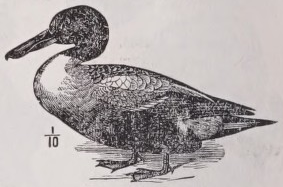
1. One who, or that which, shovels.
2. A river duck (Spatula clypeata), native of Europe and America. It has a large bill, broadest towards the tip. The male is handsomely variegated with green, blue, brown, black, and white on the body; the head and neck are dark green. Called also broadbill, spoonbill, shovelbill, and maiden duck. The Australian shoveler, or shovel-nosed duck (S. rhynchotis), is a similar species.
Shoveler
Encyclopedia Britannica
SHOVELER, formerly spelt Shovelar, and more anciently Shovelard, a word by which used to be meant the bird now almost invariably called Spoonbill (q.v.), but in the latter half of the 16th century transferred to one hitherto generally, and in these days locally, known as the Spoon-billed Duck—the Anas clypeata of Linnaeus and Spatula or Rhynchaspis clypeata of modern writers. All these names refer to the shape of the bird’s bill, which, combined with the remarkably long lamellae (not wholly incomparable with the “whalebone” of the toothless Cetaceans) that beset both maxilla and mandible, has been thought sufficient to remove the species from the Linnaean genus Anas. Except for the extraordinary formation of this feature, which carries with it a clumsy look, the male Shoveler would pass for one of the most beautiful of this generally beautiful group of birds. As it is, for bright and variegated colouring, there are few of his kindred to whom he is inferior. His golden eye, his dark green head, surmounting a throat of pure white and succeeded by a breast and flanks of rich bay, are conspicuous; while his deep brown back, white scapulars, lesser wing-coverts (often miscalled shoulders) of a glaucous blue, and glossy green speculum bordered with white present a wonderful contrast of the richest tints, heightened again by his bright orange feet. On the other hand, the female, excepting the blue wing-coverts she has in common with her mate, is habited very like the ordinary Wild-Duck, A. boscas (see vol. vii. p. 505). The Shoveler is not an abundant species, and in Great Britain its distribution is local; but its numbers have remarkably increased since the passing of the WildFowl Protection Act in 1876, so that in certain districts it has regained its old position as ...an indigenous member of the Fauna. It has not ordinarily a very high northern range, but inhabits the greater part of Europe, Asia, and America, passing southwards, like most of the Anatidae towards winter, constantly reaching India, Ceylon, Abyssinia, the Antilles, and Central America, while it is known to have occurred at that season in New Granada, and, according to Gould, in Australia. Generally resembling in its habits the other freshwater Ducks, the Shoveler has one peculiarity that has been rarely, if ever, mentioned, and one that is perhaps correlated with the structure of its bill. It seems to be especially given to feeding on the surface of the water immediately above the spot where Diving Ducks (Fuligulinae) are employing themselves beneath. On such occasions a pair of Shovelers may be watched, almost for the hour together, swimming in a circle, about a yard in diameter, their heads turned inwards towards its centre, their bills immersed vertically in the water, and engaged in sifting, by means of the long lamellae before mentioned, the floating matters that are disturbed by their submerged allies and rise to the top. These gyrations are executed with the greatest ease, each Shoveler of the pair merely using the outer leg to impel it on its circular course, and to the observer the prettiest part of the performance is the precision with which each preserves its relative distance from its comrade.
Four other species of the genus Spatula, all possessing the characteristic light blue “shoulders,” have been described:—one, S. platalea, from the southern parts of South America, having the head, neck, and upper back of a pale reddish brown, freckled or closely spotted with dark brown, and a dull bay breast with interrupted bars; a second, S. capensis, from South Africa, much lighter in colour than the female of S. clypeata ; a third and a fourth, S. rhynchotis and S. variegata, from Australia and New Zealand respectively,—these last much darker in general coloration, and the males possessing a white crescentic mark between the bill and the eye, very like that which is found in the South-American Blue-winged Teal (Querquedula cyanoptera), but so much resembling each other that their specific distinctness has been disputed by good authority. In these last two the sexual difference is well marked by the plumage; but in the South-American and SouthAfrican species it would seem that both male and female have much the same appearance, as is the case with so many species of the restricted genus Anas, though this cannot yet be asserted with certainty. (A. N. )
9th ed. Encyclopædia Britannica, vol. 21, p. 842
[734 words — estimated reading time: 5 minutes]
[734 words — estimated reading time: 5 minutes]
of Shovelful
A shark (Sphryna tiburio) allied to the hammerhead, and native of the warmer parts of the Atlantic and Pacific oceans; -- called also bonnet shark.
Shovelling
Webster's Dictionary 1913
of Shovel
Impulse Roget’s Thesaurus §276
N. impulse, impulsion, impetus, momentum, push, pulsion, thrust, shove, jog, jolt, brunt, booming, boost, throw, explosion, propulsion, percussion, concussion, collision, occursion|, clash, encounter, cannon, carambole, appulse, shock, crash, bump, impact, elan, charge, beating, blow, dint, stroke, knock, tap, rap, slap, smack, pat, dab, fillip, slam, bang, hit, whack, thwack, cuff, squash, dowse, swap, whap, punch, thump, pelt, kick, punce|, calcitration, ruade, arietation|, cut, thrust, lunge, yerk|, carom, carrom, clip *, jab, plug*, sidewinder*, sidewipe, sideswipe, hammer, sledge hammer, mall, maul, mallet, flail, ram, rammer, battering ram, monkey, pile-driving engine, punch, bat, cant hook, cudgel, ax, dynamics, seismometer, accelerometer, earthquake detector
V. give an impetus, impel, push, start, give a start to, set going, drive, urge, boom, thrust, prod, foin, cant, elbow, shoulder, jostle, justle, hustle, hurtle, shove, jog, jolt, encounter, run against, bump against, butt against, knock one's head against, run one's head against, impinge, boost, bunt, carom, clip y, fan, fan out, jab, plug *, strike, knock, hit, tap, rap, slap, flap, dab, pat, thump, beat, blow, bang, slam, dash, punch, thwack, whack, hit hard, strike hard, swap, batter, dowse|, baste, pelt, patter, buffet, belabor, fetch one a blow, poke at, pink, lunge, yerk, kick, calcitrate, butt, strike at, whip *c, (punish) 972, come into a collision, enter into collision, collide, sideswipe, foul, fall foul of, run foul of, telescope, throw
Phr. "a hit, a very palpable hit"
Propulsion Roget’s Thesaurus §284
N. # propulsion, projection, propelment, vis a tergo, push, shove, ejaculate, ejection, throw, fling, toss, shot, discharge, shy, launch, release, projectiles, ballistics, archery, propeller, screw, twin screws, turbine, jet engine, missile, projectile, ball, discus, quoit, brickbat, shot, arrow, gun, ballista, countdown, windup, shooter, shot, archer, toxophilite, bowman, rifleman, marksman, good shot, crack shot, sharpshooter
V. propel, project, throw, fling, cast, pitch, chuck, toss, jerk, heave, shy, hurl, flirt, fillip, dart, lance, tilt, ejaculate, jaculate, fulminate, bolt, drive, sling, pitchfork, send, send off, let off, fire off, discharge, shoot, launch, release, send forth, let fly, put in orbit, send into orbit, launch into orbit dash, put in motion, set in motion, set agoing, start, give a start, give an impulse to, impel, trundle, expel, carry one off one's legs, put to flight
King James Bible KJV Bible
Berean Standard Bible BSB Bible
10 KJV and 13 BSB verses contain “shove”
And thou shalt make his pans to receive his ashes, and his shovels, and his basons, and his fleshhooks, and his firepans: all the vessels thereof thou shalt make of brass.
Make all its utensils of bronze—its pots for removing ashes, its shovels, its sprinkling bowls, its meat forks, and its firepans.
And he made all the vessels of the altar, the pots, and the shovels, and the basons, and the fleshhooks, and the firepans: all the vessels thereof made he of brass.
He made all the altar’s utensils of bronze—its pots, shovels, sprinkling bowls, meat forks, and firepans.
And they shall put upon it all the vessels thereof, wherewith they minister about it, even the censers, the fleshhooks, and the shovels, and the basons, all the vessels of the altar; and they shall spread upon it a covering of badgers skins, and put to the staves of it.
and place on it all the vessels used to serve there: the firepans, meat forks, shovels, and sprinkling bowls—all the equipment of the altar. They are to spread over it a covering of fine leather and insert the poles.
Also he said, Bring the vail that thou hast upon thee, and hold it. And when she held it, he measured six measures of barley, and laid it on her: and she went into the city.
And Hiram made the lavers, and the shovels, and the basons. So Hiram made an end of doing all the work that he made king Solomon for the house of the LORD:
Additionally, Huram made the pots, shovels, and sprinkling bowls. So Huram finished all the work that he had undertaken for King Solomon in the house of the LORD:
And the pots, and the shovels, and the basons: and all these vessels, which Hiram made to king Solomon for the house of the LORD, were of bright brass.
and the pots, shovels, and sprinkling bowls. All the articles that Huram made for King Solomon in the house of the LORD were made of burnished bronze.
And Huram made the pots, and the shovels, and the basons. And Huram finished the work that he was to make for king Solomon for the house of God;
Additionally, Huram made the pots, shovels, and sprinkling bowls. So Huram finished the work that he had undertaken for King Solomon in the house of God:
The pots also, and the shovels, and the fleshhooks, and all their instruments, did Huram his father make to king Solomon for the house of the LORD of bright brass.
and the pots, shovels, meat forks, and all the other articles. All these objects that Huram-abi made for King Solomon for the house of the LORD were of polished bronze.