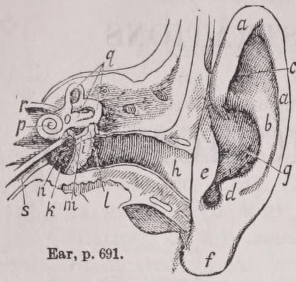
EAR. The simplest form of the organ of hearing is a small sac containing fluid, with the auditory nerve expanded upon it. Sonorous vibrations are communicated to this sac either directly through the hard parts of the head, or at the same time by a membrane exposed to the surrounding medium. Such is the form of ear found in many of the Crustacea and in the Cephalopoda. In the Vertebrata, there is a progressive development and increasing complexity from the fishes up to Mammalia. For details as to the structure of the ear in the different subdivisions of the Vertebrata, reference is made to the articles treating of these, such as Amphibia, Birds, &c. ; and the structure of the human ear will be found fully described in the article Axatomy, vol. i. p. 891. It is the object of this article to describe the phenomena of auditory sensation from the physiological point of view.
The sense of hearing is a special sensation the cause of which is an excitation of the auditory nerves by the vibrations of sonorous bodies. A description of sonorous vibrations and of their transmission is given in the article Acoustics ; here we shall consider, first, the transmission of such vibrations from the external ear to the auditory nerve, and secondly, the physiological characters of auditory sensation....
I.—1. Transmission in External Ear.— The external ear consists of the pinna, or auricle, and the external auditory meatus, or canal, at the bottom of which we find the membrana tympani, or drum head. In many animals the auricle is trumpet-shaped, and, being freely movable by muscles, serves to collect sonorous waves coming from various directions. The auricle of the human ear presents many irregularities of surface. If these irregularities are abolished by filling them up with a soft material such as wax or oil, leaving the entrance to the canal free, experiment shows that the intensity of sounds is weakened, and that there is more difficulty in judging of their direction. When waves of sound strike the auricle, they are partly reflected outwards, while the remainder, impinging at various angles, undergo a number of reflections so as to be directed into the auditory canal. Vibrations are transmitted along the auditory canal, partly by the air it contains and partly by its walls, to the membrana tympani. The absence of the auricle, as the result of accident or injury, has not caused diminution of hearing. In the auditory canal, waves of sound are reflected from side to side until they reach the membrana tympani. From the obliquity in position and peculiar curvature of this membrane, most of the waves must strike it nearly perpendicularly, and in the most advantageous direction.
2. Transmission in Middle Ear.— The middle ear is a small cavity, the walls of which are rigid with the exception of the portions consisting of the membrana tympani, and the membrane of the round window and of the apparatus filling the oval window. This cavity communicates with the pharynx by the Eustachian tube, which forms a kind of air-tube between the pharynx and the tympanum for the purpose of regulating pressure on the membrana tympani. It is generally supposed that during rest the tube is open, and that it is closed during the act of deglutition. As this action is frequently taking place, not only when food or drink is introduced, but when saliva is swallowed, it is evident that the pressure of the air in the tympanum will be kept in a state of equilibrium with that of the external air on the outer surface of the membrana tympani, and that thus the membrana tympani will be rendered independent of variations of atmospheric pressure such as may occur within certain limits, as when we descend in a diving bell or ascend in a balloon. By a forcible expiration, the oral and nasal cavities being closed, air may be driven into the tympanum, while a forcible inspiration (Valsalva’s experiment) will draw air from that cavity. In the first case, the membrana tympani will bulge outwards, in the second case inwards, and in both, from excessive stretching of the membrane, there will be partial deafness, especially for sounds of high pitch. Permanent occlusion of the tube is one of the most common causes of deafness,
The membrana tympani is capable of being set into vibration by a sound of any pitch included in the range of perceptible sounds. It responds exactly as to number of vibrations (pitch), intensity of vibrations (intensity), and complexity of vibration (quality or timbre). Consequently we can hear a sound of any given pitch, of a certain intensity, and in its own specific timbre or quality. Generally speaking, very high tones are heard more easily than low tones of the same intensity. As the membrana tympani is not only fixed by its margin to a ring or tube of bone, but is also adherent to the handle of the malleus, which follows its movements, its vibrations meet with considerable resistance. This diminishes the intensity of its vibrations, and prevents also the continued vibration of the membrane after an external vibration has ceased, so that a sound is not heard much longer than it lasts. The tension of the membrane may be affected (1) by differences of pressure on the two surfaces of the membrana tympani, as may occur during forcible expiration or inspiration, or in a pathological condition, and (2) by muscular action, due to contraction of the tensor tympani muscle. This small muscle arises from the apex of the petrous temporal and the cartilage of the Eustachian tube, enters the tympanum at its anterior wall, and is inserted into the malleus near its root. The handle of the malleus is inserted between the layers of the membrana tympani, and, as the malleus and incus move round an axis passing through the neck of the malleus from before backwards, the action of the muscle is to pull the membrana tympani inwards towards the tympanic cavity in the form of a cone, the meridians of which, according to Helmholtz, are not straight but curved, with convexity outwards. When the muscle contracts, the handle of the malleus is drawn still farther inwards, and thus a greater tension of the tympanic membrane is produced. On relaxation of the muscle, the membrane returns to its position of equilibrium by its own elasticity and by the elasticity of the chain of bones. This power of varying the tension of the membrane is a kind of accommodating mechanism for receiving and transmitting sounds of different pitch. With different degrees of tension, it will respond more readily to sounds of different pitch. Thus, when the membrane is tense, it will readily respond to high sounds, while relaxation will be the condition most adapted for low sounds. In addition, increased tension of the membrane, by increasing the resistance, will diminish the intensity of vibrations. This is especially the case for sounds of low pitch.
Helmholtz has also pointed out that the peculiar form of the membrana tympani in man has the effect of increasing the force of its vibrations at the expense of their amplitude.
The vibrations of the membrana tympani are transmitted to the internal ear partly by the air which the middle ear or tympanum contains, and partly by the chain of bones, consisting of the malleus, incus, and stapes. Of these, transmission by the chain of bones is by far the most important. In birds and in the scaly amphibia, this chain is represented by a single rod-like ossicle, the columella, but in man the two membranes—the membrana tympani and the membrane filling the fenestra ovalis—are connected by a compound lever consisting of three bones, namely, the malleus, or hammer, inserted into the membrana tympani, the tneuβ, or anvil, and the stapes, or stirrup, the base of which fits into the oval window. The lever thus formed has its fulcrum near the short process of the incus, which abuts against the tympanic wall; the power is applied at the handle of the malleus, and the resistance is at the base of the stirrup. Both by direct experimental observation and by calculation from data supplied by measurement of the lengths of the arms of the lever, Helmholtz has shown that by this arrangement vibrations are diminished in extent in the ratio of 3 to 2, but are inversely increased in force. Considering the great resistance offered to excursions of the stapes, such an arrangement must be advantageous. It must also be noted that in the transmission of vibrations of the membrana tympani to the fluid in the labyrinth or internal ear, through the oval window, the chain of ossicles vibrates as a whole and acts efficiently, although its length may be only a small fraction of the wave length of the sound transmitted.
3. Transmission in the Internal Ear.— The internal ear is composed of the labyrinth, formed of the vestibule or central part, the semicircular canals, and the cochlea, each of which consists of an osseous and a membranous portion (see vol. i. p. 893). The osseous labyrinth may be regarded as an osseous mould in the petrous portion of the temporal bone, lined by tesselated endothelium, and containing a small quantity of fluid called the perilymph. In this mould, partially surrounded by, and to some extent floating in, this fluid, there is the membranous labyrinth, in certain parts of which we find the terminal apparatus in connection with the auditory nerve, immersed in another fluid called the endolymp)h. The membranous labyrinth consists of a vestibular portion formed by two small sac-like dilatations, called the saccule and the utricle, the latter of which communicates with the semicircular canals by five openings. Each canal consists of a tube, bulging out at each extremity so as to form the so-called ampulla, in which, on a projecting ridge, called the crista acoustica, there are cells bearing or developed into long auditory hairs, which are to be regarded as the peripheral end-organs of the vestibular branches of the auditory nerve. The cochlear division of the membranous labyrinth consists of the ductus cochlearis, a tube of triangular form fitting in between the two cavities in the cochlea, called the scala vestibuli, because it commences in the vestibule, and the scala tympani, because it ends in the tympanum, at the round window. These two scalae communicate at the apex of the cochlea. The roof of the ductus cochlearis is formed by a thin membrane called the membrane of Peissner, while its floor consists of the basilar membrane, on which we find the remarkable organ of Corti, which constitutes the terminal organ of the cochlear division of the auditory nerve, and which is fully described in vol. i. p. 894. It is sufficient to state here that this organ consists essentially of an arrangement of epithelial cells bearing hairs which are in communication with the terminal filaments of this portion of the auditory nerve, and that groups of these hairs pass through holes in a closely investing membrane, membrana reticularis, which may be supposed to act as a damping apparatus, so as quickly to stop their movements. The ductus cochlearis and the two scalae are filled with fluid. Sonorous vibrations may reach the fluid in the labyrinth by three different ways—(1) by the osseous walls of the labyrinth, (2) by the air in the tympanum and the round window, and (3) by the base of the stapes inserted into the oval window.
When the head is plunged into water, or brought into direct contact with any vibrating body, vibrations must be transmitted directly. Vibrations of the air in the mouth and in the nasal passages are also communicated directly to the walls of the cranium, and thus pass to the labyrinth. In like manner, we may experience peculiar auditive sensations, such as blowing, rubbing, and hissing sounds, due to muscular contraction or to the passage of blood in vessels close to the auditory organ. It has not been satisfactorily made out to what extent, if any, vibrations may be communicated to the fluid in the labyrinth by the round window. There can be no doubt, however, that in ordinary hearing vibrations are communicated chiefly by the chain of bones. When the base of the stirrup is pushed into the oval window, the pressure in the labyrinth increases, the impulse passes along the scala vestibuli to the scala tympani, and, as the only mobile part of the wall of the labyrinth is the membrane covering the round window, this membrane is forced outwards; when the base of the stirrup passes outwards, a reverse action takes place. Thus the fluid of the labyrinth may receive a series of pulses or vibrations isochronous with the movements of the base of the stirrup, and these pulses affect the terminal apparatus in connection with the auditory nerve.
Since the size of the membranous labyrinth is so small, measuring, in man, not more than ⅜ inch in length by ∣th inch in diameter at its widest part, and since it is a chamber consisting partly of conduits of very irregular form, it is impossible to state accurately the course of vibrations transmitted to it by impulses communicated from the base of the stirrup. In the cochlea, vibrations must pass from the saccule along the scala vestibuli to the apex, thus affecting the membrane of Reissner, which forms its roof; then, passing through the opening at the apex (the helicotrema), they must descend by the scala tympani to the round window, and affect in their passage the membrana basilaris, on which the organ of Corti is situated. From the round window impulses must be reflected backwards, but how they affect the advancing impulses is not known. But the problem is even more complex when we take into account the fact that impulses are transmitted simultaneously to the utricle and to the semicircular canals communicating with it by five openings. The mode of action of these vibrations or impulses upon the nervous terminations is still unknown; but to appreciate critically the hypothesis which has been advanced to explain it, it is necessary, in the first place, to refer to some of the general characters of auditory sensation.
4. Certain conditions are necessary for excitation of the auditory nerve sufficient to produce a sensation. In the first place, the vibrations must have a certain amplitude: if too feeble, no impression will be produced. The minimum limit has been stated to be the sensation caused by the falling of a ball of pith, 1 millegramme in weight, upon a smooth surface, such as glass, from a height of 1 millimetre at a distance of 91 millimetres from the ear.
In the next place, vibrations must have a certain duration to be perceived; and lastly, to excite a sensation of a continuous musical sound, a certain number of vibrations must occur in a given interval of time. The lower limit is about 30, and the upper about 30,000 vibrations per second. Below 30, the individual impulses may be observed, and above 30,000 few ears can detect any sound at all. The extreme upper limit is not more than 35,000 vibrations per second. Auditory sensations are of two kinds—noises and musical sounds. Noises are caused by impulses which are not regular in intensity or duration, or are not periodic, or they may be caused by a series of musical sounds occurring instantaneously so as to pro duce discords, as when we place our hand at random on the key-board of a piano. Musical tones are produced by periodic and regular vibrations. In musical sounds three characters are prominent—intensity, pitch, and quality. Intensity depends on the amplitude of the vibration, and a greater or lesser amplitude of the vibration will cause a corresponding movement of the transmitting apparatus, and a corresponding intensity of excitation of the terminal apparatus. Pitch, as a sensation, depends on the length of time in which a single vibration is executed, or, in other words, the number of vibrations in a given interval of time. The ear is capable of appreciating the relative pitch or height of a sound as compared with another, although it may not ascertain precisely the absolute height of a sound. What we call an acute or high tone is produced by a large number of vibrations, while a grave or low tone is caused by few. The musical tones which can be used with advantage range between 40 and 4000 vibrations per second, extending thu3 from 6 to 7 octaves. According to E. H. Weber, practised musicians can perceive a difference of pitch amounting even to only the ⅛th of a semitone, but this is far beyond average attainment. Quality or timbre (or Klang} is that peculiar characteristic of a musical sound by which we may identify it as proceeding from a particular instrument or from a particular human voice. It depends on the fact that many waves of sound that reach the ear are really compound wave systems, built up of constituent waves, each of which is capable of exciting a sensation of a simple tone if it be singled out and reinforced by a resonator (see Acoustics), and which may sometimes be heard without a resonator, after special practice and tuition. Thus it appears thgt the ear must have some arrangement by which it resolves every wave system, however complex, into simple pendular vibrations. When we listen to a sound of any quality we recognize that it is of a certain pitch. This depends on the number of vibrations of one tone, predominant in intensity over the others, called the fundamental or ground tone, or first partial tone. The quality, or timbre, depends on the number and intensity of other tones added to it. These are termed harmonic or partial tones, and they are related to the first partial or fundamental tone in a very simple manner, being multiples of the fundamental tone: thus—
mentaΓτone. Upper Partials or Harmonice.
Notes do 1 do 2 sol 2 do 3 mi 3 sol 3 sih 3 do 4 re 4 mi 4
Partial tones.. 1 23456789 10
¾rations f ä 33 66 99 132 165 198 231 264 297 330
When a simple tone, or one free from partials, is heard, it gives rise to a simple, soft, somewhat insipid sensation, as may be obtained by blowing across the mouth of an open bottle or by a tuning fork. The lower partials added to the fundamental tone give softness combined with richness; while the higher, especially if they be very high, produce a brilliant and thrilling effect, as is caused by the brass instruments of an orchestra. Such being the facts, how may they be explained physiologically?
Little is yet known regarding the mode of action of the vibrations of the fluid in the labyrinth upon the terminal apparatus connected with the auditory nerve. There can be no doubt that it is a mechanical action, a true communication of impulses to delicate hair-like processes, by the movements of which the nervous filaments are irritated. In the human ear it has been estimated that there are about 3000 small arches formed by the rods of Corti (see Anatomy). Each arch rests on the basilar membrane, and supports rows of cells having minute hair-like processes somewhat resembling cilia. It would appear also that the filaments of the auditory nerve terminate in the basilar membrane, and possibly they may be connected with the hair-cells. At one time it was supposed by Helmholtz that these fibres of Corti were elastic and that they were tuned for particular sounds, so as to form a regular series corresponding to all the tones audible to the human ear. Thus 2800 fibres distributed over the tones of seven octaves would give 400 fibres for each octave, or nearly 33 for a semitone. Helmholtz has put forward the ingenious hypothesis that, when a pendular vibration reaches the ear, it excites by sympathetic vibration the fibre of Corti which is tuned for its proper number of vibrations. If, then, different fibres are tuned to tones of different pitch, it is evident that we have here a mechanism which, by exciting different nerve fibres, will give rise to sensations of pitch. When the vibration is not simple but compound, in consequence of the blending of vibrations corresponding to various harmonics or partial tones, the ear has the power of resolving this compound vibration into its elements. It can only do so by different fibres responding to the constituent vibrations of the sound,—one for the fundamental tone being stronger, and giving the sensation of a particular pitch or height to the sound, and the others, corresponding to the upper partial tones, being weaker, and causing special though undefined sensations, which are so blended together in consciousness as to terminate in a complex sensation of a tone of a certain quality or timbre. It would appear at first sight that 33 fibres of...