
Of the color of the ruby; red; as ruby lips.
Word of the Day: Catachrestical
1. A precious stone; a mineral of a carmine red color, sometimes verging to violet, or intermediate between carmine and hyacinth red; but its parts vary in color, and hence it is called sapphire ruby or orange red, and by some vermeille or rubicel.
2. There are two kinds of ruby the oriental or corundum, and the spinelle. The latter is distinguishable from the former by its color and crystallization.
4. Redness; red color.
5. Any thing red.
9. Rock ruby the amethystizontes of the ancients, is the most value species of garnet.
To make red.
Ruby-colored; red; as, ruby lips.
1. A precious stone of a carmine red color, sometimes verging to violet, or intermediate between carmine and hyacinth red. It is a red crystallized variety of corundum.
4. See Agate, n., 2.
5. Any species of South American humming birds of the genus Clytolaema. The males have a ruby-colored throat or breast.
Ruby
Encyclopedia Britannica
RUBY. This name is applied by lapidaries and jewellers to two distinct minerals, which may be distinguished as the true or Oriental ruby and the spinel ruby. The former is a red variety of corundum or native alumina, of great rarity and value, while the latter is an aluminate of magnesium, inferior to the true ruby in hardness and much less esteemed as a gem stone. With ancient writers the confusion was even greater, for they appear to have classed together under a common name, such as the car-bunxulus of Pliny or the άνθραξ of Greek writers, not only our two kinds of ruby but also garnets and other inferior stones of a brilliant fiery colour. By modern mineralogists it has come to be understood that when the word ruby is used without any qualifying prefix the true or Oriental stone is invariably indicated....
The Oriental ruby, like all other varieties of corundum, crystallizes in the rhombohedral system; but, as it usually occurs as small pebbles or rounded fragments, the crystalline form can rarely be traced. Its colour varies from deep cochineal to pale rose red, in some cases inclining to purple, the most valued tint being that known to experts as pigeon’s blood colour. On exposure to a high temperature the ruby becomes green, but regains its original colour on cooling—a behaviour which is consistent with the supposition that the stone owes its colour to the presence of oxide of chromium, and indeed in artificial rubies the required tint is always obtained by the use of some compound of chromium. When a ruby of the most esteemed colour is properly viewed through a dichroiscope, the colour is resolved into a carmine and an aurora red, or red inclining to orange. By this test the true ruby may be distinguished from spinel and garnet, since these minerals crystallize in the cubic system and therefore are not di-chroic. Another mode of distinction is suggested by the high density of corundum: the specific gravity of the true ruby reaches or even rises slightly above 4, and thus greatly exceeds that of either spinel or garnet. But perhaps the simplest test is afforded by its great hardness (H = 9): the sharp edge of a corundum crystal will readily scratch either a spinel or a garnet, but has no effect on a ruby. The true ruby has a very high index of refraction (∕z,= l - 78), and to this character is due the remarkable lustre of the polished stone. Mr Crookes has shown that the ruby is brilliantly phosphorescent when subjected to radiant discharge in a properly exhausted vessel, and curiously enough the red light emitted is equally vivid whatever be the colour of the corundum under experiment. The microscopic structure of the ruby has been studied by Mr Sorby, who finds that the stone contains fluid cavities and numerous crystallized enclosures of other minerals (P roc. Roy. Soc., χvii.. 1869, p. 291).
The Oriental ruby is a mineral of very limited distribution, its principal localities being confined to the kingdom of Burmah. The most ιmporUnt ruby mines are situated at Kyat Pyen, about 70 miles to the north-east of Mandalay; there are also mines at ' Mookop, a little farther north, and others in the Sagyin Hills, within 16 miles of Mandalay. In all these localities the rubies occur in association with sapphires and other precious stones, forming a gem-bearing gravel which is dug up and washed in very primitive fashion. By far the larger number of the rubies are of small size, and the larger stones are generally flawed. All rubies exceeding a certain weight were the property of the king of Burmah. The mines were jealously watched, and it was difficult for Europeans to obtain access to them; but some of the Ava workings were visited and described many years ago by Père Giuseppe d i Amato, and more recently those near Mandalay have been described by Mr Bredmeyer, who was officially connected with them (Ball). It is βUted in the older works on mineralogy that rubies occur in the Capelan Mountains near Syrian, in Pegu. In peninsular India there are but few localities that yield rubies, but they have been reported from the corundum mines of the Salem district in Madras and from Mysore. In Ceylon they occur with sapphires, but are rarer than those gems, and the Ceylon rubies are not usually of good colour. Rubies have been brought from Gandamak, in Afghanistan, but most of the stones reputed to be Afghan rubies are merely spinels.
In 1871 some remarkable deposits of corundum were discovered by Col. C. W. Jenks in Macon co., North Carolina. Rubies, sapphires, and large pebbles of coarse corundum were found in thθ bed of a river near a large mass of serpentine which afterwards became known as Corundum Hill, and these pebbles were eventually traced to certain veins in the serpentine. The corundum occurred crystallized in situ, but was rarely of such a colour as would entitle it to be called ruby. Mr G. F. Kunz, who has lately written an article on American precious stones, states that rubies and sapphires have also been found at Vernon, New Jersey; near Helena, Montana; at Santa Fe, New Mexico; in southern Colorado; and in Arizona.
Australia has occasionally yielded true rubies, but mostly of small size and inferior quality. In Victoria they have been found in the drifts of the Beechworth gold fields and at the Berwick tin mine, Wallace’s Creek; while in New South Wales they occur at Mudgee, in the Cudgegong and some of its tributaries, and at Tumberumba, co. Wynyard. A magenta-coloured turbid ruby from Victoria is known under the name of “barklyite.”
The “star ruby” is a rather cloudy variety from Ceylon, exhibiting when cut en cabochon a luminous star of six rays, reflected from the convex surface of the stone.
The largest ruby known in Europe is said to be one of the size of a small hen’s egg, which was presented by Gustavus III. of Sweden to the empress of Russia on the occasion of his visit to St Petersburg. Rubies of larger size have been described by Tavernier and other Oriental travellers, but it is probable that in many cases spinels have been mistaken for true rubies. There seems no doubt that the great historic ruby set in the Maltese cross in front of the imperial state crown of England is a spinel. This stone was given to Edward the Black Prince by Pedro the Cruel, king of Castile, on the victory of Najera' in 1367, and it was afterwards worn by Henry V. at the battle of Agincourt, when it narrowly escaped destruction.
The spinel ruby has been described in the article Mineralogy (vol. xvi. p. 386, sp. 93). The spinels used for jewellery are mostly obtained in Burmah, where they occur as octahedral crystals or as water-worn pebbles in association with the true ruby, for which they are often mistaken. They are also found in the gem-bearing gravels of Ceylon, Victoria, and New South Wales. The delicate rose-pink variety known as balas ruby was worked for centuries in Badakhshan, but the operations appear to have been suspended of late years. The mines are situated on the river Shighnan, a tributary of the Oxus. It is commonly said that the name “balas” or “balash” is a corruption of Badakhshan, while others derive it from Balkh.
The Oriental ruby has always been esteemed of far higher value than any other precious stone. A ruby of perfect colour, weighing five carats, is worth at the present day ten times as much as a diamond of equal weight (Streeter). As the weight of the stone increases, its value rapidly rises, so that rubies of exceptional size command enormous prices. There is consequently much temptation to replace the true stone by spinel or garnet or even paste. By means of oxide of chromium an excellent imitation of the colour of the ruby is obtained; and, though the ordinary “strass,” or fine lead-glass, is very soft, and therefore soon loses its lustre, it is yet possible to produce a paste consisting of silicate of alumina which is almost as hard as rock crystal.
It is an interesting fact that the chemist has frequently succeeded in causing alumina to assume artificially many of the physical Characteristicsof the native ruby. As far back as 1837 M. Gaudin reproduced the ruby on a small scale by exposing ammonia-alum to the heat of the oxyhydrogen blowpipe, whereby he obtained fused alumina which was readily coloured by the addition of oxide of chromium. A different method was followed by Ebelmen. He dissolved alumina in boric acid at a high temperature, and on the cooling of the mass obtained the alumina in a crystallized form; while if chromate of ammonium was present the crystals became veritable ruby. MM. Sainte-Claire Deville and Caron heated a mixture of fluoride of aluminium, fluoride of chromium, and boric acid, and thus obtained a fluoride of boron, which, being volatile, readily escaped, and left a solid residue of alumina coloured by the chrome. These, however, were only laboratory experiments, and it was reserved for MM. Frémy and Feil, in 1878, to reproduce the ruby and sapphire on a scale suggestive of some commercial importance. By heating a mixture of artificial alumina and red lead in a fireclay crucible, they obtained a vitreous silicate of lead (the silica being derived from the crucible) and crystallized alumina, while the addition of bichromate of potassium caused this alumina to assume the coveted tint of the ruby.
For a general description of the ruby see E. Jannettaz, Diamant et Pierres Précieuses (1881); Kluge, Handbuch der Edelsteinkunde (1860); Sclirauf, Edelsteinkunde (1869); Church, Precious Stones (1883); Streeter, Precious Slones and Gems (4th ed., 1884). For Indian localities see Ball's Econcrmic Geology, being vol. iii. of the Manual of the Geology of India (1881); for Australian localities, Livcrsidgc's Minerals of New South Wales (2d ed., 1882); for United States rubies, Quart. Jour. Geol. Soc. Lond., vol. xxx. 1874, p. 303, and American Jour. Science, ser. iii. vol. iv. 1872, pp. 109,175, and Kunz’s article in Mineral Resources of the United States, by A. Williams, jun. (1883). For the history of the stone consult King's Natural Hist, of Precious Stones (1865), and for artificial rubies, Comptes Rendus, vol. lxxxv. 1877, p. 1029.
9th ed. Encyclopædia Britannica, vol. 21, p. 47 — signed F. W. R.
[1,751 words — estimated reading time: 11 minutes]
[1,751 words — estimated reading time: 11 minutes]
Ruby
Watson's Biblical & Theological Dictionary
a beautiful gem, whose colour is red, with an admixture of purple, and is, in its most perfect state, a gem of extreme value. In hardness it is equal to the sapphire, and second only to the diamond. It is mentioned in Job xxviii, 18, and Prov. viii, 11, &c.
Watson's Biblical & Theological Dictionary
[50 words — estimated reading time: 1 minute]
[50 words — estimated reading time: 1 minute]
Having the tail, or lower part of the body, bright red.
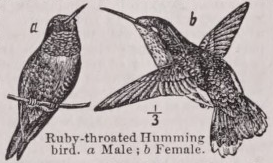
Any one of numerous species of humming birds belonging to Trochilus, Calypte, Stellula, and allies, in which the male has on the throat a brilliant patch of red feathers having metallic reflections; esp., the common humming bird of the Eastern United States (Trochilus colubris).
red sandalwood. See under Sandalwood.
Redness Roget’s Thesaurus §434
N. red, scarlet, vermilion, carmine, crimson, pink, lake, maroon, carnation, couleur de rose, rose du barry, magenta, damask, purple, flesh color, flesh tint, color, fresh color, high color, warmth, gules, ruby, carbuncle, rose, rust, iron mold, cinnabar, cochineal, fuchsine, ruddle, madder, indian red, light red, venetian red, red ink, annotto, annatto, realgar, minium, red lead, redness, rubescence, rubicundity, rubification, erubescence, blush
V. be red, become red, blush, flush, color up, mantle, redden, render red, redden, rouge, rubify, rubricate, incarnadine, ruddle
Adj. red, reddish, rufous, ruddy, florid, incarnadine, sanguine, rosy, roseate, blowzy, blowed, burnt, rubicund, rubiform, lurid, stammell blood red, russet buff, murrey, carroty, sorrel, lateritious, rubineous, rubricate, rubricose, rufulous, rose-colored, ruby-colored, cherry-colored, claret-colored, flame- colored, flesh-colored, peach-colored, salmon-colored, brick-colored, brick-colored, dust-colored, blushing, erubescent, reddened, red as fire, red as blood, red as scarlet, red as a turkey cock, red as a lobster, warm, hot, foxy, complementary colors
Goodness Roget’s Thesaurus §648
N. goodness, excellence, merit, virtue, value, worth, price, super-excellence, supereminence, superiority, perfection, coup de maitre, masterpiece, chef d'ouvre, prime, flower, cream, elite, pick, a1, nonesuch, nonpareil, creme de la creme, flower of the flock, cock of the roost, salt of the earth, champion, prodigy, tidbit, gem, gem of the first water, bijou, precious stone, jewel, pearl, diamond, ruby, brilliant, treasure, good thing, rara avis, one in a thousand, beneficence, good man
V. be beneficial, produce good, do good, profit, benefit, confer a benefit, be the making of, do a world of good, make a man of, produce a good effect, do a good turn, confer an obligation, improve, do no harm, break no bones, be good, excel, transcend, bear away the bell, stand the proof, stand the test, pass muster, pass an examination, challenge comparison, vie, emulate, rival
Adj. harmless, hurtless, unobnoxious, innocuous, innocent, inoffensive, beneficial, valuable, of value, serviceable, advantageous, edifying, profitable, salutary, favorable, propitious, fair, good, good as gold, excellent, better, superior, above par, nice, fine, genuine, best, choice, select, picked, elect, recherche, rare, priceless, unparagoned, unparalleled, superlatively, good, bully*, crackajack*, giltedged, superfine, superexcellent, of the first water, first-rate, first-class, high- wrought, exquisite, very best, crack, prime, tiptop, capital, cardinal, standard, inimitable, admirable, estimable, praiseworthy, pleasing, couleur de rose, precious, of great price, costly, worth its weight in gold, worth a jew's eye, priceless, invaluable, inestimable, precious as the apple of the eye, tolerable, up to the mark, unexceptionable, unobjectionable, satisfactory, tidy, in good condition, in fair condition, fresh, sound
Adv. beneficially, well
Phr. "jewels five words long", "long may such goodness live!", "the luxury of doing good"
Jewelry Roget’s Thesaurus §847a
N. jewel, jewelry, jewellery, bijoutry|, bijou, bijouterie, trinket, fine jewelry, costume jewelry, junk jewelry, gem, gemstone, precious stone, necklace, bracelet, anklet, earring, locket, pendant, charm bracelet, ring, pinky ring, carcanet, chain, chatelaine, broach, pin, lapel pin, torque, diamond, brilliant, rock, beryl, emerald, chalcedony, agate, heliotrope, girasol, girasole, onyx, plasma, sard, sardonyx, garnet, lapis lazuli, opal, peridot, tourmaline, chrysolite, sapphire, ruby, synthetic ruby, spinel, spinelle, balais, oriental, oriental topaz, turquois, turquoise, zircon, cubic zirconia, jacinth, hyacinth, carbuncle, amethyst, alexandrite, cat's eye, bloodstone, hematite, jasper, moonstone, sunstone, pearl, cultured pearl, fresh-water pearl, mother of pearl, coral, jeweler, gemologist, minerologist, lapidary, lapidarian, gemology, gemmology, minerology
V. shine like a diamond
King James Bible KJV Bible
Berean Standard Bible BSB Bible
0 KJV and 3 BSB verses contain “ruby”
Thou hast been in Eden the garden of God; every precious stone was thy covering, the sardius, topaz, and the diamond, the beryl, the onyx, and the jasper, the sapphire, the emerald, and the carbuncle, and gold: the workmanship of thy tabrets and of thy pipes was prepared in thee in the day that thou wast created.