
FONBLANQUE, AlbanyWilliam (1793-1872), was descended from a noble French Huguenot family, the Greniers of Languedoc. The titles of Comte de Hautserre et de Fonblanque were conferred by Henry IV. on the sons of the famous Sieur Pierre de Grenier, known in history by his gallant defence of the castle of Cessenau against the Due de Montmorenci in 1584. After the revocation of the edict of Nantes, the Greniers underwent severe persecutions on account of their devotion to the Huguenot cause; and in 1740, Abel de Grenier, Comte de Fonblanque, sent his two sons, Antoine and Jean, to England that they might be educated in the Protestant faith. John became nationalized in this country under the name of Fonblanque; and his son, John Samuel Martin Fonblanque, a distinguished equity lawyer, and the author of a standard legal work, a Treatise on Equity, became the father of the most brilliant journalist of his day. The father of Albany Fonblanque was, like his son, a staunch Liberal; he represented the borough of Camelford in parliament; and throughout his career was remarkable for the integrity and courage, as well as for the ability, with which he supported Liberal principles....
The subject of the present notice was born in London in 1793. At fourteen he was sent to Woolwich to prepare for the Royal Engineers. His health, however, failed, and for two years his studies had to be suspended. Upon his recovery, he studied for some time with Chitty, the eminent special pleader, with a view to being called to the bar. Fonblanque had no inclination for law, but he valued very highly the course of training he thus obtained, and in after life maintained that a study of law should be included in a liberal education. At the age of nineteen (1812) he commenced writing for the newspapers, and very soon attracted notice both by the boldness and liberality of his opinions, and by the brilliance of his style. Fonblanque’s manner of working might have lent some colour to the definition of genius as an infinite capacity for taking trouble. His nephew, Mr Edward Fonblanque, to whose biography we are indebted for the details given in this notice, tells us that in his earlier days he frequently wrote an article ten times before sending it to press, and this not from timidity or anxiety, for from the first his popularity was assured, but because his own ideal of political thought and composition was infinitely higher than that of the public.
As a result of this arduous and earnest cultivation he soon obtained sufficient popularity as a journalist to be able to renounce all idea of following law as a profession; but at the same time that he was eagerly taking his share in all the political struggles of this eventful period, he was also continuing his studies, devoting no less than six hours a day to the study of classics and political philosophy. Under this severe mental training his health once more broke down. At the age of twenty-one he had a long and dangerous illness, and continued weak and subject to nervous depression for the remainder of his life. His energy, however, was not impaired. He became a regular contributor to the newspapers and reviews, realizing a fair income, which, as his habits were simple and temperate, secured him against pecuniary anxieties. From 1820 to 1830 Albany Fonblanque was successively employed upon the staff of the Times and the Morning Chronicle, whilst he contributed to the Examiner, to the London Magazine, and to the Westminster Review. In 1828 the Examiner newspaper, which had been purchased by the Rev. Dr Fellowes, the learned and amiable author of the Religion of the Universe, <fcc., was given over to Fonblanque’s complete control; and for a period of seventeen years (1830 to 1847) he not only sustained the high character for political independence and literary ability which the Examiner had gained under the direction of Leigh Hunt and his brother John Hunt, but even compelled his political opponents to acknowledge a certain delight in the boldness and brightness of the wit directed against themselves. When it was proposed that the admirers and supporters of the paper should facilitate a reduction in its price by the payment of their subscription ten years in advance, not only did Mr Edward Bulwer (Lord Lytton) volunteer his aid, but also Mr Disraeli and Mr Clay, M.P., who were thus voluntarily prolonging the reign and spreading the influence of the representative Radical organ. But the Examiner under the direction of Fonblanque did not confine itself to the sphere of politics; the fine arts, literature, and the drama occupied a due share of its attention. Amongst its contributors were such men as Thackeray, Marmion Savage, John Stuart Mill, Walter Savage Landor, Charles Dickens, &c., names which do not belong exclusively to any political party, but which, associated in the work of criticism, give firm assurance that the “discovery of the best that is known and thought in the world” (Mr Arnold’s admirable definition of the true function of literary criticism) was for once at any rate in competent and impartial hands. During his connexion with the Examiner, Fonblanque had many advantageous offers of further literary employment; but he devoted his energies and talents almost exclusively to the service of the paper he had resolved to make a standard of literary excellence in the world of journalism. Whatever he wrote was as carefully prepared and revised as when he was only an aspirant to fame; every reference made and every anecdote used as an illustration he was careful to verify, and in Mr E. Fonblanque’s biography of his distinguished relative are given several racy answers he received from Count d’Orsay and others, concerning some witty story or saying which had taken his fancy, but which he was too scrupulous to repeat from memory. Foublanque was offered the governorship of Nova Scotia; but although he took great interest in colonial matters, and had used every effort to advocate the more generous political system which had colonial self-government for its goal, he decided not to abandon his beloved Examiner even for so sympathetic an employment. In 1847, however, domestic reasons induced him to accept the post of Statistical Secretary of the Board of Trade. This of course compelled him to resign the editorship of the Examiner, but he still continued to contribute largely to the paper, which, under the control of John Forster, continued to sustain its influential position. During the later years of his life, Fonblanque took no prominent part in public affairs; and when he died at the age of seventy-nine (1872) he seemed, as his nephew rightly observes, “a man who had lived and toiled in an age gone by and in a cause long since established.” The present generation, in the full enjoyment of those reforms he had laboured so bravely and unweariedly to promote, found it difficult to realize how much had been effected by Liberals of the stamp of Albany Fonblanque, in days not so remote from our own after all, before the passing of the Reform Act, when, to quote his own words—“The Test Acts were unrepealed; the Catholics were excluded from the legislature; slavery existed in our colonies; the prestige of the perfection of the law was unbroken, and the sanguinary character of the criminal code unmitigated; the corporations were sinks of corruption; a few individuals nominated nearly half the members of the House of Commons; and a parliamentary reformer was in common acceptation another word for a visionary.”
The character of Albany Fonblanque’s political activity may be judged of by a study of his England under Seven Administrations, in comparison with the course of social and political events in England from 1826 to 1837.
Although these volumes contain only articles reprinted from the Examiner, they give a vivid and spirited history of one of the most important and stormy phases of Parliamentary Reform. Fonblanque, although an ardent upholder of popular rights and an uncompromising opponent of bigotry and oppression, will never be found upon the side of violence or licence. The Chartists received from no source more complete condemnation than from the Examiner, which consistently advocated the principle that moral force was in every case to be relied upon, and that the liberties of the constitution were to be enlarged by means which were also constitutional. “In describing Lord Durham’s politics,” says Mr Edward Fonblanque, “he unconsciously depicted himself. He was not a reformer of the republican class, but he occupied as it were the frontier line of constitutional reform.” In a word, Fonblanque was an honourable example of the constitutional Radical who follows after liberty, but uses the pathway of the law. As a journalist, he must also be regarded in the light of a reformer. Journalism before his day was regarded as a somewhat discreditable profession: men of true culture were shy of entering the hot and dusty arena lest they should be confounded with the ruder combatants who fought there before the public for hire. But the fact that Fonblanque, a man not only of strong and earnest political convictions but also of exceptional literary ability, did not hesitate to choose this field as a worthy one in which both a politician and a man of letters might usefully as well as honourably put forth his best gifts, must have helped, in no small degree, to correct the old prejudice.
Life and Labours of Albany Fonblanque, edited by his nephew, Edward Barrington de Fonblanque, 1874; England under Seven Administrations, by Albany Fonblanque, 1837.
[1,612 words — estimated reading time: 10 minutes]
FOND DU LAC, a city of the United States, capital of Fond du Lac county, Wisconsin, is beautifully situated on a rising ground at the southern end of Lake Winnebago, 63 miles N.W. of Milwaukee. Railways radiate from it in various directions, and its situation on Winnebago lake gives it access to a wide district of inland navigation. It has a considerable shipping trade in wood, hay, and cattle, and possesses a large tannery, foundries, sawmills, cigar factories, carriage and waggon factories, and a railwaycar factory. The water supply is obtained chiefly from Artesian wells, which vary in depth from 90 to 130 feet. The population in 1860 was 5400, and in 1870, 12,764.
[116 words — estimated reading time: 1 minute]
FONDI, the ancient Fundi, a town of Italy in the province of Caserta, about 11 miles N.W. of Gaeta. Its principal street lies along the Appian way, and portions of its old polygonal or Cyclopean walls are still in good preservation. The castle, now in a sadly dilapidated condition, is of interest for its connexion with the Colonna family, and the Dominican convent contains a chapel which was occupied as a cell by Thomas Aquinas, and an orange-tree said to have been planted by the saint. The church of Santa Maria is a building in the Italian Gothic style, much disfigured in the interior. Between the town and the sea lies the Lago de Fondi or Locus Amyclanus, in the midst of a marshy tract which has recently been greatly diminished by draining; and near this is a cave, where, according to Tacitus, Sejanus saved the life of Tiberius. The district was in ancient times famous for its wine, including the Ager Caecubus, which gave its name to the Caecuban of the Latin poets. Population in 1871, 6632.
Fundi was probably at first a Volscian town. Its citizens were rewarded in 190 b.c. with full Roman citizenship, and enrolled in the Aemilian tribe. Under Augustus it received a colony of veterans. In the time of the barbarian invasions it suffered severely, more especially from the Saracens-in 845. The election of the anti-pope Clement VII. took place in the town in 1378, andin 1534 it was attacked and plundered by the Turkish corsair Barbarossa, who was anxious to capture the beautiful countess Giulia Gonzaga as a present for the sultan.
[274 words — estimated reading time: 2 minutes]
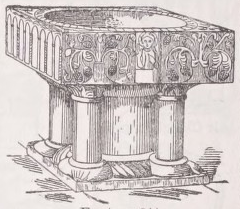
FONT (Lat. fans, It. fanie, Fr. fonts), the vessel used in churches to hold the water for Christian baptism. The modes of administering baptism have varied at different periods of the existence of the Christian churches, causing corresponding changes in the forms and auxiliaries of the receptacle of the consecrated water. There is reason to believe that in the times of the apostles and early missionaries the rite was administered by sprinkling, as whole multitudes of people, and even whole kingdoms were baptized in one day. But a very general method in early times was no doubt that of total immersion, the catechumens being received by the priest in the water. As Christianity became more general of course fewer adults would present themselves for baptism, and consequently the size of the vessel would not need to be beyond what would allow of the total immersion of an infant. In fact down to the time of the Reformation fonts continued to be made quite large enough to allow of the total immersion of infants, and there is little doubt that down to that date the method was occasionally employed. Baptism by infusion and by aspersion followed this method, though they were no doubt used concurrently, and in a sense combined, for in certain representations of the rite in illuminations and stained glass the infant is represented as seated naked in the font, while from a vessel the priest pours the water upon the head. Originally used only for sick or infirm persons, the method of baptism by infusion became gradually the established practice, and all doubts as to its validity were removed by appeal to papal and other high authority....
In early times the font was placed in the baptistery, a structure often entirely separate from the body of the church, of which the celebrated Baptistery at Florence is the finest example. In these the well or basin for containing the water was usually reached by descending steps. The baptisteries were round, square, octagonal, or crosslike in form, and in design bear the impress of the period to which they belong. Few are found of late date, and the only existing structure at all recalling them in English churches is found at Luton in Bedfordshire. The font at Luton belongs to the Decorated style of English art, and is inclosed in an octagonal structure of freestone, consisting of eight pillars about 25 feet in height, supporting a canopy. The space around the font is large enough to hold comfortably half a dozen people. At the top of the canopy is a vessel for containing the consecrated water, which when required was let down into the font by means of a pipe. The space around the font in the ancient baptisteries was of size to admit several catechumens at the same time; and not only was the whole rite of baptism performed within them, but that of the holy eucharist likewise, and even the baptism of infants. As baptism was administered in early times by bishops only, baptisteries were rare except at the principal church of the diocese. Easter, Whitsuntide, and Epiphany were the principal seasons of its administration. In the 9th century fonts became general in all churches, and baptism was performed at all times by priests of all ranks.
Of fonts still in existence few are older than the 11th century. The material in the Western Church was generally stone, and the outsides and accessories are frequently ornamented with some of the loveliest and most characteristic of the national arts of the Middle Ages. In the Eastern Church it was different. “The font, κoλvpβηθρaf says Neale (Eastern Church, i. 214), “in the Eastern Church is a far less conspicuous object than it is in the west. Baptism by immersion has been retained; but the font seldom or never possessed any beauty. The material is usually either metal or wood. In Russia the columbethra is movable, and only brought out when wanted.” The proper material for fonts in the Western Church was hard stone, as marble, porphyry, or granite. Fonts of bronze and lead are, however, sometimes found, and the basins of many stone fonts were lined with lead to prevent the absorption of the water by the porous stone. A font shaped from one block of oak is in the church at Evenechtyd, Denbighshire. Continental fonts bear distinctly the impress of the time to which they belong. They appear very early, ornamented with bas-reliefs, columns, and arches, as well as with the characteristic details of the ornamentation of their period. Representations of St John the Baptist are very common. At Pont-à-Mousson on the Moselle, one bears bas-reliefs of that saint preaching in the wilderness, and of the baptism of Christ, executed with that simple sincerity which is more valuable than the highest refinement and finish in design and execution. In the 11th and 12th centuries cup-shaped and cylindrical forms were most common, either as simple cylinders and truncated cones or supported by one or more pillars. Frequently the basin is hollowed out of one large square or oblong slab, supported at the centre by a broad column, with auxiliary columns at the corners, all bearing the mouldings and ornaments characteristic of the period. Caryatids sometimes take the place of the pillars, and sculptured animals and other grotesques of curious design sometimes form the bases. Octagonal forms are not altogether absent from this period, and even hexagons have been occasionally found. Pentagons are very rare. The font, however, at Cabourg, on the north coast of France, is formed of a pentagonal block rather bare of ornamentation, and supported by a group of columns. In the 13th century octagonal forms became more prevalent, although the earlier kinds were not discontinued.
The very remarkable font at Hildesheim in Hanover belongs to the 13 th century, and is in complete preservation. The basin rests upon the shoulders of four kneeling figures, each bearing a vase from which water is running, emblematic of the four rivers of Paradise. Above is an inscription which explains the connexion of these rivers with the virtues temperance, courage, justice, and prudence. On the sides of the cup itself are bas-reliefs representing the Passage of the Jordan, the Passage of the Red Sea, the Baptism of Christ, and the Virgin and Child. These are separated by columns, by scrolls bearing inscriptions, and by medallions with figurative heads of the abstract virtues named above, and with heads of the prophets. The font has a conical lid, similarly ornamented, and bearing also four bas-reliefs. A cast of this font is now in the South Kensington Museum. At Mayence the font, which belongs to about the year 1328, is of lead, and bears images of the Saviour, the Virgin, St Martin, and the Twelve Apostles.
Cylindrical fonts become much more rare in the 14th century, the almost universal shape being the octagon. In the l5thand 16th centuries the most elaborate and remarkable of Continental fonts were produced, and some are indeed works of the highest art in sculpture. This superiority is probably more due to increased delicacy and moderation of design, than to any great change in the shape or in the mode of attaching ornament. In early fonts, though the exterior is polygonal, the cup itself is generally circular; but it is characteristic of the 15th century fonts that the octagonal form is carried out even in the cup. The fonts at Strasburg, Freiburg, and Basel are examples of this. Few if any English fonts date from before the Conquest, but a great number of Norman fonts, perhaps more than of any other period before the Reformation, are still in existence, and form some of the most characteristic of the architectural remains of the time. In form circular or square, they are generally supported on one or more columns, and are ornamented with bas-reliefs, net-work of columns and arches, grotesques, rude foliage, niches with figures, and many other forms. Good examples of Norman fonts may be seen at Lincoln Cathedral; Iffley, Oxon; Newenden, Kent; Coleshill, Warwickshire; East Meon, Hants; and Castle Frome, Herefordshire. In the Late Norman and Early English periods, octagonal fonts became common, and with few exceptions this form continued in use until the Reformation. Early English fonts are comparatively rare. They bear the moulding, foliage, and toojh ornament in the usual style of the period. A good example of an Early English font is at All Saints, Leicester; others may be seen at St Giles, Oxford, and at Lackford, Suffolk. Fonts of the Decorated period are also less common than those of the precedent Norman or subsequent Perpendicular periods, but are superior in detail and execution to those of any other stage of our art. Fonts of the Perpendicular period are very common, and are generally raised upon steps, which, together with the body of the font, are frequently richly ornamented with panneling. It was also the custom during this period to ornament the font with shields and coats of arms, and other heraldic insignia, as at Herne, Kent.
Leaden fonts of Norman date are found at Dorchester, Oxon, at Avebury, Wilts, and other places. In Holyrood Chapel there was a brazen font in which the royal children of Scotland were baptized. It was carried off in 1544 by Sir R. Lea, and given by him to the church at St Alban’s, and was afterwards destroyed by the Puritans. A silver font was at Canterbury, which was sometimes brought to Westminster on the occasion of a royal baptism. At Chobham, Surrey, there is a leaden font covered with oaken panels of the 16th century.
In 1236 it was ordered by Edmund, archbishop of Canterbury, that baptismal fonts should be kept under lock and key, as a precaution against sorcery: “Fontes baptismales sub sera clausi teneantur propter sortilegia.” The lids appear at first to have been quite simple and flat. They gradually, however, partook of the ornamentation of the font itself, and are often of pyramidal and conical forms, highly decorated with finials, crockets, mouldings, and grotesques. Some very rich font covers may be seen at Ewelme, Oxon; St Gregory, Sudbury; North Walsingham, Norfolk; Worlingworth, Suffolk. The ordinary position of the font in the church was near the entrance, usually to the left of the south door.
See Caumont, Cours d'antiquités tnonumentales, Paris, 1830; Simpson, Series of Anticnt Baptismal Fonts ; Paley, Ancient Fonts; Viollet-le-Duc, Diet, de Γ Architecture, vol. v.; Parker’s Glossary of Architecture.
[1,759 words — estimated reading time: 11 minutes]
FONTAINE, Jean de la. See La Fontaine....
FONTAINE, Pierre François Léonard (1762-1853), French architect, was born at Pontoise, September 20, 1762. He was of a family several of whose members had distinguished themselves as architects, and he early showed the taste and the ability which promised to revive in his person the family distinction. Leaving the college of Pontoise at the age of sixteen he was sent to L’Isle-Adam, to assist in hydraulic works undertaken by the architect André. To facilitate his improvement André allowed him to have access to his plans and to copy his designs. At this time he formed a friendship with another young student of his art, Thibaut, whose passion quickened his own. In October 1779 he was sent to Paris to study in the school of Peyre the younger, and there began his acquaintance with Percier, which ripened into a life-long friendship. After six years of study he competed for a prize at the Academy, and, winning the second, received a pension and was sent to Rome (1785). Percier accompanied him. The Revolution breaking out soon after his return to France, he took refuge in England; but after ths establishment of the consulate, he was employed by Bonaparte to restore the palace of Malmaison, Henceforth he was fully engaged in the principal architectural works executed in Paris, as architect successively to Napoleon I., Louis XVIII., and Louis Philippe. In conjunction with Percier (till his death) he was employed on the Arch of the Carrousel, the restoration of the Palais-Royal, the grand staircase of the Louvre, and the works projected for the union of the Louvre and the Tuileries. In 1812 he was admitted a member of the Academy of Fine Arts, and in 1813 was named first architect to the emperor. With Percier he published the following works,— Palais, Maisons, et autres Édifices Modernes dessinés à Rome (1798); Description des Fêtes et Cérémonies du Mariage de Napoléon et de Marie Louise (1810); and Recueil de Décorations Intérieures (1812). Fontaine lost his friend and associate Percier in 1838, and died himself at Paris, October 10, 1853.
[7 words — estimated reading time: 1 minute]