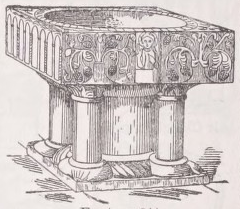
FONT (Lat. fans, It. fanie, Fr. fonts), the vessel used in churches to hold the water for Christian baptism. The modes of administering baptism have varied at different periods of the existence of the Christian churches, causing corresponding changes in the forms and auxiliaries of the receptacle of the consecrated water. There is reason to believe that in the times of the apostles and early missionaries the rite was administered by sprinkling, as whole multitudes of people, and even whole kingdoms were baptized in one day. But a very general method in early times was no doubt that of total immersion, the catechumens being received by the priest in the water. As Christianity became more general of course fewer adults would present themselves for baptism, and consequently the size of the vessel would not need to be beyond what would allow of the total immersion of an infant. In fact down to the time of the Reformation fonts continued to be made quite large enough to allow of the total immersion of infants, and there is little doubt that down to that date the method was occasionally employed. Baptism by infusion and by aspersion followed this method, though they were no doubt used concurrently, and in a sense combined, for in certain representations of the rite in illuminations and stained glass the infant is represented as seated naked in the font, while from a vessel the priest pours the water upon the head. Originally used only for sick or infirm persons, the method of baptism by infusion became gradually the established practice, and all doubts as to its validity were removed by appeal to papal and other high authority....
In early times the font was placed in the baptistery, a structure often entirely separate from the body of the church, of which the celebrated Baptistery at Florence is the finest example. In these the well or basin for containing the water was usually reached by descending steps. The baptisteries were round, square, octagonal, or crosslike in form, and in design bear the impress of the period to which they belong. Few are found of late date, and the only existing structure at all recalling them in English churches is found at Luton in Bedfordshire. The font at Luton belongs to the Decorated style of English art, and is inclosed in an octagonal structure of freestone, consisting of eight pillars about 25 feet in height, supporting a canopy. The space around the font is large enough to hold comfortably half a dozen people. At the top of the canopy is a vessel for containing the consecrated water, which when required was let down into the font by means of a pipe. The space around the font in the ancient baptisteries was of size to admit several catechumens at the same time; and not only was the whole rite of baptism performed within them, but that of the holy eucharist likewise, and even the baptism of infants. As baptism was administered in early times by bishops only, baptisteries were rare except at the principal church of the diocese. Easter, Whitsuntide, and Epiphany were the principal seasons of its administration. In the 9th century fonts became general in all churches, and baptism was performed at all times by priests of all ranks.
Of fonts still in existence few are older than the 11th century. The material in the Western Church was generally stone, and the outsides and accessories are frequently ornamented with some of the loveliest and most characteristic of the national arts of the Middle Ages. In the Eastern Church it was different. “The font, κoλvpβηθρaf says Neale (Eastern Church, i. 214), “in the Eastern Church is a far less conspicuous object than it is in the west. Baptism by immersion has been retained; but the font seldom or never possessed any beauty. The material is usually either metal or wood. In Russia the columbethra is movable, and only brought out when wanted.” The proper material for fonts in the Western Church was hard stone, as marble, porphyry, or granite. Fonts of bronze and lead are, however, sometimes found, and the basins of many stone fonts were lined with lead to prevent the absorption of the water by the porous stone. A font shaped from one block of oak is in the church at Evenechtyd, Denbighshire. Continental fonts bear distinctly the impress of the time to which they belong. They appear very early, ornamented with bas-reliefs, columns, and arches, as well as with the characteristic details of the ornamentation of their period. Representations of St John the Baptist are very common. At Pont-à-Mousson on the Moselle, one bears bas-reliefs of that saint preaching in the wilderness, and of the baptism of Christ, executed with that simple sincerity which is more valuable than the highest refinement and finish in design and execution. In the 11th and 12th centuries cup-shaped and cylindrical forms were most common, either as simple cylinders and truncated cones or supported by one or more pillars. Frequently the basin is hollowed out of one large square or oblong slab, supported at the centre by a broad column, with auxiliary columns at the corners, all bearing the mouldings and ornaments characteristic of the period. Caryatids sometimes take the place of the pillars, and sculptured animals and other grotesques of curious design sometimes form the bases. Octagonal forms are not altogether absent from this period, and even hexagons have been occasionally found. Pentagons are very rare. The font, however, at Cabourg, on the north coast of France, is formed of a pentagonal block rather bare of ornamentation, and supported by a group of columns. In the 13th century octagonal forms became more prevalent, although the earlier kinds were not discontinued.
The very remarkable font at Hildesheim in Hanover belongs to the 13 th century, and is in complete preservation. The basin rests upon the shoulders of four kneeling figures, each bearing a vase from which water is running, emblematic of the four rivers of Paradise. Above is an inscription which explains the connexion of these rivers with the virtues temperance, courage, justice, and prudence. On the sides of the cup itself are bas-reliefs representing the Passage of the Jordan, the Passage of the Red Sea, the Baptism of Christ, and the Virgin and Child. These are separated by columns, by scrolls bearing inscriptions, and by medallions with figurative heads of the abstract virtues named above, and with heads of the prophets. The font has a conical lid, similarly ornamented, and bearing also four bas-reliefs. A cast of this font is now in the South Kensington Museum. At Mayence the font, which belongs to about the year 1328, is of lead, and bears images of the Saviour, the Virgin, St Martin, and the Twelve Apostles.
Cylindrical fonts become much more rare in the 14th century, the almost universal shape being the octagon. In the l5thand 16th centuries the most elaborate and remarkable of Continental fonts were produced, and some are indeed works of the highest art in sculpture. This superiority is probably more due to increased delicacy and moderation of design, than to any great change in the shape or in the mode of attaching ornament. In early fonts, though the exterior is polygonal, the cup itself is generally circular; but it is characteristic of the 15th century fonts that the octagonal form is carried out even in the cup. The fonts at Strasburg, Freiburg, and Basel are examples of this. Few if any English fonts date from before the Conquest, but a great number of Norman fonts, perhaps more than of any other period before the Reformation, are still in existence, and form some of the most characteristic of the architectural remains of the time. In form circular or square, they are generally supported on one or more columns, and are ornamented with bas-reliefs, net-work of columns and arches, grotesques, rude foliage, niches with figures, and many other forms. Good examples of Norman fonts may be seen at Lincoln Cathedral; Iffley, Oxon; Newenden, Kent; Coleshill, Warwickshire; East Meon, Hants; and Castle Frome, Herefordshire. In the Late Norman and Early English periods, octagonal fonts became common, and with few exceptions this form continued in use until the Reformation. Early English fonts are comparatively rare. They bear the moulding, foliage, and toojh ornament in the usual style of the period. A good example of an Early English font is at All Saints, Leicester; others may be seen at St Giles, Oxford, and at Lackford, Suffolk. Fonts of the Decorated period are also less common than those of the precedent Norman or subsequent Perpendicular periods, but are superior in detail and execution to those of any other stage of our art. Fonts of the Perpendicular period are very common, and are generally raised upon steps, which, together with the body of the font, are frequently richly ornamented with panneling. It was also the custom during this period to ornament the font with shields and coats of arms, and other heraldic insignia, as at Herne, Kent.
Leaden fonts of Norman date are found at Dorchester, Oxon, at Avebury, Wilts, and other places. In Holyrood Chapel there was a brazen font in which the royal children of Scotland were baptized. It was carried off in 1544 by Sir R. Lea, and given by him to the church at St Alban’s, and was afterwards destroyed by the Puritans. A silver font was at Canterbury, which was sometimes brought to Westminster on the occasion of a royal baptism. At Chobham, Surrey, there is a leaden font covered with oaken panels of the 16th century.
In 1236 it was ordered by Edmund, archbishop of Canterbury, that baptismal fonts should be kept under lock and key, as a precaution against sorcery: “Fontes baptismales sub sera clausi teneantur propter sortilegia.” The lids appear at first to have been quite simple and flat. They gradually, however, partook of the ornamentation of the font itself, and are often of pyramidal and conical forms, highly decorated with finials, crockets, mouldings, and grotesques. Some very rich font covers may be seen at Ewelme, Oxon; St Gregory, Sudbury; North Walsingham, Norfolk; Worlingworth, Suffolk. The ordinary position of the font in the church was near the entrance, usually to the left of the south door.
See Caumont, Cours d'antiquités tnonumentales, Paris, 1830; Simpson, Series of Anticnt Baptismal Fonts ; Paley, Ancient Fonts; Viollet-le-Duc, Diet, de Γ Architecture, vol. v.; Parker’s Glossary of Architecture.

[1,759 words — estimated reading time: 11 minutes]
FONTAINE, Jean de la. See La Fontaine....
FONTAINE, Pierre François Léonard (1762-1853), French architect, was born at Pontoise, September 20, 1762. He was of a family several of whose members had distinguished themselves as architects, and he early showed the taste and the ability which promised to revive in his person the family distinction. Leaving the college of Pontoise at the age of sixteen he was sent to L’Isle-Adam, to assist in hydraulic works undertaken by the architect André. To facilitate his improvement André allowed him to have access to his plans and to copy his designs. At this time he formed a friendship with another young student of his art, Thibaut, whose passion quickened his own. In October 1779 he was sent to Paris to study in the school of Peyre the younger, and there began his acquaintance with Percier, which ripened into a life-long friendship. After six years of study he competed for a prize at the Academy, and, winning the second, received a pension and was sent to Rome (1785). Percier accompanied him. The Revolution breaking out soon after his return to France, he took refuge in England; but after ths establishment of the consulate, he was employed by Bonaparte to restore the palace of Malmaison, Henceforth he was fully engaged in the principal architectural works executed in Paris, as architect successively to Napoleon I., Louis XVIII., and Louis Philippe. In conjunction with Percier (till his death) he was employed on the Arch of the Carrousel, the restoration of the Palais-Royal, the grand staircase of the Louvre, and the works projected for the union of the Louvre and the Tuileries. In 1812 he was admitted a member of the Academy of Fine Arts, and in 1813 was named first architect to the emperor. With Percier he published the following works,— Palais, Maisons, et autres Édifices Modernes dessinés à Rome (1798); Description des Fêtes et Cérémonies du Mariage de Napoléon et de Marie Louise (1810); and Recueil de Décorations Intérieures (1812). Fontaine lost his friend and associate Percier in 1838, and died himself at Paris, October 10, 1853.
[7 words — estimated reading time: 1 minute]
FONTAINEBLEAU, a town of France, at the head of an arrondissement, in the department of Seine-et-Marne, about 37 miles S.E. from Paris on the railway to Lyons, in 48° 24' 23" N. lat. and 2° 42' 1" E. long. It stands in the midst of the forest of Fontainebleau, is well built, and has broad, clean, handsome streets. Among the more important buildings and institutions are the hotel de ville, the barracks, the court-house, two hospitals, a college, and a public library. The Pompadour mansion, and a portion of that which belonged to the cardinal of Ferrara, are still preserved; and a statue of General Damesme adorns the principal square. Wood-turning and the manufacture of porcelain and earthenware are the chief industries; and wine, grapes, garden produce, and paving stones are articles of export. The population in 1871 was 11,545. In the immediate vicinity of the town is the celebrated palace of Fontainebleau—one of the largest, and in the interior one of the most sumptuous, of the royal residences of France. The origin of the name and of the building are equally unknown; but the old manor-house was used by Louis VII. in the latter part of the 12th century, and continued a favourite residence of Philip Augustus and St Louis. The existing edifice was begun by Francis I., who laid out immense sums of money in its erection, employing Primaticcio, a famous Italian architect, to draw the plans, and commissioning Leonardo da Vinci, Andrea del Sarto, and Benvenuto Cellini to expend the resources of their arts in making it a truly royal residence. Henry IV. doubled the area of the buildings and gardens, adding among other portions the great Diana gallery, the Court of the Princes, and the Galerie des Cerfs. A canal which he constructed was afterwards filled up by Louis XIV. ...With Louis XV. the palace fell into disfavour, and for a time it was used as a military school. Napoleon I. restored it with great splendour, at a cost of 6 million francs, and often resided in it; but after the return of the Bourbons it was again allowed to fall into disrepair. Louis XVIII. and Louis Philippe both did somewhat to its restoration. The congeries of buildings is very extensive, the roofing, it is said, covering no less than 14 acres. There are five great courts, distinguished as the Court of the White Horse, the Court of the Fountain, the Oval or Donjon Court, the Court of Princes, and the Court of the Kitchens or of Henry IV. The first is also called the Court of Adieux in memory of the parting scene between Napoleon and his Old Guard in 1814, at the foot of the Horse Shoe staircase. The chapel of the Holy Trinity was built under Francis I., and the chapel of St Saturnin dates from the same period, and occupies the site of an older building which was consecrated by Thomas à Becket. It is impossible to do more than mention a few of the historical events which have taken place at Fontainebleau. Philip the Fair, Henry III., and Louis XIII. were all boru in the palace, and the first of these kings died there. James V. of Scotland was there received by his intended bride; and Charles V. of Germany was entertained there in 1539. Christina of Sweden lived there for years, and the gallery is still shown where she caused her secretary Monaldeschi to be murdered, or, as she regarded it, executed. In 1685 Fontainebleau saw the signing of the revocation of the edict of Nantes, and in the following year the death of Condé. In the 18th century it had two illustrious guests in Peter the Great of Russia and Christian VII. of Denmark; and in the early part of the 19th it was twice the residence of Pius VII.,—in 1804, when he came to consecrate the emperor, and in 1812-1814, when he was that emperor’s prisoner. It was within its walls that the sentence of divorce was passed against Josephine. The forest of Fontainebleau is one of the most beautiful wooded tracks in France, and for generations it has been the chosen haunt of French landscape painters. The most celebrated spots are the Vallée de la Solle, the Gorge au Loup, the Gorge d’Apremont, and the Fort 1’Empereur. The whole area extends to 81,740 acres, and it is traversed by 12,000 miles of road and pathway.
See Pfnor, Monographie de Fontainebleau, with text by Champollion Figeac, Paris, 1866.
[765 words — estimated reading time: 5 minutes]
FONTANA, Domenico (1543-1607), Italian architect and mechanician, was born at Mili, a village on the lake of Como, in 1543. After a good training in mathematics, he went in 1563 to join his elder brother, then studying architecture at Rome. He made rapid progress, and was taken into the service of Cardinal Montai to, for whom he erected a chapel in the church of Santa Maria Maggiore and the Villa Negroni. When the cardinal’s pension was stopped by the pope, Gregory XIII., Fontana volunteered to complete the works in hand at his own expense. The cardinal being soon after elected pope, under the name of Sixtus V., he immediately appointed Fontana his chief architect. Amongst the works executed by him were the Lateran Palace, the palace of Monte Cavallo (the Quirinal), the Vatican Library, &c. But the undertaking which brought Fontana the highest repute was the removal of the great Egyptian obelisk, brought to Rome in the reign of Caligula, w hich was lying in the circus of the Vatican, and its erection in front of St Peter’s. This he accomplished in 1586. After the death of Sixtus V., charges were brought against Fontana of misappropriation of public moneys, and Clement VIII. dismised him from his post (1592). This appears to have been just in time to save the Colosseum from being converted by Fontana into a huge cloth factory, according to a project of Sixtus V. Fontana was then called to Naples, and accepted the appointment of architect to the viceroy, the count of Miranda. At Naples he built the royal palace, constructed several canals, and projected a new harbour and bridge, which he did not live to execute. The only literary work left by this architect is his account of the removal of the obelisk, 1589. He died at Naples in 1607, and was honoured with a pompous ...funeral in the church of St Ann.
FONTANA, Lavinia (1552-1614), daughter of Prospero (see below), was a painter of no little fame, especially in portraits. She was greatly employed by the ladies of Bologna, and, going thence to Rome, painted the likenesses of many illustrious personages, being under the particular patronage of the family (Buoncamρagni) of Pope Gregory XIII., who died in 1585. The Roman ladies, from the days of this pontiff to those of Paul V., elected in 1605, showed no less favour to Lavinia than their Bolognese sisters had done; and Paul V. was himself among her sitters. Some of her portraits, often lavishly paid for, have been attributed to Guido. In works of a different kind also she united care and delicacy with boldness. Among the chief of these are a Venus in the Berlin museum; the Virgin lifting a veil from the sleeping infant Christ, in the Escorial; and the Queen of Sheba visiting Solomon. Her own portrait in youth—she was accounted very beautiful—was perhaps her masterpiece; it belongs to the Counts Zappi of Imola, the family into which Lavinia married. She is deemed on the whole a better painter than her father; from him naturally came her first instruction, but she gradually adopted the Caraccesque style, with strong quasi-Venetian colouring. She was elected into the Academy of Rome, and died in that city in 1614.
FONTANA, Prospero (1512-1597), a painter, was born in Bologna, and became a pupil of Innocenzo da Imola. He afterwards worked for Vasari and Pierino del Vaga. It was probably from Vasari that Fontana acquired a practice of offhand, self-displaying work. He undertook a multitude of commissions, and was so rapid that he painted, it is said, in a few weeks an entire hall in the Vitelli Palace at Città di Castello. Along with daring, he had fertility of combination, and in works of parade he attained a certain measure of success, although his drawing was incorrect, and his mannerism palpable. He belongs to the degenerate period of the Bolognese school, under the influence chiefly of the imitators of Raphael—Sabbatini, Sammachini, and Passerotti being three of his principal colleagues. His soundest successes were in portraiture, in which branch of art he stood so high that towards 1550 Michelangelo introduced him to Pope Julius III. as a portrait-painter; and he was pensioned by this pope, and remained at the pontifical court with the three successors of Julius. Here he lived on a grand scale, and figured as a sort of arbiter and oracle among his professional brethren. Returning to Bologna, he opened a school of art, in which he became the preceptor of Lodovico and Agostino Caracci; but these pupils, standing forth as reformers and innovators, finally extinguished the academy and the vogue of Fontana. His subjects were in the way of sacred and profane history and of fable. He has left a large quantity of work in Bologna, -—the picture of the Adoration of the Magi, in the Church of S. Maria delle Grazie, being considered his masterpiece— not unlike the style of Paul Veronese. His death took place in Rome in 1597.
[320 words — estimated reading time: 2 minutes]
FONTANES, Louis, Marquis de (1757-1821), French poet and politician, was born at Niort, in Poitou, March 6, 1757. He was a descendant of a noble Protestant family of Languedoc, banished by the revocation of the edict of Nantes, but afterwards converted to the Catholic faith and restored to their native land. Having completed his education at the college of Niort, he went in 1777, after the death of his father and brother, to Paris. He had already made several attempts in verse; and in 1778 he published a short descriptive poem entitled La Forêt de Navarre. This procured him the notice and friendship of Ducis, and he was encouraged to persevere. During the next twelve years he published Le Cri de mon Coeur; Le Jour des Morts dans une Campagne, an imitation of Gray’s Elegy·, a translation of Pope’s Essay on Man (1783), with an elegant introduction which attracted more attention than the poem itself; Le Verger; La Chartreuse de Paris; and L ’ Essai sur l ’ Astronomie (1789). In this year appeared also his Èpltre sur VÉdit en Faveur des non- Catholiques, which was crowned by the academy. The Revolution converted the poet into a journalist, and he took part in the editorship of the Mercure François and the Modérateur. Compelled to leave Paris after the death of the king, he withdrew to Lyons, where he married and remained till the arrival of Collot d’Herbois in 1793. Driven again to lead a wandering life, he displayed at once his literary power, his patriotism, and his intrepidity in the eloquent petition on behalf of the Lyonnese victims of Collot d’Herbois and his colleagues, which was presented to the convention in December of that year. For this bold appeal he was proscribed, and he owed his protection in concealment to the friendship of Madame ...Dufresnoy. After the fall of Robespierre, Fontanes was appointed professor of belles lettres at the central school, and admitted a member of the Institute. About the same time he was associated with La Harpe in the conduct of the Memorial. For one of his articles he was condemned to banishment by the Directory and expelled from the Institute. He escaped to England, and there renewed his acquaintance with Chateaubriand, also an exile. Returning to France after the 18th Brumaire, he was soon after commissioned by the first consul to write the funeral oration on Washington, and this opened a new chapter in his life. Bonaparte, satisfied with the Eloge, admitted Fontanes to frequent intercourse with him; he was soon reinstated at the Institute, and became a member of the legislative body, of which in 1804 he was made president. He was also one of the first members of the Legion of Honour; and in 1808 he was made grand master of the university. Fontanes was censured by the republican party for alleged servility to the emperor; but apparently without reason. He was created count, and in 1810 was called to the senate. He voted for the deposition of Napoleon, retained his offices under the provisional government, and was made a peer by Louis XVIII. In February 1815 the post of grand master of the university was suppressed, and Fontanes was promoted grand cordon of the Legion of Honour. He remained passive during the Hundred Days, and after the second restoration of the Bourbons was made a privy councillor. The title of marquis was conferred on him in 1817. In January 1821 he was chosen president of the Société des Bonnes Lettres; but his health had long been declining, and he died at Paris on the 17 th of March of that year. He left unfinished a poem entitled La Grèce Délivrée, of which high expectations had been formed. A collected edition of the works of Fontanes was first published by Sainte-Beuve, with a critical and biographical memoir, in 1837.
[655 words — estimated reading time: 4 minutes]
FONTARABIA. See Fuenterrabia.
[3 words — estimated reading time: 1 minute]
FONTENAY-LE-COMTE, the chief town of an arrondissement in the department of Vendée, France, is situated on both sides of the river Vendée at the point where it becomes navigable, 35 miles S.E. of La Roche-sur-Yon (Napoléon Vendée). The town has an antique and straggling appearance, but there are some good houses in the suburbs. It possesses a communal college, a prison, a hospital, a theatre, the remains of an old castle which formerly belonged to the counts of Poitiers, and two old and beautiful churches, Notre Dame and St John. Both are of Romanesque architecture, terminated with Gothic spires, the spire of Notre Dame being 311 feet in height. The principal industries are the manufacture of coarse linen and woollen cloths, brewing, and tanning; and there is a considerable trade in wine, fruits, timber, hemp, flax, and cattle.
Fontenay occupies the site of an old Roman town. It was captured by the English in 1361, and during the wars of the Huguenots it was ten times besieged. Louis XIII. in 1621 ordered the demolition of its fortifications, and in 1649, during the rebellion against the parliament, it fell into the hands of the nobles of Poitou. In the time of the Revolution it was called Fontenay-le-Peuple. Population in 1876, 7309.
[221 words — estimated reading time: 2 minutes]
FONTENELLE, Bernardle Bo vier de (1657-1757), author of the Dialogues des Morts, Entretiens sur la Pluralité des Mondes, &c., was born at Rouen on the 11th of February 1657, and died at Paris on the 9th of January 1757, having thus very nearly attained the age of 100 years. His father was an advocate settled in Rouen, his mother a sister of the great Corneille. He was educated at the college of the Jesuits in his native city, and distinguished himself by the extraordinary precocity, as well as the amazing versatility, of his talents. His teachers, who readily appreciated these, were anxious to allure him into their order, but his father had designed him for the bar, and an advocate accordingly he became; but, having lost the first cause which was entrusted to him, he soon abandoned law in disgust and gave himself wholly to literary pursuits. His attention was first directed to poetical composition; and more than once he competed for the poetry prizes of the French Academy, but never with success. He had also the sorrow of witnessing, in 1680, the total failure of his tragedy Aspar, a failure which was all the more mortifying because, for the purpose of annoying Racine, Thomas Corneille had previously sounded forth in the Mercure the praises of his nephew as the most gifted of all the younger dramatists. Fontenelle afterwards acknowledged the justice of the public verdict by burning his unfortunate drama, of which nothing but the name now survives. But for several years he persisted in the belief that poetry was his true vocation, and continued to produce dramatic compositions, the mediocrity of which, considering the author’s real talent, is positively astonishing. His opera of Thetis et Pêlée, though highly praised by Voltaire, cannot be said to rise much above ...the others; and it is significant that of all his dramatic works, not one has kept the stage. His Poésies Pastorales have no greater claim to permanent repute, being characterized by stiffness and affectation; and the utmost that can be said for his poetry in general is that it displays much of the limae labor, great purity of diction, and occasional felicity of expression. It was by his Dialogues des Morts, published in 1683, that Fontenelle first established a genuine claim to high literary rank; and that claim was very much enhanced three years later by the appearance of the Entretiens sur la Pluralité des Mondes, a work which was among the very first to illustrate the possibility of being scientific without being either uninteresting or unintelligible to the ordinary reader. It was precisely the kind of work which Fontenelle was capable of executing well, both from the natural bent of his intellect and from the course of his previous studies. His object was to popularize among his countrymen the astronomical theories of Descartes; and it may well be doubted if that philosopher ever ranked a more ingenious or successful expounder among the number of his disciples. Hitherto Fontenelle had continued to reside in Rouen, but in 1687 he removed to Paris for permanent residence there; and in the same year he published his Histoire des Oracles, a book which made a considerable noise in the theological as well as in the philosophical world. It was not so much an original work as a reduction from the Latin of Van Dale, and consisted of two essays, the first of which was designed to prove that oracles were not given by the supernatural agency of demons, and the second, that they did not cease with the birth of Christ. The clearness and precision of the style, and the smooth flow of the reasoning in this treatise, have been always much admired. It excited the suspicion of the church, however, and a Jesuit, by name Bιltus, published a ponderous refutation of it; but the peace-loving disposition of its author impelled him to leave his opponent unanswered. He was too busy, he wrote to Leclerc, and added, “Enfin, je n’ai point du tout l’humeur polémique, et toutes les querelles me déplaisent. J’aime mieux que le diable ait été prophète, puisque le père jésuite le veut, et qu’il croit cela plus orthodoxe.” To the following year (1688) belongs his Digression sur les Anciens et les Modernes, in which he took the modem side in a somewhat unnecessary controversy then raging; his Doutes sur le Système Physique des Causes Occasionelles (against Malebranche) appeared shortly afterwards. In 1691 he was received into the French Academy in spite of the determined efforts of Racine and Boileau, who on four previous occasions had secured his rejection. He subsequently was admitted a member both of the Academy of Inscriptions and of the Academy of Sciences; and in 1699 he became perpetual secretary to the latter body. This office he actually held for the long period of forty-two years; and it was in this official capacity that he wrote the Histoire de Γ Académie des Sciences, containing extracts and analyses of the proceedings, and also the Eloges of the members. These last are written with great simplicity and delicacy; while of the prefaces to the Histoire, Sainte-Beuve declares that in them “il à atteint à une véritable perfection, encore agréable et presque sévère.” The only other works of Fontenelle that require to be mentioned are his Géométrie de Γ Infini and his Apologie des Tourbillons. Of the former, his Academy composition, he himself is reported to have said (so far, justly)—“There, now, is a book which only eight men in Europe can understand, and the author is not one of the eight.” Fontenelle forms a link of connexion between two very widely different periods of French literature, that of Corneille, Racine, and Boileau on the one hand, and that of Voltaire, D’Alembert, and Diderot on the other. It is not in virtue of his great age alone that this can be said of him; he actually had much in common with the beaux esprits of the 17th century, as well as with the philosophes of the 18th. But it is to the latter rather than to the former period that he properly belongs; and it is not a little significant that while as a poet and man of fashion he was “the butt of all the clever men in Paris” during the first fifty years of his life, he latterly came to be “a force and an authority in the intellectual life” of the period. He has no claim to be regarded as a genius; but, as Sainte-Beuve has said, he well deserves a place “dans la classe des esprits infiniments distingués ”— distinguished, however, it ought to be added by intelligence rather than by intellect, and less by the power of saying much than by the power of saying a little well. In personal character he has sometimes been described as having been revoltingly heartless; and it is abundantly plain that he was singularly incapable of feeling strongly the more generous emotions—a misfortune, or a fault, which revealed itself in many ways. “Il faut avoir de l’âme pour avoir du goût” But the cynical expressions of such a man are not to be taken too literally; and the mere fact that he lived and died in the esteem of many friends suffices to show that the theoretical selfishness which he sometimes professed cannot have been consistently and at all times carried into practice.
There have been several collective editions of Fontenelle’s works. The best are those of Paris, in 8 vols. 8vo, 1790, and 5 vols. 8vo, 1825. Some of his separate works have been very frequently reprinted and also translated. The Pluralité des Mondes was translated into modem Greek in 1794. Sainte-Beuve has an interesting essay on Fontenelle, with several useful references, in the Causeries du Lzιndi, vol. iii.
[1,332 words — estimated reading time: 8 minutes]
FONTEVRAULT, or Fontevraud, in Latin Fons Εbraldi, a town of France, with a population of about 2500, in the department of Maine-et-Loire, 10 miles S.E. of Saumur, and 2 miles from the confluence of the Loire and Vienne. It is situated in the midst of a forest district, and the inhabitants carry on various minor industries fostered by the timber trade. The interest of the place centres in its abbey, which since 1804 has been utilized and abused as a central house of detention for convicts. In spite of mutilation and “translation,” the building remains a fine example of the architecture of the 12th century. The church, of which only the choir and apse are appropriated to divine service, has a beautiful nave covered by four cupolas. In a chapel in the south transept are the effigies of Henry II. of England and his wife Eleonora of Guienne, and of Richard the Lion Heart and John’s wife Isabella of Angoulême—Eleanora’s being of oak and the rest of stone. The second court of the abbey contains a remarkable building, which long went under the misnomer of chapelle funéraire, but was in reality the old kitchen. Details and diagrams will be found in Viollet-le-Duc’s Dictionnaire de Γ Architecture. There are three stories, of which the first is an octagon, the second a square, and the third an octagon; and the whole is surmounted by a sort of pyramidal structure. Fontevrault was founded about the end of the 11th century by Robert of Arbrissel, who was born in the village of Arbrissel or Arbresec, in the diocese of Rennes, and attained great fame as a preacher and ascetic. It consisted of a nunnery for virgins and widows, a magdaleneum, a hospital for lepers and other diseased folk, a convent, and a church. The church was used both by the monks and the nuns, but no ...communication was permitted between the two sexes. The order of Fontevrault was recognized by Pascal II. in 1106, and again more expressly by a bull in 1113. It was placed by its founder under the patronage of the Holy Virgin, and entrusted to the superintendence of an abbess, who was supreme not only over the nuns but also over the monks. The first who held the office was Petronella de Craon-Chemillé. The success of the order was so great that at Robert’s death it is said there were no fewer than 3000 nuns. It ultimately numbered fifty-seven priories, divided into the four provinces of France, Aquitaine, Auvergne, and Brittany. It continued till the French Revolution, and the abbey of Fontevraud was the usual place to which the princesses of the blood royal of France were sent for their education. The last abbess, Julie Sophie Charlotte de Pardaillan, died at Paris in 1799 in great destitution.
[513 words — estimated reading time: 3 minutes]